Pacific Southwest Airlines flew California skies from 1949 to 1988 with its famous smiling jets. That same name now belongs to PSA Airlines, a regional carrier flying for American Eagle today.
The Flying Shop notes the original PSA’s low-fare, high-frequency model became the direct blueprint Southwest Airlines used to build its own business decades later. Few travelers booking a 2026 flight realize that connection.
This guide covers both stories: the original PSA’s legacy and what flying on the current PSA Airlines actually feels like. You will get fleet details, cabin specifics, route coverage, and honest booking advice for your trip.
What is Pacific Southwest Airlines
Pacific Southwest Airlines was a California-based airline that operated from 1949 to 1988, and its name now belongs to a modern American Eagle regional carrier.
The original PSA, founded by Kenny Friedkin in San Diego, became known for low fares, friendly service, and aircraft painted with a smile on the nose. Today’s PSA Airlines flies regional jets for American Eagle.
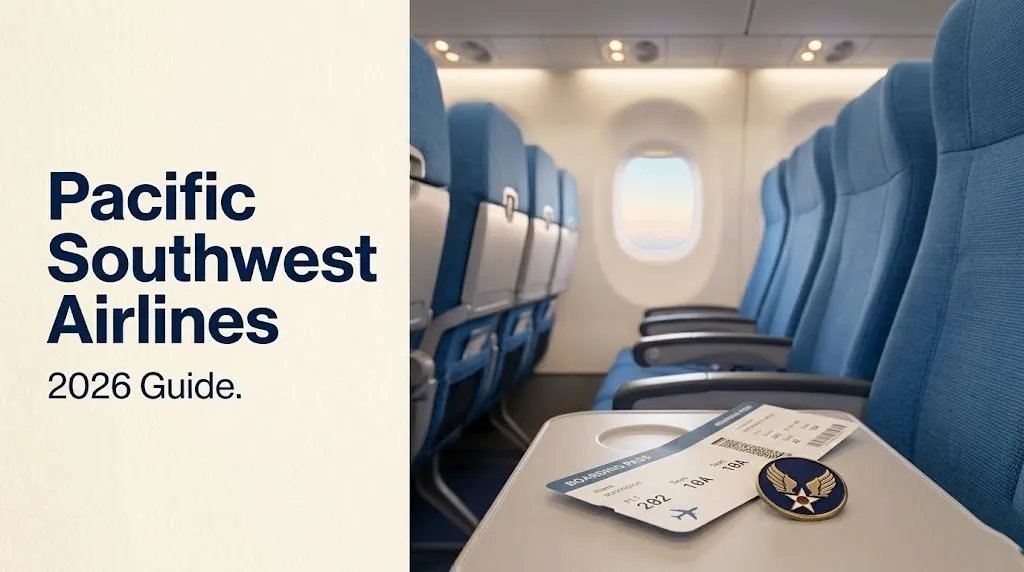
For most travelers in 2026, seeing “PSA Airlines” on a boarding pass means American Airlines assigned a regional jet to that route. The fare, ticket, and booking remain entirely with American Airlines.
This distinction matters most for first-time international travelers connecting through a major hub. A short PSA-operated leg often feeds a longer American Airlines mainline flight on the same itinerary.
Booking happens any time of year since PSA does not sell tickets directly. The honest reality is that most fliers never notice the operating carrier name unless they read their itinerary closely.
Key facts about the modern PSA Airlines:
- A wholly owned subsidiary of American Airlines Group, operating exclusively under the American Eagle brand
- Fleet built entirely around Bombardier CRJ700 and Bombardier CRJ900 regional jets
- Headquartered at Charlotte Douglas International Airport (CLT), with crew bases in Dayton, Washington, Philadelphia, and Dallas
According to the U.S. Department of Transportation, regional carriers like PSA must meet the same federal safety certification as mainline airlines operating under the same brand.
Pacific Southwest Airlines history
The original Pacific Southwest Airlines operated for 39 years before merging into USAir in 1988, ending its run as a standalone carrier.
Founded in 1949 with a single leased DC-3, PSA grew into what the Los Angeles Times once called California’s unofficial flag carrier. Its smiling jets, the “Grinningbirds,” became a regional icon.
The Wikipedia entry for PSA documents how the Airline Deregulation Act of 1978 let PSA expand beyond California into Arizona, Nevada, Utah, and Mexico. That expansion brought new competitive pressure.
For aviation enthusiasts and history-minded travelers, the San Diego Air and Space Museum holds PSA artifacts and exhibits. A visit pairs well with a Southern California layover at San Diego International Airport.
This history matters less for booking a flight today and more for understanding why the PSA name still appears on American Eagle aircraft. The brand has genuine West Coast nostalgia value.
What most travelers get wrong is assuming the original PSA still flies routes in California. It does not, and hasn’t operated independently since the 1988 merger into USAir.
To explore the PSA legacy as a traveler:
- Visit the San Diego Air and Space Museum in Balboa Park, which documents PSA’s founding and Friedkin family history
- Look for retro PSA livery on special American Airlines heritage aircraft, occasionally repainted for anniversaries
- Avoid assuming any current West Coast regional route has a direct operational link to the original PSA network
PSA Airlines today
PSA Airlines today is a Charlotte-headquartered regional carrier owned by American Airlines Group, flying Bombardier regional jets under the American Eagle brand.
PSA’s own materials describe operating roughly 600 to 800 daily flights to close to 100 destinations on behalf of American Airlines. The exact figure shifts as routes get reassigned among regional partners.
According to PSA Airlines’ fleet page, the carrier moved its headquarters from Dayton, Ohio to Charlotte, North Carolina, while retaining hundreds of staff in Dayton for maintenance and crew operations.
For business and frequent flyers, PSA-operated flights commonly appear on shorter legs feeding Charlotte, Washington National, Philadelphia, and Dallas Fort Worth. These connect to longer mainline American flights.
PSA’s network leans toward the eastern half of the United States. Travelers flying from West Coast cities are less likely to see a PSA-operated leg than someone connecting through Charlotte or DCA.
The honest assessment is that PSA Airlines runs efficiently as a feeder operation, but its name carries far more emotional weight from its California origins than its current Ohio-and-Carolina-based operations reflect.
Key Takeaway: PSA Airlines is American Airlines’ regional partner; your ticket, fare rules, and loyalty program stay with American Airlines.
Is PSA Airlines the same as American Airlines
PSA Airlines is not the same company as American Airlines, but it operates flights that are booked, marketed, and sold entirely as American Airlines flights.
PSA is one of three wholly owned regional subsidiaries inside American Eagle, alongside Envoy Air and Piedmont Airlines. American Airlines pays PSA to staff and operate specific aircraft.
For booking purposes, this distinction is invisible. You search aa.com or the American Airlines app, you pay American Airlines, and your confirmation number works exactly like any mainline American booking.
First-time international travelers sometimes worry a “different airline” on their itinerary means separate check-in counters or baggage handling. In practice, PSA flights use American Airlines gates, kiosks, and baggage systems.
This matters most when connecting internationally. A PSA-operated domestic leg feeding an American Airlines transatlantic flight uses the same terminal infrastructure as any all-mainline itinerary.
The limitation worth knowing: aircraft size differs significantly. A CRJ700 or CRJ900 has far less overhead bin space than a mainline Airbus A321 or Boeing 737 on the same route.
| Feature | American Airlines (mainline) | PSA Airlines (American Eagle) |
|---|---|---|
| Booking platform | aa.com, American app | Same, no separate site |
| Loyalty program | AAdvantage | AAdvantage, same earning |
| Typical aircraft | Boeing 737, Airbus A321 | Bombardier CRJ700, CRJ900 |
| Overhead bin space | Standard | Reduced, gate-check common |
PSA Airlines fleet CRJ700 and CRJ900
PSA Airlines flies exclusively Bombardier regional jets, specifically the CRJ700 with 65 seats and the CRJ900 with 76 seats.
Per PSA Airlines’ own fleet description, the CRJ700 entered service with the carrier in 2002, while the CRJ900 followed in 2014. Both aircraft now include newer CRJ900 NextGen deliveries.
Both aircraft types use a single-aisle, 2-2 seating configuration throughout the cabin. There is no twin-aisle option anywhere in PSA’s fleet, since both jets are narrow regional aircraft.
For families with children, the 2-2 layout means a family of four can often sit together across one row without needing a middle seat. This is a practical advantage over some 3-3 mainline layouts.
These aircraft are best suited to flights under roughly two hours. Both types are common on routes connecting Charlotte, Dayton, Washington National, and Philadelphia to smaller eastern cities.
The honest limitation is cabin height and width. Both the CRJ700 and CRJ900 have noticeably lower ceilings and narrower aisles than any mainline jet, which taller passengers will feel immediately.
PSA Airlines fleet specifications, as published by the carrier:
- Bombardier CRJ700: 65 seats total, configured with First, Main Cabin Extra, and Main Cabin sections
- Bombardier CRJ900: 76 seats total, also configured with First, Main Cabin Extra, and Main Cabin sections
- CRJ900 NextGen: Newer-build CRJ900 aircraft added to the fleet starting around 2025, replacing some older units
Confirm your specific aircraft on the American Airlines seat map tool before booking, since fleet assignments change by route and season.
PSA Airlines first class
PSA Airlines’ First Class is a domestic recliner cabin on regional jets, not a lie-flat international product, and applies to short connecting flights.
The CRJ900 carries 12 First Class seats, while the CRJ700 carries 9, based on PSA’s published configuration. Seat pitch on regional First runs noticeably tighter than mainline domestic First.
Seat pitch in this cabin typically runs around 36 to 38 inches on most CRJ configurations, though exact pitch varies by aircraft subtype. Confirm your specific aircraft’s layout before booking.
For business and frequent flyers, First Class on a PSA-operated flight still earns AAdvantage elite-qualifying benefits and priority boarding, even though the seat itself is modest compared to mainline.
This cabin makes the most sense on flights over 90 minutes, where the extra space and complimentary drink service add real comfort. On a 45-minute hop, the price gap is harder to justify.
The honest assessment: regional First is a recliner seat with extra legroom and a free drink, not the wide leather seat many travelers picture from mainline domestic First on a 737 or A321.
| Cabin | Aircraft | Seat type | Pitch range | Best for |
|---|---|---|---|---|
| First Class | CRJ700, CRJ900 | Recliner, 2-2 | Roughly 36 to 38 inches | Flights over 90 minutes |
| Main Cabin Extra | CRJ700, CRJ900 | Standard recliner, 2-2 | Roughly 33 to 35 inches | Tall passengers, short flights |
| Main Cabin | CRJ700, CRJ900 | Standard recliner, 2-2 | Roughly 31 to 32 inches | Budget travelers, sub-90 minute hops |
PSA Airlines main cabin extra
Main Cabin Extra on PSA Airlines provides extra legroom seating in the front section of the Main Cabin, behind First Class, on both CRJ aircraft types.
Seat pitch in Main Cabin Extra typically runs around 33 to 35 inches on most CRJ700 and CRJ900 configurations. That is roughly two to four inches more than standard Main Cabin.
Access to Main Cabin Extra comes through American Airlines’ fare structure: either purchase a fare that includes it, pay an upgrade fee, or use AAdvantage elite status benefits at booking or check-in.
For solo travelers and solo female travelers, an aisle seat in Main Cabin Extra near the front offers faster deplaning at smaller focus city airports like Dayton, where gate areas can be sparse.
This section makes the most sense on flights approaching the two-hour mark, where standard Main Cabin pitch starts to feel cramped. On very short hops, the upgrade often isn’t worth the fee.
The limitation most travelers miss: Main Cabin Extra on a CRJ is still a standard recliner seat. It buys legroom, not a wider seat or extra recline compared to Main Cabin.
To book or upgrade to Main Cabin Extra:
- Search your route on aa.com or the American Airlines app and check the fare comparison table at booking
- Look for the Main Cabin Extra fare option, or note the upgrade price shown for standard fares
- If you hold AAdvantage elite status, check for complimentary upgrade eligibility 24 hours before departure
- Confirm the actual seat pitch on your specific aircraft using the seat map before paying for an upgrade
- A well-chosen Main Cabin Extra seat delivers noticeably more knee room on flights over 90 minutes
PSA Airlines seat comfort and legroom
PSA Airlines seat comfort depends heavily on aircraft type, with the CRJ900 generally offering a slightly roomier feel than the smaller CRJ700.
Both aircraft use a 2-2 configuration with no middle seats anywhere in the cabin. This is a genuine comfort advantage for couples or solo travelers who prefer not sitting next to a stranger.
Seat width on both aircraft types runs narrower than mainline jets, generally in the high teens in inches per seat. Confirm exact width on the American Airlines seat map for your aircraft.
For families with children, the 2-2 layout simplifies seating since a family of four occupies one full row without splitting up. Stroller gate-check is standard procedure at all PSA-served airports.
Comfort holds up reasonably well on flights under 90 minutes. Beyond two hours, the lack of recline depth and narrower aisle become more noticeable, especially for taller passengers.
The honest limitation: there is no lie-flat or even meaningfully reclining seat anywhere in PSA’s fleet. Every seat on every PSA aircraft is a standard upright recliner, regardless of cabin name.
Insider Tip:
- Window seats on the CRJ900 sit slightly further from the aisle than on mainline jets, so aisle seats offer easier exit for connections
- The CRJ700’s smaller cabin means boarding and deplaning move faster, which helps business travelers with tight connection windows
- Solo travelers should request bulkhead Main Cabin Extra seats for the most legroom without paying for First Class
PSA Airlines in-flight wifi and entertainment
PSA Airlines aircraft generally rely on the same Wi-Fi and entertainment systems American Airlines uses fleet-wide, though availability varies by specific aircraft.
Most CRJ700 and CRJ900 aircraft do not include seatback screens. Entertainment comes through streaming to personal devices, when Wi-Fi and the American Airlines entertainment app are available on that tail.
Wi-Fi availability on regional jets has historically lagged mainline aircraft, since equipping smaller fleets takes longer during system-wide rollouts. As of recent reporting, coverage continues expanding across PSA’s CRJ900 fleet.
For business and frequent flyers needing connectivity for short connecting flights, it’s worth checking the American Airlines app before departure, which often shows whether a specific flight number has Wi-Fi equipped.
Flights under an hour rarely justify paying for Wi-Fi even when available, given the short window of usable connection time after climb and before descent.
The honest reality: travelers expecting a full entertainment screen experience similar to a long-haul mainline flight will be disappointed. Bring downloaded content for any PSA-operated segment over an hour.
According to SeatGuru, regional jet entertainment offerings should always be verified by flight number rather than assumed, since equipment varies tail by tail even within the same aircraft type.
PSA Airlines food and drinks
PSA Airlines follows American Airlines’ standard domestic food and beverage service, meaning complimentary snacks and drinks on most flights, with buy-on-board options on longer routes.
Service levels mirror whatever American Airlines offers on a given route length and time of day, regardless of whether PSA, Envoy, or Piedmont operates the actual aircraft.
First Class passengers typically receive a complimentary beverage service, sometimes including alcohol, depending on flight length and time of departure. Main Cabin passengers receive the standard snack and non-alcoholic drink service.
For budget travelers, bringing snacks from the airport remains the most reliable plan. On short regional hops, service can be limited to a single drink pass due to time constraints.
Flights under 45 minutes sometimes skip beverage service entirely if the crew cannot safely complete it before descent begins. This is more common on PSA’s shortest CRJ700 routes.
The honest limitation: regional jet galleys are smaller than mainline galleys, which limits beverage and snack variety compared to what the same traveler might receive on a mainline American flight.
Verify before traveling:
- Buy-on-board meal availability is not standard on PSA’s short regional routes and applies mainly to longer American Airlines mainline segments
- First Class beverage service, including alcohol availability, varies by flight length and departure time
- Always check the American Airlines app for your specific flight number’s service details before departure
Key Takeaway: Expect standard American Airlines snack service on PSA flights, with smaller galleys limiting variety on the shortest regional hops.
PSA Airlines routes and hubs
PSA Airlines operates primarily out of Charlotte Douglas International Airport, with additional crew bases and focus operations in Dayton, Washington, Philadelphia, and Dallas Fort Worth.
PSA’s network covers close to 100 destinations, concentrated in the eastern and central United States, feeding American Airlines’ major hub-and-spoke system rather than operating standalone point-to-point routes.
Charlotte Douglas International Airport (CLT) serves as PSA’s primary base. From CLT, PSA-operated CRJ flights connect smaller cities across the Southeast and Midwest to American’s mainline network.
For first-time international travelers connecting through Charlotte or Washington National onto a transatlantic American flight, the PSA-operated domestic leg uses the same terminal, so connection logistics remain straightforward.
Smaller focus cities like Dayton see PSA aircraft most frequently during weekday business travel periods, with reduced frequency on weekends. Confirm current schedules directly through American Airlines before booking.
The honest limitation: travelers originating on the West Coast are far less likely to encounter a PSA-operated flight than those connecting through Charlotte, DCA, PHL, or DFW, given PSA’s eastern concentration.
To navigate a PSA-operated connection:
- Check your American Airlines boarding pass for the operating carrier and aircraft type, usually shown near the gate information
- At Charlotte or Washington National, follow standard American Airlines terminal signage, since PSA uses the same gates
- Allow extra buffer time at smaller focus cities like Dayton, where gate changes can require longer walks
- Confirm your connecting gate through the American Airlines app immediately after landing
- A smooth PSA connection should feel identical to any all-mainline American itinerary, aside from the smaller aircraft
PSA Airlines vs Envoy Air vs Piedmont Airlines
PSA Airlines, Envoy Air, and Piedmont Airlines are all wholly owned American Eagle subsidiaries, but each operates different aircraft and concentrates on different parts of the route network.
SimpleFlying identifies PSA, Envoy Air, and Piedmont Airlines as the three fully owned American Eagle carriers, distinct from SkyWest Airlines and Republic Airways, which operate under separate contractual agreements.
Envoy Air flies a mix of Embraer E175 aircraft alongside CRJ types, while Piedmont Airlines operates primarily Embraer E175 aircraft. PSA remains the only one of the three flying exclusively Bombardier jets.
For business and frequent flyers who prefer the Embraer E175’s larger overhead bins and 2-2 configuration with slightly wider seats, an Envoy or Piedmont-operated flight may feel marginally roomier than a PSA CRJ.
None of these carriers can be selected by the traveler directly. American Airlines assigns the operating carrier based on aircraft availability, crew bases, and scheduling needs for that specific route and date.
The honest takeaway: differences between PSA, Envoy, and Piedmont matter mainly to aviation enthusiasts. For most travelers, the booking experience, fare rules, and loyalty earning remain identical across all three.
| Carrier | Primary aircraft | Headquarters | Cabin layout |
|---|---|---|---|
| PSA Airlines | CRJ700, CRJ900 | Charlotte, NC | First, Main Cabin Extra, Main Cabin |
| Envoy Air | Embraer E175, CRJ | Fort Worth, TX | First, Main Cabin Extra, Main Cabin |
| Piedmont Airlines | Embraer E175 | Salisbury, MD | First, Main Cabin Extra, Main Cabin |
PSA Airlines baggage policy
PSA Airlines follows American Airlines’ baggage policy in full, since all tickets, fees, and allowances are set and collected by American Airlines, not PSA.
This means carry-on bag, personal item, and checked bag rules are identical to any American Airlines mainline flight. As of recent policy, basic economy fares carry more restrictive carry-on allowances.
The practical difference on PSA’s smaller CRJ aircraft is overhead bin space. Standard carry-on bags often require gate-checking on full CRJ700 flights, even when the bag meets American’s size limits.
For families with children, strollers and car seats gate-check at no charge under American Airlines policy, and PSA’s ground crews handle this routinely given the high volume of regional connections.
This gate-check reality is most likely on full flights during peak travel periods, holidays, and weekday morning departures from business-heavy hubs like Charlotte and Washington National.
Verify directly with American Airlines before traveling, since checked bag fees, carry-on size limits, and gate-check procedures can change without notice and apply identically across all American Eagle carriers.
Important Accuracy Notes for PSA Airlines Baggage
Gate-checking on regional jets happens more often than travelers expect, and it can separate you from items you planned to use in flight.
Verify the following directly before traveling:
- Current carry-on and personal item dimensions on americanairlines.com, since basic economy and standard fares differ
- Checked bag fees for your specific route and fare class, confirmed at booking or check-in
- Whether your aircraft type for that flight number is a CRJ700 or CRJ900, shown on your boarding pass
Pack any medication, electronics, or valuables in your personal item, since that bag stays with you even if your carry-on gets gate-checked.
AAdvantage miles on PSA Airlines flights
AAdvantage miles earn normally on PSA Airlines-operated flights, since these flights are booked, ticketed, and credited entirely under the American Airlines AAdvantage program.
There is no separate loyalty program for PSA Airlines. Mile earning, elite-qualifying activity, and award redemption all follow standard AAdvantage rules regardless of which American Eagle carrier operates the aircraft.
For business and frequent flyers pursuing elite status, a short PSA-operated connecting flight contributes the same elite-qualifying miles or segments as an equivalent-distance mainline flight on the same route.
Award ticket redemptions work identically too. A traveler booking an AAdvantage award seat on a route operated by PSA pays the same mileage rate as the equivalent mainline-operated route.
This matters most for travelers building elite status through frequent short connections, since regional segments add up toward qualifying thresholds just as mainline segments do.
The honest reality: the operating carrier name has zero effect on your AAdvantage account. Verify your specific fare class and mileage earning rate at booking, since these vary by fare, not by operator.
According to the official American Airlines website, AAdvantage mileage earning is based on fare class and distance, with the operating carrier having no bearing on the calculation.
PSA Airlines safety record
PSA Airlines operates under the same FAA Part 121 certification and American Airlines safety oversight standards as any other American Eagle carrier.
Regional carriers including PSA are subject to the same federal maintenance, training, and operational requirements as mainline airlines. The FAA does not apply different safety standards based on aircraft size.
In January 2025, an American Eagle flight operated by a different regional partner, PSA’s sibling carrier, was involved in a high-profile accident near Washington National Airport, prompting industry-wide review of regional operations.
For first-time international travelers who may feel uneasy about smaller regional jets, it’s worth knowing that CRJ700 and CRJ900 aircraft hold the same airworthiness certification standards as larger commercial jets.
This is most relevant when booking connections through Washington National or other dense regional hubs, where regional jet traffic volume is highest and travelers may notice more aircraft of this size.
The honest reality: statistically, commercial aviation safety standards apply uniformly across mainline and regional operations, but always check current FAA and NTSB advisories for any specific route before traveling if you have concerns.
Important Accuracy Notes for PSA Airlines Safety
Safety oversight applies equally across American Eagle carriers, but specific incident information changes as investigations proceed.
Verify the following directly before traveling:
- Current FAA safety advisories at faa.gov for any specific aircraft type or route you are concerned about
- The DOT Air Travel Consumer Report for on-time and cancellation data by carrier
- Recent news coverage for any operational changes affecting your specific departure airport
If you have specific safety concerns about a route, contact American Airlines customer service directly before your travel date.
Is it worth flying PSA Airlines
Flying a PSA Airlines-operated flight is worth it for most travelers, since the price, booking, and loyalty benefits are identical to any American Airlines flight on the same route.
The price premium question doesn’t really apply here, because travelers cannot choose between PSA and mainline American for the same route and date. The aircraft assignment is set by American.
For business and frequent flyers, the main consideration is connection timing at hubs like Charlotte, where regional gates can sit further from mainline gates, requiring extra buffer time.
For budget travelers, fares stay identical regardless of operating carrier, so there’s no cost advantage or disadvantage tied to seeing “PSA Airlines” on an itinerary.
This matters most when booking connecting itineraries with tight layovers under 60 minutes. A PSA-operated regional leg arriving late can affect a tight connection just like any other flight.
The honest verdict: PSA Airlines delivers a reliable, standard American Airlines experience on a smaller aircraft. The only real adjustment is expecting less personal space and smaller overhead bins on the regional leg.
Key Takeaway: A PSA-operated flight changes your aircraft size, not your fare, loyalty benefits, or booking process with American Airlines.
Frequently Asked Questions About Pacific Southwest Airlines
Is Pacific Southwest Airlines still around?
The original Pacific Southwest Airlines stopped operating in 1988 after merging into USAir.
Its name lives on through PSA Airlines, a modern regional carrier owned by American Airlines Group.
PSA Airlines flies Bombardier CRJ700 and CRJ900 jets under the American Eagle brand today.
What is PSA Airlines and is it the same as American Airlines?
PSA Airlines is a wholly owned regional subsidiary of American Airlines Group, not a separate booking entity.
Flights operated by PSA are sold, ticketed, and serviced entirely as American Airlines flights.
Your fare rules, baggage policy, and AAdvantage account work exactly as they would on any mainline American flight.
Does PSA Airlines have first class?
Yes, PSA Airlines offers First Class on both its CRJ700 and CRJ900 aircraft.
The CRJ900 has 12 First Class seats and the CRJ700 has 9, based on PSA’s published configuration.
This is a domestic recliner cabin, not a lie-flat product, with seat pitch typically around 36 to 38 inches.
What planes does PSA Airlines fly?
PSA Airlines operates an all-jet fleet of Bombardier CRJ700 and CRJ900 regional aircraft, including newer CRJ900 NextGen deliveries.
The CRJ700 seats 65 passengers and the CRJ900 seats 76, both in a 2-2 single-aisle configuration.
Confirm your specific aircraft on the American Airlines seat map tool before booking, since fleet assignments vary by route.
Do I earn AAdvantage miles on a PSA Airlines flight?
Yes, AAdvantage miles earn normally on any flight operated by PSA Airlines.
Mileage earning depends on your fare class and flight distance, not on which American Eagle carrier operates the aircraft.
Elite-qualifying miles and segments also count the same as they would on a mainline American flight.
Is it bad if my flight is operated by PSA Airlines?
No, a PSA Airlines-operated flight is not a downgrade in safety, price, or booking terms.
PSA operates under the same FAA certification standards as American Airlines mainline aircraft.
The main difference travelers notice is a smaller cabin with reduced overhead bin space on the Bombardier CRJ700 and CRJ900.
Closing
The single most useful thing to remember: PSA Airlines is American Airlines, just flying a smaller Bombardier jet on that specific leg of your trip.
Before you fly, check your boarding pass for the aircraft type and confirm your seat pitch on the American Airlines seat map tool.
Fleet assignments, baggage fees, and AAdvantage rules can change without notice, so verify current details on americanairlines.com before booking and again before departure.
With that confirmed, you can book your connection with the same confidence as any mainline American Airlines flight.