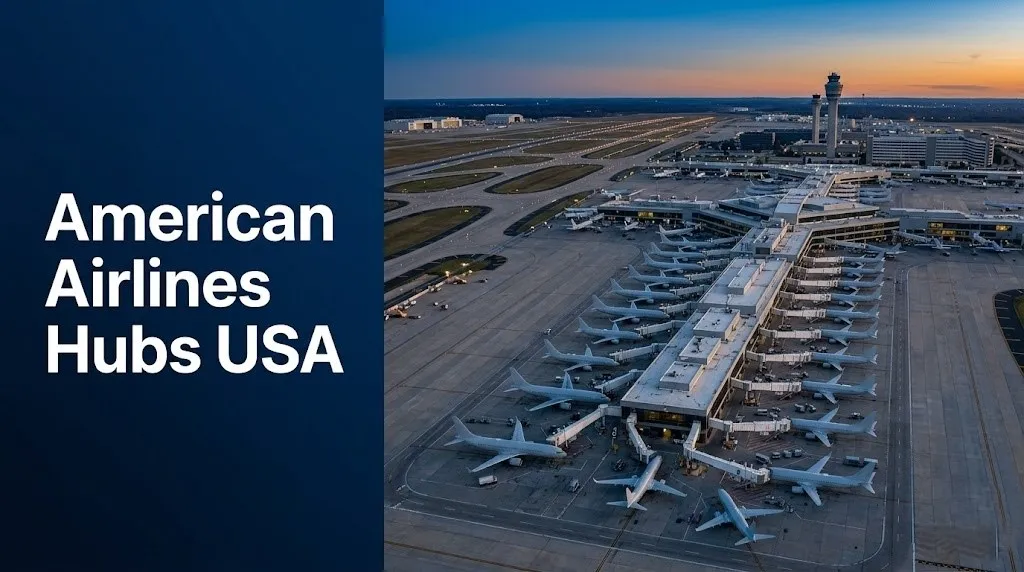
American Airlines operates ten hub airports across the United States, anchoring the largest airline network in the world. American Airlines hubs USA span the South, Midwest, East Coast, and West Coast.
DFW alone handles close to 16,000 monthly American Airlines flights, more than any other hub in the network. That single number explains why your connection city often matters more than your destination.
This guide breaks down every American Airlines hub by terminal, lounge, and connection quality. You will also get traveler-specific guidance for choosing the right routing for your trip.
How Many Hubs Does American Airlines Have
American Airlines operates ten hub airports across the United States as of 2026. These hubs form the backbone of its hub-and-spoke network alongside several smaller focus cities.
The official hub list includes Charlotte, Chicago O’Hare, Dallas-Fort Worth, Los Angeles, Miami, New York JFK and LaGuardia, Philadelphia, Phoenix, and Washington DC. Each hub plays a distinct geographic role in the network.
Business travelers should know that hub count affects how many one-stop options exist to a given city. First-time international travelers benefit from understanding that most transatlantic and Latin American connections route through just three or four of these ten airports.
DFW, CLT, and ORD see the heaviest connection volume, especially during weekday morning and evening banks. Travelers connecting through smaller hubs like DCA may find fewer rebooking options if a flight is delayed.
Most travelers assume every hub offers equal connection strength, but that is incorrect. According to the American Airlines Newsroom, the nine traditionally designated hub markets each serve a different regional purpose, from Latin American gateway to Midwest connector.
Key American Airlines hub cities at a glance:
- Dallas-Fort Worth (DFW), the airline’s largest hub by flight volume
- Charlotte (CLT), the primary East Coast connecting hub
- Chicago O’Hare (ORD), the Midwest connection point
- Miami (MIA), the main gateway to Latin America and the Caribbean
- New York JFK and LaGuardia, the New York metro presence
Verify your specific routing on the official American Airlines website before booking, since hub assignments can shift with seasonal schedule changes.
American Airlines Main Hub: Dallas Fort Worth (DFW)
Dallas Fort Worth International Airport (DFW) is American Airlines’ largest and busiest hub by every operational measure. DFW handles close to 16,000 monthly American Airlines flights and offers nearly 2.8 million seats.
American operates from multiple terminals at DFW, with Terminal D serving as the international hub including the Flagship Lounge near Gate D23. Domestic connections spread across Terminals A, B, and C depending on the route.
Connection times at DFW run tight during peak banks, especially midday and early evening. DFW’s average flight distance is around 1,119 miles, reflecting its role connecting short and medium-haul domestic routes to long-haul international service.
Business and frequent flyers benefit most from DFW’s dense schedule and Flagship Lounge access on qualifying international or transcontinental tickets. Families connecting through DFW should budget extra time, since the airport’s size means longer walks between gates.
The honest limitation at DFW is its sheer scale. The terminals are spread far enough apart that a short connection between, say, Terminal A and Terminal D can require a Skylink train ride.
| Terminal | Primary Use | Lounge Access | Best For |
|---|---|---|---|
| Terminal D | International, Flagship | Flagship Lounge, Admirals Club | Long-haul connections |
| Terminal A | Domestic | Admirals Club | Sun Belt connections |
| Terminal C | Domestic regional | Admirals Club | American Eagle flights |
Verify your gate and terminal assignment directly with American Airlines before your connection, since DFW reassigns gates frequently.
American Airlines Charlotte Hub (CLT)
Charlotte Douglas International Airport (CLT) is American Airlines’ primary connecting hub for the East Coast and a secondary Caribbean gateway. American operates around 11,030 monthly flights from CLT, representing roughly 90 percent of the airport’s total traffic.
American uses Concourse B, Concourse C, and Concourse D for its CLT operations, with major international routes to Athens, Amsterdam, Frankfurt, and London. Domestic routes from CLT reach cities like Atlanta, Austin, and Bangor.
CLT works well for business travelers needing East Coast connections with frequent departure banks throughout the day. Solo travelers will find CLT’s concourse layout fairly compact, with shorter walks than DFW between most gates.
A new Flagship Lounge is planned for CLT as part of American’s 2026 expansion. The Bulkhead Seat notes that CLT’s current Provisions by Admirals Club location sits on Concourse A near Gate A1.
The honest limitation at CLT is weather. Charlotte experiences frequent thunderstorm-related ground stops in summer, which can cascade into network-wide delays given how much of American’s schedule routes through this single airport.
To navigate a CLT connection efficiently:
- Check your concourse assignment on the American app before landing
- Allow at least 45 minutes for a same-concourse connection
- Avoid booking sub-60-minute connections during summer storm season
- Use the people movers between concourses rather than walking when pressed for time
- A well-planned CLT connection still gets you to most East Coast cities same-day even after a short delay
Important Accuracy Notes for Charlotte Connections
CLT’s exposure to severe weather creates real misconnection risk during summer months. Verify the following directly before traveling:
- Current weather advisories at FAA.gov for the Charlotte region on your travel date
- Your minimum connection time for CLT on the American Airlines booking confirmation
- Whether your fare class allows free same-day rebooking if your CLT connection is missed
Build a buffer of at least 90 minutes for any CLT connection during June through September.
Key Takeaway: DFW and CLT carry the heaviest American Airlines connection volume, so build extra buffer time at both during peak travel seasons.
American Airlines Chicago O’Hare Hub (ORD)
O’Hare International Airport (ORD) serves as American Airlines’ primary hub for the Midwest. ORD connects passengers across a wide network of domestic and international American Airlines flights.
American operates primarily from Terminal 3 at ORD, with a Flagship Lounge located in Concourse H/K according to lounge tracking sources. American is also building a new, expanded Admirals Club lounge at ORD Concourse L, spanning more than 10,000 square feet.
Frequent flyers connecting through ORD benefit from American’s strong domestic schedule density to cities throughout the Midwest and Great Plains. Families should note that Terminal 3 has play areas, but security lines can run long during morning peak hours.
ORD connections work best scheduled outside the 6 to 9 AM and 4 to 7 PM windows when the airport runs at its busiest. Winter travelers should expect a higher chance of weather-related delays from November through March.
The honest limitation at ORD is winter operations. Even a moderate snow event can trigger cascading delays across American’s entire Midwest schedule, since ORD functions as the connection point for so many regional routes.
Insider Tip:
- The new Concourse L Admirals Club expansion will ease congestion once complete, per American’s 2026 announcements
- Solo travelers connecting through ORD should download the MyFly Chicago app for real-time security wait times
- Business travelers with tight ORD connections should request a gate agent reroute proactively if weather alerts appear
Verify current terminal assignments with American Airlines directly, since ORD construction projects can shift gate locations.
American Airlines Miami Hub (MIA)
Miami International Airport (MIA) is American Airlines’ primary gateway to Latin America and the Caribbean. MIA handles over 9,000 monthly American Airlines flights and more than 1.6 million monthly seats, making it one of the airline’s vital international gateways.
American currently operates three lounge spaces at MIA, including an Admirals Club at D15 and both Flagship and Admirals Club lounges at D30. American plans to expand these into a larger Flagship Lounge with a la carte dining.
First-time international travelers connecting through MIA to South America will find extensive Spanish-language signage and staff support. Business travelers heading to cities like Bogota, Sao Paulo, or Santiago will typically find their connection concentrated in the North Terminal’s D concourse.
MIA connections to Latin America cluster in late evening departure banks for overnight arrivals. Hurricane season, June through November, creates the highest disruption risk for MIA connections.
The honest limitation at MIA is its aging terminal infrastructure outside the renovated Flagship areas. Some D concourse gates remain dated compared to American’s newer Flagship investments at PHL and planned upgrades elsewhere.
Key documents and prep for MIA connections to Latin America:
- Valid passport with at least six months validity for most South American destinations
- Any required visa or entry document for your specific destination country
- Proof of onward travel if connecting to a country requiring it at check-in
Always verify destination entry requirements with the U.S. State Department before booking a MIA connection to an international destination.
American Airlines Los Angeles Hub (LAX)
Los Angeles International Airport (LAX) functions as American Airlines’ hub for the West Coast and its transpacific gateway. LAX serves American’s West Coast network and connects to transpacific destinations across the Pacific.
American operates from Terminal 4 at LAX, with a Flagship Lounge located near Gate 41 according to lounge directories. The Bulkhead Seat documents this Flagship Lounge as one of American’s network-wide premium facilities.
Business and frequent flyers connecting through LAX to Asia or Australia gain access to the Flagship Lounge on qualifying premium tickets. Solo female travelers connecting internationally through LAX should know Terminal 4 has 24-hour staffed information desks near security.
LAX works best for connections scheduled with at least 90 minutes of buffer, since the airport’s roadway congestion can affect even airside transfers during peak hours. Avoid scheduling tight connections during the Thanksgiving and December holiday travel weeks.
The honest limitation at LAX is that American’s presence is smaller than at its eastern hubs, meaning fewer same-day rebooking options if your transpacific connection is missed.
| Hub Feature | LAX Detail |
|---|---|
| Primary Terminal | Terminal 4 |
| Lounge | Flagship Lounge near Gate 41, Admirals Club |
| Connection Strength | Strong transpacific, moderate domestic |
| Best For | West Coast and Asia-Pacific connections |
Confirm your LAX terminal assignment with American directly, since transpacific schedules shift seasonally.
Key Takeaway: MIA and LAX anchor American’s international connections, but both carry seasonal disruption risk travelers should plan around.
American Airlines New York Hubs: JFK and LaGuardia
American Airlines operates two New York hubs, John F. Kennedy International Airport (JFK) and LaGuardia Airport (LGA), serving different markets. JFK functions as American’s secondary transatlantic hub, mainly serving destinations with high demand from local New York traffic, while LaGuardia is American’s primary New York domestic hub.
American’s Admirals Club at JFK sits in Terminal 8 alongside its Flagship Lounge, while the LaGuardia Admirals Club is located in Terminal B. JFK Terminal 8 also houses the Greenwich Lounge, shared with British Airways.
Business travelers flying transatlantic from JFK gain access to one of American’s most prominent Flagship facilities. Families flying domestic routes from LaGuardia will find Terminal B has been substantially modernized in recent years.
JFK connections to Europe cluster in evening departure banks for morning arrivals. LaGuardia’s domestic schedule runs dense throughout the day, particularly on the Boston and Washington shuttle-style routes.
The honest limitation of American’s New York presence is that it is smaller than at Delta or JetBlue, meaning fewer same-day alternatives if a JFK transatlantic flight is delayed or canceled.
According to One Mile at a Time, American’s New York Flagship presence at JFK carries different branding than its other five Flagship Lounges, reflecting the British Airways joint venture relationship.
First-time international travelers departing JFK should:
- Confirm Terminal 8 for American Airlines departures when booking
- Arrive at least three hours early for transatlantic departures
- Use the AirTrain from any New York airport connection point to reach Terminal 8
A well-planned JFK departure leaves enough buffer to enjoy the Flagship Lounge before a transatlantic flight.
American Airlines Philadelphia Hub (PHL)
Philadelphia International Airport (PHL) serves as American Airlines’ primary gateway for transatlantic connections along the East Coast. American recently debuted a 25,000-square-foot Flagship and Admirals Club lounge complex at PHL Terminal A West, its fifth Flagship Lounge and ninth premium lounge worldwide.
American first introduced scan-to-order menu technology at the PHL Flagship Lounge, letting guests order dishes via QR code rather than from a buffet. This concept is now expanding to other Flagship locations.
Business travelers connecting through PHL to Europe will find one of American’s newest premium lounge experiences. Budget travelers on domestic connections through PHL will not access these lounges without a qualifying premium ticket or membership.
PHL connections to Europe typically depart in the evening for morning arrivals, similar to other East Coast gateways. Winter weather can affect PHL similarly to ORD and CLT, though generally with less severe disruption.
The honest limitation at PHL is that its domestic network is thinner than CLT’s, meaning fewer one-stop domestic options if you are not connecting internationally.
Insider Tip:
- The new PHL Flagship Lounge includes cheese monger stations as part of American’s 2026 dining upgrades
- Frequent flyers with Executive Platinum status get strong value from PHL’s new premium facilities on transatlantic tickets
- Solo travelers connecting domestically through PHL should check Admirals Club access rules, since standard domestic tickets do not qualify
Verify current PHL lounge access requirements with American Airlines, since premium lounge policies are actively evolving in 2026.
American Airlines Phoenix Hub (PHX)
Phoenix Sky Harbor International Airport (PHX) serves as American Airlines’ hub for the Southwest region. American operates a significant portion of Sky Harbor’s domestic traffic, connecting passengers between California, the Mountain West, and the rest of the network.
PHX connections to Hawaii operate seasonally, with American flying between PHX and Honolulu’s Daniel K. Inouye International Airport during peak demand periods. These seasonal Flagship-designated flights between PHX and HNL grant Admirals Club access even on domestic tickets.
Families heading to Hawaii from the Southwest benefit from PHX’s seasonal nonstop options without needing a West Coast connection. Business travelers connecting through PHX to California find a dense daytime schedule with multiple departure banks.
PHX connections work well year-round, though summer heat occasionally causes ground delays during extreme temperature events. Winter brings the heaviest Hawaii-bound traffic from PHX.
The honest limitation at PHX is that its international footprint beyond Mexico and seasonal Hawaii service is limited compared to American’s coastal hubs.
Key things to know about PHX connections:
- Admirals Club locations exist at Sky Harbor for AAdvantage elite members and qualifying ticket holders
- Seasonal HNL routes from PHX may not operate year-round, so confirm dates before booking
- Domestic connections through PHX to the Midwest often route through DFW or ORD instead
Confirm seasonal route availability for PHX directly with American Airlines before booking Hawaii connections.
Key Takeaway: PHL’s new Flagship Lounge and PHX’s seasonal Hawaii routes show how American is investing differently in each hub.
American Airlines Washington DC Hub (DCA)
Ronald Reagan Washington National Airport (DCA) is American Airlines’ hub for the Washington metro area. DCA functions within American’s ten-hub network alongside CLT, ORD, DFW, LAX, MIA, JFK, LGA, and PHL.
American operates a significant share of DCA’s gate capacity, primarily serving short-haul East Coast routes and the Northeast shuttle corridor. Admirals Club access exists at DCA for qualifying travelers, though Flagship Lounge service is not currently offered at this airport.
Business travelers on the Washington to New York or Washington to Boston corridor find DCA’s compact layout efficient for quick turnarounds. Families should note DCA has strict slot controls, meaning schedules are tightly timed with little flexibility for delays.
DCA connections work best for short-haul East Coast trips rather than as a gateway to longer connections. Government travel patterns mean DCA gets notably busier around major DC events and the legislative calendar.
The honest limitation at DCA is its small size and runway constraints, which can create ripple delays across the entire East Coast network during bad weather.
Important Accuracy Notes for DCA Connections
DCA’s proximity to restricted airspace and its compact runway layout create unique delay patterns. Verify the following directly before traveling:
- Current FAA airspace advisories for the Washington DC region
- Whether your connection requires a terminal change, since DCA has limited concourses
- Any temporary flight restrictions that commonly affect DCA during high-profile events
Build extra buffer time for any DCA connection scheduled during major Washington events.
American Airlines Hub vs Focus City: What Is the Difference
A hub is an airport where American Airlines bases significant aircraft and crew to build connecting itineraries, while a focus city has a strong American presence without the same connection-building role. American’s official hub designation covers Charlotte, Chicago O’Hare, Dallas-Fort Worth, Los Angeles, Miami, New York JFK and LaGuardia, Philadelphia, Phoenix, and Washington DC.
Airports like Austin or Raleigh-Durham have growing American Airlines service and even Admirals Club lounges, but they function more as focus cities or large stations than true connecting hubs. American has announced new Admirals Clubs for cities including Charlotte, Austin, Nashville, Chicago, and Washington DC as part of its 2026 expansion.
Business travelers should not assume a city with an Admirals Club automatically offers strong connection options. First-time international travelers booking through a focus city may find fewer same-day rebooking choices than at a true hub.
This distinction matters most when something goes wrong with your flight. Understanding it before booking helps you choose itineraries with better recovery options if delays occur.
The honest reality is that American’s marketing sometimes blurs this line by emphasizing lounge openings at non-hub cities. A new Admirals Club does not mean a focus city has hub-level connection density.
To evaluate whether your connection city is a true hub:
- Check if the city appears on American’s official ten-hub list
- Look at how many daily American departures the airport has to your destination
- If only one or two daily options exist, treat it as a focus city for backup planning
A true hub gives you same-day rebooking options if your original flight is disrupted.
American Airlines Admirals Club and Flagship Lounge Locations
American Airlines operates Admirals Club lounges at over 50 airports and six Flagship Lounges at its premier hubs. The six Flagship Lounges are located in Chicago, Dallas, Los Angeles, Miami, New York, and Philadelphia, with the New York location carrying different branding.
American Airlines operates 48 Admirals Club lounges across the United States, Argentina, Brazil, Canada, France, Mexico, and the United Kingdom. Access typically requires membership, a qualifying premium ticket, or elite status.
Frequent flyers with Executive Platinum or ConciergeKey status enjoy the broadest access across both lounge types. Budget travelers on basic economy tickets generally cannot access either lounge type without a separate membership purchase.
One-day Admirals Club passes cost around the equivalent of $79 or 7,900 AAdvantage miles, though peak-hour capacity limits may turn passholders away. This pricing should be verified directly with American before relying on it.
The honest limitation of American’s lounge network is uneven distribution. Travelers connecting through smaller hubs like PHX or DCA have far fewer premium options than those routing through DFW or PHL.
| Lounge Type | Network Size | Typical Access | Best For |
|---|---|---|---|
| Flagship Lounge | 6 locations | First/Business international, Flagship tickets | Long-haul premium travelers |
| Admirals Club | 48+ locations | Membership, elite status, qualifying tickets | Frequent domestic and international flyers |
Verify current lounge access rules and locations directly on the American Airlines website, since 2026 expansions are ongoing.
Key Takeaway: American’s hub vs focus city distinction and its uneven lounge network both affect how smoothly your connection actually runs.
Best American Airlines Hub for Connecting Flights
Dallas Fort Worth (DFW) and Charlotte (CLT) are American Airlines’ strongest hubs for connecting flights based on schedule density. DFW handles close to 16,000 monthly flights, the highest volume in the network, making it the deepest pool of rebooking options.
CLT follows closely with around 11,030 monthly American Airlines flights representing roughly 90 percent of the airport’s total traffic. Both airports offer dense same-day departure banks to most major US cities.
Business travelers who need flexibility after a missed connection benefit most from routing through DFW or CLT. Solo travelers prioritizing shorter walking distances may prefer CLT’s more compact concourse layout over DFW’s sprawling terminals.
DFW and CLT both run their heaviest connection banks on weekday mornings and early evenings. Weekend schedules at both airports are noticeably thinner, meaning fewer rebooking options if something goes wrong on a Saturday.
The honest tradeoff is that DFW’s size creates longer walks while CLT’s weather exposure creates more frequent disruptions. Neither hub is perfect, but both beat smaller focus cities for recovery options.
To choose the best hub for your connection:
- Compare DFW and CLT options for your specific route on American’s booking site
- Check the minimum connection time listed for each airport
- Avoid the absolute minimum connection time if traveling during storm season or winter
A well-chosen DFW or CLT connection gives you multiple same-day alternatives if your first flight runs late.
American Airlines International Gateways
American Airlines routes most international long-haul flights through MIA, JFK, DFW, PHL, and LAX. MIA serves as the primary gateway for Latin America and the Caribbean, with over 9,000 monthly flights and more than 1.6 million monthly seats.
JFK and PHL anchor transatlantic service, while DFW and LAX handle a mix of European, Latin American, and transpacific routes. PHL’s new Flagship Lounge specifically supports its growing transatlantic role.
First-time international travelers should expect customs and immigration processing at whichever US gateway they arrive into, even on a connecting itinerary. Families flying to Europe often find JFK or PHL offers more nonstop European options than smaller hubs.
International schedules concentrate departures in the evening for overnight transatlantic flights and late-night departures for Latin American red-eyes. Summer remains the highest-demand season for transatlantic gateways.
The honest limitation is that American’s transpacific network from LAX and DFW is smaller than its transatlantic and Latin American networks, meaning fewer Asia-Pacific nonstop options than competitors.
Bullet list of American’s primary international gateways:
- Miami International Airport (MIA), Latin America and Caribbean focus
- John F. Kennedy International Airport (JFK), transatlantic focus with British Airways joint venture
- Philadelphia International Airport (PHL), growing transatlantic gateway with new Flagship Lounge
- Dallas Fort Worth International Airport (DFW), mixed long-haul gateway
- Los Angeles International Airport (LAX), transpacific and Latin American gateway
Verify entry requirements for your destination country at the U.S. State Department website before booking any international connection.
American Airlines Hub Airport Comparison
The table below compares American Airlines’ major hub airports across region, role, and lounge access.
| Hub | IATA Code | Region Served | Primary Role | Lounge Tier | Best For |
|---|---|---|---|---|---|
| Dallas Fort Worth | DFW | South/Central | Largest overall hub | Flagship + Admirals Club | High-volume connections |
| Charlotte | CLT | East Coast | Primary East Coast hub | Admirals Club, Flagship planned | East Coast connections |
| Chicago O’Hare | ORD | Midwest | Midwest connector | Flagship + Admirals Club | Midwest connections |
| Miami | MIA | Latin America/Caribbean | International gateway | Flagship + Admirals Club | Latin America connections |
| Los Angeles | LAX | West Coast | Transpacific gateway | Flagship + Admirals Club | West Coast and Asia |
| New York JFK | JFK | Northeast | Transatlantic gateway | Flagship (Greenwich Lounge) | Transatlantic travelers |
| New York LaGuardia | LGA | Northeast | Domestic NY hub | Admirals Club | Domestic shuttle routes |
| Philadelphia | PHL | East Coast | Transatlantic gateway | Flagship + Admirals Club | Premium transatlantic |
| Phoenix | PHX | Southwest | Southwest connector | Admirals Club | Southwest and Hawaii |
| Washington DCA | DCA | Mid-Atlantic | Short-haul connector | Admirals Club | Northeast corridor |
Business travelers should weigh lounge access alongside connection density when choosing a routing. Families on a budget may prioritize hubs without Flagship Lounges, since fares through those hubs sometimes run lower.
This table reflects hub roles as of mid-2026. Confirm current terminal and lounge assignments directly with American Airlines before traveling, since the airline’s lounge expansion is ongoing.
Key Takeaway: DFW, CLT, and MIA offer the deepest connection options, while PHL and JFK lead on premium international lounge access.
How American Airlines Hubs Affect Flight Prices and Routing
Routing through a major American Airlines hub usually affects price through connection structure rather than direct hub-based surcharges. Fares connecting through DFW or CLT often run competitively because of the high volume of available itineraries on those routes.
Booking a connection through a smaller hub like DCA or PHX sometimes costs more if fewer competing itineraries exist for that specific routing. Per The Points Guy’s May 2026 valuation, American miles are worth roughly 1.6 cents apiece, which affects whether redeeming miles for a hub connection makes financial sense.
Budget travelers comparing fares should check whether a one-stop itinerary through DFW costs less than a nonstop through a smaller market. Business travelers using miles for upgrades often find better availability on flights connecting through major hubs with more frequent service.
Fares connecting through hubs tend to be most competitive when booked several weeks ahead of departure. Last-minute bookings through smaller focus cities can carry a noticeable price premium due to limited seat inventory.
The honest reality is that hub routing affects schedule reliability more than it affects raw ticket price in most cases. A slightly higher fare through a stronger hub can be worth it if it means more rebooking options.
To use hub knowledge when booking:
- Search both nonstop and one-stop options through major hubs like DFW or CLT
- Compare total travel time against any price savings from a connection
- Avoid connections through hubs with known seasonal weather risk if your schedule is inflexible
Choosing the right hub for your connection can mean the difference between a smooth trip and a missed event.
Tips for Navigating American Airlines Hub Airports
Navigating any American Airlines hub starts with knowing your terminal before you arrive at the airport. Download the American Airlines app and check your gate assignment as soon as it posts.
At sprawling hubs like DFW, allow extra time for the Skylink train between terminals. At more compact hubs like CLT or LGA, walking between gates is usually faster than waiting for a people mover.
Solo travelers should identify the nearest Admirals Club or Flagship Lounge entry point if they hold qualifying access. Families traveling with young children benefit from hubs like PHL and MIA, which have more extensive family facilities in their newer terminal areas.
Morning departure banks tend to be the most crowded at every major hub, especially DFW, ORD, and CLT. Evening international departure banks at MIA, JFK, and PHL also see heavy security volume.
The honest truth about hub navigation is that no amount of planning eliminates all risk during severe weather. Building in buffer time remains the single most effective strategy at any American Airlines hub.
Practical tips for navigating any American Airlines hub:
- Check your terminal and gate on the American app before leaving for the airport
- Build at least 60 to 90 minutes of connection buffer at weather-prone hubs like CLT, ORD, and DCA
- Identify lounge locations in advance if you hold Admirals Club or Flagship access
- Use TSA PreCheck or Clear where available to reduce security wait times at busy hubs
A traveler who plans around hub-specific quirks arrives with far less stress than one who treats every airport the same.
Frequently Asked Questions About American Airlines Hubs USA
How many hubs does American Airlines have?
American Airlines operates ten hub airports across the United States as of 2026.
These include Charlotte, Chicago O’Hare, Dallas-Fort Worth, Los Angeles, Miami, New York JFK and LaGuardia, Philadelphia, Phoenix, and Washington DC.
Verify current hub designations on the American Airlines Newsroom before assuming a city’s role in the network.
What is American Airlines’ biggest hub?
Dallas Fort Worth International Airport (DFW) is American Airlines’ biggest hub by flight volume and seat capacity.
DFW handles close to 16,000 monthly American Airlines flights, more than any other airport in the network.
This makes DFW the strongest connection point for rebooking if your flight is delayed.
Is Charlotte a major American Airlines hub?
Yes, Charlotte Douglas International Airport (CLT) is American Airlines’ primary East Coast connecting hub.
American operates around 11,030 monthly flights from CLT, representing roughly 90 percent of the airport’s total traffic.
CLT connects passengers to both domestic East Coast cities and international destinations including Athens, Amsterdam, Frankfurt, and London.
Does American Airlines have a hub in New York?
Yes, American Airlines operates two hubs in the New York area, JFK and LaGuardia.
JFK serves as American’s secondary transatlantic hub with a Flagship Lounge in Terminal 8.
LaGuardia functions as American’s primary New York domestic hub, with its Admirals Club located in Terminal B.
What is the difference between an American Airlines hub and a focus city?
A hub is an airport where American bases significant connecting service, while a focus city has strong service without the same connection density.
American’s ten official hubs include DFW, CLT, ORD, MIA, LAX, JFK, LGA, PHL, PHX, and DCA.
Cities with new Admirals Clubs but fewer daily American departures, such as Austin or Nashville, function more as focus cities.
Which American Airlines hub has the best lounges?
Philadelphia and Dallas Fort Worth currently offer some of American’s strongest lounge experiences.
PHL recently opened a 25,000 square foot Flagship and Admirals Club complex in Terminal A West.
DFW combines a Flagship Lounge near Gate D23 with multiple Admirals Club locations across its terminals.
Final Thoughts on American Airlines Hubs
Knowing American’s ten hub airports helps you choose connections with better rebooking options when things go wrong. DFW and CLT offer the deepest schedules, while PHL and JFK lead on premium lounge access.
Before booking, check your connection city against this hub list and confirm your terminal assignment on the American Airlines app. Lounge locations, terminal assignments, and seasonal routes change as American continues its 2026 expansion, so verify details directly with American before departure.
With this hub map in mind, you can now choose a routing that fits your schedule, your lounge access, and your tolerance for weather-related risk.