Is Southwest Airlines safe in 2026? Yes, Southwest holds a strong regulatory safety record despite a recent string of close-call headlines.
The FAA completed a Certificate Holder Evaluation Program review of Southwest and found no significant safety issues.
This guide breaks down Southwest’s fleet, pilot training, FAA oversight, and recent incidents.
You will also see how Southwest compares to Delta, American, United, Spirit, and Frontier on safety.
Is Southwest Airlines Safe
Southwest Airlines is safe to fly, with a strong regulatory standing despite recent operational incidents making headlines.
Southwest operates a single-fleet model using only Boeing 737 variants, which simplifies pilot training and maintenance procedures across the airline.
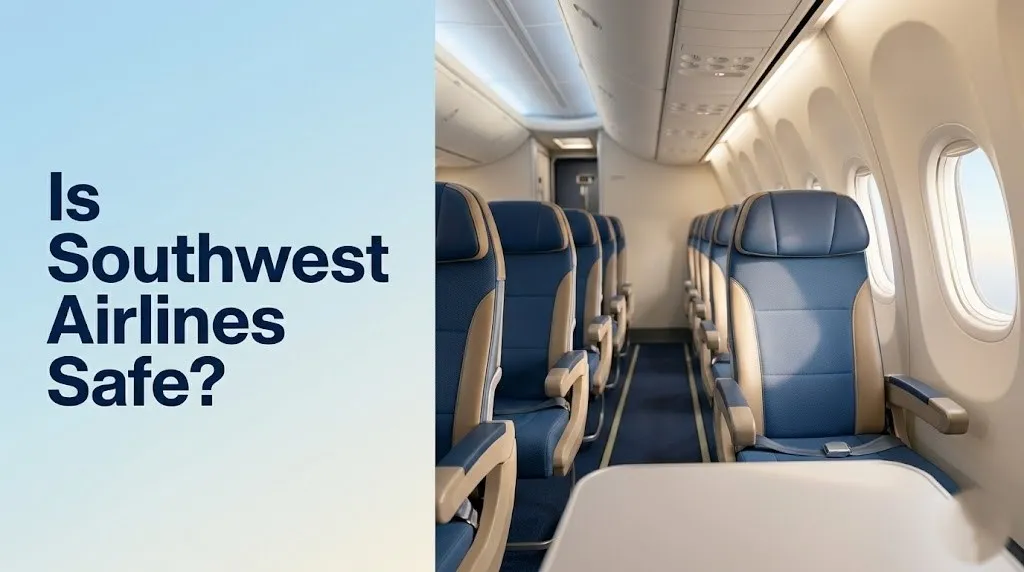
This consistency is a recognized safety advantage compared to airlines running mixed fleets with multiple aircraft types and training programs.
Airline Ratings, a third-party safety review platform, has scored Southwest highly on its safety index, which weighs audits, fleet age, and incident history.
Travelers can check this score directly on the Airline Ratings website before booking, since scores are updated periodically.
Nervous flyers benefit most from understanding that fatal commercial accidents remain extremely rare across the entire U.S. industry, not just Southwest.
Families and frequent flyers should focus less on individual headlines and more on the underlying regulatory data covered in the sections below.
Booking timing does not affect safety, since FAA oversight applies to every Southwest flight year-round regardless of season.
What most travelers do not realize is that “near miss” headlines often describe air traffic control errors, not aircraft or crew failures.
Southwest’s specific limitation is that its high-frequency, point-to-point schedule at congested airports increases its exposure to runway and airspace incidents.
Insider Tip:
Southwest’s single-aircraft-type fleet (all Boeing 737 variants) reduces training complexity compared to airlines that fly five or six different aircraft families.
Most travelers never check the FAA’s Certificate Holder Evaluation Program findings, which are public and specific to each airline.
For nervous flyers, reading the actual FAA review summary is often more reassuring than scrolling news headlines about individual incidents.
Southwest Airlines Safety Record
Southwest Airlines has never had a fatal accident involving a passenger fatality from an in-flight structural or mechanical failure in its commercial history.
The airline’s most serious past incident involved an uncontained engine failure that resulted in a single passenger fatality after cabin damage, an event the NTSB investigated thoroughly.
That investigation led to industrywide changes in engine fan blade inspection requirements across the Boeing 737 fleet.
Travelers can review NTSB final reports on past incidents directly through the NTSB’s public accident database at no cost.
Frequent flyers who track airline safety trends should know that one historical incident decades apart does not represent current operational risk.
First-time travelers booking their first Southwest flight should know this single event remains the exception across tens of millions of flights.
The safety record looks strongest when viewed over multi-decade windows rather than isolated news cycles tied to a single year.
Short-term incident clusters, like the 2025-2026 near misses, reflect air traffic control system strain more than airline-specific failures.
The honest limitation here is that Southwest, like every major carrier, has had isolated serious incidents that shaped industry-wide safety rules.
No airline’s record is spotless, and travelers should weigh decades of data rather than any single event.
| Metric | Southwest Airlines | Industry Context |
|---|---|---|
| Fatal passenger accidents (commercial era) | One cabin fatality from engine failure | Comparable to other major U.S. carriers |
| Fleet type | Boeing 737 family only | Most peers operate mixed fleets |
| FAA review outcome | No significant issues found in CHEP review | Standard for major carriers |
| Network model | Point-to-point | Differs from hub-and-spoke peers |
Key Takeaway: Southwest’s long-term fatal accident history is comparable to other major U.S. carriers, with one historical exception that reshaped industry engine inspection rules.
Southwest Airlines Safety Rating
Southwest Airlines holds a high safety rating from Airline Ratings, a recognized third-party aviation safety review platform.
Airline Ratings scores carriers across categories including audits, fleet age, incident rates, pilot training standards, and safety culture.
To check the current score, travelers should visit the Airline Ratings website directly, since scores update as new audit data becomes available.
This is more useful than relying on a single number, since the underlying categories show where an airline performs strongest.
Budget travelers comparing Southwest to other low-cost carriers should look specifically at the fleet age and audit categories, not just the overall score.
Business travelers booking frequently may care more about the on-time and operational categories than the raw safety number alone.
Ratings can shift after major audits or incident investigations, so checking close to your booking date gives the most current picture.
A rating from six months ago may not reflect a recent FAA review outcome or a new incident investigation.
The honest limitation of third-party ratings is that they aggregate public data and cannot predict individual flight risk.
A high score reflects systemic safety practices, not a guarantee about any specific aircraft or crew on a given day.
Key sources to check before booking:
- Airline Ratings safety score page for Southwest, updated periodically with category breakdowns
- IATA Operational Safety Audit (IOSA) registry, which lists airlines that have passed this operational audit
- DOT Air Travel Consumer Report, which tracks complaint and incident data by carrier
Southwest Airlines Fleet and Aircraft Safety
Southwest operates a fleet built entirely around the Boeing 737 family, including the 737-700, 737-800, and Boeing 737 MAX 8.
This single-family approach means every pilot trains on aircraft sharing the same basic systems and cockpit layout.
Fleet age varies by aircraft, with older 737-700s flying alongside newer MAX 8 deliveries entering service over recent years.
Travelers can check the specific aircraft assigned to their flight using Southwest’s flight status tools, though aircraft swaps happen for operational reasons.
Families booking longer domestic routes may notice newer MAX 8 aircraft on transcontinental flights more often than on short regional hops.
Solo travelers on short routes are more likely to be assigned older 737-700 or 737-800 aircraft, which remain in active, maintained service.
Aircraft age alone does not indicate risk, since maintenance schedules and inspections apply regardless of when an aircraft entered service.
Newer deliveries simply mean more recent avionics and cabin technology, not a meaningful difference in underlying safety standards.
The honest limitation is that fleet commonality also means a single type-wide issue, like the prior 737 MAX grounding industrywide, can affect a larger share of Southwest’s operation than airlines with mixed fleets.
That tradeoff cuts both ways: simpler training and maintenance, but less diversification if one aircraft type faces a fleet-wide grounding.
According to the Federal Aviation Administration, all Boeing 737 MAX aircraft returned to commercial service only after meeting updated certification requirements following the prior worldwide grounding.
Southwest 737 MAX Safety Record
The Boeing 737 MAX 8 operating on Southwest is safe to fly under current FAA certification standards.
The 737 MAX fleet was grounded worldwide for roughly 20 months following two fatal accidents involving other airlines, neither of which involved Southwest.
Boeing and the FAA implemented software, training, and sensor changes before allowing the MAX back into commercial service.
Travelers can verify current MAX certification status through FAA public statements, since any new directives are published immediately.
Nervous flyers specifically worried about the MAX should know Southwest’s MAX 8 aircraft have operated for several years since recertification without a Southwest-specific MAX safety grounding.
Frequent flyers booking longer routes are statistically more likely to fly a MAX 8, since Southwest deploys these aircraft on higher-demand routes.
The aircraft type assigned to any flight can change due to maintenance swaps, so booking a specific aircraft is never guaranteed.
Travelers who want to avoid the MAX entirely can check aircraft type on flight-tracking tools before departure, though swaps remain possible up to boarding.
The honest limitation is that public concern about the MAX persists even though the certification fixes addressed the specific failure modes from the earlier accidents.
No aircraft type has a perfect public reputation, and the MAX’s history means it draws more scrutiny than comparable aircraft with cleaner headlines.
Important Accuracy Notes for 737 MAX Concerns
Travelers with significant anxiety about the 737 MAX should verify current FAA airworthiness directives before booking a flight known to use this aircraft.
Verify the following directly before traveling:
- Current FAA airworthiness directive status for the Boeing 737 MAX 8, checked through the FAA’s official website
- Aircraft type assigned to your specific flight, checked through Southwest’s flight status tool or a flight-tracking service close to departure
- Any active NTSB investigations involving the MAX fleet, checked through the NTSB’s public database
The single most important action is checking the FAA’s current airworthiness status page before your departure date, not relying on older news coverage.
Southwest Airlines Pilot Training and Crew Standards
Southwest Airlines pilots train under FAA-mandated programs that include simulator training, recurrent checks, and type-specific certification for the Boeing 737 family.
Because Southwest operates only 737 variants, pilots can move between most aircraft in the fleet without a separate type rating process.
This reduces training complexity compared to airlines whose pilots must hold separate certifications for multiple aircraft families.
Recurrent training and proficiency checks occur on a regular cycle set by FAA regulations, applying equally to every major U.S. carrier.
Business and frequent flyers who fly Southwest regularly are flying with crews subject to the same federal training minimums as Delta, American, or United pilots.
First-time international travelers connecting through U.S. domestic legs on Southwest should know domestic crew standards do not differ based on route type.
Training standards do not vary seasonally, though crew scheduling adjusts during high-demand periods like winter holidays and severe weather events.
Travelers flying during major storm systems may experience more crew-related delays as scheduling rules limit duty hours during disruptions.
The honest limitation is that Southwest’s high-frequency point-to-point model can mean tighter crew turnaround times between flights compared to hub-based carriers.
Tighter turnarounds do not violate federal duty-time rules, but they do leave less schedule buffer when delays occur.
According to the Federal Aviation Administration, all U.S. commercial pilots must meet identical minimum flight hour, training, and recurrent certification requirements regardless of carrier.
Key Takeaway: Southwest pilots meet the same FAA training minimums as every major U.S. carrier, with fleet commonality simplifying type-specific certification.
Southwest Airlines FAA Oversight and Audits
The FAA actively oversees Southwest Airlines through ongoing inspections and the Certificate Holder Evaluation Program (CHEP), a comprehensive operational review.
A recent CHEP review of Southwest, launched after a cluster of 2024 incidents, concluded without identifying significant safety issues.
The review covered training, maintenance procedures, and operational practices across Southwest’s network.
Travelers can find FAA statements about airline-specific reviews through the FAA’s official press releases and public statements.
Frequent flyers who follow aviation news should know that CHEP reviews are not unique to Southwest, since the FAA periodically audits all major carriers.
Families planning travel do not need to monitor ongoing audits directly, since any finding requiring immediate action would trigger public FAA notices and operational changes.
The timing of audits does not correlate with seasonal travel demand, and reviews can launch at any point during the year.
A completed review with no significant findings is a positive signal, but it does not mean future incidents cannot occur.
The honest limitation is that audits are point-in-time assessments, and operational conditions like air traffic congestion can change between review cycles.
According to CNN, the FAA’s investigation into a Southwest close call near Nashville found that air traffic control instructions, not aircraft or crew failure, placed two Southwest flights in proximity.
This distinction matters: many recent incidents trace back to air traffic control direction rather than Southwest’s internal procedures.
Southwest Airlines Recent Safety Incidents
Southwest Airlines has been involved in several notable operational incidents since 2024, most tied to close proximity events rather than mechanical failures.
A 2024 incident off Hawaii involved a Southwest flight coming within roughly 400 feet of the ocean, which the FAA investigated as part of its broader review.
Other 2024 incidents included a “dutch roll” event on a flight to Phoenix and a flight that dropped to 525 feet over Oklahoma.
Travelers can review FAA incident summaries for specific flight numbers and dates through FAA public statements and aviation news coverage.
Nervous flyers should know each of these events resulted in safe landings, with the FAA review concluding no significant systemic safety issues afterward.
Frequent flyers tracking these stories should distinguish between incidents that triggered onboard alarms, like the dutch roll, and those involving altitude deviations corrected by crews.
These incidents occurred over roughly a year and prompted the FAA’s CHEP review described in the prior section.
No single incident led to a grounding of Southwest’s fleet or a change in its operating certificate.
The honest limitation is that a cluster of incidents within one year, even without fatalities, understandably raises traveler concern and warrants the scrutiny it received.
The FAA’s conclusion that no significant issues were found does not erase that these events happened and were investigated seriously.
Important Accuracy Notes for Incident History
Travelers researching specific incidents should verify details through primary FAA and NTSB sources rather than secondhand summaries, since dates and altitudes are frequently cited inconsistently across outlets.
Verify the following directly before forming conclusions:
- Specific flight numbers and dates, checked against FAA public statements and NTSB preliminary reports
- Investigation status and outcomes, checked through the NTSB’s public incident database
- Any resulting operational changes, checked through Southwest’s official safety communications
The single most important action is reading the FAA’s own review conclusion rather than relying only on incident-by-incident headlines.
Southwest Airlines Near Miss Incidents 2025 2026
Southwest Airlines experienced multiple near miss incidents across 2025 and into 2026, most involving close proximity to other aircraft on or near runways.
In March 2025, a Southwest 737-700 flying from Sacramento to Burbank had a close call with a private Cessna Citation near Van Nuys Airport (VNY) during poor visibility.
In February 2025, a Southwest flight aborted landing at Chicago Midway International Airport (MDW) to avoid a business jet crossing the runway.
A separate incident near Phoenix Sky Harbor International Airport (PHX) involved a Southwest flight getting too close to an American Airlines flight during approach.
Solo travelers and families flying through Midway, Burbank, or Sky Harbor should know these airports have drawn broader scrutiny for airspace congestion across multiple airlines, not just Southwest.
Business travelers with frequent connections through congested hubs may notice more go-arounds and holding patterns during peak traffic periods as controllers manage tighter spacing.
These incidents cluster around airports known for tight airspace, where multiple carriers and private aircraft operate in close proximity.
The pattern reflects broader U.S. air traffic control staffing and airspace design challenges documented across the industry in 2025 and 2026.
The honest limitation is that Southwest’s high flight frequency at these specific airports statistically increases its exposure to these events compared to airlines with fewer flights at the same fields.
A go-around, while alarming to passengers, is a designed safety procedure that pilots train for and execute as intended.
According to CNN, the Nashville incident specifically traced back to air traffic control instructions that placed two aircraft on conflicting paths, not a Southwest procedural failure.
Key Takeaway: Most 2025-2026 Southwest near misses trace back to air traffic control and airspace congestion, not aircraft or crew failures.
Southwest Airlines Emergency Landings and Diversions
Emergency landings and diversions on Southwest flights are handled through standard FAA-mandated procedures shared across the U.S. airline industry.
Diversions can occur for medical emergencies, mechanical precautionary issues, or severe weather, and crews are trained to prioritize a safe landing over schedule.
A precautionary diversion does not necessarily indicate a serious mechanical problem, since crews divert proactively for issues that could become serious if ignored.
Travelers can check whether a specific flight diverted using flight-tracking tools, which show rerouted paths and landing airports in near real time.
Families traveling with young children should know gate agents and crew prioritize rebooking for diverted flights, though wait times can extend significantly during weather events.
First-time travelers experiencing a diversion for the first time should know this is a normal, trained-for procedure rather than a sign of an unsafe aircraft.
Diversions are more frequent during winter storm season and severe thunderstorm periods, particularly across Southwest’s Midwest and Texas-heavy network.
Booking earlier flights in the day during storm season reduces the chance of cascading delays if a diversion occurs upstream in the schedule.
The honest limitation is that Southwest’s point-to-point network means a diversion at one airport can ripple into delays for connecting itineraries differently than at hub-based carriers.
Passengers with tight connections should build extra buffer time during high-risk weather windows.
To navigate a diversion if it happens:
- Check Southwest’s app or website immediately for rebooking options on the next available flight
- Verify ground transportation options if the diversion airport is far from your original destination
- Avoid assuming the diversion reflects an aircraft defect, since most are precautionary or weather-related
- Allow extra connection time during winter months when diversion risk increases
- A well-handled diversion results in a safe landing and rebooking within hours, not a safety concern about the aircraft
Southwest Airlines Turbulence and Weather Safety
Southwest Airlines aircraft are equipped with weather radar and operate under the same FAA turbulence avoidance procedures as every major U.S. carrier.
Turbulence itself is rarely dangerous to the aircraft, since modern jets including the Boeing 737 family are engineered to withstand far more stress than typical turbulence produces.
The primary risk during turbulence is passenger injury from being out of a seatbelt, which is why crews enforce seatbelt signs strictly.
Travelers can check turbulence forecasts for their route using third-party turbulence forecast tools before flying, though in-flight conditions can change quickly.
Solo travelers and nervous flyers should request an aisle seat near the wing, often perceived as the smoothest area of the cabin during turbulence.
Families with young children should keep car seats and lap infants secured per crew instructions, since turbulence-related injuries disproportionately affect unsecured passengers.
Turbulence risk increases seasonally, with summer thunderstorm season and winter jet stream patterns both contributing to rougher flights on certain routes.
Booking morning flights can reduce exposure to afternoon thunderstorm-related turbulence on routes through the central United States.
The honest limitation is that no airline, including Southwest, can eliminate turbulence, since it is a weather phenomenon outside any carrier’s control.
What differs between airlines is how consistently crews enforce seatbelt compliance, and Southwest’s crews follow the same FAA-mandated announcements as peers.
Insider Tip:
Keep your seatbelt fastened whenever seated, even when the sign is off, since most turbulence injuries happen to unbuckled passengers.
Window seats over the wing tend to feel the least motion during moderate turbulence on the Boeing 737 family.
Nervous flyers specifically benefit from booking morning departures on routes prone to afternoon convective weather.
Southwest Airlines vs Delta American United Safety
Southwest Airlines, Delta Air Lines, American Airlines, and United Airlines all operate under identical FAA safety certification and oversight requirements.
None of these four carriers has had a U.S. commercial fatal accident from a structural or systemic failure in recent decades, aside from isolated historical exceptions investigated by the NTSB.
The primary operational difference is fleet composition: Southwest flies only Boeing 737 variants, while Delta, American, and United operate mixed fleets including Airbus and Boeing widebodies.
Travelers can compare current safety scores for each carrier directly on the Airline Ratings website, which uses consistent scoring categories across airlines.
| Airline | Fleet Type | Network Model | Notable Recent Scrutiny | Best For |
|---|---|---|---|---|
| Southwest Airlines | Boeing 737 family only | Point-to-point | 2025-2026 near miss cluster, FAA review concluded no major issues | Budget domestic flyers wanting fleet commonality |
| Delta Air Lines | Mixed Airbus and Boeing | Hub-and-spoke | Periodic operational incidents typical of large carriers | Frequent flyers prioritizing hub connectivity |
| American Airlines | Mixed Airbus and Boeing | Hub-and-spoke | Periodic operational incidents typical of large carriers | Travelers needing extensive international hub access |
| United Airlines | Mixed Airbus and Boeing | Hub-and-spoke | Periodic operational incidents typical of large carriers | Long-haul international connections from major hubs |
Frequent flyers comparing carriers for safety alone will find minimal practical difference, since all four meet identical FAA standards.
Families choosing based on route convenience should prioritize network fit over safety, since safety differences between these four are not statistically meaningful for typical travelers.
The honest limitation is that headline visibility differs: Southwest’s 2025-2026 incident cluster received more sustained news coverage than comparable isolated events at hub carriers during the same period.
More coverage does not equal more underlying risk, but it does shape public perception unevenly.
Southwest Airlines vs Spirit Frontier Safety
Southwest Airlines, Spirit Airlines, and Frontier Airlines all meet the same FAA safety certification requirements regardless of their budget positioning.
Southwest’s single-fleet Boeing 737 model contrasts with Spirit’s Airbus A320 family fleet and Frontier’s Airbus A320neo family fleet.
Safety certification does not vary based on ticket price tier, since FAA oversight applies equally to ultra-low-cost and traditional low-cost carriers.
Travelers can verify each carrier’s current Airline Ratings safety score directly, since scores are published per airline rather than per price category.
| Airline | Fleet Type | Cost Tier | Standout Note | Honest Limitation |
|---|---|---|---|---|
| Southwest Airlines | Boeing 737 family | Low-cost | Free carry-on and personal item, single fleet type | 2025-2026 near miss cluster drew FAA scrutiny |
| Spirit Airlines | Airbus A320 family | Ultra-low-cost | Strict, well-enforced bag policies | Stricter fee enforcement increases passenger frustration, not a safety factor |
| Frontier Airlines | Airbus A320neo family | Ultra-low-cost | Newer average fleet age | Fewer route options than Southwest in many markets |
Budget travelers comparing these three on safety alone should know the differences are operational and policy-based, not certification-based.
Solo travelers prioritizing free carry-on allowances may find Southwest’s policy more convenient, though this relates to cost, not safety.
The honest limitation is that ultra-low-cost carriers like Spirit and Frontier sometimes face more scrutiny over maintenance delays affecting schedule reliability, which is a reliability issue rather than a certification issue.
As of recent policy, verify current baggage and fee structures directly with each airline before booking, since these change without notice.
Key Takeaway: Southwest, Spirit, and Frontier all meet identical FAA certification standards; differences lie in fleet type and fees, not safety oversight.
Is Southwest Safe for Nervous Flyers
Southwest Airlines is a reasonable choice for nervous flyers, since its safety record and FAA standing match other major U.S. carriers.
Nervous flyers often respond well to understanding statistics: commercial aviation fatalities are so rare that the National Safety Council has historically found too few cases to calculate per-passenger lifetime odds.
Southwest’s crews follow the same announcement and seatbelt enforcement procedures as every major carrier, which can help anxious passengers feel oriented during turbulence or delays.
Travelers can request specific seating, like an aisle seat near the front, through Southwest’s seat selection process during check-in.
Nervous flyers specifically benefit from booking direct flights when possible, since connections add more variables and waiting time that can heighten anxiety.
First-time travelers with anxiety should consider flying during daytime hours, when turbulence from convective storms is typically less intense than late afternoon.
The best time to manage anxiety is before departure: reviewing what turbulence feels like physically versus what it means mechanically can reduce in-flight stress.
Avoid booking the last flight of the day during storm-prone seasons, since delays and diversions compound later in the schedule.
The honest limitation is that no amount of statistical reassurance eliminates anxiety for everyone, and some travelers benefit more from professional support, like fear-of-flying courses, than from data alone.
Southwest does not offer a dedicated fear-of-flying program, so travelers seeking structured support should look at third-party aviation anxiety courses.
To prepare for a flight with anxiety:
- Choose an aisle seat near the wing, often the smoothest part of the cabin
- Book morning departures during thunderstorm season to reduce turbulence likelihood
- Avoid the last flight of the day during winter storm periods when delays compound
- Review what turbulence physically feels like versus what it mechanically means for the aircraft
- A well-prepared nervous flyer arrives with realistic expectations and a seat choice that reduces sensory triggers
Southwest Airlines Safety for Families and Solo Travelers
Southwest Airlines is a practical, safety-comparable option for both families and solo travelers, with no certification differences based on traveler type.
Families benefit from Southwest’s open seating policy combined with family boarding, which allows parents with young children to board earlier and sit together.
Solo travelers benefit from the same single-fleet consistency, since crew procedures and safety briefings do not vary based on how many people are in a party.
Travelers can check Southwest’s family boarding policy and current seating procedures directly on Southwest’s official website before their flight date.
Families with young children should know car seats are permitted in flight when properly installed, and crews can assist with placement guidance before takeoff.
Solo female travelers flying domestically on Southwest face the same safety procedures as any other passenger, with cabin crew available throughout the flight for any concerns.
Family boarding works best when arriving early enough to secure a family boarding position, since this group boards after the first tier but before general boarding.
Solo travelers have more seating flexibility and can choose aisle or window positions based on personal preference without coordinating with travel companions.
The honest limitation is that Southwest’s open seating model means families arriving late in the boarding process may not find seats together, which is a comfort issue rather than a safety one.
As of recent policy, verify current family boarding procedures directly with Southwest before traveling, since boarding group structures can be adjusted.
Bullet list, what families and solo travelers should prepare:
- Families: arrive early for family boarding positioning to sit together, and bring car seat installation instructions if traveling with infants
- Solo travelers: select seating based on personal comfort, since no companion coordination is needed
- Both groups: verify current carry-on and personal item dimensions directly with Southwest before packing, since these policies can change
How to Check Southwest Flight Safety Before You Fly
Travelers can check Southwest flight safety information through the FAA’s public statements, NTSB’s incident database, and Airline Ratings’ safety score page.
The FAA publishes statements on completed reviews like the Certificate Holder Evaluation Program, which travelers can search for by airline name.
The NTSB maintains a public database of investigated incidents, searchable by airline, date, and flight number for travelers researching specific events.
Travelers can also check the DOT Air Travel Consumer Report, which tracks complaint rates and operational statistics by carrier monthly.
Frequent flyers who travel often may want to bookmark these sources and check periodically rather than only after seeing a news headline.
First-time travelers booking a single trip can do a quick check of the Airline Ratings score and FAA’s most recent statement about Southwest before finalizing a booking.
The best time to check is during the booking research phase, not immediately before departure when anxiety about a flight may already be heightened.
Checking weeks in advance allows time to adjust plans if a major new finding emerges, though this is rare for established carriers.
The honest limitation is that no single source gives a complete real-time picture, since FAA reviews, NTSB investigations, and rating updates happen on different schedules.
Cross-referencing two or three sources gives a more balanced view than relying on any single rating or news article.
To research a specific flight’s safety context:
- Search the FAA’s official website for the most recent statements involving Southwest Airlines
- Check the NTSB’s public database for any open investigations involving your specific aircraft type
- Review the current Airline Ratings safety score for Southwest, noting the category breakdown
- Cross-check the DOT Air Travel Consumer Report for recent operational statistics
- A well-researched traveler arrives at booking with realistic context rather than headline-driven assumptions
Key Takeaway: Cross-check the FAA, NTSB, and Airline Ratings directly rather than relying on a single headline or score.
Frequently Asked Questions About Is Southwest Airlines Safe
Is Southwest Airlines safe to fly in 2026?
Southwest Airlines is safe to fly, with FAA oversight finding no significant safety issues in its most recent comprehensive review.
The airline’s single Boeing 737 fleet supports consistent pilot training and maintenance practices across its network.
Recent near-miss headlines reflect broader air traffic congestion issues affecting multiple carriers, not a Southwest-specific defect.
Has Southwest Airlines ever had a fatal crash?
Southwest Airlines has had one passenger fatality in its commercial history, from an uncontained engine failure that damaged the cabin.
The NTSB investigated this incident and it led to industrywide changes in engine fan blade inspection requirements.
No other fatal passenger accidents have occurred in Southwest’s operating history.
Why does Southwest Airlines keep having near misses?
Southwest’s near misses in 2025 and 2026 largely trace back to air traffic control instructions and airspace congestion at busy airports.
High flight frequency at congested airports like Chicago Midway and Phoenix Sky Harbor increases statistical exposure to these events.
The FAA’s investigations into these incidents did not find significant Southwest-specific safety failures.
Is the Boeing 737 MAX safe on Southwest flights?
The Boeing 737 MAX 8 is certified safe to fly following FAA-mandated software, sensor, and training changes after its prior worldwide grounding.
Southwest’s MAX 8 fleet has operated for years since recertification without a Southwest-specific MAX grounding.
Travelers can verify current FAA airworthiness directives for the MAX before booking if they have specific concerns.
Is Southwest Airlines safer than Spirit or Frontier?
Southwest, Spirit, and Frontier all meet identical FAA safety certification requirements regardless of their budget pricing.
Differences between these carriers relate to fleet type, fees, and reliability, not safety certification levels.
No meaningful safety distinction exists between these three based on publicly available data.
What should nervous flyers know about flying Southwest?
Nervous flyers can expect Southwest crews to follow the same FAA-mandated safety procedures as every major U.S. carrier.
Booking morning, direct flights and choosing an aisle seat near the wing can reduce common anxiety triggers like turbulence.
Commercial aviation fatalities remain extremely rare across the entire industry, including Southwest.
Final Thoughts
Southwest Airlines remains a safe choice for 2026 travel, supported by a clean FAA review and decades of fleet-wide consistency.
The 2025-2026 near-miss cluster reflects airspace congestion, not a Southwest-specific safety failure.
Before booking, check the current FAA statements and Airline Ratings score for Southwest, since audit outcomes and ratings update periodically.
Policies, fares, and safety review outcomes can change, so verify current information directly through the FAA, NTSB, and Southwest’s official channels before your departure date.
Booking with this context means you can fly Southwest with realistic, data-grounded confidence rather than headline-driven worry.