A mistake with the United Airlines battery policy is not a minor inconvenience. It can result in a valuable device being confiscated at the gate.
United follows strict FAA and IATA international safety regulations for all flights. The airline has zero tolerance for undeclared or improperly packed lithium batteries.
This guide translates dense legal safety rules into a clear packing list. You will know exactly where to pack every device from a power bank to a drone battery.
United Airlines Battery Policy
The United Airlines battery policy strictly prohibits loose lithium batteries in checked baggage. All spare lithium batteries must travel in your carry-on bag.
This rule exists to prevent a catastrophic cargo hold fire. A lithium battery fire cannot be easily extinguished by an aircraft’s fire suppression system.
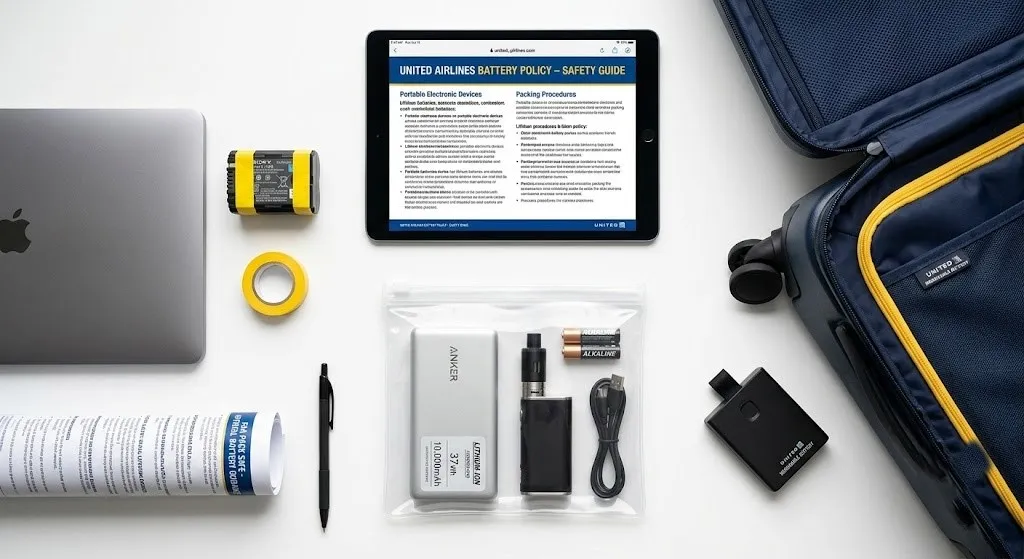
The policy covers all lithium ion and lithium metal batteries. This includes power banks, laptop batteries, camera batteries, and even AA lithium cells.
Family travelers must be vigilant about children’s devices. That toy with a hidden lithium battery must be packed according to the same strict carry-on rules.
The FAA enforces these rules globally through safety directives. United’s gate agents are legally required to comply without exception.
United Airlines Lithium Batteries
Lithium batteries on United Airlines are divided into two distinct categories. These are lithium ion, which are rechargeable, and lithium metal, which are non-rechargeable.
Lithium ion batteries power your laptop, phone, tablet, and portable charger. Lithium metal batteries are typically found in watches, calculators, and some high-end cameras.
The most critical rule is about the battery’s physical state. A battery installed inside a device is treated differently than a loose spare battery.
Business travelers must understand this distinction to pack efficiently. A laptop with its battery installed can go in a checked bag, but a loose spare laptop battery cannot.
The honest truth is that all spare batteries should be carried with you. The safest strategy eliminates all doubt at the check-in counter.
Key Takeaway: All spare lithium batteries must be in your carry-on bag. Installed batteries in devices have slightly different rules.
United Airlines Portable Charger and Power Bank Rules
You can bring a portable charger on a United Airlines flight only in your carry-on bag. Power banks are strictly forbidden in any checked baggage.
This rule applies to power banks of all sizes and capacities. A small lipstick-style charger is treated identically to a massive high-capacity power station.
The gate agent sees the power bank as a dangerous uninstalled battery. Its purpose as a charger does not exempt it from the spare battery rule.
Solo travelers often rely on a single large power bank for a long-haul flight. Pack this item in your personal item bag for easy access during security screening.
The risk of losing a power bank is highest at the baggage drop. If you check the wrong bag by accident, the airline may remove and discard your charger.
United Airlines Watt-Hour Limit for Batteries
United Airlines follows the standard FAA watt-hour (Wh) limit of 100 Wh for most portable electronic devices. This covers all standard laptops, tablets, and phone batteries.
A battery rated between 100 Wh and 160 Wh requires explicit airline approval at check-in. You are limited to two of these larger batteries per passenger.
These larger batteries are typically found in professional-grade equipment. Extended-life laptop batteries and professional drone batteries often exceed 100 Wh.
Photographers and filmmakers must check the rating printed on their drone’s LiPo battery. A DJI Inspire or similar pro-drone battery often requires pre-approval from United.
The calculation is simple: Voltage (V) x Amp-hours (Ah) = Watt-hours (Wh). A battery with 20 volts and 5 amp-hours is a 100 Wh battery.
| Battery Type | Max Wh (No Approval) | Max Wh (With Approval) | Carry-On Rule |
|---|---|---|---|
| Standard Laptop/Phone | 100 Wh | N/A | Allowed |
| Extended-Life Laptop | N/A | 100-160 Wh (Max 2) | Allowed with approval |
| Professional Drone | N/A | 100-160 Wh (Max 2) | Allowed with approval |
| Any Power Bank | 100 Wh | N/A | Allowed |
| Over 160 Wh | Forbidden | Forbidden | Forbidden |
Key Takeaway: A battery over 100 Wh must have airline approval. Anything over 160 Wh is completely forbidden on a passenger flight.
United Airlines Carry-On Battery Rules
United Airlines battery rules for a carry-on are designed to prevent short circuits. A loose lithium battery must be in its original packaging or have its terminals taped.
A simple piece of electrical tape over the metal contacts prevents a dangerous short. A battery without protection can spark if it touches keys, coins, or another battery.
The best practice is to keep every spare battery in a separate protective case. A zippered pouch with dedicated battery slots is ideal for a frequent business traveler.
Business travelers with multiple gadgets must be disciplined in their packing. Throwing loose batteries into a backpack pocket is the most common and avoidable security risk.
Security agents at the TSA checkpoint are trained to spot loose batteries in x-ray bins. You will be pulled aside for a manual bag check if they are not properly stored.
United Airlines Checked Baggage Battery Rules
The most important checked baggage rule is absolute. No spare or loose lithium batteries are ever permitted in a bag you check.
This rule includes power banks, loose camera batteries, and charging cases. An AirPods case with its own battery is a power bank and is forbidden in checked luggage.
A device with an installed battery is generally allowed in a checked bag. However, the device must be completely powered off to prevent accidental activation.
Family travelers are at the highest risk for accidentally checking a prohibited item. A child’s tablet-powered toy in a checked duffel bag violates this rule.
The honest risk is that United will open your bag and confiscate the item. The airline is not liable for any device removed for safety reasons from a checked bag.
Key Takeaway: Never pack a spare battery in a checked bag. A powered-off device with an installed battery is the only exception.
United Airlines Smart Luggage Battery Policy
Smart luggage with a built-in power bank is allowed on United Airlines only if you can remove the battery. The battery must be easily accessible and detachable.
You must remove this battery from the bag before bringing it onto the plane. The removed battery then follows the standard carry-on power bank rules.
If you must check the smart bag, the battery must still be removed first. A non-removable battery in a smart suitcase means the entire bag is forbidden.
Solo travelers who invested in expensive smart luggage must practice this removal. The process must be quick and tool-free to avoid delaying the boarding line.
The limitation is that many older smart luggage models lack a removable battery. Verify your specific model’s design against this policy before a United trip.
United Airlines Battery Enforcement at the Gate
United Airlines battery enforcement is the final safety check. Gate agents are authorized to deny boarding if you refuse to surrender a prohibited item.
A prohibited battery discovered at the gate will be confiscated and destroyed. The airline does not have the capacity to store or return a dangerous hazardous material.
The enforcement is a partnership with the TSA. An item flagged by TSA at security will be reported to the gate if it poses an ongoing safety risk for the flight.
A photographer with a non-compliant drone battery faces a terrible choice at the gate. You must surrender a valuable professional asset or miss your flight.
The honest reality is that arguing will not change the outcome. A gate agent’s safety directive overrides any frequent flyer status or loyalty program tier.
Photographer’s Guide to United Airlines Battery Rules
A professional photographer must master the United Airlines watt-hour rule. Your drone and camera grip batteries are the most scrutinized items in your kit.
A standard Sony V-mount or Anton Bauer camera battery can easily exceed 100 Wh. You must calculate the watt-hour rating for each one before you fly.
Carry all spare batteries in your carry-on with terminals taped and in protective cases. A single loose terminal can cause a chain reaction in a crowded camera bag.
Photographers should carry a printed copy of the FAA Pack Safe guidelines. Presenting this official document to a skeptical gate agent can resolve a dispute quickly.
The limitation is the two-battery rule for the 100-160 Wh category. A full film shoot often requires more than two of these large professional power sources.
Key Takeaway: Photographers must calculate watt-hours for pro batteries and tape every terminal. Carry the FAA Pack Safe document as a backup.
Business Traveler Battery and Gadget Guide for United
A business traveler’s workflow depends on a laptop, tablet, and a large power bank. Every one of these items is a lithium battery device under the policy.
The golden rule is to never check your primary tech bag. A lost checked suitcase with your laptop’s spare batteries is both a work crisis and a safety violation.
The TSA PreCheck line still enforces the battery inspection rule. Business travelers should place their spare battery pouch in a separate bin to speed up screening.
International business travelers face an added layer of scrutiny in foreign airports. A United codeshare partner may have different local interpretations of the same global IATA rule.
The honest workflow tip is to consolidate devices. A powerful laptop with a long-life internal battery eliminates the need for a spare battery entirely.
Family Travel and Electronic Device Policy on United
Family travel on United involves managing many small devices. Each child’s tablet, portable game console, and noise-canceling headphones contain a lithium battery.
A parent must audit every device before packing. A single forgotten AA lithium battery in a checked stuffed animal can trigger a bag search.
All family power banks must be packed in the adult’s carry-on backpack. You do not want a child’s bag with a prohibited power bank to be gate-checked accidentally.
Families benefit from a single, centralized electronics charging kit. Packing all spare batteries into one parent-managed pouch simplifies the security process dramatically.
The honest challenge is flying with baby monitors. A portable, battery-powered baby monitor base station often contains a non-removable lithium battery and must be a carry-on.
Key Takeaway: One adult should manage all family spare batteries in a single, well-organized carry-on pouch.
United Airlines Damaged or Recalled Battery Policy
United Airlines forbids any damaged, defective, or recalled lithium battery from any flight. This rule applies to both carry-on and checked baggage with no exceptions.
A bulging, swollen, or hot battery is a critical fire hazard. The cabin crew will treat it as an active safety threat and initiate emergency procedures.
The Samsung Galaxy Note 7 ban is the most famous example of a global recall enforcement. All travelers must heed manufacturer safety recalls immediately before flying.
If your phone battery is visibly swollen from age, it is forbidden. You must have it replaced by a certified technician before you bring the device to any airport.
The policy also covers batteries dropped in water. A device that has been submerged should be considered damaged and is not safe for air travel.
United Airlines E-Cigarette and Vape Battery Rules
E-cigarettes and vaping devices are classified as battery-powered devices by United. They are strictly forbidden in checked baggage under any circumstances.
You must carry your vape pen or e-cigarette in your person or carry-on bag. The device must be completely powered off and protected from accidental activation.
The use and charging of these devices is strictly prohibited onboard the aircraft. This is a federal regulation, not just an airline policy, and carries severe penalties.
Solo travelers who use these devices must be aware of this zero-tolerance policy. A vape pen found in a checked bag will result in a call from security and a confiscation.
The rule also applies to spare vape batteries. They follow the same rule as power banks and must have protected terminals in your carry-on.
United Airlines vs. FAA Lithium Battery Regulations
The United Airlines battery policy is a direct implementation of FAA safety regulations. The airline does not create its own rules for hazardous materials.
The FAA “Pack Safe” campaign is the definitive source for all travelers. Its guidelines are the legal framework that United, Delta, and American Airlines all follow identically.
The IATA Dangerous Goods Regulations add an extra layer for international flights. A battery rule that is valid on a domestic United flight is identical on a United flight to London.
Comparing United to Delta on battery policy reveals no practical difference. The FAA is the single authority, making an “airline vs. airline” comparison for batteries a myth.
The only difference is the strictness of the gate agent’s interpretation. This is a human factor, not a policy difference between United and its competitors.
Key Takeaway: The FAA, not United, writes the battery rules. All major US airlines follow the same safety standard.
United Airlines Battery Terminal and Gate Check Procedure
If United flags a prohibited battery in your checked bag, you will be paged at the terminal. You must return to the check-in counter and remove the item yourself.
If you fail to return, your bag will be opened by security, and the battery will be removed. The device and the battery will then be disposed of, and you will be notified.
At the gate, a prohibited item is handled with zero flexibility. The gate agent will inform you of the rule and give you the immediate choice to surrender the item or not fly.
First-time international travelers should understand the finality of this process. There is no “holding area” for your item, and it will not be shipped to your destination.
The honest advice is to never let it get to this point. A careful self-audit of your bags before you leave for the airport is the only way to avoid this stressful scenario.
United Airlines Official Battery Policy Verification
The United Airlines battery policy is a living document subject to FAA emergency orders. A device allowed today could be banned tomorrow by a new safety directive.
You must verify the current policy on the official United Airlines “Dangerous Goods” page. Do this during your 24-hour online check-in process before you pack.
The FAA Pack Safe website is the secondary official source you should check. A cross-reference of these two sites provides the definitive rule for your specific device.
This verification is not optional for professional photographers or drone pilots. The high-capacity batteries in your kit are the most likely to be affected by a regulatory change.
Frequently Asked Questions About United Airlines Battery Policy
Can I bring a power bank on a United Airlines flight?
You can bring a power bank on a United flight only in your carry-on bag.
It is strictly forbidden to pack a power bank of any size in checked luggage.
The power bank must be under 100 watt-hours and have protected terminals to prevent short circuits.
Are lithium batteries allowed in checked baggage on United?
Loose spare lithium batteries are never allowed in checked baggage on United Airlines.
Devices with installed batteries, like a powered-off laptop, are generally permitted in checked bags.
The safest rule is to pack all battery-powered devices and all spare batteries in your carry-on.
What is the maximum watt-hour limit for batteries on United?
The standard limit is 100 watt-hours for most portable electronic devices without prior approval.
Batteries rated between 100 and 160 watt-hours require explicit airline approval at the check-in counter.
No battery over 160 watt-hours is allowed on a United passenger aircraft in any bag.
Can I bring my smart luggage on a United flight?
You can bring smart luggage on a United flight only if the battery is easily removable.
You must remove the lithium battery before you board the plane or check the bag at the counter.
Smart luggage with a non-removable battery is completely prohibited and will not be accepted.
What happens if I pack a prohibited battery in my checked bag?
United Airlines will page you at the terminal to return to the check-in counter and remove it.
If you do not return, the bag will be opened, and the prohibited battery will be confiscated and disposed of.
You will not be entitled to any compensation for the confiscated item.
Can I bring AA or AAA batteries in my carry-on on United?
Yes, standard non-lithium AA and AAA batteries are allowed in your carry-on bag.
Lithium AA and AAA batteries must follow the same spare battery carry-on rules to protect the terminals.
All spare batteries, regardless of type, should be packed to prevent contact with metal objects.
The single most important United Airlines battery rule is that spare lithium batteries never go in a checked bag. If you remember this one fact and pack your power banks and loose batteries in your carry-on, you eliminate the biggest risk.
Your next step is to check the watt-hour rating on your largest professional battery before you fly. Then, tape the terminals of every loose battery you own with electrical tape.
Airline safety policies change. Confirm your specific device on the official United Airlines Dangerous Goods page during your 24-hour check-in.
Pack smart. Pack safe. Your devices will arrive with you, and your flight will be uneventfully safe.