Seattle has two commercial airports serving scheduled passenger flights. Seattle-Tacoma International Airport (SEA) and Paine Field Airport (PAE) are your only two airline options.
Seattle-Tacoma International Airport handled over 50 million passengers in the most recent reporting year. Paine Field serves a smaller but growing domestic passenger base north of downtown.
This guide names every commercial airport, the airlines flying from each, and the exact ground transfer logistics for downtown, the Eastside, and the cruise terminals. You will know which airport code to search before you close this page.
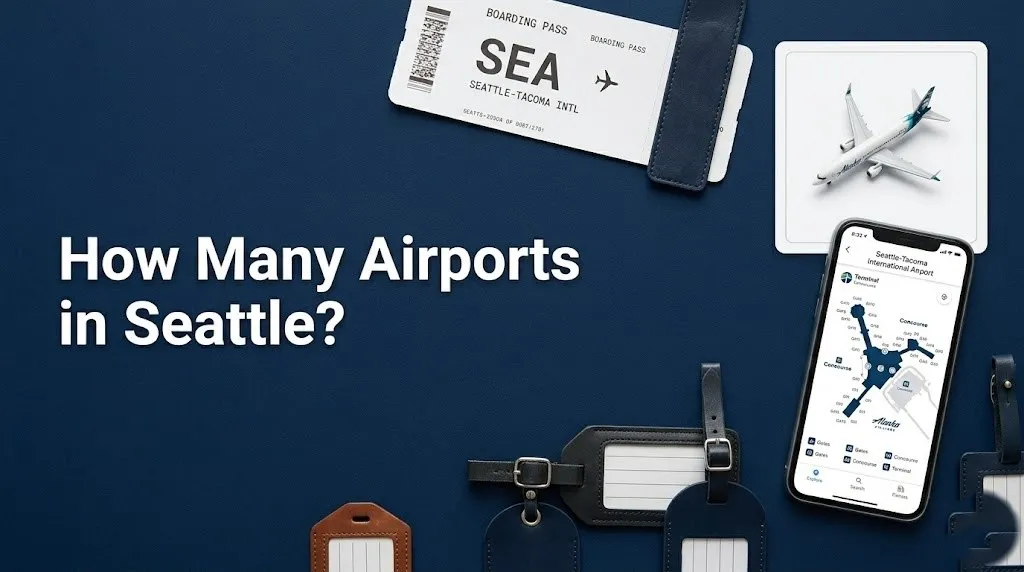
How Many Airports in Seattle?
Seattle has two commercial passenger airports with scheduled airline service. Six additional airports serve general aviation, cargo, and seaplane operations in the metro area.
Seattle-Tacoma International Airport (SEA) is the primary international gateway for the Pacific Northwest. Paine Field Airport (PAE) in Everett offers domestic commercial service through a single modern terminal.
The remaining airports include Boeing Field (BFI), Renton Municipal Airport (RNT), and several seaplane bases. These facilities do not serve scheduled commercial airline passengers and should not appear in your flight search.
Key Seattle-area airports and their roles:
- Seattle-Tacoma International Airport (SEA): Primary commercial and international hub
- Paine Field Airport (PAE): Secondary commercial domestic terminal
- Boeing Field / King County International Airport (BFI): Cargo, general aviation, Boeing test flights
- Kenmore Air Harbor Seaplane Base (LKE): Scheduled seaplane service to regional destinations
- Renton Municipal Airport (RNT): General aviation and Boeing 737 manufacturing delivery center
- Lake Union Seaplane Base: Seaplane charters and scenic flights
First-time Seattle visitors should search SEA as their default airport. It serves every major domestic airline and international carrier flying to the Pacific Northwest. Business travelers with meetings in Everett or Snohomish County should check PAE first if their origin city is served. Budget travelers flying Spirit or Frontier must fly into SEA because neither carrier serves Paine Field.
Key Takeaway: Seattle has exactly two airports where you can book a commercial airline ticket: SEA and PAE.
Seattle-Tacoma International Airport
Seattle-Tacoma International Airport (SEA) is the primary commercial airport for the Seattle metropolitan area. It sits approximately 14 miles south of downtown Seattle and 20 miles north of downtown Tacoma.
The Port of Seattle owns and operates SEA as the 8th-busiest airport in the United States by passenger volume. The airport serves as a major hub for both Alaska Airlines and Delta Air Lines with extensive domestic and international route networks.
SEA processes more than 30 airlines across four concourses and two satellite terminal buildings. The central terminal building connects to the North Satellite and South Satellite via an underground automated transit system called the SEA Underground. International arrivals clear U.S. Customs and Border Protection in the International Arrivals Facility at the South Satellite. The facility opened in 2022 and significantly improved the international arrival experience compared to the prior basement-level facility.
Business travelers should budget extra time for the satellite transit system if departing from an S or N gate. The train ride is short, but the walk from the central checkpoint to the train station adds time to your journey. Families with children will find the central terminal easier to navigate before going through security. The post-security connector between concourses allows gate-to-gate walking, but distances can exceed 15 minutes from end to end. Budget travelers connecting on separate tickets should allow a minimum of 90 minutes between domestic arrivals and departures at SEA.
SEA offers the most complete airline roster in the Pacific Northwest. Its honest limitation is congestion: TSA checkpoint wait times during peak morning hours from 5:00 AM to 9:00 AM can exceed 30 minutes, and the central terminal’s pre-security food and seating options are limited compared to the post-security concourses. Solo travelers and business travelers benefit most from SEA’s airline density. First-time international travelers landing at SEA will find clear signage and a modern customs facility that makes the arrival process straightforward.
Key Takeaway: SEA is the only Seattle airport for international flights, cruise connections, and any airline beyond Alaska’s PAE route map.
Seatac Airport Terminals
Seattle-Tacoma International Airport operates a central terminal with four concourses and two satellite buildings. Concourse A, B, C, and D connect directly from the central terminal post-security checkpoint.
The North Satellite serves Alaska Airlines and its regional partner Horizon Air primarily. The South Satellite hosts Delta Air Lines international departures, other international carriers, and some domestic operations.
Concourse A recently completed a modernization project with expanded seating, new dining options, and upgraded gate areas. Concourse B houses Southwest Airlines, JetBlue, and a mix of other carriers. Concourse C serves Alaska Airlines domestic mainline flights and features an Alaska Lounge near gate C16. Concourse D handles American Airlines, Frontier, Spirit, and several international carriers with a recently renovated gate area.
The North Satellite connects to the central terminal via the SEA Underground train system in approximately two minutes. The South Satellite connection takes a similar amount of time on the train. Both satellites also connect via secure walkway tunnels for travelers who prefer to walk. The walk from the central terminal to the North Satellite takes approximately 10 minutes at a normal pace. Budget travelers flying Spirit or Frontier should note these carriers typically operate from Concourse D, which requires the longest walk from the central checkpoint.
First-time Seattle visitors should review their gate assignment on the airline’s app before arriving. The satellite transit system is efficient, but unexpected for travelers unfamiliar with SEA’s layout. Families with strollers should allow extra time for the elevator connections at each satellite station. Business travelers with tight connections should verify whether their arriving and departing flights share a concourse or require satellite transit. Knowing this before deplaning saves significant connection stress.
Key Takeaway: SEA’s terminal layout requires satellite transit for many Alaska and Delta flights, so always check your gate before heading to the airport.
Airlines at Seatac Airport
Seattle-Tacoma International Airport hosts more than 30 airlines spanning domestic, international, and cargo operations. Alaska Airlines and Delta Air Lines dominate the airport’s passenger traffic as co-hub operators.
Alaska Airlines operates its largest hub at SEA with flights to over 90 destinations across North America. Delta operates an international gateway hub with transatlantic and transpacific routes plus extensive domestic connectivity. United Airlines, American Airlines, Southwest Airlines, JetBlue, Frontier, and Spirit all maintain significant presence at SEA with varying gate concentrations.
Primary airlines at SEA by concourse:
- Alaska Airlines: Concourse C, Concourse D, North Satellite
- Delta Air Lines: Concourse A, Concourse B, South Satellite
- United Airlines: Concourse A
- American Airlines: Concourse D
- Southwest Airlines: Concourse B
- JetBlue: Concourse B
- Frontier Airlines: Concourse D
- Spirit Airlines: Concourse D
- International carriers (British Airways, Emirates, Lufthansa, ANA, Korean Air, Qatar Airways, Turkish Airlines, and others): South Satellite
Budget travelers should compare Alaska and Delta main cabin fares against Spirit and Frontier base fares carefully. The base fare on a budget carrier looks cheaper until you add a carry-on bag, seat assignment, and a checked bag. Families checking multiple bags often find Alaska’s first checked bag fee structure more favorable than the cumulative fees on ultra-low-cost carriers. Business travelers loyal to Delta or Alaska will find robust schedules with frequent flights to most major U.S. cities. First-time international travelers connecting through SEA should note that many international flights depart from the South Satellite, requiring the satellite train transit.
SEA’s airline density is its strongest feature. The honest limitation is that no single airline offers nonstop service to every major destination. Check your specific route on the Port of Seattle’s official flight schedule tool before assuming your desired nonstop exists.
Paine Field Passenger Terminal
Paine Field Airport (PAE) in Everett operates a single modern commercial passenger terminal approximately 25 miles north of downtown Seattle. The Snohomish County Airport Authority manages the facility.
The passenger terminal opened in March 2019 and was designed specifically for a premium small-airport experience. It features two gates, a streamlined TSA checkpoint, a comfortable waiting area with fireplace seating, and a grab-and-go food and beverage operation. The terminal building is a fraction of SEA’s footprint, which means walking distances from curbside to gate are under two minutes for most passengers.
Business travelers consistently report that PAE’s curb-to-gate speed is the airport’s strongest advantage. A traveler arriving 45 minutes before departure can typically reach the gate with time to spare. Families with young children benefit enormously from the compact layout because the short walking distances and small crowds eliminate the stress of navigating a major hub. First-time travelers who find large airports intimidating will experience the exact opposite at PAE: the terminal is calm, quiet, and easy to understand on first sight.
PAE’s honest limitation is its small size. The terminal has limited food and beverage options compared to SEA’s dozens of restaurants and shops. A flight delay at PAE means waiting in a small terminal with one food counter. The single-terminal layout also means gate changes are rare, which is both a benefit and a limitation: there is nowhere else to go if you need something the terminal does not offer. Solo travelers accustomed to pre-flight lounge access will find no dedicated lounge facility at PAE.
Verify current terminal hours directly with Snohomish County Airport Authority before booking an early morning or late evening PAE flight. The terminal operates on a schedule tied to flight departures and is not open 24 hours. Confirm your specific flight’s check-in window on the Alaska Airlines app before arriving at the airport.
Key Takeaway: PAE delivers a sub-60-second curb-to-gate experience with the trade-off of minimal terminal amenities.
Airlines at Paine Field
Alaska Airlines is the primary commercial carrier operating scheduled passenger flights from Paine Field. The airline serves PAE with mainline Boeing 737 aircraft and Embraer 175 regional jets operated by its subsidiary Horizon Air.
Alaska’s PAE route map includes nonstop service to Las Vegas (LAS), Phoenix (PHX), Los Angeles (LAX), Orange County (SNA), San Diego (SAN), San Francisco (SFO), and Portland (PDX). Seasonal and additional West Coast routes may operate depending on demand and aircraft availability. The route network focuses heavily on West Coast destinations with some service to key western hubs.
No other U.S. airline operates scheduled commercial passenger flights from PAE as of the current operating year. United Airlines previously explored PAE service but does not currently operate from the airport. Delta, American, Southwest, JetBlue, Frontier, and Spirit do not serve Paine Field. Budget travelers hoping for ultra-low-cost carrier options at PAE will not find them. The entire PAE commercial operation is Alaska Airlines mainline and regional service.
Business travelers flying Alaska from West Coast cities to the northern Seattle metro area gain the most from PAE’s route map. The combination of Alaska’s frequent West Coast schedules and PAE’s fast terminal creates a genuinely time-efficient travel experience from curbside to landing. Families traveling to the San Diego, Orange County, or Las Vegas areas will find PAE departures significantly less stressful than SEA for these specific routes. Solo travelers and first-time visitors should verify that their specific origin city appears on Alaska’s current PAE route map before booking. Routes change seasonally.
Check Alaska Airlines’ official route map for current Paine Field destinations before booking your flight. The airline may adjust PAE service based on demand, aircraft availability, and operational factors that are not broadly announced.
Seatac vs Paine Field
The choice between Seattle-Tacoma International Airport and Paine Field comes down to three factors: airline availability, final destination, and tolerance for airport size. SEA offers more airlines and routes; PAE offers less stress and faster processing.
| Feature | Seattle-Tacoma (SEA) | Paine Field (PAE) |
|---|---|---|
| IATA Code | SEA | PAE |
| Distance to Downtown Seattle | 14 miles south | 25 miles north |
| Commercial Airlines | 30+ | Alaska Airlines only |
| International Flights | Yes, extensive | No |
| Terminal Size | 4 concourses + 2 satellites | Single terminal, 2 gates |
| Curb-to-Gate Time | 15 to 40 minutes typical | Under 2 minutes |
| Lounge Access | 5+ lounges across terminals | None |
| Best Traveler Profile | International, cruise, all airlines | Alaska domestic, Snohomish County destinations |
| Honest Limitation | Congestion and walking distances | Limited routes and no amenities |
Business travelers with meetings north of downtown Seattle in Everett, Mukilteo, or Lynnwood should fly into PAE on Alaska whenever the route is available. The time savings on the ground offset any fare difference from SEA. Cruise passengers must fly into SEA regardless of airline preference. PAE has no viable ground transfer infrastructure to the Pier 66 and Pier 91 cruise terminals. Budget travelers flying any carrier other than Alaska must use SEA because PAE offers no low-cost carrier options.
First-time Seattle visitors will find PAE easier to navigate but SEA more useful for the full Seattle experience. The Link Light Rail connection from SEA to downtown makes exploring the city simple without a car. PAE requires a rental car or rideshare to reach Seattle proper.
Key Takeaway: Fly SEA for international, cruise, and multi-airline choice; fly PAE for an Alaska Airlines domestic flight when your final destination is north of Seattle.
Which Seattle Airport Is Best
The best Seattle airport depends entirely on your airline, your final destination, and what you value more: route choice or low-stress processing. There is no single correct answer for every traveler.
Seattle-Tacoma International Airport (SEA) is best for travelers who need airline flexibility, an international connection, a cruise transfer, or a direct Link Light Rail ride into downtown Seattle. No other Puget Sound airport offers these capabilities. Paine Field (PAE) is best for Alaska Airlines domestic travelers whose final destination sits north of downtown Seattle and who will accept the limited route map in exchange for a vastly quieter terminal experience.
Budget travelers have no choice: SEA is the only option that serves Spirit, Frontier, and other low-cost carriers. First-time international travelers must also fly into SEA because PAE has no international arrivals facility. Families with children will find PAE dramatically less stressful for any route Alaska serves from Everett, but they must verify the route exists before committing. Business travelers splitting time between downtown Seattle and the Eastside should evaluate both airports based on the specific meeting location. A Bellevue office is roughly equidistant from both airports but more directly accessible from SEA via I-405 express lanes during non-peak hours.
Cruise passengers make up the largest traveler profile that should not consider PAE under almost any circumstance. The ground transfer from PAE to Pier 66 or Pier 91 is expensive, time-consuming, and lacks dedicated public transit options. SEA offers a straight shot north on the Link Light Rail to Westlake Station plus a short rideshare or taxi to either cruise terminal. Solo travelers prioritizing a calm, quiet airport experience will genuinely enjoy PAE if the route works. Travelers who want lounge access, multiple dining options, and the energy of a major international hub will prefer SEA.
How to Get from Seatac to Downtown Seattle
The Sound Transit Link Light Rail 1 Line provides direct train service from Seattle-Tacoma International Airport to downtown Seattle. The station sits inside the airport parking garage, connected to the central terminal by a covered pedestrian walkway on the fourth floor.
The train ride from SeaTac/Airport Station to Westlake Station in the downtown core takes approximately 38 minutes. Trains depart every 8 to 12 minutes during peak daytime hours and less frequently during late-night windows. The fare is distance-based and payable via the ORCA card system or the Transit GO Ticket mobile application.
Rideshare services including Uber and Lyft operate from a dedicated pickup zone in the airport parking garage. The walk from baggage claim to the rideshare pickup area takes approximately five to seven minutes. A rideshare trip to downtown Seattle typically takes 25 to 40 minutes depending on I-5 traffic conditions. Taxi service is available from the third floor of the parking garage with a flat-rate fare structure to the downtown hotel zone.
Budget travelers should take the Link Light Rail. It is the most affordable option by a wide margin and avoids I-5 traffic entirely. Families with multiple large suitcases may prefer a rideshare or taxi directly to their hotel because navigating the light rail with heavy bags during peak hours is difficult. Business travelers heading to downtown hotels will find the light rail competitive with driving time during weekday rush hour when I-5 northbound slows significantly. The Westlake Station exit puts you within walking distance of most major downtown hotels and the Pike Place Market area.
Verify current Link Light Rail operating hours on the Sound Transit website before booking a late-night SEA arrival. The train does not run 24 hours, and replacement bus service is limited. A late-night arrival after light rail closure means a rideshare or taxi is your only ground option.
Key Takeaway: The Link Light Rail from SEA to downtown takes about 38 minutes and is the most cost-effective transit option for solo travelers and light packers.
Paine Field to Seattle Transfer
Paine Field Airport (PAE) sits in Everett, approximately 25 miles north of downtown Seattle. No direct public transit rail connection exists between PAE and downtown Seattle as of the current transit infrastructure.
Rideshare services and taxis are the primary transfer option from PAE to Seattle. A rideshare trip from PAE to downtown Seattle takes 35 to 50 minutes depending on I-5 southbound traffic conditions. The trip to Bellevue or the Eastside takes 40 to 55 minutes via I-405. Taxi service is available from the PAE terminal curb on a metered or negotiated fare basis with no flat-rate structure to Seattle.
A rental car is the most practical option for travelers whose final destination is outside downtown Seattle and north of the city. PAE’s rental car facility sits adjacent to the passenger terminal with a short walk from baggage claim. Driving from PAE to the Eastside technology corridor in Bellevue or Redmond is a direct shot south on I-405. Business travelers with meetings in the northern suburbs will find PAE vastly more convenient than SEA for these destinations. The drive from PAE to Bothell, Woodinville, or Kirkland is 25 to 35 minutes in normal traffic.
Solo travelers heading to downtown Seattle should compare the total cost and time of a PAE flight plus rideshare against an SEA flight plus light rail fare. The light rail from SEA often makes SEA the more cost-effective and time-competitive option for downtown-bound travelers, even if the PAE airport experience feels better. Families staying in the northern suburbs like Lynnwood, Shoreline, or Edmonds will find PAE genuinely more convenient than SEA because the ground transfer is shorter and simpler.
Cruise passengers should not fly into PAE for a Seattle cruise departure. The transfer to Pier 66 or Pier 91 is long, expensive, and offers no transit alternative. Use SEA for all cruise connections.
Seattle Airport Lounges
Seattle-Tacoma International Airport offers a strong lounge network across multiple concourses and satellite terminals. Paine Field has no dedicated airport lounge facility.
The Alaska Lounge at SEA operates locations in Concourse C near gate C16, the North Satellite near gate N1, and Concourse D. Alaska Lounge members, first class passengers on qualifying Alaska itineraries, and Priority Pass members with select memberships gain access subject to capacity controls. The Concourse C lounge is the newest and largest Alaska Lounge in the system. It features a full bar, hot food, and views of the airfield and Mount Rainier on clear days.
The Delta Sky Club operates in Concourse A near gate A1 with runway views, a full bar, and hot food service. Delta One passengers, Sky Club members, and eligible American Express cardholders gain access. The American Express Centurion Lounge occupies a central location in the post-security connector between Concourse B and Concourse C. Amex Platinum and Centurion cardholders gain access with same-day boarding passes.
The Club at SEA operates two locations: one in Concourse A and one in the South Satellite. These lounges serve Priority Pass members and travelers with LoungeKey access. They offer a quieter experience than the main concourses with light food and beverage service. International first and business class passengers on several carriers access partner lounges in the South Satellite.
Budget travelers should not expect complimentary lounge access included in any basic economy or standard economy fare. Paid day passes are available at The Club at SEA for travelers willing to purchase access. Families with long layovers at SEA should evaluate a lounge day pass against the cost of airport restaurant dining. The lounge offers a quieter space with included food and drinks, which can match or beat restaurant pricing for a family of three or four. Verify current lounge hours and access policies directly with each lounge operator or your credit card issuer before traveling.
Key Takeaway: SEA has Alaska Lounges, a Delta Sky Club, a Centurion Lounge, and two The Club at SEA locations; PAE has zero lounge facilities.
Seatac Airport Parking
Seattle-Tacoma International Airport operates a multi-level parking garage directly connected to the central terminal by pedestrian skybridges. Off-airport parking lots surround the airport with shuttle service to the terminal.
The SEA parking garage offers four levels of terminal-adjacent parking with hourly, daily, and weekly rate structures. General parking is available on floors 4 through 8 of the garage. Terminal Direct parking on floors 4 and 5 offers premium-priced spaces closest to the skybridge entrances. The garage frequently reaches capacity during peak holiday travel periods and summer weekends. The Port of Seattle posts real-time parking availability on its website.
Off-airport parking operators including WallyPark, Master Park, Doug Fox Parking, and several others run continuous shuttle services to the terminal. Shuttle pickup frequency ranges from every 10 to 20 minutes depending on the operator and time of day. Off-airport parking costs significantly less than the terminal garage for trips extending beyond three days. Budget travelers taking a week-long trip should compare off-airport parking rates directly on each operator’s website before arriving.
Business travelers on short trips should use the terminal garage for time efficiency. The direct walk from the garage to TSA checkpoints in the central terminal saves 15 to 20 minutes versus an off-airport shuttle loop. Families checking multiple bags will find the terminal garage far more practical than managing luggage on an off-airport shuttle. Solo travelers on longer trips benefit most from off-airport parking savings because the shuttle wait time matters less when you are not managing children or tight schedules.
Reserve parking in advance whenever possible. Both the Port of Seattle garage and major off-airport operators accept advance reservations online. Advance booking secures your space and typically locks in a better rate than drive-up pricing during peak periods.
Paine Field Parking
Paine Field Airport operates a surface parking lot and a multi-level parking garage directly adjacent to the passenger terminal. The walk from the furthest parking space to the terminal entrance takes under three minutes.
The parking facility is compact, well-lit, and designed for the airport’s low-volume passenger profile. Parking rates are structured for daily and extended stay with a lower total cost than SEA’s terminal garage for comparable duration trips. The lot and garage rarely reach full capacity except during peak holiday periods when Alaska Airlines adds extra PAE flights. Snohomish County Airport Authority publishes current parking rates and availability on its official website.
The primary advantage of PAE parking is the combination of low walk time and high vehicle security in a compact, single-entrance facility. A traveler can park, walk to the terminal, clear security, and reach the gate inside 10 minutes from engine off. No shuttle bus, no garage elevator navigation, no skybridge walk. This is a genuine practical advantage for families with young children who dread the long parking-to-gate journey at major hubs.
Budget travelers should compare the total cost of PAE parking plus a PAE flight against SEA off-airport parking plus an SEA flight on a similar route. PAE parking is less expensive than SEA terminal garage parking but more expensive than SEA’s off-airport lots for long trips. The time saved may justify the cost difference for a short weekend trip. A two-week trip where parking costs accumulate significantly may tip the balance back toward SEA with off-airport parking.
Business travelers on a 48-hour trip to Everett or North Seattle will find PAE parking the most efficient option in the region. The total door-to-destination time from home parking spot to arrival gate is genuinely unmatched by SEA on any day.
Key Takeaway: PAE parking is a three-minute walk to the gate with no shuttle required, making it the region’s most time-efficient airport parking experience.
Closest Airport to Downtown Seattle
Boeing Field (BFI) is geographically the closest airport to downtown Seattle at approximately 4 miles south of the central business district. It is not a commercial passenger airport. You cannot book a commercial flight into Boeing Field.
The closest airport to downtown Seattle that accepts commercial passenger flights is Seattle-Tacoma International Airport (SEA) at approximately 14 miles south. The Link Light Rail connects SEA directly to the downtown core in roughly 38 minutes. This makes SEA the practical closest airport for any traveler whose destination is downtown Seattle, Capitol Hill, Belltown, South Lake Union, or the central waterfront.
Paine Field (PAE) sits approximately 25 miles north of downtown Seattle with no direct rail connection. It is the third-closest airport by distance but the least practical for downtown-bound travelers without a rental car. Kenmore Air Harbor Seaplane Base (LKE) sits at the north end of Lake Washington approximately 10 miles from downtown. Kenmore Air operates scheduled seaplane flights to the San Juan Islands and British Columbia destinations. This is the most time-efficient option for travelers heading to the islands, but it does not serve any destination that replaces a traditional airline flight.
Business travelers with downtown meetings should fly into SEA unless their specific meeting location is north of the Ship Canal. The light rail from SEA to University Street or Westlake Station deposits you in the center of the financial district. Solo travelers staying in downtown hotels without a car will find SEA the only practical airport choice. Families renting a vehicle and heading to a vacation rental north of the city may find PAE more convenient than SEA, particularly for destinations in Edmonds, Lynnwood, or Mukilteo.
Do not search for flights into Boeing Field. No commercial airline serves BFI. Confusing it with SEA or PAE could cause a frustrating booking error.
Flying into Seattle for Cruise
Seattle-Tacoma International Airport (SEA) is the correct airport for travelers departing from the Port of Seattle cruise terminals. Paine Field has no direct cruise transfer infrastructure and should not be used for cruise travel.
Seattle operates two primary cruise terminals. Pier 66, the Bell Street Pier Cruise Terminal, sits on the downtown waterfront approximately 15 miles north of SEA. Pier 91, the Smith Cove Cruise Terminal, sits roughly 4 miles northwest of downtown and approximately 18 miles from SEA. Both terminals are accessible from SEA via the Link Light Rail to Westlake Station plus a short rideshare or taxi to your specific pier. Budget travelers can take the light rail to Westlake and then transfer to a rideshare for the final mile to either terminal, saving significantly over a direct airport-to-pier taxi.
Cruise passengers flying Alaska Airlines should not use Paine Field even if their origin city is served. The PAE-to-cruise-terminal transfer requires a long rideshare or taxi trip with no transit alternative. The time and cost of the ground transfer eliminates any advantage gained from PAE’s quieter terminal experience. The total door-to-pier journey from PAE is more complicated and more expensive than from SEA in almost all scenarios.
Arrive at SEA at least 24 hours before your cruise departure time whenever possible. A morning-of-cruise flight creates unacceptable risk if your inbound flight is delayed or canceled. The Port of Seattle cruise terminals begin boarding in the late morning and early afternoon. An early morning arrival at SEA on cruise day leaves almost no buffer for operational disruptions. Solo travelers and couples should fly in the day before and book a downtown hotel near Westlake Station for easy cruise morning access via light rail and rideshare.
Key Takeaway: Fly into SEA for every Seattle cruise departure. Arrive the day before your sailing. The Link Light Rail plus a short rideshare is the most cost-effective pier transfer.
Seattle Seaplane Bases
Seattle operates several seaplane bases that serve regional destinations in the Puget Sound, San Juan Islands, and British Columbia. These are not airline airports in the traditional sense, but they are a genuine transportation option for specific regional travel.
Kenmore Air operates the primary scheduled seaplane service from its Lake Union base at 950 Westlake Avenue North. The airline flies de Havilland Canada DHC-3 Otter floatplanes to Friday Harbor, Roche Harbor, Orcas Island, Lopez Island, and multiple British Columbia destinations including Victoria and Vancouver harbors. Kenmore Air also operates from its Lake Washington base at Kenmore Air Harbor (LKE) near the north end of the lake.
Seaplane flights are not a substitute for traditional airline travel to Seattle. They serve a completely different purpose: fast, scenic, point-to-point regional travel between waterfront locations. A traveler flying into SEA from Chicago cannot connect to a Kenmore Air seaplane flight to the San Juan Islands under a single airline ticket. The two systems operate independently and require separate bookings, separate baggage policies, and a ground transfer between SEA and the Lake Union seaplane dock.
Budget travelers should compare the total cost of a Kenmore Air seaplane flight against the Washington State Ferries vehicle-and-passenger fare from Anacortes to the San Juan Islands. The seaplane is faster and more scenic but significantly more expensive than the ferry. Solo travelers heading to Friday Harbor for a weekend will find the seaplane a genuinely memorable and time-efficient option if the fare fits the trip budget. Families of four will find the ferry dramatically more cost-effective for the same route.
Verify Kenmore Air’s current schedule, fare structure, and baggage weight limits on the airline’s official website before booking. Seaplane payload restrictions mean baggage allowances are tighter than on any commercial airline. Pack light or expect to pay for excess baggage or leave items behind.
Key Takeaway: Seattle seaplane bases serve regional island and coastal destinations, not traditional commercial airline routes into the city.
Important Accuracy Notes for Seattle Airport Travel
Airline routes, terminal assignments, parking rates, lounge access policies, and ground transfer fares change without broad public notice. Always verify the following directly before traveling:
- Verify your airline’s current terminal and gate assignment on the Port of Seattle official website or your airline’s mobile app before departure day. Concourse and satellite assignments shift.
- Verify current PAE service directly with Alaska Airlines. Routes to and from Paine Field may be added or removed seasonally.
- Verify Link Light Rail operating hours on the Sound Transit website if your SEA flight arrives late at night. The train does not run 24 hours.
- Verify parking availability on the Port of Seattle parking page or your chosen off-airport operator’s website before driving to SEA during holiday peaks.
- Verify current cruise terminal assignments with the Port of Seattle and your cruise line. Pier 66 and Pier 91 serve different cruise lines.
- Verify lounge access policies with your specific credit card issuer or lounge membership program. Access rules and guest policies change periodically.
The most important single action before departure: open your airline’s mobile app and confirm your terminal, gate, and boarding time on the morning of your flight.
Frequently Asked Questions About Seattle Airports
How many commercial airports are in Seattle?
Seattle has exactly two commercial passenger airports with scheduled airline service.
Seattle-Tacoma International Airport (SEA) and Paine Field Airport (PAE) are your only two airline options.
Do not search for flights into Boeing Field because it is a cargo and general aviation facility with no commercial passenger flights.
Which airport is better, SeaTac or Paine Field?
SeaTac is better for international flights, cruise transfers, and multi-airline choice across more than 30 carriers.
Paine Field is better for Alaska Airlines domestic travelers heading to destinations north of downtown Seattle who value a quiet, fast terminal experience.
The right airport depends entirely on your airline, your final destination in the Seattle area, and whether you value route choice or low-stress processing more.
Does Paine Field have international flights?
Paine Field does not have any scheduled international commercial passenger flights.
PAE serves only domestic routes operated by Alaska Airlines to West Coast destinations and select western hubs.
All international flights to the Seattle metro area arrive and depart from Seattle-Tacoma International Airport (SEA).
How far is SeaTac from downtown Seattle?
Seattle-Tacoma International Airport is approximately 14 miles south of downtown Seattle.
The Sound Transit Link Light Rail 1 Line connects the airport to Westlake Station in downtown in roughly 38 minutes.
A rideshare or taxi trip to downtown Seattle takes 25 to 40 minutes depending on I-5 traffic conditions.
Can you fly into Boeing Field?
You cannot fly into Boeing Field (BFI) as a commercial passenger because no airline operates scheduled passenger service at this airport.
Boeing Field serves cargo operations, general aviation, corporate aircraft, and Boeing test flights from the adjacent manufacturing facility.
Book your commercial flight into Seattle-Tacoma International Airport (SEA) or Paine Field (PAE) instead.
What is the easiest airport to fly into for a Seattle cruise?
Seattle-Tacoma International Airport (SEA) is the easiest airport for a Seattle cruise because it offers direct Link Light Rail service toward the cruise terminals.
Take the light rail from SeaTac/Airport Station to Westlake Station and then a short rideshare or taxi to Pier 66 or Pier 91.
Do not fly into Paine Field for a cruise because the ground transfer to the cruise terminals is long, expensive, and has no transit option.
Your Seattle Airport Decision in One Step
Search your airline first. If it is not Alaska Airlines, fly into Seattle-Tacoma International Airport (SEA). If it is Alaska Airlines, check whether your origin city is on the current Paine Field route map. If it is, decide whether your final destination is north of downtown Seattle. A yes means Paine Field is genuinely the better airport experience. A no, with a downtown Seattle, Eastside, or cruise terminal destination, means SEA and the Link Light Rail will likely serve you better.
Verify your airline’s current PAE service, terminal assignment, and ground transfer specifics before booking. Airport operations, airline route maps, parking rates, and lounge access policies change without broad announcement. The Port of Seattle website and your airline’s mobile app are your most reliable sources for trip-day accuracy. Book the flight, check your gate assignment the morning of departure, and you will arrive in the right Seattle with the right transfer waiting.