
A map of airports is the most powerful tool for planning a cheap and efficient US trip. You must understand which airline dominates which city to book the cheapest fare.
The “Big 3” airlines, Delta, United, and American, operate fortress hubs that control regional traffic. A budget airline likely uses a cheaper secondary airport in the exact same city.
This guide draws the strategic airline map so you can book like a professional. Never pay a premium for the wrong airport again.
Map of Airports
The continental United States contains over 500 commercial service airports with scheduled passenger flights. These airports are geographically clustered around major metropolitan areas and airline hub cities.
A true strategic airport map is not just dots on a page. It is a visual representation of airline power, showing which carrier controls the gates at each location.
First-time international travelers should study the map of major hub airports before booking a connecting flight. A missed connection at a massive hub like Atlanta (ATL) is far easier to rebook than at a small outstation.
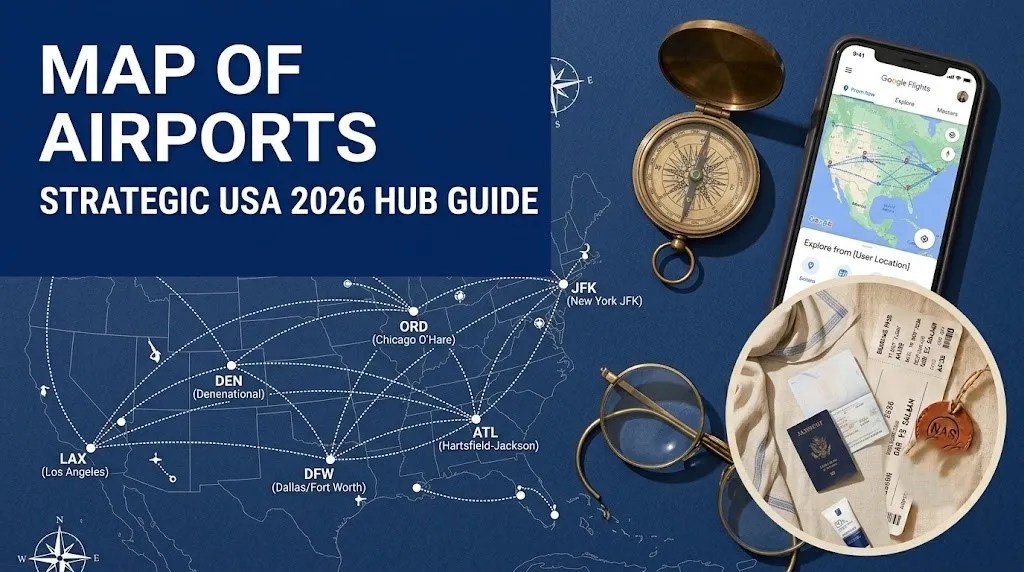
Budget travelers should use the map to identify the cheapest secondary airport in a metropolitan area. A flight into Fort Lauderdale (FLL) on Spirit often costs less than a flight into Miami (MIA) on American.
The Federal Aviation Administration (FAA) publishes the official airport facility directory for every US airport. This is the definitive source for runway and terminal data on the map.
Major US Airports Map
The major US airport map is defined by the 30 large-hub airports that handle the vast majority of passenger traffic. These airports are primarily the fortress hubs of the Big 3 legacy airlines.
Hartsfield-Jackson Atlanta International (ATL) sits at the top of the map as the busiest airport in the world. Delta Air Lines controls over 70 percent of the gate space here.
Business travelers should route through a major hub airport for the best lounge access and rebooking options. A delay at a Delta hub like ATL gives you access to multiple nearby Sky Clubs and frequent alternative flights.
Families with a tight connection should avoid a 45-minute layover at a sprawling major hub like Dallas/Fort Worth (DFW) . The sheer size of the terminal complex requires a lengthy SkyLink train ride between gates.
The DOT Air Travel Consumer Report states that the major hub airports handle over 90 percent of all US passenger traffic. Focus your map study on these 30 specific airports.
Major Airports Map
A major airports map highlights the largest international gateways on the US coastlines and the mid-continent hubs. Los Angeles (LAX) and New York (JFK) anchor the international arrival routes.
The interior hubs of Chicago O’Hare (ORD) and Dallas/Fort Worth (DFW) serve as the domestic super-connectors. A map of flight paths shows these mid-continent hubs as the central spokes of the national network.
Solo travelers flying from Asia should use the West Coast hubs of San Francisco (SFO) or Los Angeles (LAX) for the shortest connection. A flight to the East Coast through these gateways adds significant transit time.
A traveler heading to Florida should not fly through a congested Northeast hub like Newark (EWR) in winter. A southern connection through Charlotte (CLT) or Atlanta (ATL) avoids the ice and snow delay map.
IATA reports that the geographic location of a hub on the map directly dictates its efficiency for specific connecting routes. A mid-continent hub is mathematically the shortest connection between the two coasts.
Key Takeaway: The map of hubs reveals the fastest and cheapest connection routes.
Delta Airlines Hub Airports Map
Delta Air Lines operates its primary fortress hub at Hartsfield-Jackson Atlanta International (ATL) . This single airport handles more passengers than any other on the planet.
The Delta hub map also includes major connecting complexes at Minneapolis-St. Paul (MSP) , Detroit (DTW) , and Salt Lake City (SLC) . These northern and mountain hubs efficiently funnel traffic from the Midwest and West to the transatlantic routes.
Business travelers should use the Delta hub at Salt Lake City (SLC) for a connection to the Pacific Northwest. The modern terminal and the stunning mountain backdrop make for a genuinely pleasant layover experience.
A traveler heading to Europe should connect through Atlanta (ATL) or New York (JFK) on a Delta itinerary. These hubs offer the highest frequency of daily transatlantic departures and the best Sky Club lounge network.
The official Delta route map shows the dense spiderweb of flights radiating out from ATL to every corner of the country. Studying this map unlocks the logic behind the Delta pricing algorithm.
United Airlines Hub Airports Map
United Airlines anchors its route map on the massive mid-continent fortress hub at Chicago O’Hare (ORD) . This hub captures traffic from both coasts and funnels it into the extensive transpacific and transatlantic network.
The United hub map also features powerful coastal gateways at Newark (EWR) , San Francisco (SFO) , and Houston (IAH) . These hubs serve as the primary launch points for flights to Europe, Asia, and Latin America respectively.
Solo travelers heading to Asia should connect through San Francisco (SFO) on United for the shortest flight time. The SFO hub offers the densest concentration of transpacific wide-body departures on the US West Coast.
A business traveler heading to Latin America should use the Houston (IAH) hub for the most direct routing. United controls the majority of the gate space at IAH, offering high frequencies to Mexico and Central America.
Conde Nast Traveler ranks the new United Polaris Lounge at Newark (EWR) as a top-tier hub for the premium passenger. The lounge access alone justifies the connection through this specific hub.
American Airlines Hub Airports Map
American Airlines centers its massive route map on the powerful mid-continent fortress of Dallas/Fort Worth (DFW) . This hub is the largest single-airline connecting complex in the world by flight volume.
The American hub map also relies heavily on Charlotte (CLT) , Miami (MIA) , and Chicago O’Hare (ORD) . The Charlotte hub specifically dominates the southeastern US traffic flow to the Caribbean and Florida.
A traveler heading to the Caribbean or South America should connect through Miami (MIA) on American Airlines. The MIA hub is the undisputed king of Latin American traffic, with high-frequency flights to every major capital city.
Families with a tight connection should be cautious at Dallas/Fort Worth (DFW) . The five massive semi-circle terminals require a very long train ride that can easily consume a 45-minute legal layover.
The official American Airlines route map displays the dense concentration of flights radiating from DFW across the entire southern United States. The map explains why American dominates the Texas and Florida markets.
Key Takeaway: ATL is Delta, ORD is United, DFW is American. Memorize these three hubs.
Southwest Airlines Focus Cities Map
Southwest Airlines does not use the traditional hub-and-spoke model of the Big 3 legacy carriers. It operates a point-to-point network anchored by major “focus cities” on the map.
Key Southwest Airlines focus cities include Las Vegas (LAS) , Chicago Midway (MDW) , Baltimore (BWI) , and Denver (DEN) . These airports serve as large operational bases where Southwest dominates the local gate space.
Budget travelers should search for a Southwest flight into Chicago Midway (MDW) instead of the legacy hub at O’Hare. MDW is closer to the downtown Loop and is dominated by Southwest’s low-cost gates.
Business travelers with a tight schedule should know that Southwest does not appear on major online travel agency maps. You must book directly on the Southwest website to see the true point-to-point route map.
The Points Guy identifies Southwest’s focus city map as the key to finding the cheapest last-minute domestic fare. The high-frequency point-to-point routes allow for aggressive pricing on heavily contested corridors.
Spirit Airlines Airport Map
Spirit Airlines operates a different map entirely, focusing on large leisure destinations and major metropolitan areas. It frequently uses cheaper secondary airports to lower operating costs and fares.
Spirit serves Fort Lauderdale (FLL) instead of the more expensive Miami (MIA) on the same South Florida map. A fare to FLL on Spirit is almost always significantly lower than a legacy fare to MIA.
Budget travelers searching for a flight to the New York City area should check Spirit’s map for Newark (EWR) service. Spirit aggressively prices the Newark route to compete with United on its own fortress hub turf.
A family flying to the Los Angeles area should know that Spirit uses LAX directly, not a distant secondary field. The low-cost carrier competes head-to-head with the legacy airlines inside the primary airport terminal.
Always verify the exact airport code on a Spirit Airlines booking before purchasing a ticket. The airline’s route map occasionally shifts between a primary airport and a secondary field based on gate availability.
Cheapest Airports to Fly Into USA
Fort Lauderdale-Hollywood International (FLL) is consistently the cheapest major airport to fly into in the United States. The competition between Spirit, JetBlue, and Southwest keeps the base fares very low.
Las Vegas McCarran International (LAS) offers intensely cheap fares due to massive leisure demand and heavy competition. Every low-cost carrier flies to Vegas, and the legacy carriers match the price war aggressively.
Budget travelers entering the US from Europe should search for a flight into New York Stewart (SWF) on Norse Atlantic. This distant secondary field offers low transatlantic base fares, but the transfer to Manhattan is long and costly.
Solo travelers on a tight budget should search for a one-way fare into Orlando International (MCO) . The ultra-high leisure traffic volume and the massive Southwest presence create a permanently cheap fare environment.
Google Flights Explore map identifies the exact cheapest airport to fly into on any given date. Use the interactive map tool to pinpoint the lowest-cost gateway for your specific travel window.
Key Takeaway: FLL, LAS, and MCO are the cheapest airports to fly into in the USA.
West Coast International Airports Map
The major West Coast international gateways are Los Angeles (LAX) , San Francisco (SFO) , and Seattle-Tacoma (SEA) . These three airports serve as the primary arrival points for transpacific flights from Asia and Oceania.
Vancouver International (YVR) in Canada also functions as a major gateway for flights to the Pacific Northwest region. A traveler heading to Seattle should compare a flight into YVR on the map against a direct SEA arrival.
Solo travelers arriving from Japan or Korea should use San Francisco (SFO) as the primary West Coast gateway. The United Airlines transpacific hub here offers the most frequent connections to the interior US.
A business traveler heading to Silicon Valley should consider San Jose (SJC) as an alternative to the crowded SFO. The smaller airport is physically closer to the tech campuses and offers a faster curb-to-gate experience.
The FAA airport diagrams show the exact runway layout and terminal configuration for each West Coast gateway. Study the map of SFO to understand the frequent fog-related ground delay program in the morning.
East Coast Major Airports Map
The major East Coast airports form a dense corridor from Boston (BOS) down to Miami (MIA) . This is the most congested and delay-prone airspace on the entire US airport map.
New York City is served by three major airports: JFK, LaGuardia (LGA) , and Newark (EWR) . The airport you choose on the map dramatically affects your ground transfer time and the airline availability.
Business travelers with a meeting in Lower Manhattan should fly into LaGuardia (LGA) for the quickest cab ride. A long-haul international arrival must use JFK or Newark, as LGA is a domestic-only airport.
Families with a connection to Europe should use JFK or Newark (EWR) for the best lounge and dining options. The newly renovated terminals at both airports offer a genuinely pleasant pre-flight experience.
The Port Authority of New York and New Jersey publishes the official map and terminal guide for all three NYC airports. Verify the terminal assignment on this map before driving to the wrong airport.
Midwest Hub Airports Map
The Midwest is dominated by the two fortress hubs of Chicago O’Hare (ORD) and Detroit (DTW) . These airports are physically situated on the map to serve as the most efficient connectors between the East and West Coasts.
Minneapolis-St. Paul (MSP) also serves as a major Delta Air Lines hub for the northern Midwest region. A traveler heading to the Dakotas or Montana will almost certainly connect through MSP on a Delta itinerary.
Business travelers with a winter connection should prefer Detroit (DTW) over Chicago O’Hare (ORD) on a snowy day. The McNamara Terminal at DTW is an enclosed, modern facility that handles de-icing more efficiently than ORD.
A solo traveler on a tight budget should compare a fare into Chicago Midway (MDW) against a fare into O’Hare (ORD) . The Southwest-dominated Midway Airport is physically closer to the city center and often cheaper.
The FAA National Airspace System Status map shows real-time ground delays at every Midwest hub. Check this map before a winter connection through ORD to avoid a stranding event.
Key Takeaway: ORD and DTW are the Midwest super-connectors. Use DTW in winter.
Major International Airports USA Map
The primary US international gateways on the map are New York (JFK) , Los Angeles (LAX) , Miami (MIA) , and San Francisco (SFO) . These four airports handle the vast majority of inbound long-haul international flights.
Chicago O’Hare (ORD) and Atlanta (ATL) serve as the primary mid-continent international arrival hubs for connecting passengers. A traveler arriving from Europe and heading to Texas will clear customs at ATL or ORD first.
First-time international travelers should choose an entry point with a simple, modern customs hall. San Francisco (SFO) and Detroit (DTW) have newer international arrival facilities with intuitive passenger flow layouts.
A family arriving on a long flight should avoid the notoriously congested immigration hall at Miami (MIA) on a Saturday afternoon. The lines for non-US passport holders stretch for hours during the peak cruise ship arrival window.
U.S. Customs and Border Protection (CBP) publishes the official wait time data for every international airport. Check this map before booking to avoid a four-hour connection line.
Best Connecting Airports USA
Hartsfield-Jackson Atlanta International (ATL) is the best connecting airport in the United States. The layout is a single, long, intuitive spine with a frequent underground train connecting the concourses.
Detroit Metropolitan Wayne County (DTW) is the single best airport for a stress-free winter connection. The enclosed McNamara Terminal features an indoor express tram and a clean, modern aesthetic.
Charlotte Douglas International (CLT) is the best hub for a quick domestic connection on American Airlines. The terminal is compact, and a walk from the farthest gate to the center takes under 10 minutes.
Solo travelers with a tight 45-minute legal connection should only accept this risk at Detroit (DTW) or Charlotte (CLT) . The train and walking distances at Dallas/Fort Worth (DFW) make a tight connection very risky.
Conde Nast Traveler ranks DTW and ATL as the most passenger-friendly connection hubs in the United States. The clear signage, the frequent trains, and the clean restrooms make these airports a pleasure to transit.
Interactive Airport Map App
The Flightradar24 app provides the best real-time interactive map of airport traffic and delays globally. You can tap any airport on the map to see the current departure board and weather conditions.
The Google Flights Explore map is the best tool for finding the cheapest airport to fly into on a flexible date. Type “United States” as your destination and scroll the interactive map for live base fare data.
Solo travelers should download the specific airline app for the most accurate gate map and connection walking time. The United app provides a live “airport map” that directs you step-by-step from your arrival gate to the connection.
A family with a long layover should use the LoungeBuddy app to find a pay-per-use lounge on the interactive terminal map. A shower and a quiet seat change the entire physical experience of a long transit.
Always verify the current terminal assignment on the official airport authority’s interactive map before leaving for the airport. The map on a third-party site might reflect an outdated gate assignment from a previous season.
Airport Code Finder Map
An IATA airport code is a three-letter unique identifier for every commercial airport on the map. LAX is Los Angeles, ORD is Chicago O’Hare, and JFK is New York Kennedy.
The official IATA Airline and Airport Code Search tool provides the definitive code finder database. Enter a city name, and the tool outputs the correct IATA code for every airport serving that metropolitan area.
Budget travelers must learn the specific IATA code for the secondary airport used by Spirit or Allegiant. A booking for “Chicago” might route to ORD (O’Hare) or MDW (Midway), and the ground transfer is very different.
Solo travelers should double-check the IATA code on the boarding pass against the airport code finder app. A flight to “New York” could land at JFK, LGA, or EWR, and a mistake here is a costly and exhausting error.
The official IATA code finder is the only source of truth for the correct three-letter code. Use this tool before booking any ticket to verify the exact airport location on the strategic map.
Frequently Asked Questions About the Map of US Airports
What is the busiest airport in the United States?
Hartsfield-Jackson Atlanta International Airport (ATL) is the busiest airport in the US and the world.
It handles over 100 million passengers annually and serves as the main hub for Delta Air Lines.
The airport map shows it as the central connecting point for all southeastern US travel.
Which US city has the most airports?
New York City is served by three major commercial airports: JFK, LaGuardia (LGA), and Newark (EWR).
Each airport on the map serves a distinct role: JFK for long-haul, LGA for domestic, and EWR for United.
A traveler must choose the correct airport code to avoid a costly cross-town transfer.
Where are Delta’s main hub airports located?
Delta’s primary fortress hub is at Hartsfield-Jackson Atlanta International (ATL).
Other major hubs include Minneapolis-St. Paul (MSP), Detroit (DTW), and Salt Lake City (SLC).
The Delta route map radiates from these hubs to cover the entire United States.
What airport does Spirit Airlines use for Chicago?
Spirit Airlines uses Chicago O’Hare International Airport (ORD) for its Chicago operations.
It does not fly to the closer-in Chicago Midway (MDW) airport.
Always check the IATA code on a Spirit booking to confirm you are flying to ORD, not another city.
What is the cheapest major airport to fly into in the USA?
Fort Lauderdale-Hollywood International (FLL) is often the cheapest major airport for a US entry.
Las Vegas (LAS) and Orlando (MCO) also offer intensely low base fares due to heavy leisure competition.
Use the Google Flights Explore map to pinpoint the cheapest gateway on your exact travel date.
Which US airport is best for connecting flights?
Hartsfield-Jackson Atlanta International (ATL) is the best airport for a smooth connection.
Detroit (DTW) and Charlotte (CLT) are also excellent, compact connecting hubs with fast transit trains.
Avoid a tight connection at Dallas/Fort Worth (DFW) because the train ride between terminals is very long.
The strategic airport map reveals that Atlanta is Delta, Dallas is American, and Chicago is United. Memorize these three hub pairings to instantly book the cheapest and most efficient routing.
Open the Google Flights Explore map now and zoom in on your target destination region. Identify the cheapest secondary airport code, and book the budget carrier fare to that specific gateway.
Airline hub designations and terminal assignments are fixed on the 2026 map but shift gradually with mergers. Always verify the current IATA code and terminal directly on the official airline website before booking.