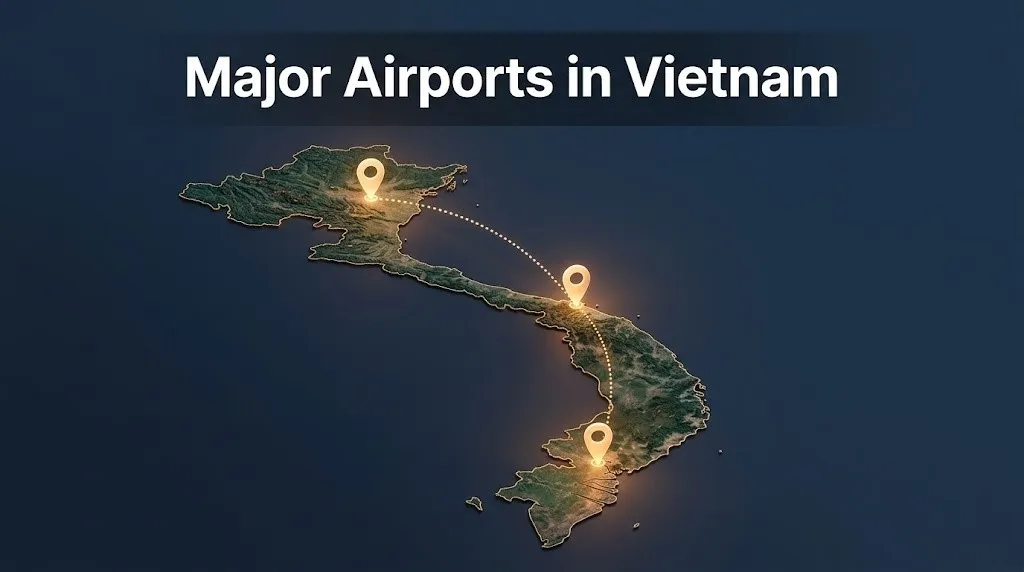
Vietnam operates 10 international airports and 12 domestic airports spanning the country from the Chinese border to the Gulf of Thailand. Three airports serve as the primary international gateways with Noi Bai in the north, Tan Son Nhat in the south, and Da Nang in the center.
Airports Corporation of Vietnam manages the country’s civil airport network with several facilities undergoing major expansion through 2026. The new Long Thanh International Airport near Ho Chi Minh City is under construction to eventually relieve pressure on overcrowded Tan Son Nhat.
This guide covers every major Vietnamese airport with honest assessments of terminal quality, transfer logistics, lounge access, and which entry point works best for your specific itinerary. You will finish knowing exactly which airport to book for your Vietnam trip.
Major Airports in Vietnam Complete Guide
Vietnam’s airport network centers on three international gateways serving the north, central, and southern regions of the country. Noi Bai International Airport serves Hanoi, Tan Son Nhat International Airport serves Ho Chi Minh City, and Da Nang International Airport anchors the central coast.
Ten airports hold international designation with direct flights from Asia, the Middle East, Europe, Australia, and North America arriving at the main gateways. The remaining 12 domestic airports connect smaller cities and provinces to the major hubs.
Vietnam Airlines, VietJet Air, and Bamboo Airways operate the majority of domestic and international flights from Vietnamese airports. International carriers including Korean Air, Japan Airlines, Singapore Airlines, Qatar Airways, Emirates, and Turkish Airlines serve the primary gateways.
The airport experience varies dramatically between facilities in Vietnam. Noi Bai’s newer international terminal is modern and efficient while Tan Son Nhat struggles with severe overcrowding during peak hours and the Tet holiday period.
First-time visitors to Vietnam should choose their arrival airport based on their itinerary rather than defaulting to the largest or most familiar airport. Flying into Da Nang saves hours of travel time for central Vietnam trips compared to arriving in Hanoi or Ho Chi Minh City.
How Many International Airports Are in Vietnam
Vietnam has 10 international airports as of 2026 with more facilities undergoing upgrades to receive international flights. The ten airports with international designation handle flights from across Asia, the Middle East, Europe, and Australia.
The three primary international gateways are Noi Bai International Airport in Hanoi, Tan Son Nhat International Airport in Ho Chi Minh City, and Da Nang International Airport on the central coast. These three airports handle the vast majority of international passenger traffic into Vietnam.
Secondary international airports include Cam Ranh near Nha Trang, Phu Quoc on the southern island, Cat Bi in Hai Phong, Can Tho in the Mekong Delta, Phu Bai in Hue, Van Don near Halong Bay, and Lien Khuong in Dalat. These airports receive regional international flights primarily from other Asian countries.
International designation means the airport has customs and immigration facilities to process arriving international passengers. Domestic airports without international designation only handle flights within Vietnam.
Budget travelers should check international flight pricing into secondary gateways like Cam Ranh or Phu Quoc. Charter and low-cost carrier flights from Korea, China, and Southeast Asia sometimes price significantly below fares to the main gateways.
| Airport Name | IATA Code | Region | International Routes From |
|---|---|---|---|
| Noi Bai | HAN | North (Hanoi) | Asia, Middle East, Europe, Australia |
| Tan Son Nhat | SGN | South (Ho Chi Minh City) | Asia, Middle East, Europe, Australia, North America |
| Da Nang | DAD | Central | Asia, Middle East |
| Cam Ranh | CXR | South Central (Nha Trang) | Asia, Russia (seasonal) |
| Phu Quoc | PQC | Southern Islands | Asia, Europe (seasonal) |
Noi Bai International Airport Hanoi Guide
Noi Bai International Airport serves Hanoi and northern Vietnam from a location roughly 30 kilometers north of the capital’s city center. The airport operates two terminals with Terminal 2 handling all international flights and Terminal 1 serving domestic routes.
Terminal 2 at Noi Bai opened in 2015 and offers a modern, spacious passenger experience that compares favorably with regional airports in Bangkok or Kuala Lumpur. The terminal features clear signage in Vietnamese and English with immigration and customs processing in a bright, open hall.
Vietnam Airlines, VietJet Air, and Bamboo Airways operate domestic flights from Terminal 1 with frequent service to Ho Chi Minh City, Da Nang, and other Vietnamese cities. The Hanoi to Ho Chi Minh City route is one of the busiest domestic air corridors in Southeast Asia.
Ground transportation from Noi Bai to Hanoi’s Old Quarter takes approximately 40 to 60 minutes by taxi or ride-hailing service depending on traffic. The airport bus route 86 connects to the city center for a lower cost with a journey time closer to 60 to 75 minutes.
Business travelers will find Noi Bai’s Terminal 2 significantly less stressful than Tan Son Nhat for international arrivals. Immigration queues move faster, the terminal is less crowded, and the overall passenger flow feels more organized.
Families with children arriving at Noi Bai should use the official airport taxi counter or the Grab ride-hailing app to avoid the persistent touts outside the arrivals hall. Pre-booked private transfers offer the most reliable option for families with luggage and young children.
| Noi Bai Detail | Specification |
|---|---|
| IATA code | HAN |
| Terminals | T1 (domestic), T2 (international) |
| Distance to Hanoi Old Quarter | 30 km |
| Transfer time to city | 40 to 75 minutes |
| Lounge access | Priority Pass, Vietnam Airlines Lotus Lounge, pay-per-use |
| Best for | Northern Vietnam itineraries, Ha Long Bay, Sapa |
Tan Son Nhat International Airport Ho Chi Minh City
Tan Son Nhat International Airport is Vietnam’s busiest airport located within Ho Chi Minh City just 8 kilometers from the District 1 city center. The airport operates two terminals with the international terminal handling flights from across the globe and the domestic terminal serving Vietnam’s busiest domestic routes.
Tan Son Nhat’s international terminal is genuinely overcrowded during peak arrival banks from mid-afternoon through evening. Immigration queues can exceed 45 minutes, baggage claim is cramped, and the arrivals hall is a wall of people during the busiest periods.
The domestic terminal at Tan Son Nhat is similarly congested with frequent delays during the afternoon thunderstorm season from May to October. The Hanoi to Ho Chi Minh City shuttle route operates at extreme frequency but on-time performance suffers during weather events and peak Tet holiday periods.
Ground transportation from Tan Son Nhat to District 1 takes 20 to 40 minutes by taxi or Grab depending on traffic. The airport’s urban location is convenient for the city center but means airport access roads clog during Ho Chi Minh City’s notorious rush hours.
Business travelers should avoid booking flights arriving at Tan Son Nhat between 3 PM and 7 PM when international arrival banks create the longest immigration queues. Morning arrivals typically process faster with lighter passenger loads.
First-time international travelers arriving at Tan Son Nhat should prepare for a chaotic arrivals experience. The visa on arrival counter, immigration queues, and baggage claim area can feel overwhelming compared to more orderly airports in the region.
| Tan Son Nhat Detail | Specification |
|---|---|
| IATA code | SGN |
| Terminals | International terminal, Domestic terminal |
| Distance to District 1 | 8 km |
| Transfer time to city | 20 to 40 minutes |
| Lounge access | Priority Pass, Vietnam Airlines Lotus Lounge, pay-per-use |
| Best for | Southern Vietnam, Mekong Delta, Ho Chi Minh City business |
Key Takeaway: Noi Bai offers a better international arrival experience than Tan Son Nhat, but Tan Son Nhat’s central city location is unmatched for convenience.
Da Nang International Airport Complete Overview
Da Nang International Airport serves central Vietnam and is the best airport for reaching Hoi An, Hue, and the beaches of Da Nang city. The airport sits within Da Nang city limits approximately 5 kilometers from the city center and 30 kilometers from Hoi An’s ancient town.
The airport operates a modern international terminal and a domestic terminal in a compact, easy-to-navigate layout. Da Nang’s manageable size compared to Hanoi or Ho Chi Minh City airports makes it the most passenger-friendly international gateway in Vietnam.
International flights arrive at Da Nang from Korea, Japan, China, Taiwan, Thailand, Malaysia, Singapore, and the Middle East. Direct long-haul flights from Europe and North America do not serve Da Nang, requiring a connection through Hanoi, Ho Chi Minh City, or a regional Asian hub.
Ground transportation from Da Nang airport to Hoi An takes approximately 45 minutes by taxi or private car at a reasonable cost for the distance. The drive to Hue takes roughly 2 to 2.5 hours through the Hai Van Pass or the tunnel.
Families heading to Hoi An resorts should fly into Da Nang rather than connecting through Ho Chi Minh City or Hanoi. The direct arrival saves hours of additional travel time and avoids the stressful domestic-to-international terminal transfers at the larger airports.
Solo travelers will find Da Nang airport easy to navigate with Grab ride-hailing readily available outside the terminal. The airport’s compact size means no long walks, no shuttle trains, and no confusion about which terminal or exit to use.
| Da Nang Detail | Specification |
|---|---|
| IATA code | DAD |
| Terminals | International terminal, Domestic terminal |
| Distance to Hoi An | 30 km |
| Transfer to Hoi An | 45 minutes |
| Lounge access | Priority Pass, Vietnam Airlines Lotus Lounge, pay-per-use |
| Best for | Hoi An, Hue, Da Nang beaches, central Vietnam |
Cam Ranh International Airport Nha Trang
Cam Ranh International Airport serves Nha Trang and the south-central coast of Vietnam from a coastal location approximately 35 kilometers south of Nha Trang city. The airport primarily handles regional international flights from Korea, China, Russia, and Southeast Asia.
The international terminal at Cam Ranh is modern and manages seasonal tourist traffic reasonably well during peak beach season from November to April. The terminal can feel crowded during Korean and Russian charter flight arrival banks but rarely reaches Tan Son Nhat levels of congestion.
Domestic flights connect Cam Ranh to Hanoi and Ho Chi Minh City with Vietnam Airlines, VietJet Air, and Bamboo Airways operating multiple daily frequencies. The domestic terminal is basic but functional with limited food and retail options beyond the security checkpoint.
Ground transportation from Cam Ranh to Nha Trang takes approximately 45 minutes by taxi or shuttle bus along a coastal road with ocean views. The airport shuttle bus offers a lower-cost option with multiple drop-off points along the Nha Trang beach strip.
Beach resort travelers heading to Nha Trang or Doc Let Beach should compare international flight pricing into Cam Ranh against flights into Ho Chi Minh City plus a domestic connection. Cam Ranh sometimes offers competitive international fares from Asian hub cities.
Families on beach vacations will find Cam Ranh less overwhelming than arriving at Tan Son Nhat and connecting domestically. The smaller terminal footprint means shorter walks and faster baggage delivery compared to Vietnam’s larger airports.
Phu Quoc International Airport Guide
Phu Quoc International Airport serves Phu Quoc Island off Vietnam’s southern coast with flights from regional Asian cities and domestic connections to Hanoi and Ho Chi Minh City. The airport sits near the island’s center approximately 10 kilometers from the popular Long Beach area.
The airport terminal is modern and compact, handling international and domestic flights in a single building with separate arrival and departure areas. Phu Quoc’s airport feels more like a relaxed island terminal than a major international gateway.
International flights serve Phu Quoc from Korea, China, Taiwan, Thailand, Malaysia, and Singapore with seasonal European charter service. The 30-day visa exemption for Phu Quoc Island allows many nationalities to enter without a Vietnamese visa when arriving directly at PQC.
Ground transportation on Phu Quoc relies on taxis, ride-hailing services, and hotel shuttles with no public bus system at the airport. Most resorts offer complimentary airport pickup included in the room rate or bookable as an add-on.
Families heading to Phu Quoc resorts benefit from the island’s visa exemption policy and the airport’s manageable size. The visa-free entry for Phu Quoc eliminates the visa application process entirely for travelers staying only on the island.
Budget travelers should confirm whether their Phu Quoc resort includes airport transfers before booking. Independent taxi fares from the airport to Long Beach area hotels are moderate but can be avoided with pre-arranged resort pickup.
| Phu Quoc Detail | Specification |
|---|---|
| IATA code | PQC |
| Terminals | Single combined terminal |
| Visa exemption | 30 days for all nationalities on direct international arrival |
| Distance to Long Beach | 10 km |
| Transfer to Long Beach | 15 to 25 minutes |
| Lounge access | Priority Pass, pay-per-use lounge available |
Key Takeaway: Da Nang and Phu Quoc offer the most pleasant airport experiences in Vietnam with manageable sizes, modern facilities, and less crowding than the major city airports.
Northern Vietnam Airports and Which to Use
Noi Bai International Airport in Hanoi is the primary gateway for northern Vietnam and the best arrival point for Hanoi, Ha Long Bay, Sapa, and the northern highlands. Most international travelers visiting northern Vietnam should fly into Noi Bai.
Cat Bi International Airport in Hai Phong serves as an alternative northern gateway closer to Ha Long Bay and the coastal regions east of Hanoi. The airport is approximately 60 kilometers from Ha Long Bay, roughly half the distance from Noi Bai.
Van Don International Airport near Ha Long Bay opened in 2018 as Vietnam’s first privately developed airport. The facility is the closest airport to Ha Long Bay at roughly 50 kilometers but receives limited flight service primarily from Ho Chi Minh City and select Asian routes.
Dien Bien Phu Airport in the far northwest serves the historic battlefield region with domestic flights from Hanoi. The airport has limited service and small aircraft operations, making it more of a niche destination than a practical entry point.
Budget travelers heading to Ha Long Bay should compare total transfer costs from Noi Bai, Cat Bi, and Van Don airports. The flight fare difference between airports is sometimes offset by the shorter ground transfer time and lower transfer cost.
Solo travelers on northern Vietnam itineraries will find Noi Bai’s modern Terminal 2 the easiest arrival experience. Grab ride-hailing operates from the airport, and the bus route 86 provides an affordable transfer option to Hanoi’s Old Quarter.
| Northern Airport | IATA | Best For | Distance to Hanoi/Ha Long Bay |
|---|---|---|---|
| Noi Bai | HAN | Hanoi, Sapa, general northern entry | 30 km to Hanoi |
| Cat Bi | HPH | Ha Long Bay, Hai Phong | 60 km to Ha Long Bay |
| Van Don | VDO | Ha Long Bay, Bai Tu Long Bay | 50 km to Ha Long Bay |
Southern Vietnam Airports and Regional Alternatives
Tan Son Nhat International Airport in Ho Chi Minh City is the primary southern gateway but Long Thanh International Airport is under construction to supplement and eventually replace portions of Tan Son Nhat’s traffic. Long Thanh is not yet operational as of 2026 reporting.
Can Tho International Airport serves the Mekong Delta region with domestic flights from Hanoi, Da Nang, and Phu Quoc plus limited international service from other Southeast Asian countries. The airport is the best arrival point for Mekong Delta river cruise embarkation.
Phu Quoc International Airport provides a direct island entry point for travelers whose Vietnam itinerary focuses entirely on the southern islands. The 30-day visa exemption for direct international arrivals at Phu Quoc is a significant convenience.
Lien Khuong Airport in Dalat serves the Central Highlands with domestic flights from major Vietnamese cities and limited international charter service. Dalat’s elevation means cooler temperatures and occasional fog-related flight disruptions during the December to February period.
Rach Gia Airport and Ca Mau Airport serve the far southern Mekong Delta and southern tip of Vietnam with domestic flights on small ATR 72 turboprop aircraft operated by Vietnam Airlines and Bamboo Airways.
Business travelers heading to Ho Chi Minh City have no practical alternative to Tan Son Nhat until Long Thanh Airport opens. The urban location and high flight frequency make Tan Son Nhat the only viable choice despite its crowding problems.
| Southern Airport | IATA | Best For | Honest Note |
|---|---|---|---|
| Tan Son Nhat | SGN | Ho Chi Minh City, Mekong Delta gateway | Overcrowded, urban location |
| Can Tho | VCA | Mekong Delta direct access | Limited flights, regional |
| Phu Quoc | PQC | Island resort, visa exemption | Visa-free entry for direct arrivals |
| Lien Khuong | DLI | Dalat, Central Highlands | Weather disruptions in winter |
Central Vietnam Airports for Hue and Hoi An
Da Nang International Airport is the best airport for central Vietnam, serving Hoi An, Hue, and Da Nang city. International travelers visiting Hoi An or Hue should fly into Da Nang rather than connecting domestically from Hanoi or Ho Chi Minh City.
Phu Bai International Airport in Hue provides an alternative central Vietnam entry point with limited international flights and domestic connections. The airport is approximately 15 kilometers from Hue’s city center, making it more convenient for Hue-focused itineraries than Da Nang.
Chu Lai Airport and Dong Hoi Airport serve smaller central coast destinations with domestic flights from Hanoi and Ho Chi Minh City. Dong Hoi is the closest airport to Phong Nha-Ke Bang National Park and its famous caves.
The drive from Da Nang airport to Hoi An takes approximately 45 minutes while the drive to Hue takes 2 to 2.5 hours depending on whether you take the Hai Van Tunnel or the scenic Hai Van Pass coastal road.
Families heading to Hoi An resorts should book private transfers from Da Nang airport in advance through their hotel or a reputable transfer service. The short drive is straightforward, but pre-arranged transport eliminates the need to negotiate with taxi drivers.
Solo travelers arriving at Da Nang will find Grab ride-hailing available and reliable for the transfer to Hoi An or Da Nang city hotels. The ride-hailing fare is fixed and eliminates the taxi meter and negotiation stress.
Key Takeaway: Fly into Da Nang for Hoi An and central Vietnam. Connecting through Hanoi or Ho Chi Minh City adds unnecessary travel time and airport stress.
Vietnam Domestic Airports and Regional Connections
Vietnam operates 12 domestic airports connecting provincial cities to the major hubs in Hanoi, Ho Chi Minh City, and Da Nang. Vietnam Airlines, VietJet Air, and Bamboo Airways operate extensive domestic networks with high flight frequency on the main trunk routes.
The Hanoi to Ho Chi Minh City domestic route is one of the busiest in the world with dozens of daily flights operated by all three major carriers. Flight time is approximately 2 hours with fares varying widely based on booking lead time and seasonal demand.
Domestic airports in Vietnam range from modern facilities like Lien Khuong in Dalat to basic single-runway airports with minimal amenities. Smaller airports like Dong Hoi, Pleiku, and Tuy Hoa have limited food and retail options beyond security.
Domestic flight delays are common in Vietnam, particularly during the afternoon thunderstorm season from May to October and during the Tet holiday period. Schedule morning flights for the best on-time performance when connecting to international departures.
Budget travelers should compare domestic flight fares across Vietnam Airlines, VietJet Air, and Bamboo Airways for the same route. VietJet Air often offers the lowest base fares but adds fees for baggage, seat selection, and in-flight purchases.
Families with checked luggage should calculate the all-in cost of VietJet Air and Bamboo Airways fares including baggage fees before booking. Vietnam Airlines includes checked baggage in standard fares, which can make the headline price difference smaller than it first appears.
Getting From Vietnam Airports to City Centers
Getting from Vietnam’s major airports to city centers involves taxis, ride-hailing apps, airport buses, and pre-arranged private transfers. Grab is the dominant ride-hailing app in Vietnam and operates at all major airports.
Noi Bai Airport to Hanoi Old Quarter takes 40 to 75 minutes by taxi or Grab depending on traffic. The airport bus route 86 connects to the city center for a lower fare with a journey time of 60 to 75 minutes.
Tan Son Nhat Airport to Ho Chi Minh City District 1 takes 20 to 40 minutes by taxi or Grab. The airport is close to the city center, but traffic congestion on the access roads can extend transfer times during morning and evening rush hours.
Da Nang Airport to Hoi An takes approximately 45 minutes by taxi or private car. Grab operates from Da Nang airport, and pre-arranged hotel transfers are widely available for Hoi An resort guests.
Cam Ranh Airport to Nha Trang takes approximately 45 minutes along a coastal road. The airport shuttle bus provides a lower-cost option with multiple stops along the Nha Trang beach strip.
Solo female travelers should use the Grab app or pre-arranged hotel transfers rather than hailing taxis outside Vietnamese airports. Grab provides driver identification, route tracking, and fare transparency that random taxi touts do not offer.
| Airport | City/Destination | Transfer Time | Best Transfer Option |
|---|---|---|---|
| HAN | Hanoi Old Quarter | 40 to 75 min | Grab or bus 86 |
| SGN | District 1 | 20 to 40 min | Grab or hotel transfer |
| DAD | Hoi An | 45 min | Hotel transfer or Grab |
| CXR | Nha Trang | 45 min | Airport shuttle or hotel transfer |
Vietnam Airport Lounges and Priority Pass Access
Vietnam’s major international airports offer lounge access through Priority Pass, airline business class tickets, and pay-per-use options. Noi Bai, Tan Son Nhat, Da Nang, Cam Ranh, and Phu Quoc airports all have at least one lounge accepting Priority Pass.
Vietnam Airlines Lotus Lounges operate at Noi Bai, Tan Son Nhat, and Da Nang airports with access for Vietnam Airlines business class passengers, SkyTeam elite members, and Priority Pass holders. The Lotus Lounge at Noi Bai’s international terminal offers the best lounge experience in Vietnam with hot food, bar service, and shower facilities.
Tan Son Nhat’s international terminal has multiple lounge options including the Vietnam Airlines Lotus Lounge, the SASCO Business Lounge, and the Le Saigonnais Lounge. Priority Pass access varies between lounges, and capacity controls during peak hours mean access is not guaranteed.
Da Nang International Airport’s CIP Orchid Lounge accepts Priority Pass and provides basic refreshments and seating. The lounge is functional but smaller and less impressive than the Lotus Lounge facilities in Hanoi or Ho Chi Minh City.
Cam Ranh International Airport offers a CIP Lounge accepting Priority Pass with basic amenities appropriate for the airport’s smaller scale. Phu Quoc International Airport has a pay-per-use lounge that also accepts Priority Pass with limited food and beverage options.
Business travelers with Priority Pass should verify current lounge acceptance at their specific Vietnamese airport on the Priority Pass app before departure. Lounge partnerships change, and capacity restrictions during peak international departure banks are common.
| Airport | Lounge Name | Priority Pass | Shower | Best For |
|---|---|---|---|---|
| HAN | Vietnam Airlines Lotus Lounge | Yes | Yes | Best lounge in Vietnam |
| SGN | SASCO Business Lounge | Yes | Yes | Multiple options |
| DAD | CIP Orchid Lounge | Yes | No | Functional, basic |
| CXR | CIP Lounge | Yes | No | Small airport lounge |
| PQC | Pay-per-use lounge | Yes | No | Limited amenities |
Best Airport to Fly Into Vietnam for Your Itinerary
Fly into Noi Bai International Airport for northern Vietnam itineraries covering Hanoi, Ha Long Bay, Sapa, Ninh Binh, and the northern highlands. Noi Bai’s modern international terminal and efficient operations make it the best passenger experience among Vietnam’s major airports.
Fly into Da Nang International Airport for central Vietnam itineraries covering Hoi An, Hue, Da Nang beaches, and the Hai Van Pass. Da Nang eliminates the need for a domestic connection from Hanoi or Ho Chi Minh City and saves hours of travel time.
Fly into Tan Son Nhat International Airport only when your itinerary focuses on Ho Chi Minh City, the Mekong Delta, or southern beach destinations. The airport’s crowding problem is real, but the central location makes it the only practical choice for Ho Chi Minh City.
Fly into Phu Quoc International Airport if your entire Vietnam trip stays on the island. The 30-day visa exemption for direct international arrivals eliminates the Vietnamese visa process entirely for island-only itineraries.
Fly into Cam Ranh International Airport for Nha Trang beach itineraries when direct international flights from your origin city are available. Connecting through Ho Chi Minh City and flying domestically to Cam Ranh is the alternative when direct flights are not available.
Multi-stop itineraries often work best with an open-jaw booking arriving at one airport and departing from another. Arriving in Hanoi and departing from Ho Chi Minh City or Da Nang avoids the need to backtrack for your departure flight.
| Itinerary | Best Arrival Airport | Alternative |
|---|---|---|
| Hanoi, Ha Long Bay, Sapa | Noi Bai (HAN) | Cat Bi (HPH) for Ha Long Bay |
| Hoi An, Hue, Da Nang beaches | Da Nang (DAD) | Phu Bai (HUI) for Hue only |
| Ho Chi Minh City, Mekong Delta | Tan Son Nhat (SGN) | Can Tho (VCA) for Delta |
| Phu Quoc Island only | Phu Quoc (PQC) | N/A |
| Nha Trang beaches | Cam Ranh (CXR) | SGN plus domestic flight |
Key Takeaway: Match your arrival airport to your first destination, not to the largest airport. Open-jaw tickets arriving north and departing south save backtracking time.
Vietnam Airport Comparison and Passenger Experience
Noi Bai International Airport offers the best overall passenger experience among Vietnam’s major airports with a modern Terminal 2, efficient immigration, and organized ground transportation. The airport compares favorably with regional peers in Bangkok and Kuala Lumpur.
Tan Son Nhat International Airport delivers the most stressful passenger experience due to chronic overcrowding in both international and domestic terminals. The airport is operating well beyond its designed capacity until Long Thanh Airport opens to relieve pressure.
Da Nang International Airport provides the most pleasant mid-size airport experience in Vietnam with manageable passenger volumes, modern facilities, and a layout that makes navigation straightforward even for first-time visitors.
Cam Ranh and Phu Quoc international airports handle seasonal tourist volumes reasonably well with facilities sized appropriately for their traffic levels. Both airports can feel crowded during peak charter flight arrival banks but recover quickly.
Vietnam’s domestic airports range from modern facilities with basic amenities to small single-room terminals with limited services. Set expectations appropriately for domestic connections through smaller airports where food options and seating may be limited.
Business travelers who value airport efficiency should prioritize Noi Bai over Tan Son Nhat whenever their itinerary allows. The difference in immigration processing time and terminal crowding between the two airports is significant.
| Airport | Passenger Experience | Crowding Level | Best For |
|---|---|---|---|
| HAN | Best overall, modern T2 | Moderate | Smooth arrival |
| SGN | Stressful, overcrowded | High | Urban convenience |
| DAD | Pleasant, manageable | Low to moderate | Central Vietnam |
| CXR | Functional, seasonal | Moderate in season | Beach resort access |
| PQC | Relaxed, compact | Low | Island resort, visa-free |
Vietnam Visa on Arrival and eVisa Airport Entry Points
Vietnam visa on arrival and eVisa acceptance varies by airport with all 10 international airports processing eVisa entries as of 2026. The eVisa system has expanded significantly, covering most nationalities for tourist stays of up to 90 days.
Tan Son Nhat, Noi Bai, and Da Nang international airports process the widest range of visa entry types including eVisa, visa on arrival with pre-approval letter, and direct visa exemption for eligible nationalities. These three airports are the safest choice for travelers with complex visa situations.
Phu Quoc International Airport offers a 30-day visa exemption for all nationalities arriving directly on international flights and staying only on the island. Travelers continuing to mainland Vietnam from Phu Quoc must hold a valid Vietnamese visa.
The visa on arrival process at Vietnamese airports requires a pre-approval letter obtained online before travel. Without this letter, visa on arrival is not available, and travelers without an eVisa or visa exemption will be denied boarding or entry.
Smaller international airports like Phu Bai in Hue, Cat Bi in Hai Phong, and Van Don near Ha Long Bay process eVisas but may have less experienced immigration staff with eVisa processing. Arrive with printed copies of all visa documents when entering through secondary international airports.
Verify current Vietnamese visa requirements for your specific nationality on the official Vietnam Immigration Department website or the U.S. State Department Vietnam travel page before booking. Entry rules change, and visa exemptions are nationality-specific with varying stay durations.
Important Accuracy Notes for Vietnam Airports
Vietnam visa entry point designations, airport terminal assignments, lounge access agreements, and domestic flight schedules change without public notice. Airport expansion projects continue at multiple facilities through 2026.
Verify the following directly before traveling:
- Current Vietnamese visa requirements and eligible entry airports for your nationality on the official Vietnam Immigration Department eVisa portal, as visa policies and entry point designations change periodically.
- Your airline’s specific terminal assignment at Tan Son Nhat or Noi Bai on the airline’s official website 24 hours before departure, as domestic and international terminals are in separate buildings.
- Current lounge access policies on the Priority Pass app or your airline’s lounge access page, as lounge partnerships change and capacity controls during peak hours are common.
- Domestic flight on-time performance for afternoon bookings during the May to October thunderstorm season, as weather-related delays are frequent.
The single most important pre-travel action: confirm your visa eligibility and entry airport compatibility before booking flights. An eVisa accepted at Noi Bai may not be accepted at a smaller international airport.
Frequently Asked Questions About Major Airports in Vietnam
How many major international airports does Vietnam have?
Vietnam has 10 international airports with Noi Bai, Tan Son Nhat, and Da Nang serving as the three primary gateways.
The remaining seven international airports handle regional flights primarily from Asia and seasonal charter service.
All 10 international airports now process eVisa entries as of 2026.
What is the main airport in Vietnam?
Tan Son Nhat International Airport in Ho Chi Minh City is Vietnam’s busiest airport by passenger volume and flight movements.
Noi Bai International Airport in Hanoi serves as the second major gateway and offers a better passenger experience with its modern international terminal.
Da Nang International Airport anchors central Vietnam as the third primary international gateway.
Which airport is closest to Hanoi city center?
Noi Bai International Airport is approximately 30 kilometers north of Hanoi’s Old Quarter and city center.
The airport serves as the primary gateway for all northern Vietnam destinations including Hanoi.
The drive to the city center takes 40 to 75 minutes by taxi or Grab depending on traffic conditions.
Can I get a visa on arrival at Vietnam airports?
Vietnam visa on arrival requires a pre-approval letter obtained online before travel and is processed at major international airports.
Without the pre-approval letter, visa on arrival is not available at any Vietnamese airport.
The eVisa system now covers most nationalities and is the simpler option for eligible travelers entering at any of Vietnam’s 10 international airports.
What is the best airport to fly into for Hoi An?
Da Nang International Airport is the best airport for reaching Hoi An with a transfer time of approximately 45 minutes.
Flying into Da Nang directly saves hours compared to connecting through Hanoi or Ho Chi Minh City.
The airport serves international flights from across Asia and domestic flights from Vietnam’s major cities.
Are there airport lounges at Vietnam international airports?
Vietnam’s major international airports have lounges accepting Priority Pass, airline business class tickets, and pay-per-use entry.
Noi Bai’s Vietnam Airlines Lotus Lounge offers the best lounge experience in Vietnam with hot food, bar service, and shower facilities.
Tan Son Nhat, Da Nang, Cam Ranh, and Phu Quoc airports also offer lounge access with varying levels of facilities and service.
Vietnam’s airport network gives you genuine choice in where to start your trip. Noi Bai in Hanoi offers the best arrival experience. Da Nang is the smartest entry point for central Vietnam beach and culture itineraries. Tan Son Nhat works when Ho Chi Minh City is your destination, but prepare for crowds.
Match your arrival airport to the first stop on your itinerary rather than defaulting to the largest or most familiar airport. An open-jaw ticket arriving in one city and departing from another eliminates unnecessary backtracking and saves hours of domestic travel time.
Verify your visa eligibility and entry airport compatibility on the official Vietnam Immigration Department eVisa portal before booking flights. Terminal assignments, lounge access, and domestic flight schedules change. Confirm current details directly with your airline and airport before departure. The right airport choice makes the difference between a smooth start to your Vietnam trip and an unnecessarily stressful one.