The Dominican Republic has seven international airports, and choosing the right one determines how fast you reach your resort or city hotel. Most travelers default to Punta Cana International Airport (PUJ) because it sits closest to the country’s largest resort corridor.
According to the Junta de Aviación Civil, PUJ processed over 11 million passengers in 2025. That makes it the busiest airport in the DR by a significant margin.
This guide covers all seven DR airports with IATA codes, transfer times, specific airlines, and honest verdicts by traveler type. Use it before you book flights, not after.
Dominican Republic Airports: The Complete Overview
The Dominican Republic operates seven international airports spread across its northern, eastern, southern, and central regions. No other Caribbean nation of similar size matches this level of geographic distribution.
Six of the seven airports handle scheduled international service from North America and Europe. The seventh, La Isabela International Airport (JBQ), focuses primarily on domestic and regional charter traffic.
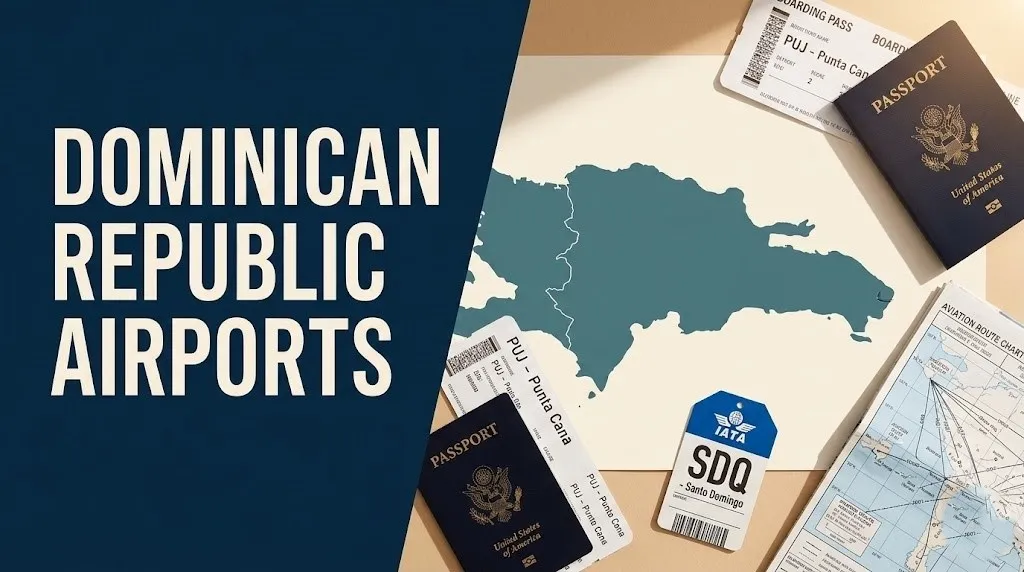
The three busiest airports handle the overwhelming majority of international arrivals. Punta Cana (PUJ), Las Américas (SDQ), and Cibao (STI) together account for roughly 90 percent of total passenger volume.
Aerodom, formally known as Aeropuertos Dominicanos Siglo XXI S.A., operates five of the seven airports. Grupo Puntacana operates PUJ privately. La Romana’s LRM is operated by the Central Romana Corporation.
Budget travelers should note that not all seven airports offer the same level of US carrier service. PUJ and SDQ have the broadest airline choice, including budget carriers Spirit Airlines, Frontier Airlines, and Allegiant Air.
Families with children flying to resort areas should target PUJ first. All major family resort chains in the Punta Cana and Bávaro corridors connect directly to PUJ with pre-arranged shuttle services.
How Many International Airports Does the Dominican Republic Have?
The Dominican Republic has seven international airports, more than any other individual Caribbean island nation. This network reflects the country’s position as one of the most visited destinations in the Caribbean.
The seven airports serve distinct regions of the country. Choosing the wrong one can mean a three-hour ground transfer instead of a twenty-minute one.
| Airport | IATA | Region | 2025 Passengers |
|---|---|---|---|
| Punta Cana International | PUJ | East | 11,006,110 |
| Las Américas International | SDQ | South/Capital | 5,221,168 |
| Cibao International | STI | North/Central | 2,285,035 |
| Gregorio Luperón International | POP | North | 814,076 |
| La Romana International | LRM | Southeast | 235,026 |
| Samaná El Catey International | AZS | Northeast | 97,665 |
| La Isabela International | JBQ | Capital/Domestic | 56,588 |
Passenger figures sourced from the Junta de Aviación Civil and the Banco Central de la República Dominicana.
First-time international travelers often search for “Dominican Republic airport” and assume one main hub exists. The country has seven, and six of them handle international arrivals.
The honest reality is that airport choice matters enormously here. The Dominican Republic has rugged interior terrain, and ground roads between regions can be slow. Flying into the right airport saves hours.
Key Takeaway: The Dominican Republic has 7 international airports. PUJ is the busiest, SDQ serves the capital, and choosing the correct airport can save you 2-3 hours of ground travel.
The Major Airports in the Dominican Republic
The three major airports in the Dominican Republic are Punta Cana International (PUJ), Las Américas International (SDQ), and Cibao International (STI). Together, they serve the vast majority of international visitors.
PUJ dominates the tourism market. SDQ serves Santo Domingo’s business and government traffic. STI serves the country’s second-largest city and the economically significant Cibao agricultural valley.
The four smaller airports, POP, LRM, AZS, and JBQ, serve specific regional needs. They offer fewer direct international routes but dramatically shorter transfers for travelers headed to their specific areas.
Business and frequent flyers typically operate through SDQ and STI. Both airports have VIP lounge access and stronger connections to Latin American hubs via Copa Airlines and Avianca.
Insider Tip:
PUJ’s iconic thatched palm-leaf roof terminal design is genuinely distinctive among Caribbean airports. The architecture is intentionally tropical, but do not mistake charm for functionality. Long immigration queues at PUJ during peak winter arrivals are well documented. Plan accordingly.
Punta Cana International Airport (PUJ)
Punta Cana International Airport (PUJ) handles more passengers than any other airport in the Dominican Republic, processing over 11 million travelers in 2025 according to the Banco Central de la República Dominicana.
PUJ is privately owned and operated by Grupo Puntacana, which distinguishes it from the other six airports. It is one of the few privately operated major international airports in the Caribbean.
PUJ serves the Punta Cana, Bávaro, Cap Cana, and Uvero Alto resort corridors. The airport sits on the eastern tip of the island, approximately 25 kilometers from most major resort zones.
Airlines operating scheduled service at PUJ from the US include American Airlines, Delta Air Lines, JetBlue Airways, United Airlines, Spirit Airlines, Frontier Airlines, and Allegiant Air. International carriers include British Airways, Air France, Iberia, and Condor from Europe.
PUJ has two terminals. Terminal A handles primarily charter and low-cost international traffic. Terminal B handles major legacy and international flag carriers.
The airport features a VIP departure lounge accessible to all Terminal B departing passengers. It includes a swimming pool, which makes it one of the more unusual airport lounge amenities in the Caribbean. Verify current access terms and any usage fees directly with the airport before departure.
Families with children are best served by PUJ. Transfer times to Bávaro resort zones run approximately 20 to 30 minutes under normal traffic conditions, which keeps the post-flight logistics manageable with young children.
The honest limitation of PUJ is immigration processing time during peak winter arrivals. December through April can see queues stretching 45 to 90 minutes during simultaneous wide-body aircraft arrivals.
Las Américas International Airport, Santo Domingo (SDQ)
Las Américas International Airport (SDQ) serves Santo Domingo, the Dominican Republic’s capital city and the oldest European-founded city in the Americas. It processed over 5.2 million passengers in 2025.
SDQ is located in Punta Caucedo, approximately 30 kilometers east of Santo Domingo’s colonial city center. Ground transfer to the city center typically runs 25 to 45 minutes depending on traffic.
SDQ serves as the primary hub for Arajet, the DR’s low-cost carrier, and for SKYhigh Dominicana. It also handles significant international service from American Airlines, Delta Air Lines, JetBlue Airways, Copa Airlines, Avianca, and Iberia.
Business and frequent flyers are the primary users of SDQ. The airport’s location relative to the capital, its connectivity to Latin American hubs via Copa Airlines from Panama City, and its stronger domestic connectivity make it the right choice for non-resort travelers.
Transfer options from SDQ to the city center include taxis (negotiate fare before getting in) and private transfer services booked in advance. Public bus service exists but is not recommended for travelers unfamiliar with the Santo Domingo metro area.
The honest limitation of SDQ: it is frequently misbooked by travelers who assume it is the primary tourist gateway. If you’re heading to Punta Cana, booking into SDQ instead of PUJ adds roughly 2.5 to 3 hours of road travel each way. Verify your destination before booking.
Key Takeaway: SDQ is the right airport for Santo Domingo business and city tourism. It’s the wrong airport for Punta Cana and Bávaro resort travel — the road transfer makes it a costly error.
Cibao International Airport, Santiago (STI)
Cibao International Airport (STI) serves Santiago de los Caballeros, the Dominican Republic’s second-largest city, processing over 2.2 million passengers in 2025. It is the third-busiest airport in the country.
STI is located in the Licey area of Santiago Province. The airport sits in the Cibao Valley, which is the country’s agricultural and industrial heartland.
Airlines operating at STI include American Airlines, JetBlue Airways, Copa Airlines, and several charter carriers. Direct service from New York (JFK) and Miami is available, though frequency is lower than at PUJ or SDQ.
Travelers visiting family rather than resorts represent a significant share of STI’s passenger base. The Santiago diaspora community, particularly from New York and New Jersey, generates consistent demand for direct STI service.
STI is also the right choice for travelers heading to Jarabacoa or Constanza, mountain towns popular for eco-tourism and adventure travel that are significantly closer to STI than to PUJ or SDQ.
The honest limitation of STI is its smaller international route network. Budget carriers with broad US coverage, such as Spirit Airlines and Frontier Airlines, do not serve STI. Travelers on a price-first strategy will find fewer low-fare options here.
Gregorio Luperón International Airport, Puerto Plata (POP)
Gregorio Luperón International Airport (POP) serves Puerto Plata and the north coast resort corridor, processing approximately 814,000 passengers in 2025. It is located in Sosúa, Puerto Plata Province.
POP serves beach towns including Sosúa, Cabarete, Río San Juan, and Puerto Plata city itself. It is the gateway to the Amber Coast, a region with strong windsurfing and kitesurfing credentials.
Airlines serving POP include JetBlue Airways, Delta Air Lines, Air Canada, WestJet, Copa Airlines, and several European charter carriers. Direct service from New York and Boston is available seasonally. Verify current route schedules with airlines before booking, as POP service is heavily seasonal.
Solo travelers and adventure travelers find POP the most useful alternative airport. The north coast has a different character from the resort-heavy eastern corridor, with smaller boutique properties, water sports infrastructure, and more local dining options.
The honest limitation of POP: the international schedule shrinks considerably in the low season (August through November). Travelers planning shoulder-season trips should verify that their preferred airline still operates direct service to POP before booking, as some routes shift seasonally to PUJ.
Insider Tip:
Cabarete, one of the most active kitesurfing destinations in the Caribbean, is approximately 25 minutes by road from POP. Traveling into PUJ instead adds roughly 5 hours of driving. POP is non-negotiable for north coast adventure travelers.
Key Takeaway: POP is the correct airport for Puerto Plata, Sosúa, and Cabarete. Flying into PUJ or SDQ instead adds a half-day of unnecessary ground travel for north coast visitors.
La Romana International Airport (LRM)
La Romana Casa de Campo International Airport (LRM) is the most exclusive airport in the Dominican Republic, serving the luxury resort complex at Casa de Campo with approximately 235,000 passengers in 2025.
LRM is operated by the Central Romana Corporation, which also operates the Casa de Campo resort. This private-sector operation gives the airport an unusually focused purpose: moving luxury resort guests in and out efficiently.
American Airlines operates nonstop service to LRM from Miami (MIA). British Airways and TUI Airways have expanded service to LRM from London. Air Canada provides seasonal Canadian service. Verify current schedules with each airline directly before booking.
Luxury resort travelers and business and frequent flyers attending corporate retreat events at Casa de Campo are the dominant users of LRM. The transfer from LRM to the Casa de Campo resort entrance runs approximately 5 to 10 minutes.
The honest limitation of LRM: it serves almost exclusively the Casa de Campo catchment area. Travelers not staying at or near Casa de Campo, Bayahibe, or La Romana city will find very limited transport connections beyond this zone.
Budget travelers and those seeking broader Dominican Republic itineraries should not book into LRM. The airport’s route network is thin, fares are typically higher due to limited competition, and ground transport beyond the immediate La Romana area is impractical.
Samaná El Catey International Airport (AZS)
Samaná El Catey International Airport (AZS), also known as Aeropuerto Internacional Presidente Juan Bosch, serves the Samaná Peninsula in the northeast, processing approximately 97,665 passengers in 2025.
AZS opened in 2006 specifically to make the Samaná Peninsula accessible by air without requiring a multi-hour road transfer from Santo Domingo or Punta Cana. The peninsula is widely regarded as one of the most scenically distinctive parts of the Dominican Republic.
WestJet has operated seasonal service to AZS from Canadian cities including Toronto and Halifax. Air Canada provides winter charter service. European charter carriers also use AZS for seasonal resort packages. Current route availability is highly seasonal, so verify with airlines before planning around AZS.
Solo travelers and adventurous first-time visitors drawn to whale watching, Los Haitises National Park, and the town of Las Terrenas are best served by AZS. The peninsula has a different pace and character than the Punta Cana resort zone.
The honest limitation of AZS: international route options are thin, seasonal, and primarily charter-based. Travelers from US cities without direct AZS service must connect through SDQ or PUJ, which often erases the travel time advantage.
Families considering Samaná should be realistic about logistics. The drive from PUJ or SDQ to Samaná takes 2.5 to 3.5 hours depending on road conditions. When AZS has a direct flight from your departure city, it is worth booking. When it does not, a road transfer from SDQ is more predictable.
La Isabela International Airport, Santo Domingo (JBQ)
La Isabela International Airport (JBQ) is the smallest of the seven Dominican Republic airports, processing approximately 56,588 passengers in 2025. It primarily serves domestic routes within the Dominican Republic and some regional Caribbean connections.
JBQ is located in the Herrera district of Santo Domingo. It operates separately from SDQ and handles a distinct set of short-haul and general aviation traffic.
Air Century uses JBQ as a domestic hub, connecting Santo Domingo with smaller regional points including Samaná, Puerto Plata, and El Portillo. For travelers who need to connect between Dominican Republic airports without long road transfers, Air Century’s domestic network via JBQ is the practical option.
First-time international travelers will not arrive at JBQ on an international commercial flight. It is relevant only if you are traveling domestically within the DR after arriving at SDQ.
The honest assessment of JBQ: it is not a destination airport for international visitors. Its value is as a domestic connector. Travelers planning to visit multiple regions of the Dominican Republic should check Air Century’s domestic routes before assuming road travel is the only inter-regional option.
Key Takeaway: JBQ is a domestic connector, not an international gateway. International travelers arrive at one of the other six airports and may use JBQ only to connect to smaller domestic destinations within the DR.
Which Airport to Fly Into in the Dominican Republic
The right Dominican Republic airport depends entirely on your destination within the country. PUJ is correct for Punta Cana and Bávaro; SDQ is correct for Santo Domingo; STI is correct for Santiago; POP for Puerto Plata and the north coast.
There is no universal “best” airport. The correct answer changes completely based on where your hotel or resort is located.
| Destination | Best Airport | IATA | Approximate Transfer |
|---|---|---|---|
| Punta Cana / Bávaro | Punta Cana International | PUJ | 20-40 min |
| Cap Cana | Punta Cana International | PUJ | 15-25 min |
| Casa de Campo / La Romana | La Romana International | LRM | 5-10 min |
| Santo Domingo | Las Américas International | SDQ | 25-45 min |
| Santiago / Cibao Valley | Cibao International | STI | 20-30 min |
| Puerto Plata / Sosúa / Cabarete | Gregorio Luperón International | POP | 10-30 min |
| Samaná / Las Terrenas | Samaná El Catey International | AZS | 30-50 min |
| Jarabacoa / Constanza | Cibao International | STI | 60-90 min |
Transfer times are approximate under normal road conditions. Verify current road conditions and seasonal festival traffic with your transfer provider before travel.
Luxury resort travelers visiting Casa de Campo make a common and expensive error: booking into PUJ rather than LRM. The price difference between these airports in airfare is sometimes small, but the ground transfer differential is roughly 2 hours and a significant transfer cost.
Budget travelers should prioritize airports with strong Spirit Airlines, Frontier Airlines, and Allegiant Air service. PUJ has all three. SDQ has some Spirit service. STI and POP have limited budget carrier access.
Dominican Republic Airport Transfers: Getting to Your Hotel
Airport transfer is the most underplanned part of a Dominican Republic trip. Road distances between airports and resorts are longer than maps suggest, and impromptu taxi negotiation at the exit of any DR airport is stressful and often expensive.
Pre-book transfers before departure. Every major resort corridor has private transfer operators, and most all-inclusive resorts include or sell transfers at the booking stage.
Transfer options from PUJ to resort zones:
- Pre-booked private transfer: Most reliable. Book before departure through your resort or a third-party operator. Prices vary by corridor and vehicle size. Verify current pricing directly with the operator.
- Shared shuttle: Lower cost, longer travel time due to multiple resort drops. Works best for travelers heading to the central Bávaro corridor.
- Resort-operated bus: Many all-inclusive resorts operate direct airport pickup. Confirm availability and cost at booking.
- On-site taxi: Available but requires negotiating the fare before entering the vehicle. Dominican Republic taxi meters are not standard.
- Rental car: Major international car rental companies operate at PUJ. Driving yourself is an option for experienced travelers comfortable with Dominican road conditions.
Transfer times from SDQ to the colonial city center run 25 to 45 minutes by private car under normal conditions. Rush hour in Santo Domingo extends this materially.
Families with children should always pre-book. Arriving at a Dominican airport with young children and no arranged transfer creates a chaotic and high-cost situation at the exit gate.
Solo travelers can comfortably use shared shuttles to the major resort corridors. For more remote destinations like Las Terrenas or Cabarete, arrange a private transfer in advance.
Airlines Flying to the Dominican Republic
Dozens of airlines serve the Dominican Republic’s international airports from the US, Canada, Europe, and Latin America. The route choice is widest at PUJ.
US carriers with scheduled service to the Dominican Republic include:
- American Airlines: Flies to PUJ, SDQ, STI, and LRM from Miami (MIA), New York (JFK), Charlotte (CLT), and other hubs. Verify current schedule with American Airlines directly.
- Delta Air Lines: Serves PUJ and SDQ primarily from Atlanta (ATL) and New York (JFK). Seasonal POP service also operates.
- JetBlue Airways: Serves PUJ, SDQ, STI, and POP from New York (JFK), Boston (BOS), and Fort Lauderdale (FLL).
- United Airlines: Serves PUJ and SDQ from New York (EWR), Houston (IAH), and Chicago (ORD).
- Spirit Airlines: Serves PUJ and SDQ from Fort Lauderdale (FLL) and other Florida-area hubs.
- Frontier Airlines: Operates seasonal service to PUJ from multiple US cities.
- Allegiant Air: Serves PUJ from secondary US markets.
Canadian carriers Air Canada and WestJet operate seasonal winter service to PUJ, SDQ, POP, and AZS. European service to PUJ includes British Airways from London (LHR), Air France from Paris (CDG), Iberia from Madrid (MAD), and Condor from Frankfurt (FRA).
The Points Guy and similar fare-tracking publications consistently identify PUJ as one of the most competitive routes for budget transatlantic and Caribbean fares from the US East Coast.
Budget travelers should compare fares from Spirit Airlines, Frontier Airlines, and Allegiant Air for PUJ routes. These carriers serve PUJ specifically, not the other six airports. Traveling on a budget and heading to the north coast means accepting a connecting flight or an expensive road transfer.
Verify all airline schedules and route availability directly with the carrier before booking. Caribbean routes change seasonally, and some winter routes do not operate in summer.
Key Takeaway: PUJ has the widest airline choice of any Dominican Republic airport, including all major US legacy carriers and budget carriers. Other airports offer fewer direct US routes.
Dominican Republic Airports Map: Understanding the Geography
The Dominican Republic occupies the eastern two-thirds of the island of Hispaniola. Its airports are distributed around the coastline and interior, reflecting the country’s geography and its tourism development pattern.
Understanding the island’s layout explains why airport choice is so consequential. The interior terrain includes mountain ranges that make cross-country driving slow.
Geographic airport distribution:
- East coast (PUJ): Serves the resort-heavy eastern tip, including Punta Cana, Bávaro, Cap Cana, and Uvero Alto.
- South (SDQ): Serves the capital, Santo Domingo, and the southern coastal corridor.
- Southeast (LRM): Serves La Romana, Casa de Campo, and Bayahibe.
- North-central (STI): Serves Santiago, the Cibao Valley, and the central highlands.
- North coast (POP): Serves Puerto Plata, Sosúa, and Cabarete.
- Northeast (AZS): Serves the Samaná Peninsula and Las Terrenas.
- Capital/domestic (JBQ): Serves Santo Domingo domestic traffic.
The distance from PUJ (east) to POP (north coast) by road is approximately 3.5 to 4 hours. This is why flying into the right airport matters as much as choosing the right destination.
First-time international travelers often underestimate Dominican Republic road distances. The island looks small on a map, but mountain terrain and two-lane roads between regions mean that “nearby” on a map may be two or three hours by ground.
For travelers visiting multiple regions, domestic flights via Air Century from JBQ can replace some of the longer road transfers. Check current Air Century route availability before making this part of your itinerary.
Dominican Republic Tourist Card and E-Ticket Requirements
US citizens do not need a visa to enter the Dominican Republic for tourism. A tourist card is required, but for air travelers it is now bundled into the cost of your airline ticket.
The Dominican Republic General Directorate of Migration (DGM) requires all arriving passengers to complete a digital E-Ticket before travel. The form is available at eticket.migracion.gob.do.
What you need to enter the Dominican Republic in 2026:
- Valid US passport (for US citizens, the passport needs only to remain valid for the duration of your stay, not six months beyond it, under the extended DGM resolution current through December 31, 2026).
- Completed E-Ticket QR code (mandatory for all air arrivals; complete this before departing the US).
- Tourist card (the USD 10 fee is now included in your airline ticket price for most commercial air travelers).
- Return or onward travel documentation.
- Evidence of accommodation if requested by immigration officers.
Verify all current entry requirements directly with the official Dominican Republic tourism portal at godominicanrepublic.com or the U.S. State Department Dominican Republic travel page before booking your trip. Entry requirements change without public announcement.
The DGM has extended its relaxed passport validity rule through December 31, 2026 for US, EU, UK, and Canadian citizens. This means your passport does not need the usual six-month validity buffer. However, it must be valid through your departure date from the DR. Confirm this rule is still in effect before departing by checking the DGM official website or the U.S. State Department.
First-time international travelers often arrive without completing the E-Ticket, causing processing delays at immigration. Complete the E-Ticket at eticket.migracion.gob.do within 72 hours before your flight.
Families with children must complete the E-Ticket for every traveler in the group, including minors. One submission covers the family group but each member’s details must be entered.
Dominican Republic Airport Tips for First-Time Travelers
First-time visitors to Dominican Republic airports should complete the E-Ticket before the flight, not during layovers. Attempting to fill it out in-flight without Wi-Fi is a documented source of arrival stress.
Arrive at the airport at least three hours before an international departure. This is particularly important at PUJ during peak winter season, when security and check-in queues are substantial.
Key tips for first-time travelers at Dominican Republic airports:
- Carry your printed or downloaded E-Ticket QR code. Cell service in arrival halls can be unreliable, and searching for the email confirmation at the immigration line slows everyone down.
- Declare cash amounts above USD 10,000 and food items at customs. Dominican customs officers actively check declarations, and incorrect declarations result in fines.
- Do not accept unofficial transportation offers inside the terminal or immediately outside the exit doors. Walk to the designated transfer meeting zone or to the official taxi rank.
- Exchange currency at airport exchange booths only as a last resort. Rates are consistently worse than at city banks or ATMs. Use a no-foreign-transaction-fee card at the airport ATM instead.
- Confirm your hotel’s check-in time before booking an early morning arrival. Most resort check-in times are 3:00 PM, and arriving at 7:00 AM means waiting in the lobby.
Budget travelers should know that Spirit Airlines, Frontier Airlines, and Allegiant Air do not include carry-on bags in their base fares to the Dominican Republic. Factor baggage fees into your total cost comparison before assuming a low headline fare is your actual all-in price. Verify current baggage policies directly with your carrier before flying, as policies change.
Solo female travelers should pre-book airport transfers with a named driver and confirmation sent to a trusted contact at home. The transfer meeting zones at PUJ and SDQ are generally safe and organized, but knowing your driver’s name and vehicle plate in advance removes a point of uncertainty.
Important Accuracy Notes for Dominican Republic Airport Travel:
The following points carry meaningful risk of traveler error and must be verified before departure.
Verify the following directly before traveling:
- E-Ticket requirement and the correct official portal (eticket.migracion.gob.do) at the Dominican Republic General Directorate of Migration website, since the form and process can be updated.
- Tourist card fee inclusion status with your specific airline, since bundling is standard for commercial air but may not apply to private or charter flights.
- Passport validity rules with the U.S. State Department Dominican Republic travel page, since the extended validity exemption has a stated expiry of December 31, 2026 and must be renewed to remain in effect.
- Airline schedule and route availability for STI, POP, AZS, and LRM, since these airports have seasonal route changes that do not always appear in flight search engines until close to departure.
- Transfer pre-booking with your chosen operator, since peak season demand means reputable providers book out weeks in advance.
The single most important action before departure: complete your E-Ticket at eticket.migracion.gob.do. Missing this step is the most common cause of delayed immigration processing for first-time DR travelers.
Frequently Asked Questions About Dominican Republic Airports
How many airports does the Dominican Republic have?
The Dominican Republic has seven international airports.
The seven are Punta Cana (PUJ), Las Américas in Santo Domingo (SDQ), Cibao in Santiago (STI), Gregorio Luperón in Puerto Plata (POP), La Romana (LRM), Samaná El Catey (AZS), and La Isabela in Santo Domingo (JBQ).
JBQ primarily serves domestic and regional charter traffic rather than scheduled international service.
What is the main airport in the Dominican Republic?
Punta Cana International Airport (PUJ) is the busiest airport in the Dominican Republic.
PUJ processed over 11 million passengers in 2025 according to the Banco Central de la República Dominicana, roughly double the volume of Las Américas International Airport (SDQ) in Santo Domingo.
SDQ is the main airport for the capital city and business travelers; PUJ is the main gateway for international resort tourism.
Which Dominican Republic airport is closest to Punta Cana resorts?
Punta Cana International Airport (PUJ) is the closest airport to Punta Cana and Bávaro resort zones.
Transfer time from PUJ to the Bávaro resort corridor runs approximately 20 to 30 minutes under normal road conditions.
Cap Cana properties are 15 to 25 minutes from PUJ; Uvero Alto properties are 40 to 60 minutes from PUJ.
Do I need a visa to fly to the Dominican Republic as a US citizen?
US citizens do not need a visa to enter the Dominican Republic for tourism.
A tourist card is required, but the USD 10 fee is bundled into commercial airline tickets for most air travelers arriving from the US.
All air travelers must complete the digital E-Ticket form at eticket.migracion.gob.do before departure. Verify current entry requirements with the U.S. State Department Dominican Republic travel page before booking, as requirements change.
How long is the transfer from Punta Cana airport to my hotel?
Transfer time from PUJ to your hotel depends on which resort corridor you are staying in.
Bávaro and central Punta Cana resort zones are approximately 20 to 30 minutes from PUJ. Cap Cana is 15 to 25 minutes. Uvero Alto runs 45 to 60 minutes.
Pre-book your transfer before departure. On-site taxi negotiation at PUJ exit gates is consistently less efficient and often more expensive than pre-arranged private transfers.
Which airlines fly direct to the Dominican Republic from the US?
American Airlines, Delta Air Lines, JetBlue Airways, United Airlines, Spirit Airlines, Frontier Airlines, and Allegiant Air all operate direct service to the Dominican Republic from various US cities.
American Airlines has the widest route network into DR airports, serving PUJ, SDQ, STI, and LRM.
Spirit Airlines and Frontier Airlines serve primarily PUJ, making budget direct options more limited for travelers headed to SDQ, STI, or POP. Verify current routes with each airline before booking.
Choosing the right Dominican Republic airport is the most impactful pre-trip decision most travelers overlook. Book into PUJ for resort travel, SDQ for Santo Domingo, LRM for Casa de Campo, POP for the north coast, and STI for Santiago and the Cibao region.
Complete your E-Ticket before you fly and confirm your transfer is booked. Airline routes, entry requirements, and tourist card rules all change, so verify the current status of each at godominicanrepublic.com and the U.S. State Department Dominican Republic travel page before departure.