
Costa Rica has two international airports serving commercial passenger flights from the United States and beyond. Your airport choice determines whether you spend your first day on the beach or in traffic.
Juan Santamaria International Airport (SJO) sits in the central highlands near San Jose. Liberia Guanacaste Airport (LIR) serves the northwestern Pacific coast and the dry tropical Guanacaste province.
This guide maps every airport that matters for your trip. You will learn exactly which airport to fly into, which domestic airlines serve the remote coasts, and how long your ground transfer will actually take.
Airports in Costa Rica Map
Costa Rica has two international airports and over a dozen domestic airstrips that serve scheduled passenger flights. The country’s airport network divides logically by coast and by tourist region.
Picture Costa Rica with San Jose in the center, the Pacific coast to the west, and the Caribbean coast to the east. Juan Santamaria International Airport (SJO) sits just northwest of downtown San Jose in the Central Valley. Liberia Guanacaste Airport (LIR) sits near the northwestern Pacific coast in Guanacaste province. All domestic flights radiate outward from the San Jose metropolitan area, primarily from SJO itself and from nearby Tobias Bolanos International Airport (SYQ).
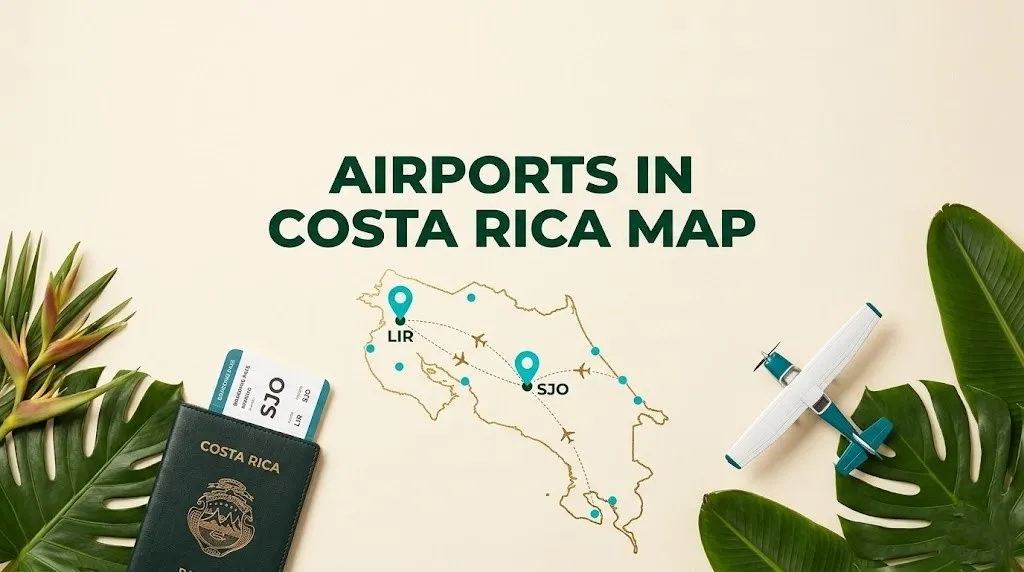
The domestic airstrip network connects tourists to the coasts. Tamarindo Airport (TNO) serves the northern Nicoya Peninsula surf towns. Quepos La Managua Airport (XQP) serves the Manuel Antonio national park area. Drake Bay Airport (DRK) serves the remote Osa Peninsula. Puerto Jimenez Airport (PJM) serves the southern Osa and Corcovado region. Tortuguero Airport (TTQ) serves the northern Caribbean coast turtle-nesting region. Limon International Airport (LIO) serves the southern Caribbean coast near Puerto Viejo de Talamanca.
First-time Costa Rica visitors should think of SJO as the gateway to everything except Guanacaste beaches. Budget travelers flying Spirit Airlines or Frontier Airlines will arrive at SJO because neither budget carrier serves LIR. Families heading to an all-inclusive Papagayo Peninsula resort must fly into LIR and avoid SJO entirely because the ground transfer from San Jose would consume most of a day. Solo travelers and adventure seekers heading to the Osa Peninsula should fly into SJO and connect on a Sansa Airlines domestic flight to Drake Bay.
Key Takeaway: Costa Rica’s airport map splits the country into two zones: the SJO zone for central, Caribbean, and southern Pacific destinations, and the LIR zone for Guanacaste and northern Nicoya.
Costa Rica International Airports
Costa Rica has exactly two international airports that receive scheduled commercial flights from the United States, Canada, Europe, and Latin America. Juan Santamaria International Airport (SJO) and Daniel Oduber Quiros International Airport, known as Liberia Guanacaste Airport (LIR), are your two entry points.
SJO handles the majority of Costa Rica’s international air traffic as the primary hub for the country. It sits in the Central Valley near the capital city of San Jose and serves as the connecting point for nearly all domestic flights to coastal destinations. LIR is the smaller, more specialized international gateway serving the northwestern Guanacaste province and the Nicoya Peninsula. It has grown significantly in the past decade as direct flights from U.S. cities have proliferated.
The critical geographic distinction between these two airports drives every Costa Rica trip planning decision. SJO is approximately four to five hours by road from the Guanacaste beaches. LIR is approximately 30 to 90 minutes by road from those same beaches. Conversely, SJO is roughly 10 minutes from downtown San Jose and within three hours of Arenal Volcano, Manuel Antonio, and the Caribbean coast. LIR is four to five hours from those same central and eastern destinations.
Budget travelers often book the cheapest Costa Rica flight without checking which airport it serves. A cheap Spirit Airlines flight into SJO may look like a bargain until you add a five-hour private transfer to your Tamarindo hotel. Families should calculate total trip cost including ground transfers before choosing an airport. Business travelers with meetings in San Jose must fly into SJO regardless of flight cost. First-time visitors to a Papagayo resort should filter their flight search to LIR only and accept that the fare may be higher because the transfer savings will offset it.
Juan Santamaria International Airport
Juan Santamaria International Airport (SJO) is Costa Rica’s primary international airport located approximately 20 minutes northwest of downtown San Jose in the city of Alajuela. It handles the vast majority of international passenger traffic entering the country.
SJO operates a single terminal building with two concourses serving both international and domestic flights. The terminal has undergone phased renovation and expansion in recent years to accommodate growing passenger volumes. Facilities include multiple car rental counters, restaurants, duty-free shops, an airport lounge, and domestic flight check-in desks. Immigration and customs processing is located on the main level for arriving international passengers. The airport can feel crowded during peak arrival windows in the early afternoon when multiple U.S. flights land simultaneously.
Multiple international airlines operate at SJO across North America, Latin America, and Europe. Domestic carriers Sansa Airlines and Costa Rica Green Airways operate connecting flights from SJO to coastal destinations using small turboprop aircraft. The domestic terminal is a short walk from the main international arrivals hall. First-time international travelers should allow at least 90 minutes to clear immigration, collect baggage, and clear customs at SJO during peak periods. Budget travelers arriving on Spirit or Frontier should expect a basic arrivals experience with no airline lounge access unless purchased separately. Business travelers can access the airport’s VIP lounge with priority pass membership or a paid day pass.
SJO’s honest limitation is its geographic distance from the Guanacaste beaches that many tourists come to Costa Rica to experience. A traveler landing at SJO with a Tamarindo hotel reservation faces a five-hour ground transfer. Solo travelers should consider a domestic flight connection to a coastal airstrip if their final destination is far from San Jose. This is often cheaper in total trip cost and time than a private transfer.
Key Takeaway: SJO is Costa Rica’s busiest airport and the correct entry point for central highlands, Caribbean coast, and southern Pacific destinations.
Liberia Guanacaste Airport
Liberia Guanacaste Airport (LIR), officially Daniel Oduber Quiros International Airport, serves the northwestern Pacific coast of Costa Rica. It sits approximately 8 miles west of the city of Liberia in Guanacaste province.
LIR operates a single terminal building that expanded significantly in recent years to handle growing international traffic. The terminal is modern, air-conditioned, and considerably smaller and less crowded than SJO. Immigration and customs processing is generally faster than at SJO because fewer flights arrive simultaneously. The arrivals hall leads directly to a courtyard with rental car counters, tour operator desks, and shuttle pick-up zones. A small VIP lounge is available airside for departing passengers.
LIR’s geographic position is its single greatest asset. The airport sits within a 90-minute drive of the most popular Guanacaste beach destinations including Tamarindo, Playa Flamingo, Playa Conchal, Las Catalinas, the Papagayo Peninsula resorts, and Nosara. The drive from LIR to Tamarindo takes approximately 60 to 75 minutes on paved roads. The drive to the Papagayo Peninsula resorts including the Four Seasons and Andaz takes approximately 30 to 40 minutes. This proximity makes LIR the only correct choice for travelers whose final destination is anywhere in Guanacaste or the northern Nicoya Peninsula.
Families with young children will find LIR a vastly more pleasant arrival experience than SJO for Guanacaste trips. The shorter transfer time means kids are on the beach within an hour of clearing customs instead of spending five hours in a shuttle van. Luxury travelers heading to Papagayo resorts should fly into LIR exclusively and book a private transfer or resort-arranged pickup. Budget travelers who find a cheap flight into SJO should calculate the transfer cost before booking. A five-hour private transfer from SJO can cost more than the fare difference between SJO and LIR flights.
SJO vs LIR
The choice between San Jose (SJO) and Liberia (LIR) is the single most important Costa Rica trip planning decision. Your airport determines your transfer time, your total trip cost, and whether you spend your first afternoon on the beach or on the highway.
| Feature | San Jose SJO | Liberia LIR |
|---|---|---|
| IATA Code | SJO | LIR |
| Geographic Zone | Central Valley | Guanacaste Province |
| Distance to San Jose | 12 miles (20 min) | 135 miles (4 to 5 hrs) |
| Distance to Tamarindo | 155 miles (4.5 to 5.5 hrs) | 40 miles (60 to 75 min) |
| Distance to Arenal | 80 miles (2.5 to 3 hrs) | 95 miles (3 to 3.5 hrs) |
| Distance to Manuel Antonio | 95 miles (3 to 3.5 hrs) | 175 miles (5 to 6 hrs) |
| U.S. Airlines | Alaska, American, Delta, United, Southwest, JetBlue, Spirit, Frontier | Alaska, American, Delta, United, Southwest, JetBlue |
| Domestic Flights | Yes, to all coastal airstrips | No scheduled domestic connections |
| Lounge Access | VIP lounge airside and landside | Small VIP lounge airside |
| Best Traveler Profile | Central highlands, Caribbean, southern Pacific, Osa Peninsula | Guanacaste beaches, Papagayo, Nicoya Peninsula |
| Honest Limitation | Far from Guanacaste beaches | No domestic flight connections |
Budget travelers must check both SJO and LIR pricing before booking. The fare difference is often smaller than the ground transfer cost difference. Families heading to Guanacaste should filter searches to LIR only and accept a potentially higher fare because the transfer savings will justify it. Business travelers with meetings in San Jose have no choice and must fly SJO. First-time visitors unsure of their itinerary should default to SJO because it provides access to more of the country.
Key Takeaway: Fly LIR for Guanacaste beaches and Nicoya Peninsula; fly SJO for everything else including Arenal, Manuel Antonio, and the Caribbean.
Which Costa Rica Airport Is Better
Neither Costa Rica airport is universally better. The right airport depends entirely on your final destination within Costa Rica and your traveler profile.
Liberia Guanacaste Airport (LIR) is better for any traveler whose final destination sits in Guanacaste province or the northern Nicoya Peninsula. The transfer time savings are dramatic: 60 to 90 minutes from LIR versus five hours from SJO to Tamarindo. This holds true for Tamarindo, Playa Grande, Playa Flamingo, Playa Conchal, Las Catalinas, Nosara, Samara, and the Papagayo Peninsula resort complex. LIR is also the better airport for travelers connecting to southern Nicaragua destinations like San Juan del Sur because Liberia sits close to the border.
Juan Santamaria International Airport (SJO) is better for travelers heading to the central highlands, Arenal Volcano, Monteverde, Manuel Antonio, the Osa Peninsula, the Caribbean coast, or any destination in the southern half of the country. SJO is also the better airport for travelers who plan to connect to a domestic flight to a remote coastal airstrip because all domestic airlines operate from San Jose. Travelers who want lounge access with more robust facilities will find SJO’s VIP lounge offerings superior to LIR’s single small airside lounge.
Solo travelers with flexible plans should fly into SJO and then book domestic flights or shuttles based on weather and surf conditions. Families with a fixed resort reservation in Guanacaste must fly into LIR because the transfer time difference is too significant with children. Budget travelers should price both airports including the transfer cost to their specific hotel before deciding. A cheap flight to the wrong airport is not a bargain. First-time visitors who plan to see both Arenal and a Guanacaste beach should consider flying into LIR and out of SJO on an open-jaw ticket to avoid a long return transfer.
Airlines That Fly to Costa Rica
Costa Rica receives direct flights from the United States, Canada, Mexico, Central America, South America, and Europe. The U.S. market dominates international service with the highest frequency and broadest route coverage.
Major U.S. carriers serving Costa Rica include Alaska Airlines, American Airlines, Delta Air Lines, United Airlines, Southwest Airlines, JetBlue Airways, Spirit Airlines, and Frontier Airlines. U.S. airlines serve SJO from major hubs including Atlanta, Dallas, Houston, Miami, Newark, Los Angeles, and Denver. LIR receives U.S. service from a smaller subset of these cities with Alaska, American, Delta, United, Southwest, and JetBlue operating seasonal or year-round routes.
Canadian airlines Air Canada and WestJet serve both SJO and LIR from Toronto, Montreal, and Calgary on a seasonal schedule that peaks during the Canadian winter. Copa Airlines connects Costa Rica to the rest of Latin America through its Panama City hub. Avianca offers connections through its San Salvador and Bogota hubs. European carriers including Iberia, Air France, Lufthansa, Edelweiss Air, and British Airways operate direct flights to SJO from their respective hubs. No European airline flies direct to LIR as of current schedules.
Budget travelers flying from the U.S. should compare Spirit and Frontier fares into SJO against full-service carrier fares into LIR. The budget carrier base fare will be lower, but checked bag fees, carry-on fees, and seat selection fees narrow the gap quickly. Families with checked luggage should calculate the all-in cost including baggage fees before assuming the budget carrier is cheaper. Business travelers and loyalty program members should prioritize their preferred airline’s hub for direct service and upgrade availability.
Verify current airline service on the official Costa Rica tourism board’s flight schedule page or directly with each airline before booking. Seasonal routes appear and disappear without broad announcement.
Key Takeaway: Eight U.S. airlines serve Costa Rica, with all flying to SJO and a subset flying to LIR depending on the season.
Airlines at San Jose Airport
Juan Santamaria International Airport (SJO) hosts the largest concentration of airlines in Costa Rica. More than 20 international carriers operate scheduled passenger flights to SJO from across the Americas and Europe.
U.S. airlines with direct service to SJO include Alaska Airlines, American Airlines, Delta Air Lines, United Airlines, Southwest Airlines, JetBlue Airways, Spirit Airlines, and Frontier Airlines. This is the most complete U.S. carrier roster of any Central American airport. American Airlines operates from its Miami and Dallas hubs. United serves SJO from Houston, Newark, and Denver. Delta flies from Atlanta and seasonally from other hubs. Southwest offers service from Houston, Baltimore, and seasonal routes. JetBlue connects from Orlando, Fort Lauderdale, and New York. Spirit and Frontier operate from their Florida bases and select focus cities.
International carriers beyond the U.S. include Air Canada, WestJet, Copa Airlines, Avianca, Aeromexico, Iberia, Air France, Lufthansa, Edelweiss Air, British Airways, and KLM. This diverse international roster makes SJO one of the best-connected airports in Latin America. Copa Airlines’ Panama City hub connection is particularly useful for travelers originating in cities without direct SJO service.
Business travelers loyal to a specific airline alliance will find Star Alliance (United, Avianca, Copa, Lufthansa), Oneworld (American, British Airways, Iberia), and SkyTeam (Delta, Air France, KLM) all represented at SJO. First-time international travelers connecting through a U.S. hub should verify their baggage is checked through to SJO at their first departure point. Budget travelers flying Spirit or Frontier should download the airline’s app and check in before arriving at the airport to avoid counter check-in fees. Verify your airline’s current terminal and gate assignment on the official SJO airport website before departure day.
Airlines at Liberia Airport
Liberia Guanacaste Airport (LIR) serves a smaller but growing roster of international carriers focused on the North American market. The airport’s route network is heavily concentrated on direct service from U.S. and Canadian cities.
U.S. airlines serving LIR include Alaska Airlines, American Airlines, Delta Air Lines, United Airlines, Southwest Airlines, and JetBlue Airways. Alaska Airlines operates from Los Angeles and seasonally from other West Coast cities. American flies from Miami, Dallas, and seasonal routes. Delta serves LIR from Atlanta and seasonally from Minneapolis and other hubs. United operates from Houston, Newark, Denver, and seasonal expansion cities. Southwest offers service from Houston and Baltimore. JetBlue connects from New York and Boston on a seasonal schedule.
Canadian carriers Air Canada and WestJet serve LIR from Toronto, Montreal, and Calgary with peak frequency during the Canadian winter season from November through April. Copa Airlines connects LIR to its Panama City hub for Latin American connections. European carriers do not serve LIR directly as of current route schedules. A traveler originating in Europe must connect through a U.S. or Canadian hub to reach LIR.
Budget travelers will note that Spirit Airlines and Frontier Airlines do not serve LIR. The lowest published fares to Guanacaste typically appear on Southwest, JetBlue, or major U.S. carrier basic economy fares. Families heading to a Papagayo resort should search LIR flights first and only consider SJO if the LIR fare difference is genuinely extreme. The transfer cost from SJO to Guanacaste for a family of four often exceeds the per-person fare savings on a budget SJO flight. Verify LIR route maps directly with each airline because seasonal schedules change and some routes operate only during peak months.
Key Takeaway: LIR serves U.S. and Canadian airlines heavily, with no European direct service and no budget ultra-low-cost carriers as of current route maps.
Costa Rica Domestic Airports
Costa Rica operates an extensive network of small domestic airstrips serving tourist destinations inaccessible by direct international flights. These airstrips are concentrated along the Pacific coast with additional service to the Caribbean coast and the Osa Peninsula.
The domestic airport network functions as a hub-and-spoke system radiating from the San Jose metropolitan area. Most domestic flights depart from Juan Santamaria International Airport (SJO) or from nearby Tobias Bolanos International Airport (SYQ) in the Pavas district of San Jose. Two domestic airlines, Sansa Airlines and Costa Rica Green Airways, operate the vast majority of scheduled domestic passenger flights. A small number of charter operators including Aerobell Airlines serve additional routes on demand.
Key domestic airstrips and the destinations they serve:
- Tamarindo Airport (TNO): Northern Nicoya Peninsula surf beaches and resorts
- Quepos La Managua Airport (XQP): Manuel Antonio National Park
- Drake Bay Airport (DRK): Northern Osa Peninsula and Corcovado access
- Puerto Jimenez Airport (PJM): Southern Osa Peninsula and Corcovado National Park
- Golfito Airport (GLF): Southern Pacific coast and Pavones surf access
- Tortuguero Airport (TTQ): Northern Caribbean coast turtle-nesting region
- Limon International Airport (LIO): Southern Caribbean coast and Puerto Viejo de Talamanca
Domestic flights within Costa Rica are primarily operated by single-engine turboprop aircraft. Sansa Airlines flies the Cessna 208B Grand Caravan seating up to 12 passengers. Costa Rica Green Airways flies the Cessna 208 Caravan and Cessna 172 aircraft on select routes. These are small, non-pressurized aircraft with strict baggage weight limits. Solo travelers and adventure travelers connecting to the Osa Peninsula will find domestic flights a vastly superior option to ground transfers that can take eight hours or more on rough roads. Families with young children should evaluate whether their kids are comfortable in a small single-engine aircraft with limited cabin space before booking a domestic flight.
Sansa Airlines Domestic Flights
Sansa Airlines is Costa Rica’s primary domestic carrier operating scheduled passenger flights from San Jose to coastal and remote airstrips. The airline operates as the domestic arm of Avianca with a hub at Juan Santamaria International Airport (SJO).
Sansa operates a fleet of Cessna 208B Grand Caravan aircraft configured with 12 passenger seats in a single-cabin layout. These single-engine turboprop aircraft are the workhorses of Costa Rican domestic aviation. They are reliable, well-suited to short unpaved airstrips, and offer spectacular low-altitude views of the Costa Rican landscape during flight. The aircraft cabin is not pressurized and flights operate at altitudes below 10,000 feet, which makes for smooth and scenic flying in clear weather.
Sansa’s route network covers the Pacific coast from north to south. Destinations include Tamarindo (TNO), Nosara (NOB), Samara (PLD), Cobano (for Montezuma and Santa Teresa), Quepos La Managua (XQP), Drake Bay (DRK), Puerto Jimenez (PJM), and Golfito (GLF). The airline also serves Tortuguero (TTQ) on the northern Caribbean coast and Limon (LIO) on the southern Caribbean coast. Flight times are short, typically 30 to 60 minutes, which replaces ground transfers of five to eight hours on challenging roads.
Solo travelers and adventure travelers will find Sansa the most time-efficient way to reach the Osa Peninsula from San Jose. The flight to Drake Bay takes roughly 50 minutes compared to an eight-hour drive and a boat transfer. Budget travelers should compare Sansa fares against shared shuttle costs on a time-versus-money basis. Families must check Sansa’s current baggage weight limits on the airline’s official website before booking. The Cessna Grand Caravan has tight weight restrictions, and excess baggage may be bumped to a later flight or refused outright. Book Sansa flights at least two to three weeks ahead during peak dry season months.
Key Takeaway: Sansa Airlines operates Cessna 208B Grand Caravans from SJO to coastal airstrips, turning eight-hour ground transfers into 50-minute flights.
Costa Rica Green Airways
Costa Rica Green Airways is a newer domestic carrier offering scheduled and charter flights from San Jose to select coastal destinations. The airline operates from Tobias Bolanos International Airport (SYQ) in the Pavas district of San Jose.
Costa Rica Green Airways operates Cessna 208 Caravan aircraft on its scheduled routes, configured for small passenger groups. The airline differentiates itself from Sansa with a focus on premium small-group service, flexible scheduling, and charter options. Flights depart from SYQ rather than SJO, which means international arriving passengers must complete a short ground transfer between the two San Jose airports. The airline arranges this transfer for connecting passengers who book the full itinerary.
The Costa Rica Green Airways route network includes service to Quepos La Managua (XQP) for Manuel Antonio, Drake Bay (DRK) for the Osa Peninsula, Puerto Jimenez (PJM) for the southern Osa, Tamarindo (TNO) for the northern Nicoya, and several other coastal destinations on a scheduled or charter basis. The airline’s smaller passenger counts and premium service approach make it a strong option for families or small groups who want a more personalized domestic flight experience.
Solo travelers connecting through SJO to a Costa Rica Green Airways flight at SYQ must allow at least two hours between international arrival and domestic departure. The ground transfer between airports plus check-in and baggage processing consumes that time. Budget travelers will find Sansa’s per-seat pricing more competitive on shared routes, but Costa Rica Green Airways offers a premium alternative for travelers who value flexibility and small-group service. Verify current schedules, routes, and SYQ transfer logistics directly on the Costa Rica Green Airways official website before booking. Domestic airline schedules in Costa Rica are subject to change with minimal notice.
San Jose Airport to Arenal Transfer
The transfer from Juan Santamaria International Airport (SJO) to the Arenal Volcano area takes approximately 2.5 to 3.5 hours depending on road conditions and your exact destination. The route covers roughly 80 miles of highway and mountain roads.
The drive from SJO to La Fortuna, the primary town serving Arenal Volcano, follows Route 1 westbound and then turns north onto well-maintained mountain roads. The route is paved for its entire length as of current road conditions. Road signage is adequate but not comprehensive, so a GPS or phone-based navigation system with offline maps is strongly recommended. The drive passes through coffee plantations and cloud forest terrain with scenic viewpoints.
Shared shuttle transfers operate daily from SJO to La Fortuna and Arenal-area hotels at scheduled intervals. A shared shuttle is the most cost-effective door-to-door option for solo travelers and couples. The total journey time on a shared shuttle runs longer than a private transfer because the shuttle stops at multiple hotels along the route. A private transfer takes approximately 2.5 hours directly to your Arenal hotel and costs significantly more than a shared shuttle. Rental cars are available at SJO from major international agencies including Hertz, Enterprise, and local operators.
Budget travelers should book a shared shuttle in advance through a reputable operator. Verify the shuttle company’s departure times match your flight arrival because most shared shuttles depart on a fixed schedule. Families with young children will find a private transfer more practical because the direct trip avoids multiple hotel stops. Solo travelers comfortable driving in a foreign country can rent a small car for the SJO-to-Arenal drive. A 4×4 is not required for this specific route. The entire drive is on paved roads in normal dry season conditions.
Key Takeaway: The SJO-to-Arenal drive takes 2.5 to 3.5 hours on paved roads, with shared shuttles offering the best cost-value ratio for solo travelers.
Liberia Airport to Tamarindo Transfer
The transfer from Liberia Guanacaste Airport (LIR) to Tamarindo takes approximately 60 to 75 minutes on paved roads covering roughly 40 miles. This is one of Costa Rica’s most straightforward and well-traveled airport transfer routes.
The drive from LIR to Tamarindo follows Route 21 south and then Route 155 west toward the coast. The roads are paved and well-maintained for their entire length as of current conditions. The route passes through dry tropical forest and cattle ranch land typical of Guanacaste province. A GPS or offline navigation app is recommended because the final approach into Tamarindo involves several turns without prominent signage.
Shared shuttle transfers, private transfers, and rental cars are all readily available at LIR. Shared shuttles depart on a scheduled basis and offer the most cost-effective transfer option. A private transfer provides direct hotel delivery in about 60 minutes and is the preferred option for families and small groups. Major rental car agencies operate desks in the LIR arrivals courtyard. Advance reservation is strongly recommended during the December through April peak tourist season when vehicles and shuttles sell out.
Budget travelers should price shared shuttle fares against the total cost of a rental car plus mandatory Costa Rican liability insurance before committing. A rental car may be more cost-effective for a group of three or more if you plan to use the car during your stay. Solo travelers staying in a central Tamarindo hotel can save significantly by booking a shared shuttle rather than a private transfer. Families with a resort reservation should book a private transfer or use the resort’s arranged pickup service for the smoothest arrival experience. Verify current road conditions with your transfer provider or rental agency before departure, as rainy season downpours can temporarily affect unpaved side roads.
Closest Airport to Tamarindo Costa Rica
Tamarindo Airport (TNO) is the closest airport to Tamarindo at roughly 3 miles north of town. Liberia Guanacaste Airport (LIR) is the closest international airport at approximately 40 miles east.
Tamarindo Airport (TNO) is a small domestic airstrip served by Sansa Airlines and Costa Rica Green Airways on flights from San Jose. The flight from SJO to TNO takes about 50 minutes. This is a genuine logistical option for travelers who have already arrived in San Jose and need a fast connection to Tamarindo. It is not an alternative to LIR for international arrivals because no international airline serves TNO.
The practical closest airport for a traveler originating in the United States or Canada is Liberia Guanacaste Airport (LIR). The 60 to 75-minute drive from LIR to Tamarindo is fast, direct, and on good roads. A traveler who flies into SJO and connects on a domestic flight to TNO will spend roughly the same total travel time as a traveler who flies directly into LIR and drives to Tamarindo. The direct LIR flight with a ground transfer is almost always the more convenient and less logistically complex option.
Solo travelers already in San Jose who need to reach Tamarindo quickly should book a Sansa flight to TNO. The 50-minute flight replaces a five-hour drive. Budget travelers should compare a Sansa fare plus a San Jose hostel night against the cost of a direct LIR flight plus a shuttle to Tamarindo. Families heading to a Tamarindo vacation rental should fly directly into LIR and take a private transfer. Do not fly into SJO and then drive to Tamarindo unless you genuinely have no other option.
Key Takeaway: Liberia Guanacaste Airport (LIR) is the practical closest international airport to Tamarindo with a 60 to 75-minute drive.
Best Airport for Costa Rica Beach Vacation
The best airport for a Costa Rica beach vacation depends on which coast you are visiting and the specific beach destination. Liberia Guanacaste Airport (LIR) serves the northern Pacific beaches. Juan Santamaria International Airport (SJO) serves the central Pacific, southern Pacific, and Caribbean beaches.
Fly into LIR for the following beach destinations: Tamarindo, Playa Flamingo, Playa Conchal, Las Catalinas, Playa Grande, Nosara, Samara, Carrillo, the Papagayo Peninsula resorts including the Four Seasons and Andaz, Playas del Coco, Playa Hermosa Guanacaste, and Playa Panama. LIR also serves Nicaragua’s San Juan del Sur as a practical entry point for travelers continuing north across the border.
Fly into SJO for the following beach destinations: Manuel Antonio, Jaco, Playa Hermosa Puntarenas, Dominical, Uvita, Pavones, the Osa Peninsula including Drake Bay and Puerto Jimenez, Puerto Viejo de Talamanca, Cahuita, Tortuguero, and the entire southern Caribbean coast. For the Osa Peninsula and southern Pacific coast, connect from SJO on a Sansa Airlines or Costa Rica Green Airways domestic flight to Drake Bay or Puerto Jimenez.
Budget travelers should choose their airport based on total trip cost including transfers, not the flight fare alone. A cheap flight into SJO for a Tamarindo vacation adds a five-hour transfer cost that often exceeds the fare savings. Families should fly into LIR for any Guanacaste beach and into SJO for Manuel Antonio or the Caribbean. Solo travelers surfing the Nicoya Peninsula should fly into LIR for Tamarindo and Nosara, and into SJO with a domestic connection for the southern Pacific breaks. Never assume SJO is the default Costa Rica airport because the Guanacaste coast is the country’s most popular beach region and LIR serves it directly.
Important Accuracy Notes for Costa Rica Airport Travel
Domestic flight schedules, international airline route maps, and ground transfer road conditions change without broad public notice in Costa Rica. Seasonal weather affects both flight reliability and drive times.
Verify the following directly before traveling:
- Verify current domestic flight routes and schedules directly with Sansa Airlines and Costa Rica Green Airways before booking. Seasonal changes are common.
- Verify international airline service to LIR and SJO on the airline’s official route map. Some routes operate seasonally only.
- Verify ground transfer drive times with your shuttle provider or rental agency and account for rainy season road impacts.
- Verify current baggage weight limits for domestic flights on Sansa and Costa Rica Green Airways official websites. Small aircraft have strict weight restrictions.
- Check the U.S. State Department Costa Rica travel page for current entry requirements and safety information before departure.
- Confirm your specific hotel’s distance from each airport and ask the hotel which transfer option they recommend based on current road conditions.
The single most important action before booking: decide your beach destination first, then choose the airport that serves it directly. Never choose an airport based on flight price alone.
Frequently Asked Questions About Costa Rica Airports
How many international airports are in Costa Rica?
Costa Rica has exactly two international airports with scheduled commercial passenger service from the United States and beyond.
Juan Santamaria International Airport (SJO) serves the central highlands near San Jose.
Liberia Guanacaste Airport (LIR) serves the northwestern Guanacaste province and Nicoya Peninsula beaches.
Is it better to fly into San Jose or Liberia Costa Rica?
Fly into Liberia (LIR) if your destination is any Guanacaste beach, the Papagayo Peninsula, or the northern Nicoya Peninsula.
Fly into San Jose (SJO) if your destination is Arenal, Manuel Antonio, the Caribbean coast, or the Osa Peninsula.
Your specific final destination in Costa Rica determines which airport is better because the drive between SJO and LIR takes four to five hours.
What is the closest airport to Tamarindo Costa Rica?
Tamarindo Airport (TNO) is the closest airport at 3 miles away, served by domestic flights from San Jose on Sansa Airlines and Costa Rica Green Airways.
Liberia Guanacaste Airport (LIR) is the closest international airport at roughly 40 miles away with a drive time of 60 to 75 minutes.
For international travelers, LIR is the practical airport to fly into for Tamarindo because no international airline serves TNO.
Do I need a domestic flight within Costa Rica?
You need a domestic flight if your international arrival is at SJO and your final destination is the Osa Peninsula, Drake Bay, or Puerto Jimenez.
You do not need a domestic flight if you fly into LIR for Guanacaste beaches or if you drive from SJO to Arenal or Manuel Antonio.
A domestic flight saves hours of ground travel for remote coastal destinations but is unnecessary for destinations within a three-hour drive of your international arrival airport.
Which US airlines fly direct to Costa Rica?
Eight U.S. airlines fly direct to Costa Rica including Alaska Airlines, American Airlines, Delta Air Lines, United Airlines, Southwest Airlines, JetBlue Airways, Spirit Airlines, and Frontier Airlines.
All eight serve Juan Santamaria International Airport (SJO) in San Jose.
Alaska, American, Delta, United, Southwest, and JetBlue also serve Liberia Guanacaste Airport (LIR) on seasonal or year-round schedules.
How long is the drive from San Jose airport to Arenal?
The drive from Juan Santamaria International Airport (SJO) to La Fortuna in the Arenal Volcano area takes approximately 2.5 to 3.5 hours.
The roughly 80-mile route follows paved roads through the Central Valley and into the mountain foothills.
A private transfer or shared shuttle is the most common ground transportation option for this route, and a 4×4 vehicle is not required.
Your Costa Rica Airport Decision in Three Steps
First, decide your primary destination. Guanacaste or Nicoya Peninsula means Liberia Airport (LIR). Everything else means San Jose Airport (SJO). Second, compare the all-in cost including ground transfers for your specific hotel, not just the flight fare. Third, book your international flight, then immediately secure your domestic connection or ground transfer because both sell out during peak season.
Costa Rica’s airport network is simple once you see the geographic logic. The country splits into two zones, each served by one international airport and connected by a network of domestic flights that turn long drives into short scenic hops. Verify airline routes, domestic schedules, and road conditions directly with operators before you travel. Policies, flight schedules, and seasonal service patterns change without broad notice. Book the right airport, lock in your transfer, and you will spend your first Costa Rica afternoon exactly where you intended to be.