Ethiopian Airlines operates Africa’s largest and most modern fleet connecting over 125 international destinations.
Most passengers book for the competitive Africa fares, not for an extravagant experience.
The airline joined Star Alliance in 2011 and now moves roughly 12 million passengers yearly through its Addis Ababa hub.
Its network reaches more African cities than Emirates, Turkish Airlines, and Qatar Airways combined.
This review covers the hard product on A350 and 787 Dreamliner aircraft, the soft service reality, and the ADD transit hub.
It tells you which cabins deliver real value and which traveler types should look at competing carriers.
Ethiopian Airlines Safety and Reliability Standards
Ethiopian Airlines maintains a strong safety record with a modern fleet and an IATA Operational Safety Audit certification.
The airline completed the FAA’s IASA Category 1 safety assessment and maintains extensive internal pilot training programs.
The fleet’s average age remains under seven years, which is young by global full-service carrier standards.
New Airbus A350 and Boeing 787 Dreamliner deliveries continue replacing the older Boeing 767 and 777 fleet.
Business and frequent flyers value the airline’s on-time departure statistics on long-haul intercontinental routes to Europe and North America.
Regional African routes face more operational delays from airport infrastructure and weather than from the airline’s own shortcomings.
First-time international travelers transiting through Addis Ababa should know the airport sits at 7,700 feet of elevation.
The altitude means aircraft take longer to lift off and cabin service timing sometimes shifts from high-altitude galley limitations.
Key Takeaway: Ethiopian Airlines meets global safety oversight standards, but the high-altitude ADD hub creates unique operational realities travelers should expect.
Ethiopian Airlines Fleet and Cabin Configurations
Ethiopian Airlines operates a mixed wide-body fleet of Airbus A350-900, Boeing 787-8, and Boeing 787-9 Dreamliner aircraft on long-haul routes.
The older Boeing 777-300ER still serves a few high-density routes with a less competitive cabin product.
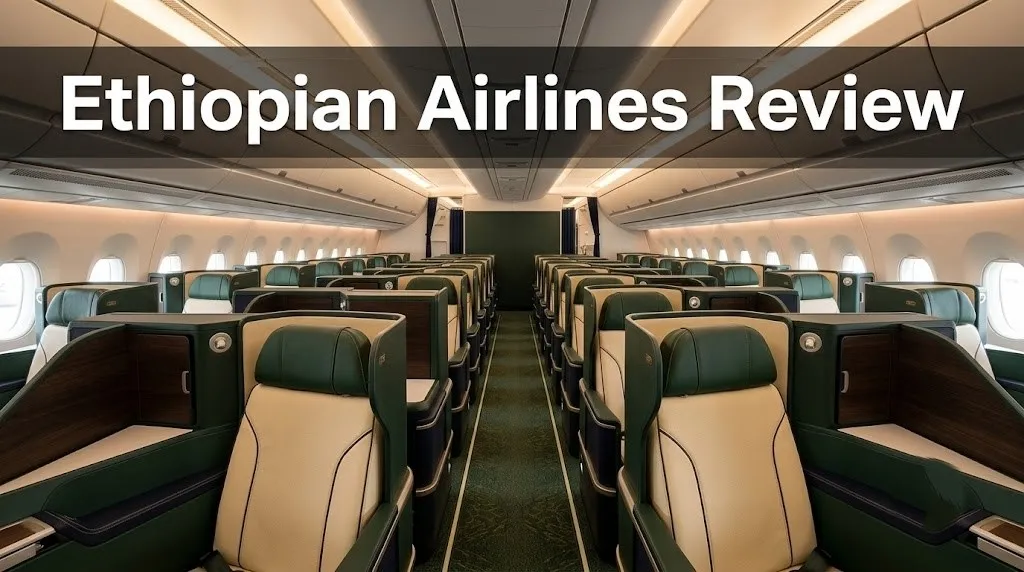
The A350-900 offers the best hard product with a 1-2-1 reverse herringbone layout in business class and a quieter cabin.
Boeing 787-8 aircraft use a 2-2-2 configuration in Cloud Nine business class, which lacks direct aisle access for window passengers.
Budget travelers in economy get a standard 3-3-3 layout on the 787 with modern seat architecture and better humidity control.
The older 777-300ER packs in a tighter 3-4-3 economy arrangement that feels noticeably more cramped on long sectors.
Families should prioritize the A350 and 787 for more modern seat design and better cabin pressure management.
Solo travelers in business class must pick the A350 to guarantee direct aisle access in every seat.
Insider Tip: Check the specific aircraft assigned to your flight date on the Ethiopian Airlines seat map tool.
The airline swaps equipment more frequently than European carriers, and a booked A350 can become a 787-8 with an inferior business seat.
Ethiopian Airlines Economy Class Legroom and Comfort
Ethiopian Airlines economy class provides a standard 31 to 32 inches of seat pitch on its long-haul Boeing 787 Dreamliner and Airbus A350 aircraft.
The seat width measures around 17 to 18 inches across most of the modern wide-body fleet.
The 787-8 Dreamliner features Boeing’s Signature Interior with larger windows, LED mood lighting, and better cabin pressure.
Passengers on 10-hour flights between Washington D.C. and Addis Ababa report noticeably less fatigue on the Dreamliner compared to older metal.
Budget travelers get a functional seat cushion that feels adequate for a transatlantic flight but not plush.
Tall passengers over six feet will find the knee clearance tight and should request a bulkhead or exit row seat at check-in.
Families with children appreciate the adjustable headrests with folding wings that provide some neck support for sleeping.
The absence of a premium economy cabin means no middle-ground upgrade option exists between economy and the pricey Cloud Nine business class.
Solo female travelers transiting overnight should pre-select a window seat to avoid aisle disturbances on long Africa-Asia segments.
The economy cabin feels safe and well-attended on Ethiopian Airlines flights staffed by professional crews.
Important Accuracy Notes for Ethiopian Airlines Seat Assignments
Seat pitch and configuration can vary between aircraft subtypes, even within the same model family.
Verify the following directly before booking:
Your specific flight’s aircraft type on the Ethiopian Airlines seat map tool during booking or manage booking portal
Exit row and bulkhead seat availability and any associated seat selection fees for your fare class
The exact seat configuration for your 787 flight, as the 787-9 layout differs slightly from the 787-8
Ethiopian Airlines Business Class Seats: Cloud Nine
Ethiopian Airlines Cloud Nine business class delivers a true lie-flat bed on the Airbus A350-900 and Boeing 787-9 Dreamliner.
The A350 uses a 1-2-1 reverse herringbone configuration with direct aisle access from every seat and a fully flat sleeping surface.
The Boeing 787-8 Dreamliner business class uses a dated 2-2-2 layout with angled-flat seats that do not go fully horizontal.
Window passengers in a 2-2-2 configuration must step over a sleeping neighbor to reach the aisle, a significant privacy and comfort limitation.
Business and frequent flyers flying from North America to Addis Ababa should specifically book the A350 service for the superior seat.
The A350 business seat converts to a roughly 78-inch bed with good width and a mattress pad provided on request.
Solo travelers should avoid the 787-8 business class on overnight long-haul sectors where the angled-flat recline disrupts proper sleep.
The 2-2-2 seat feels more like a premium recliner than a true business class bed and lags behind competitor products.
The seat control panel is intuitive and the privacy shell on the A350 creates a genuinely personal space.
Storage around the seat remains limited compared to Emirates’ A380 business class or Turkish Airlines’ 787 business product.
| Aircraft Type | Seat Configuration | Bed Type | Direct Aisle Access | Best For |
|---|---|---|---|---|
| Airbus A350-900 | 1-2-1 reverse herringbone | Fully lie-flat | Yes, every seat | Solo travelers, long-haul |
| Boeing 787-9 Dreamliner | 1-2-1 | Fully lie-flat | Yes | Overnight transatlantic |
| Boeing 787-8 Dreamliner | 2-2-2 | Angled-flat | No, window seats blocked | Short to medium Africa hops |
| Boeing 777-300ER | 2-2-2 | Angled-flat | No | Avoid, choose A350 route |
Key Takeaway: Ethiopian Cloud Nine on the A350 ranks with global competitors, but the 787-8 angled-flat seat is a genuine letdown on routes marketed as premium.
Ethiopian Airlines Inflight Meals and Dining Quality
Ethiopian Airlines serves authentic Ethiopian cuisine alongside standard Western meal options on all long-haul international flights.
The injera, a traditional sourdough flatbread, arrives with flavorful doro wat chicken stew and berbere-spiced lentil dishes.
The airline’s catering hub in Addis Ababa produces fresh meals that depart noticeably from the bland standardization of many global carriers.
Ethiopian coffee service, served from a traditional jebena pot on request, is a genuinely distinctive inflight experience.
Business class dining on the A350 includes a dine-on-demand service with meals plated on ceramic dishes with metal cutlery.
The presentation feels closer to a premium restaurant than the tray-table delivery common on competing African carriers.
Budget travelers in economy receive two hot meal services on long-haul flights with generous portion sizes and fresh bread.
Vegetarians will find the lentil and vegetable stews more satisfying than the typical pasta-and-sauce economy option on Western airlines.
First-time international travelers unfamiliar with Ethiopian cuisine should request the Western option if spicy food causes discomfort.
Berbere spice blend is moderately hot, and the cabin crew cannot adjust the spice level of pre-plated meals.
Insider Tip: Ask for the turbot or tilapia fish dish on flights departing Addis Ababa.
The freshwater fish sourced from Ethiopian lakes is the best economy meal option and regularly outshines the chicken and beef choices.
Ethiopian Airlines Inflight Entertainment Systems
Ethiopian Airlines equips its Airbus A350 and Boeing 787 fleet with high-definition touchscreen inflight entertainment systems.
The screen size measures roughly 12 to 16 inches in business class and 9 to 11 inches in economy class.
The content library includes Hollywood new releases, Nollywood productions, Bollywood hits, and a rich selection of African cinema and music.
Travelers flying for cultural immersion will find the Ethiopian music and documentary content a unique introduction to the destination.
Business and frequent flyers will notice the interface responsiveness feels one generation behind Qatar Airways’ Oryx One or Emirates’ ice system.
The remote control is a tethered handset that works well enough but lacks the second-screen functionality of more premium competitors.
Families with children get a dedicated kids’ section with animated films and basic games.
The parental lock controls work, but the children’s content library is smaller than what Emirates or Turkish Airlines provides.
Budget travelers on older Boeing 777-300ER aircraft may encounter smaller, lower-resolution screens with a more limited selection.
WiFi is available on A350 and select 787 aircraft, but coverage is not fleet-wide and remains unreliable over central Africa.
The IFE system includes a moving map with flight statistics that aviation enthusiasts will appreciate.
Noise-canceling headphones are provided in business class and are adequate but not the high-end Bose or Sony models some competitors distribute.
Ethiopian Airlines Addis Ababa Lounge Access
Ethiopian Airlines operates the Cloud Nine Lounge and the Star Alliance Gold Lounge at Addis Ababa Bole International Airport.
Cloud Nine business class passengers, ShebaMiles Gold Elite members, and Star Alliance Gold cardholders receive lounge access.
The Cloud Nine Lounge in the international departure area offers a spacious seating area with runway views and a dedicated dining zone.
The food spread includes injera-based dishes, fresh salads, hot soups, and a complimentary bar service with Ethiopian coffee.
Business and frequent flyers will find the lounge functional and comfortable, but it does not match the opulence of Emirates’ Dubai lounges.
The shower facilities are clean and available, which matters enormously for passengers connecting after a long-haul overnight flight.
First-time international travelers transiting ADD should use the lounge during long layovers for a quieter rest environment.
The main terminal seating areas get congested during the morning and evening departure banks when connecting traffic peaks.
The lounge WiFi works more reliably than the general terminal network, making it a better space for last-minute work.
Solo female travelers will find the lounge well-lit and staffed with attentive attendants, creating a more comfortable transit space than the public concourse.
Key Takeaway: The Cloud Nine Lounge exceeds expectations for a hub lounge in East Africa, with fresh food and shower access making it a genuine layover asset.
Ethiopian Airlines Transit Experience at ADD
Addis Ababa Bole International Airport serves as Ethiopian Airlines’ sole connecting hub and Africa’s busiest transit point.
Connecting passengers follow a dedicated transit corridor that separates from arriving passengers clearing immigration at ADD.
The terminal layout follows a single-building design with a newer international wing and a cramped older section still in use.
Passengers connecting between two international flights pass through a security screening checkpoint before re-entering the departure concourse.
Business and frequent flyers on tight 90-minute connections should move to the transit security point immediately upon deplaning.
The morning and evening transit banks create long screening queues that can swallow 30 minutes, and the queue discipline differs from Western airport norms.
Families with young children transiting late at night face a terminal with limited play areas and minimal open food outlets after 10 p.m.
Pack snacks in carry-on bags and download entertainment for children before arriving at ADD for night connections.
Solo travelers transiting overnight should confirm their hotel voucher eligibility at the Ethiopian Airlines transit desk before leaving the airport.
The airline provides complimentary Skylight Hotel accommodation for long layovers exceeding a specific duration, but the policy changes without notice.
The terminal’s air conditioning struggles during the afternoon heat, and the altitude above 7,700 feet makes walking long distances tiring.
Wheelchair assistance and electric cart service exist but must be requested well in advance through the airline’s special assistance desk.
Insider Tip: Ethiopian Airlines offers a free Addis Ababa city tour for passengers with long layovers, subject to immigration eligibility.
Verify your nationality’s visa-on-arrival status before booking the tour, as not all passport holders qualify without a pre-arranged eVisa.
Ethiopian Airlines Baggage and Carry-On Policy
Ethiopian Airlines standard economy class baggage allowance permits two checked bags weighing 23 kilograms each on most international long-haul routes.
The carry-on allowance permits one bag up to 7 kilograms plus a personal item such as a handbag or small laptop sleeve.
Business class passengers receive two checked bags at 32 kilograms each and an expanded carry-on allowance of two pieces.
The Cloud Nine baggage tag priority delivery works well at major airports but inconsistently at smaller African regional stations.
Budget travelers must verify the specific fare class baggage rules, as Ethiopian Airlines’ discount economy fares sometimes exclude the second checked bag.
A bag weighing over 23 kilograms at check-in triggers excess weight charges that climb steeply for every additional kilogram.
Families traveling with infants get an additional checked bag allowance for strollers and car seats free of charge.
The airline enforces carry-on weight limits at Addis Ababa departures more strictly than at outstation airports like Washington Dulles or London Heathrow.
First-time international travelers connecting through ADD from a domestic Ethiopian flight should reconfirm the baggage allowance on the domestic leg.
Domestic Ethiopian routes use smaller turboprop and Q400 aircraft with tighter weight and size restrictions that differ from the international policy.
Important Accuracy Notes for Ethiopian Airlines Baggage
Baggage allowances differ by route, fare class, and frequent flyer status level.
Verify the following directly before packing:
Your exact fare class baggage allowance on the Ethiopian Airlines manage booking portal or e-ticket receipt
Carry-on weight limits for your specific route, as ADD departures are enforced with a scale at the security checkpoint entrance
Domestic connection baggage rules if your itinerary includes a domestic Ethiopian sector
Ethiopian Airlines ShebaMiles Loyalty Program
Ethiopian Airlines runs the ShebaMiles frequent flyer program with Silver, Gold, and Platinum elite status tiers.
ShebaMiles miles accrue on Ethiopian Airlines flights and on partner airlines within the Star Alliance network.
Gold Elite status delivers the most practical benefits including lounge access, priority boarding, and an extra checked bag.
The mileage redemption chart offers reasonable value for flights within Africa and between Africa and the Middle East on Ethiopian-operated metal.
Business and frequent flyers based in North America will find ShebaMiles less rewarding than United MileagePlus or Air Canada Aeroplan for transatlantic redemptions.
The program’s award availability on long-haul business class seats is limited during peak summer and December holiday travel periods.
Budget travelers can earn ShebaMiles on Ethiopian’s affordable economy fares, though the lowest booking classes earn a reduced mileage rate.
Miles expire after three years of account inactivity, so occasional travelers must keep the account active with a small earning or redemption.
First-time international travelers should credit Ethiopian Airlines flights to a Star Alliance program they already use, like United MileagePlus.
This strategy consolidates miles in one program rather than leaving small balances across multiple African airline programs with limited redemption options.
ShebaMiles offers a family pooling feature that allows related travelers to combine miles into one account.
This benefit helps families accumulate enough miles for a reward ticket faster than individual earning would allow.
Key Takeaway: ShebaMiles works best for Africa-based travelers and frequent fliers on the continent, while North American travelers should credit to a U.S. Star Alliance program instead.
Ethiopian Airlines vs Emirates: Which Airline Wins
Ethiopian Airlines and Emirates serve different network strengths, and the better airline depends entirely on the specific route.
Emirates operates a premium-heavy, all-wide-body fleet with superior business class and inflight entertainment across every aircraft.
Ethiopian Airlines offers more nonstop African destinations and often delivers a better fare on Africa-to-Asia and Africa-to-North America itineraries.
Emirates routes nearly all Africa flights through Dubai, adding significant flight time for travelers heading to East or West Africa from North America.
Business and frequent flyers on a New York to Nairobi itinerary will arrive faster on Ethiopian via ADD than on Emirates via DXB.
The Emirates A380 business class seat, bar, and lounge experience far outclass the Ethiopian Cloud Nine product on the A350.
Budget travelers flying from Washington D.C. to Addis Ababa will find Ethiopian’s nonstop service beats Emirates’ one-stop routing in both price and travel time.
Emirates economy class offers a more polished soft product, but Ethiopian’s direct flight saves six hours or more on this specific route.
Families connecting through Dubai get a more child-friendly airport with better play areas, dining, and smoother transit logistics.
Solo travelers seeking luxury and consistent Wi-Fi should choose Emirates, while travelers prioritizing destination access and lower fares should book Ethiopian.
| Feature | Ethiopian Airlines | Emirates |
|---|---|---|
| Best Business Seat | A350 1-2-1 lie-flat | A380 1-2-1 lie-flat with bar |
| Africa Destinations | 60+ cities nonstop from ADD | 25+ cities via Dubai |
| Hub Transit | ADD, functional but basic | DXB, world-class terminals |
| Inflight WiFi | Limited, A350/787 only | Fleet-wide, mostly reliable |
| Best For | Africa coverage, competitive fares | Premium experience, Asia connections |
Ethiopian Airlines vs Turkish Airlines for Africa Routes
Ethiopian Airlines and Turkish Airlines compete directly on Africa-to-Europe and Africa-to-North America connecting traffic.
Turkish Airlines operates a larger network into West Africa while Ethiopian dominates East and Southern African routes.
The Turkish Airlines business class on the 787-9 offers a 1-2-1 configuration with fully lie-flat seats and the exceptional Istanbul lounge.
Ethiopian’s A350 business class matches Turkish on the hard product seat, but the Istanbul lounge experience at IST is globally superior.
Budget travelers flying from Lagos to London will find Turkish Airlines often cheaper with a better economy meal service and a shorter overall routing.
Ethiopian Airlines from Lagos to London requires a longer detour through Addis Ababa with a less competitive total journey time.
Business and frequent flyers based in Europe connecting to Southern Africa should choose Ethiopian for the most direct routing via ADD.
Turkish Airlines routes Southern Africa flights through Istanbul, adding a geographically inefficient northern detour compared to Ethiopian’s more direct path.
Families transiting Istanbul find a far smoother experience with better terminal amenities, children’s play areas, and a wider food selection.
Solo travelers with a long layover should choose Turkish to enjoy the free Istanbul tour program and the incomparable IST business lounge.
First-time international travelers to East Africa will find Ethiopian’s cultural immersion begins the moment they step onto the aircraft.
Turkish Airlines offers a more European cabin experience that feels less destination-specific but more consistently polished.
Key Takeaway: Turkish Airlines wins on soft product and hub experience for West Africa, while Ethiopian Airlines wins on route logic and connectivity for East and Southern Africa.
Ethiopian Airlines vs Kenya Airways: African Carriers
Ethiopian Airlines and Kenya Airways represent Africa’s two largest full-service carriers competing for connecting traffic.
Ethiopian operates a larger, younger fleet with more long-haul aircraft and a broader African network than Kenya Airways.
Kenya Airways narrow-body business class on the Boeing 737 or Embraer E190 uses recliner seats that cannot match Ethiopian’s wide-body lie-flat product.
Ethiopian deploys wide-body aircraft on several high-density intra-Africa routes, offering a genuine business class seat on routes where Kenya Airways offers a standard recliner.
Budget travelers flying from North America to East Africa will find Ethiopian’s Washington and Chicago nonstop service unavailable on Kenya Airways.
Kenya Airways relies heavily on European codeshare partners for transatlantic traffic, adding a connection in London, Paris, or Amsterdam.
Business and frequent flyers who value a modern terminal transit experience should choose Kenya Airways’ Nairobi Jomo Kenyatta hub over Addis Ababa.
Nairobi’s newer terminal 1A is brighter and less congested than ADD, though the Kenya Airways Pride Lounge lags behind Ethiopian’s Cloud Nine Lounge.
Families connecting through Nairobi get a less chaotic terminal experience with more food options and clearer signage in English.
Solo female travelers transiting Nairobi at night will find the terminal staff more approachable than the sometimes brusque ADD security personnel.
Both airlines belong to different alliances, Kenya Airways in SkyTeam and Ethiopian in Star Alliance, making the loyalty program choice significant.
Travelers invested in Star Alliance should book Ethiopian, while Delta SkyMiles loyalists should route through Nairobi on Kenya Airways.
Ethiopian Airlines Traveler Suitability: Who Should Fly
Ethiopian Airlines suits Africa-focused travelers who prioritize nonstop connectivity and competitive fares over a polished premium experience.
The airline genuinely delivers for travelers flying to secondary African cities where competitors offer zero or inconvenient service.
Budget travelers heading to East, Central, or Southern Africa should book Ethiopian for the best combination of fare and flight frequency.
The airline’s density of service to cities like Lilongwe, Kigali, and Lusaka means shorter overall travel times than connecting through Europe or the Gulf.
Business and frequent flyers flying long-haul between North America and Africa get a solid product on the A350 with a true lie-flat bed.
The same traveler flying between Asia and Africa should compare Emirates and Qatar Airways, which offer a more consistent business class experience across the fleet.
Families with children should book daytime ADD transits and avoid the late-night connecting bank where terminal services are limited.
The airline provides child meals on request and the crew is generally warm toward families, but the ADD terminal lacks extensive child-friendly facilities.
Solo female travelers will find the onboard experience safe and professionally staffed, though the ADD transit terminal feels less comfortable for solo women at night.
Pre-book the Skylight Hotel and confirm the transit hotel voucher at check-in for overnight layovers to avoid the public terminal seating.
First-time international travelers to Africa get a genuine African experience from the moment of boarding with Ethiopian crew and cuisine.
This cultural authenticity is a genuine asset for travelers seeking destination immersion, not a generic global airline experience.
Key Takeaway: Ethiopian Airlines is the smart choice for direct Africa connectivity and competitive fares on modern aircraft, but not for travelers who prioritize a seamless luxury transit hub.
Frequently Asked Questions About Ethiopian Airlines
Is Ethiopian Airlines a safe airline to fly in 2026?
Ethiopian Airlines holds an IATA Operational Safety Audit certification and completes FAA safety assessments on its U.S.-bound routes.
The airline’s modern Airbus A350 and Boeing 787 fleet maintains an average age of under seven years.
The high-altitude Addis Ababa hub at 7,700 feet creates operational considerations, but the airline’s safety management systems are globally audited.
Does Ethiopian Airlines business class have lie-flat seats?
Ethiopian Airlines business class on the Airbus A350-900 and Boeing 787-9 Dreamliner offers a fully lie-flat seat with direct aisle access.
The Boeing 787-8 Dreamliner business class uses an angled-flat seat in a 2-2-2 configuration that does not go fully horizontal.
Check the specific aircraft assigned to your flight on the Ethiopian Airlines seat map tool before booking.
What is the food like on Ethiopian Airlines flights?
Ethiopian Airlines serves authentic Ethiopian cuisine including injera flatbread with doro wat chicken stew on all long-haul international flights.
Western meal options are available and the business class dining uses ceramic dishware with dine-on-demand service on the A350.
The Ethiopian coffee service from a traditional jebena pot is a genuine highlight that distinguishes the airline from competitors.
How is the transit experience at Addis Ababa Bole Airport?
Addis Ababa Bole International Airport handles high connecting passenger volumes with a functional single-building terminal design.
Transit security screening can take 30 minutes during peak morning and evening connecting banks.
The terminal offers limited dining and seating during overnight transit hours, and travelers with long layovers should confirm hotel voucher eligibility.
Does Ethiopian Airlines offer inflight WiFi?
Ethiopian Airlines offers WiFi on Airbus A350 and select Boeing 787 aircraft with coverage that is not fleet-wide.
The connection remains unreliable over central African airspace and the service should not be counted on for work productivity.
Business travelers requiring consistent connectivity should download all essential documents before the flight.
What is Ethiopian Airlines baggage allowance for economy class?
Ethiopian Airlines economy class baggage allowance typically permits two checked bags at 23 kilograms each on international long-haul routes.
The carry-on allowance is one bag up to 7 kilograms plus a personal item, and ADD departures enforce weight limits strictly.
Exact allowance varies by fare class and route, so verify your specific baggage entitlement on the Ethiopian Airlines manage booking portal.
Your Ethiopian Airlines Booking Decision
Ethiopian Airlines delivers Africa’s most extensive network on a modern A350 and 787 fleet at genuinely competitive fares. The Cloud Nine business class on the A350 competes with global carriers, though the 787-8 product disappoints. The ADD transit experience remains functional rather than enjoyable.
Your single most important action is to verify the exact aircraft type assigned to your flight date. The difference between an A350 and a 787-8 on a 14-hour sector changes the entire travel experience. Use the Ethiopian Airlines seat map tool during booking and check again 72 hours before departure.
Aircraft assignments, baggage policies, transit hotel eligibility, and visa rules for Addis Ababa transit change without public notice. Verify your specific flight details, baggage allowance, and visa requirements directly with Ethiopian Airlines and the U.S. State Department travel page before departure. A verified aircraft type and confirmed transit plan make the difference between a smooth Africa connection and an uncomfortable surprise.