Ethiopian Airlines baggage allowance is a two-system rule that changes based on your departure city. Flights from the US and Canada use a “piece concept” based on the number of suitcases. Most other international routes use a “weight concept” based on total kilograms.
The strictest enforcement happens at Addis Ababa Bole International Airport during the busy morning transit bank. A bag that is one kilogram over the limit will trigger a fee at the connecting gate. You cannot negotiate this fee with the gate agent.
This guide decodes the exact weight, size, and fee structure for every class of service on Ethiopian Airlines. You will learn the specific rule that applies to your exact route before you pack.
Ethiopian Airlines Baggage Allowance
Ethiopian Airlines baggage allowance depends on your departure airport, destination, fare class, and ShebaMiles elite status. The airline uses the piece concept for North American routes and the weight concept for most routes within Africa, Europe, and Asia.
The piece concept allocates a specific number of bags with a per-bag weight limit. The weight concept allocates a total weight allowance across all of your checked luggage. Confusing these two systems at check-in results in an unexpected charge or a forced repacking of your suitcase on the terminal floor.
First-time international travelers flying from Washington Dulles to Addis Ababa will encounter the piece concept. Families relocating through Addis Ababa to a final destination in Southern Africa will likely face the weight concept on the connecting segment. Business travelers with a multi-city itinerary should verify the baggage system for every single leg of their ticket.
The official Ethiopian Airlines website contains a baggage calculator tool that accepts your booking reference number. Enter your specific flight details into this tool for the definitive allowance for your itinerary. Print the result or save a screenshot to your phone before leaving for the airport.
Key Takeaway: Check whether your route uses the piece or weight concept before you pack, because the difference is financially painful.
Ethiopian Airlines Baggage Weight
Ethiopian Airlines baggage weight limits are set at 23 kilograms per bag on the piece concept and a total of 20 to 40 kilograms on the weight concept, depending on the route. The standard economy class weight concept allowance on many intra-Africa routes is 30 kilograms.
Bags weighing between 23 kilograms and 32 kilograms on a piece concept flight are charged a flat overweight fee at the check-in counter. A single bag exceeding 32 kilograms will not be accepted as standard checked baggage under any circumstances. The bag must be repacked into multiple lighter bags or shipped as cargo.
The weight allowance on flights from Addis Ababa to destinations in Asia and the Middle East varies significantly by specific country. Verify the exact kilogram allowance for your specific destination using the Ethiopian Airlines baggage calculator. Budget travelers who pack dense items like books and electronics should weigh their bag at home on a digital luggage scale.
Solo travelers on a safari trip with heavy camera gear should pack lenses in a carry-on to reduce the checked bag weight. Business travelers carrying heavy presentation materials should upgrade to Cloud Nine business class for the higher weight allowance. Families with children should split heavy items across multiple bags to avoid a single overweight charge.
The U.S. Department of Transportation requires airlines to disclose baggage fees clearly at the time of booking, but the weight concept rules for international connections are often buried in the fine print.
Ethiopian Airlines Baggage Size
Ethiopian Airlines baggage size limits adhere to the standard international maximum of 158 linear centimeters per checked bag. This is the total of the bag’s length, width, and height added together. A standard large suitcase measuring roughly 75 centimeters by 50 centimeters by 30 centimeters falls within this limit.
A bag that exceeds 158 linear centimeters but stays under 203 linear centimeters is classified as an oversize item. The oversize fee is a flat charge applied at the check-in counter regardless of the bag’s weight. A bag exceeding 203 linear centimeters is not accepted as standard baggage and must be shipped as air freight.
Golf clubs, skis, and large musical instruments all fall under the oversize baggage policy on Ethiopian Airlines. These items are accepted with a confirmed oversize fee, provided they are properly packed in a hard-sided case. The airline accepts soft-sided golf bags, but the damage liability for a soft case lies entirely with the passenger.
Solo travelers checking a large duffel bag for a backpacking trip should measure the bag’s total dimensions before arriving at the airport. Families traveling with a double stroller should check the oversize policy because many large strollers exceed the 158-centimeter limit. Business travelers should use a standard-sized suitcase to avoid an oversize charge on a multi-leg African itinerary.
Measure your bag from wheel to handle at its maximum extension. The linear total is the only number the check-in agent will accept.
Key Takeaway: Keep your checked bag under 158 linear centimeters and under 23 kilograms to avoid both an oversize and an overweight charge.
Ethiopian Airlines Checked Baggage Weight
Ethiopian Airlines checked baggage weight for economy class on piece concept routes, including flights from North America, is two bags at 23 kilograms each. The weight concept routes typically offer a total combined allowance of 20 kilograms for a discount economy fare and up to 40 kilograms for a flexible fare on the same route.
The piece concept applies to all Ethiopian Airlines flights departing the United States and Canada. Passengers flying from Washington Dulles to Addis Ababa receive two free checked bags up to 23 kilograms each. Passengers flying from Addis Ababa to Johannesburg on the same ticket will face the weight concept for the connecting flight.
A traveler flying from New York to Nairobi via Addis Ababa on a single ticket must navigate both systems on the same journey. The piece concept applies to the first leg, and the weight concept applies to the second leg. Ethiopian Airlines will honor the more generous allowance for through-checked baggage on a single ticket, but this policy is inconsistently applied.
Business travelers on a single ticket from the US to a final African destination should confirm the through-check policy at the origin check-in counter. Families relocating with multiple bags should consolidate luggage into fewer bags that meet the weight concept total. Budget travelers on separate tickets should expect the weight concept allowance for any intra-Africa segment booked independently.
Verify the exact kilogram allowance for your specific ticket by entering your booking reference into the Ethiopian Airlines baggage calculator tool.
Ethiopian Airlines Carry On Size
Ethiopian Airlines carry on size is limited to a maximum of 55 centimeters by 35 centimeters by 25 centimeters. This translates to roughly 21.5 inches by 13.5 inches by 10 inches in standard carry-on luggage dimensions. The bag must fit into the sizing frame at the check-in counter or the boarding gate.
Economy class passengers are allowed one carry-on bag plus one personal item such as a laptop bag, a small handbag, or a duty-free shopping bag. The combined weight of the carry-on and the personal item is limited to 7 kilograms on most routes. The gate agent will weigh your carry-on bag if it appears oversized or heavy.
Cloud Nine business class passengers are allowed two carry-on bags plus a personal item, with a combined weight limit of 12 kilograms. The overhead bins on the Ethiopian Airlines Airbus A350-900 and Boeing 787-8 Dreamliner are designed to accommodate standard roll-aboard suitcases. Smaller regional aircraft used on intra-Africa routes have shallower overhead bins that cannot fit a large carry-on.
Solo travelers should pack a change of clothes and essential toiletries in the carry-on bag for any itinerary connecting through Addis Ababa. Families with children should carry extra snacks and entertainment in a personal item that fits under the seat. Business travelers should ensure their laptop bag meets the personal item dimensions and not the larger carry-on size.
Confirm the specific aircraft type for your flight and verify that your carry-on bag fits the published dimensions before departure.
Ethiopian Airlines Hand Luggage Weight
Ethiopian Airlines hand luggage weight is capped at 7 kilograms total for economy class passengers and 12 kilograms for Cloud Nine business class travelers. The total is the combined weight of the carry-on suitcase plus any personal item.
The airline enforces the hand luggage weight limit with a scale at the check-in counter in Addis Ababa and at some international outstations. A carry-on that exceeds the weight allowance will be gate-checked to your final destination. You will not be charged a fee for a gate-checked bag on most routes, but you must collect it from the baggage carousel on arrival.
The hand luggage weight limit is separate from the checked baggage allowance. You cannot redistribute excess checked bag weight into your carry-on to avoid an overweight fee. The gate agent will weigh your carry-on independently of your checked luggage.
Solo travelers carrying a heavy laptop, camera, and books should use a lightweight carry-on suitcase to stay under the 7-kilogram limit. Business travelers with a large laptop and a second device should upgrade to Cloud Nine for the 12-kilogram carry-on allowance. Families should use a diaper bag as the personal item for one adult and pack light for the children’s in-flight needs.
Weigh your loaded carry-on bag at home with a digital luggage scale. A 7-kilogram limit is easy to exceed with a laptop and a full toiletry bag.
Key Takeaway: Pack your carry-on to weigh under 7 kilograms total in economy class or expect a gate check.
Ethiopian Airlines Baggage Policy for International Flights
Ethiopian Airlines baggage policy for international flights splits into two distinct systems based on the departure country. Flights from the US, Canada, and Brazil use the piece concept with a per-bag weight limit of 23 kilograms. Flights from most other international destinations use the weight concept with a total kilogram allowance.
The piece concept route from North America provides two checked bags of 23 kilograms each in economy class. The weight concept route from Europe to Addis Ababa typically provides a 30-kilogram total allowance in economy class. The same passenger flying on the same aircraft in the same seat will have a different allowance depending on which end of the route they board.
International travelers connecting through Addis Ababa to a third country on a single ticket are generally protected by the most generous allowance of the ticketed journey. This through-check policy is stated on the Ethiopian Airlines website, but enforcement varies by check-in agent and airport. A traveler flying from London to Cape Town via Addis Ababa on one ticket should receive the London-allowance weight concept for the entire trip.
First-time international travelers should print the baggage allowance page for their specific route from the Ethiopian Airlines website. Business travelers on a multi-city ticket should confirm the allowance for each segment at the first check-in counter. Families relocating internationally should contact Ethiopian Airlines customer service in writing to confirm the through-check policy for their specific itinerary.
Verify your exact international flight baggage allowance using the official Ethiopian Airlines baggage calculator before you leave home.
Ethiopian Airlines Excess Baggage Fee
Ethiopian Airlines excess baggage fee is charged per extra bag, per overweight kilogram, or per oversize item depending on the violation. The fee varies significantly by route, and the highest charges apply at Addis Ababa Bole International Airport for passengers connecting to a weight-concept destination.
An extra bag on a piece-concept route costs a flat fee that increases if the bag also exceeds the 23-kilogram weight limit. An overweight bag weighing between 23 and 32 kilograms on a piece-concept route incurs a charge that is typically calculated as a percentage of the local base fare. An extra kilogram on a weight-concept route is charged per kilogram over the total allowance.
Excess baggage fees are payable in US dollars or the local currency equivalent at the airport check-in counter. Ethiopian Airlines does not allow payment for excess baggage online in advance on most routes. The check-in agent will direct you to a separate service desk to pay the fee and receive a receipt before returning to complete check-in.
Budget travelers should pre-purchase an extra checked bag online if the option appears during the booking process on the Ethiopian Airlines website. Families traveling with many bags should consolidate luggage into fewer, heavier bags up to the 23-kilogram limit. Solo travelers should weigh all bags at home and remove items to stay within the free allowance.
The honest limitation of Ethiopian Airlines’ excess baggage system is the inability to pre-pay for most routes and the inconsistent enforcement at outstation airports.
Ethiopian Airlines Cabin Baggage
Ethiopian Airlines cabin baggage rules follow a strict size, weight, and quantity limit that varies by class of service. Economy class passengers may carry one standard carry-on bag and one personal item into the cabin. Cloud Nine business class passengers may carry two larger bags and one personal item.
The cabin baggage must fit into the overhead bin or under the seat in front of you. The overhead bins on the Airbus A350-900 and Boeing 787-8 Dreamliner are spacious enough for a standard roll-aboard suitcase positioned wheels-first. Smaller aircraft in the Ethiopian fleet, including the Boeing 737-800 used on regional routes, have narrower bins that require the suitcase to be placed flat.
Liquids, gels, and aerosols in the cabin baggage must comply with the international 100-milliliter rule for each individual container. All liquids must fit into a single, clear, resealable one-liter plastic bag. Ethiopian Airlines enforces this rule at the security checkpoint in Addis Ababa, and oversized toiletry containers will be confiscated.
Solo travelers carrying only a backpack as a carry-on item will find the Ethiopian Airlines policy generous and straightforward. Families with young children can bring a diaper bag as the child’s personal item in addition to the adult allowances. Business travelers should store a laptop in a slim sleeve inside the personal item for easy access during the security screening.
The cabin baggage rules are standard for a Star Alliance member airline and are generally consistent across all international routes.
Key Takeaway: One carry-on, one personal item, 7 kilograms total weight, and standard liquid rules apply in economy class.
Ethiopian Airlines Sports Equipment Policy
Ethiopian Airlines sports equipment policy accepts golf clubs, skis, snowboards, surfboards, bicycles, and fishing equipment as part of the checked baggage allowance. The equipment must be packed in a hard-sided protective case or a purpose-built travel bag designed for the specific item.
A set of golf clubs counts as one piece toward your checked baggage allowance on the piece concept route. If you are already at your checked bag limit, the golf clubs will be charged as an excess bag. The same rule applies to a bicycle packed in a bike box and a surfboard in a padded board bag.
Skis and a ski boot bag packed together count as a single checked item on Ethiopian Airlines. The total linear dimensions of the ski bag cannot exceed 203 centimeters. Snowboards are treated identically to skis under the policy.
Solo travelers heading to a golf destination should check whether their ticket allows two checked bags on the piece concept before packing the clubs. Families traveling with a child’s bicycle for a long-term relocation should contact Ethiopian Airlines in advance to confirm the bike box dimensions. Business travelers who intend to check sporting equipment should book a fare class that includes sufficient checked baggage allowance.
Confirm your specific sporting equipment policy directly with Ethiopian Airlines customer service before you book, as seasonal restrictions apply to some items on certain routes.
Ethiopian Airlines Extra Baggage Allowance for Students
Ethiopian Airlines extra baggage allowance for students provides a generous additional weight or piece allowance for passengers traveling on a student visa. The standard student offer includes an extra checked bag or an additional 10 kilograms of weight on the weight concept, depending on the route.
The student baggage allowance applies only to Ethiopian Airlines-operated flights and must be requested at the time of booking. You must present a valid student visa and an enrollment letter from the educational institution at the check-in counter. The documents must be originals, not photocopies, and the check-in agent will verify the details.
The student allowance is available for both outbound and return flights during the academic year. The benefit does not extend to family members traveling on the same booking. Each eligible student must book their own ticket and present their own documentation.
Budget travelers starting a semester abroad should mention the student baggage allowance when booking with Ethiopian Airlines directly. Families relocating a student should contact the airline to request the allowance in writing before paying for the ticket. Solo students should carry the visa and enrollment letter in a handbag, not in a checked suitcase.
Verify the current student baggage allowance policy directly with Ethiopian Airlines customer service before you book your ticket, as the terms change periodically.
Ethiopian Airlines Infant Baggage Allowance
Ethiopian Airlines infant baggage allowance provides a free checked bag of up to 10 kilograms for an infant traveling on a lap fare. The infant is defined as a child under two years of age who does not occupy their own seat on the flight.
The free infant checked bag is in addition to the adult passenger’s standard checked baggage allowance. The infant’s bag can be a small suitcase or a soft-sided duffel containing diapers, clothing, and baby supplies. A collapsible stroller and a car seat are also accepted free of charge in addition to the infant’s checked bag.
A collapsible stroller can be used up to the aircraft door and then gate-checked for delivery at the aircraft door upon arrival. A car seat can be checked as luggage or used on board the aircraft if a seat has been purchased for the infant. The car seat must be approved for aircraft use with a visible FAA or equivalent certification label.
Families with an infant should pack a dedicated baby bag as the infant’s checked item and use a diaper bag as the adult’s personal item. First-time international travelers with an infant should gate-check the stroller and bring a baby carrier for the boarding process. Budget travelers should maximize the infant’s free baggage allowance to distribute weight across more bags.
Confirm the current infant baggage allowance with Ethiopian Airlines before flying because the weight limit for the free checked bag can vary by route.
Ethiopian Airlines ShebaMiles Extra Baggage
Ethiopian Airlines ShebaMiles extra baggage is a core elite status benefit for Silver and Gold tier members. ShebaMiles Silver members receive an extra 10 kilograms on the weight concept or one extra bag on the piece concept. ShebaMiles Gold members receive an extra 20 kilograms or one extra bag weighing up to 32 kilograms.
The elite baggage allowance is added to the standard fare class allowance at check-in when the ShebaMiles number is attached to the reservation. The benefit applies to Ethiopian Airlines-operated flights only and is not valid on codeshare flights operated by partner airlines. The extra weight or piece is calculated based on the departure airport and the baggage system in use for that route.
The elite baggage benefit is a significant value for travelers who frequently fly with excess luggage. A ShebaMiles Gold member flying from Addis Ababa to Dubai on the weight concept receives 20 extra kilograms at no cost. The same member flying from Washington Dulles to Addis Ababa on the piece concept receives an extra checked bag up to 32 kilograms.
Business travelers with ShebaMiles Gold status should ensure their frequent flyer number is attached to every Ethiopian Airlines booking. Families with an elite member in the traveling party can consolidate the group’s luggage onto the elite member’s ticket. Solo travelers who regularly exceed the standard allowance should prioritize achieving ShebaMiles Silver or Gold status.
Verify your current elite tier benefits on the ShebaMiles section of the Ethiopian Airlines official website before flying.
Key Takeaway: ShebaMiles Gold members receive a significant extra baggage allowance that eliminates excess fees on most trips.
Star Alliance Gold Baggage Allowance Ethiopian
Star Alliance Gold baggage allowance Ethiopian provides an extra checked bag or 20 kilograms of additional weight on Ethiopian Airlines flights for elite members of partner programs. The benefit applies to any Star Alliance Gold cardholder regardless of which program issued the status.
A United Airlines MileagePlus Premier Gold member flying Ethiopian Airlines from Addis Ababa to Johannesburg receives the extra baggage allowance. A Lufthansa Senator member flying Ethiopian Airlines from Frankfurt to Addis Ababa receives the same benefit. The Star Alliance Gold baggage benefit is standardized across all member airlines.
The extra allowance is applied at check-in when the Star Alliance Gold card is presented or the member’s number is attached to the booking. The check-in agent will verify the status level and add the extra piece or weight to the reservation. The benefit is not retroactive and cannot be added after the bag has already been charged an excess fee.
Business travelers who hold Star Alliance Gold status through a US or European frequent flyer program should ensure their partner number is attached to the Ethiopian Airlines booking. Families with a Star Alliance Gold member in the group can assign the most luggage to that passenger’s ticket. Solo travelers on an African safari should leverage Star Alliance Gold status to carry extra camera gear without a penalty.
Confirm your Star Alliance Gold status is active and linked to your Ethiopian Airlines reservation before departure.
Ethiopian Airlines Business Class Baggage
Ethiopian Airlines business class baggage allowance offers two checked bags of up to 32 kilograms each on the piece concept and a total 40 to 50 kilograms on the weight concept. The Cloud Nine business class cabin provides the highest free baggage allowance available on the airline.
The 32-kilogram per-bag weight limit on the piece concept is generous and accommodates heavy business equipment or dense luggage. The weight concept allowance of up to 50 kilograms covers the needs of virtually any business traveler or leisure passenger on a long trip. The business class carry-on allowance of two bags plus a personal item up to 12 kilograms total provides additional flexibility.
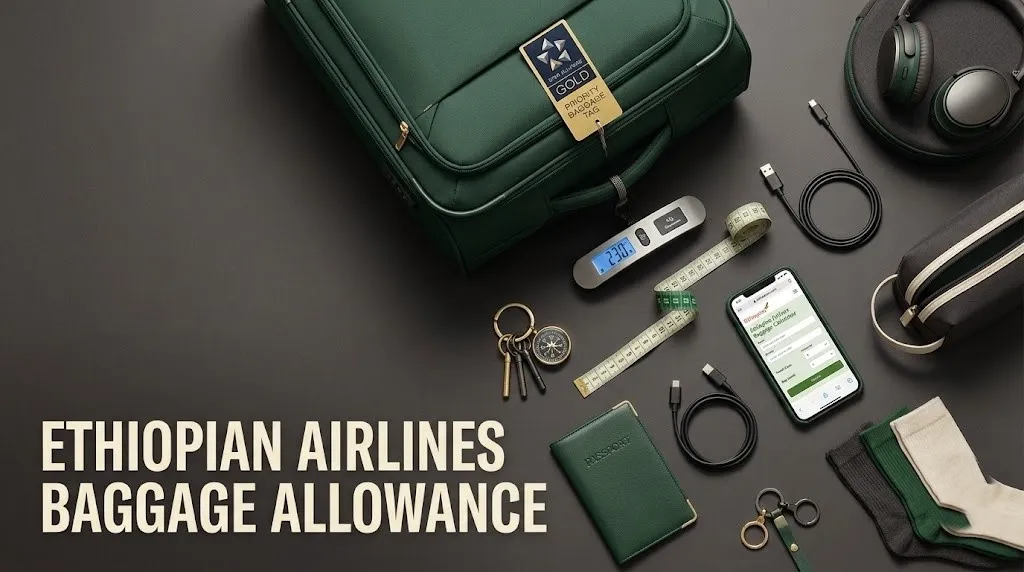
The Cloud Nine business class baggage tags include a priority handling logo that signals to baggage handlers to load these bags last. Priority-tagged bags are typically among the first to arrive on the baggage carousel at the destination. This perk is a time-saver for business travelers on a tight schedule.
Solo business travelers attending a conference with heavy presentation materials should book Cloud Nine for the 32-kilogram per-bag limit. Families splurging on business class for a long international trip will appreciate the generous total weight allowance. Budget travelers upgrading to business class on a weight-concept route should confirm the exact kilogram allowance for their specific destination.
The official Ethiopian Airlines website states the Cloud Nine baggage allowance clearly, but route-specific variations exist.
Ethiopian Airlines Baggage Size in CM
Ethiopian Airlines baggage size in CM is standardized at 158 centimeters linear total for a standard checked bag. This is calculated by adding the height, width, and depth of the suitcase together. A typical large suitcase measuring 75cm x 50cm x 33cm falls exactly at the limit.
The carry-on bag size limit is 55cm x 35cm x 25cm, which is the standard international cabin bag dimension. The personal item must be smaller than the carry-on and must fit entirely underneath the seat in front of you. A laptop bag measuring 40cm x 30cm x 10cm fits the personal item size comfortably.
An oversize checked bag between 158cm and 203cm linear total is accepted with an oversize fee at the check-in counter. A bag exceeding 203cm is not accepted as standard checked baggage on any Ethiopian Airlines flight. The bag must be broken down into smaller pieces or shipped as cargo.
Solo travelers with a backpacking pack that extends with an internal frame should measure the pack at its maximum extension. Families checking a large, rigid suitcase should verify the total linear centimeters before leaving home. Business travelers using a garment bag should confirm that the folded bag does not exceed 158 linear centimeters.
Measure your bag with a soft tape measure from the widest points including wheels, handles, and pockets. The dimensions on the luggage tag are often only for the interior compartment.
Key Takeaway: Measure your suitcase including wheels and handles; 158 linear centimeters is the strict maximum for a standard checked bag.
Important Accuracy Notes for Ethiopian Airlines Baggage
Ethiopian Airlines baggage rules change without public notice, and enforcement varies significantly between airports and individual check-in agents. A bag accepted without a fee in Washington Dulles may be charged an excess fee at the transfer desk in Addis Ababa.
Verify the following directly before traveling:
- Your exact baggage allowance using the Ethiopian Airlines baggage calculator tool on the official website
- The current excess baggage fee for your route by calling Ethiopian Airlines customer service
- Your ShebaMiles or Star Alliance Gold elite status benefits are correctly attached to your reservation
- The current student or infant baggage documentation requirements at the time of check-in
Weigh and measure every bag at home before leaving for the airport. A digital luggage scale costs far less than an excess baggage charge.
Frequently Asked Questions About Ethiopian Airlines Baggage
What is the checked baggage weight limit on Ethiopian Airlines?
The checked baggage weight limit on Ethiopian Airlines is 23 kilograms per bag on piece concept routes from North America.
Weight concept routes to and from other international destinations offer a total allowance of 20 to 40 kilograms depending on the fare class.
Business class passengers receive a per-bag weight limit of 32 kilograms on the piece concept.
How many bags can I take on Ethiopian Airlines economy class?
Economy class passengers on piece concept routes from the US and Canada can check two bags of 23 kilograms each.
On weight concept routes, economy class passengers receive a total kilogram allowance rather than a specific bag count.
The exact number of bags allowed on a weight concept route depends on the total weight distributed across the suitcases.
What is the carry-on baggage size on Ethiopian Airlines?
The carry-on baggage size limit on Ethiopian Airlines is 55cm x 35cm x 25cm.
Economy passengers may bring one carry-on and one personal item with a combined weight of 7 kilograms.
Business class passengers are allowed two carry-on bags and one personal item up to a combined 12 kilograms.
Does Ethiopian Airlines charge for excess baggage?
Ethiopian Airlines charges for excess baggage based on the extra bag, the overweight kilograms, or the oversize dimensions.
The excess baggage fee varies by route and is calculated in US dollars or the local currency equivalent at the airport.
Payment is required at a separate service desk before the boarding pass is issued.
Do Star Alliance Gold members get extra baggage on Ethiopian Airlines?
Star Alliance Gold members receive an extra checked bag or 20 kilograms of additional weight on Ethiopian Airlines flights.
The benefit applies to any valid Star Alliance Gold cardholder regardless of which member airline issued the status.
The elite number must be attached to the reservation for the extra allowance to be applied at check-in.
What is Ethiopian Airlines student baggage allowance?
Ethiopian Airlines student baggage allowance provides an extra checked bag or an additional 10 kilograms on the weight concept.
A valid student visa and an enrollment letter must be presented at check-in to receive the allowance.
The benefit must be requested at the time of booking and does not apply to family members on the same reservation.
Pack to the Exact Limit
Ethiopian Airlines offers a generous baggage allowance by international standards, but the two-system rule punishes travelers who pack without verifying their route. Know whether your journey uses the piece concept or the weight concept before you put the first item in your suitcase.
Weigh your bags at home with a digital scale and measure the linear dimensions including the wheels and handles. Attach your ShebaMiles number and any Star Alliance Gold status to your reservation before you arrive at the airport. Print the baggage calculator result for your specific booking and carry it with your passport.
Confirm your exact allowance, excess fee structure, and any applicable elite benefits directly with Ethiopian Airlines before departure. Your packing list is only as good as the baggage policy it fits inside.