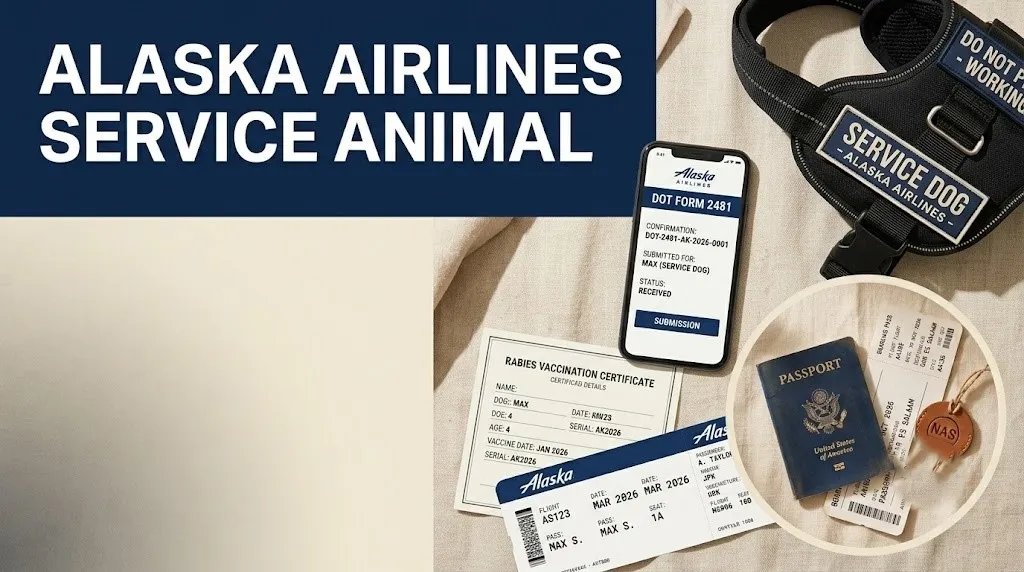
Alaska Airlines allows fully trained service dogs to travel in the cabin for free under strict DOT rules. You must submit the DOT Form 2481 exactly 48 hours before your flight.
A poorly prepared handler will be denied boarding at the gate without the correct digital paperwork. The gate agent will not negotiate on the federal form requirement.
This guide covers the exact form link, the seat blocking rules, and the pet relief stations. Know the 2026 policy before you book the ticket.
Alaska Airlines Service Animal
Alaska Airlines defines a service animal as a dog trained to do work for a person with a disability. It does not recognize emotional support animals, cats, or miniature horses as service animals.
The airline follows the U.S. Department of Transportation (DOT) Air Carrier Access Act rules strictly. Your dog must be harnessed, leashed, or tethered at all times in the cabin and gate area.
Solo travelers with a psychiatric service dog must carry the same DOT Form 2481 as other handlers. The airline cannot ask about the specific disability but can verify the dog’s training status.
Business travelers with a service animal should book the premium class cabin for the extra footwell space. The Boeing 737 MAX 9 premium seat offers more floor clearance than the standard economy row.
The honest limitation is that Alaska only accepts dogs as service animals in 2026. Other animals, even if they perform legitimate tasks, are legally classified as pets.
Alaska Airlines Service Animal Policy
Alaska Airlines requires service dog handlers to electronically submit a federal attestation form pre-flight. The DOT form confirms the animal is a trained service dog, not a pet.
You must complete the form 48 hours before departure, or you risk a boarding denial. The airline reviews the form and pre-clears your animal for the specific flight segment.
First-time travelers with a service dog should call Alaska’s dedicated disability assistance desk after submitting the form. A live agent can block a seat next to you for the dog at no charge.
Families with a child handler must have an adult complete the DOT attestation on the minor’s behalf. The child still handles the dog, but the legal declaration must come from an adult.
Verify the exact 48-hour deadline and form version directly on the official Alaska Airlines website. The DOT updates the form number and submission portal without wide notice.
Alaska Airlines Emotional Support Animal Policy
Emotional support animals (ESAs) are not recognized as service animals on Alaska Airlines in 2026. They travel as regular pets in a carrier under the seat with full pet fees.
The DOT Air Carrier Access Act was revised to exclude ESAs from service animal protections. A letter from a therapist no longer grants cabin access without a carrier or fee.
Budget travelers with an ESA should book a standard pet-in-cabin reservation instead of fighting the rule. The pet fee is non-refundable and applies per direction of travel on the entire itinerary.
Solo travelers with anxiety should note that a trained psychiatric service dog still qualifies under the DOT rule. The dog must perform a specific task, like alerting to an oncoming panic attack.
The honest reality is that ESA handlers must pay the pet fee and use an FAA-approved carrier now. Trying to pass an ESA as a service dog is a federal offense with serious legal consequences.
Key Takeaway: ESAs are pets on Alaska Airlines. Only trained dogs qualify as service animals.
Alaska Airlines Service Dog Form
The required form is the U.S. Department of Transportation Service Animal Air Transportation Form (DOT Form 2481) . You can download it directly from the Alaska Airlines website under the “Accessible Services” tab.
The form requires your contact details, the dog’s trainer information, and a legal liability attestation. You must certify that the dog will not misbehave or be a direct threat to other passengers.
Solo travelers with a self-trained service dog should list themselves as the trainer on the DOT form. This is legally permissible under the Air Carrier Access Act as of 2026.
Business travelers with a frequent flyer profile should save the completed PDF form for future reuse. The form is valid for a single round-trip itinerary, not a permanent pass.
Always verify the current DOT form version directly on the official Alaska Airlines site before filling it out. An outdated form will be rejected by the digital submission portal.
Alaska Airlines Service Animal DOT Form
The DOT Form 2481 is a mandatory federal attestation for every service dog on an airplane. You must certify the dog’s health, training, and behavior under penalty of federal perjury law.
The form also requires a rabies vaccination date if the dog is over four months old. Alaska Airlines checks this vaccination record electronically against the animal’s health certificate.
Solo travelers flying to Hawaii must fill out an additional state-specific animal quarantine attestation. This separate form is required by the State of Hawaii Department of Agriculture for entry.
First-time handlers should fill out the DOT form on a desktop computer, not a phone screen. The digital signature field and PDF upload function often malfunction on mobile web browsers.
IATA reports that incomplete DOT forms are the single largest cause of service animal boarding denials globally. Cross-check every text field before hitting the final submission button.
How to Submit Service Animal Form Alaska Airlines
You submit the DOT Form 2481 through the Alaska Airlines “Trip Details” portal on their website. The “Add Service Animal” link appears after you have completed the flight booking.
To submit your service dog form:
- Log in to your Alaska Airlines Mileage Plan account and select your specific flight itinerary.
- Click the “Add Service Animal” hyperlink under the “Special Services” section of the booking.
- Fill out the DOT Form 2481 digital fields with your exact legal name and the trainer’s details.
- Upload a clear photo of your dog’s face and a separate image of the current rabies vaccination certificate.
- Accept the federal attestation under penalty of perjury and submit the form 48 hours before departure.
- Wait for a confirmation email with a unique Service Request Number and save this locally.
Solo travelers with spotty internet should submit the form days early, not hours before the flight. The digital portal requires a stable connection for the final encrypted PDF upload.
Key Takeaway: Submit the digital form 48 hours early and save the confirmation number.
Alaska Airlines Service Dog at the Airport
Check in at the full-service Alaska Airlines counter with a human agent, not the self-service kiosk. The agent will verify your DOT form approval and print a physical boarding pass for the dog.
Proceed through TSA security with your dog on a short, non-retractable leash and a tight harness. The dog must pass through the metal detector under your direct physical control without setting it off.
Solo travelers should ask for pre-boarding at the gate podium immediately after the agent arrives. This allows you to settle the dog into the footwell before other passengers crowd the aisle.
Business travelers with a tight connection at Seattle (SEA) should locate the pet relief station before the gate. A frantic search for a grass patch in a crowded terminal will cause a missed flight.
TSA allows service dogs to walk through the metal detector while the handler holds the leash. A sit-stay command executed perfectly prevents a physical pat-down delay for both of you.
Alaska Airlines Service Animal Seat Assignment
Alaska Airlines blocks the seat next to you at no extra cost to accommodate your service dog’s space. You cannot purchase an extra seat solely for the dog to occupy like a human passenger.
The dog must fit entirely within your footwell space without protruding into the passenger aisle. A large breed service dog requires a specific aircraft type with a generous footwell.
Solo travelers with a large breed dog must avoid the bulkhead row on the Boeing 737-900ER. The fixed armrests and narrow footwell cutout in the bulkhead physically do not fit a Labrador or a Golden Retriever.
Business travelers should book the window seat in a regular row for a contained, quiet corner. This position prevents the dog from being accidentally stepped on by a service cart or a passenger.
SeatGuru documents that the best Alaska Airlines seat for a service dog is the non-bulkhead window. The Airbus A321neo family operated by codeshare partners has a significantly more spacious floor configuration.
Alaska Airlines Pet Relief Area Seattle
Seattle-Tacoma International Airport (SEA) has fully fenced, indoor pet relief stations in every concourse. The main service animal relief area is located post-security in the Central Terminal near Gate C-10.
The relief station provides artificial turf, a red fire hydrant, and a dedicated waste disposal bin. A wash station with running water and paper towels is directly adjacent to the relief area.
Solo travelers with a connecting flight at SEA should plan a 20-minute relief stop at minimum. The walk from the North Satellite to the Central Terminal station takes over 10 minutes via the train.
Business travelers with a service dog should use the Alaska Lounge in Concourse D for a quiet pre-flight rest. The lounge provides a calm environment, though the actual relief station is still a walk away.
Confirm the current relief station location on the official Port of Seattle SEA airport map before you fly. Concourse construction in 2026 may temporarily relocate the designated service animal area.
Key Takeaway: The SEA relief station is inside security near Gate C-10.
Alaska Airlines vs Delta Service Animal Policy
Alaska Airlines and Delta Air Lines both follow the same federal DOT service animal rules strictly. Both airlines ban emotional support animals from the free cabin access benefit.
| Feature | Alaska Airlines | Delta Air Lines |
|---|---|---|
| Required Form | DOT Form 2481 | DOT Form 2481 |
| Submission Deadline | 48 hours before departure | 48 hours before departure |
| Free Seat Blocking | Yes, next to handler | Yes, next to handler |
| Bulkhead Policy | Not recommended for large dogs | Physically restricts large dogs |
| Lounge Access | Alaska Lounge, no pet restrictions | Delta Sky Club, no pet restrictions |
Delta uses a slightly more restrictive automated gate agent alert system for unverified animals. An Alaska gate agent has more manual discretion to resolve a late DOT form issue.
Business travelers with a large breed service dog should prefer Alaska’s Boeing 737 MAX 9 over Delta’s Boeing 737-900ER. The MAX’s slimline seats provide a measurable inch more floor clearance.
Flying with a Large Service Dog on Alaska Airlines
Book the specific Boeing 737 MAX 9 aircraft for a large breed service dog on Alaska Airlines. The MAX’s redesigned sidewall scoop provides the most generous footwell in the mainline fleet.
Avoid the Embraer 175 regional jet operated by Horizon Air as Alaska SkyWest. The window seat on this small plane has a sharp fuselage curve that cuts into shoulder space significantly.
Solo travelers with a Great Dane or a giant breed must purchase a second adjacent seat for comfort. The standard footwell on any Alaska narrow-body aircraft cannot accommodate a dog over 80 pounds.
A family traveling with a large Labrador should book an entire row of three seats together. This prevents a stranger from sitting next to a dog that occupies part of their footwell space.
Verify your aircraft type on the official Alaska Airlines seat map tool before selecting a seat. An equipment swap from a MAX to an older Boeing 737 ruins the floor space calculation.
Alaska Airlines Service Animal in First Class
Alaska Airlines First Class on the Boeing 737 MAX 9 provides the best service dog experience in the fleet. The wider seat with a generous pitch creates a large, private footwell for the animal.
The dog must still fit entirely within your individual footwell in the first-class cabin. The aisle must remain completely clear of paws, tails, or a leash for FAA safety compliance.
Business travelers with a service dog should pay the first-class premium for the upgraded cabin experience. A relaxed dog that is not jostled by a drink cart is a safer medical device during the flight.
The flight attendant will offer a pre-departure beverage while the dog settles into the footwell position. The larger armrest console provides a safe barrier between the dog and the adjacent passenger.
The honest limitation is that first-class award upgrades clear very late on Alaska Airlines. You may book the ticket expecting first class but get stuck in a tight premium class footwell.
Alaska Airlines Service Animal Denied Boarding
You will be denied boarding if the service dog is visibly aggressive, snarling, or urinates at the gate. The airline legally treats a misbehaving service animal as a direct threat under FAA rules.
A handler without a completed DOT Form 2481 on file 48 hours prior is automatically denied. The gate agent cannot override the system block for a missing federal attestation record.
Solo travelers with a psychiatric service dog that barks in fear must de-escalate the behavior immediately. A reactive bark at a loud boarding announcement is not grounds for denial, but a lunge is.
Business travelers with a tight schedule should have a local backup pet sitter on standby in the hub city. A denial at 6 a.m. before a critical meeting in another city requires an immediate contingency plan.
The Points Guy identifies incomplete paperwork as the top reason for boarding denials, not bad behavior. Triple-check your DOT submission confirmation email before leaving for the airport.
Service Animal Behavior on Plane Alaska Airlines
The service dog must remain in a firm sit or down-stay position for the entire flight without exception. Alaska Airlines requires full physical control with a harness, leash, or tether at every moment.
The dog cannot sit on your lap, even if it is a small breed psychiatric service Chihuahua. The dog must occupy the floor space, not a passenger seat, an empty seat, or your tray table.
Solo travelers should tire out the dog with a long walk at the pre-security pet relief area. A physically exhausted dog sleeps through the engine noise and the drink cart rattles without a stir.
A family with a working service dog should practice a “tuck” command in a tight home space beforehand. The dog must curl into a compact ball inside the footwell without an inch of overflow.
The DOT Air Travel Consumer Report states that an airline can remove a dog that growls once or snaps. Do not test this rule with a stressed animal on a turbulent cross-country flight.
Key Takeaway: A calm, tucked dog that fits in your footwell is the legal requirement.
DOT Service Animal Rules Alaska Airlines
The U.S. Department of Transportation (DOT) limits service animals to dogs only on commercial flights. The Air Carrier Access Act was formally amended to exclude miniature horses and exotic species.
You must personally attest under federal penalty of perjury that your dog is a trained service animal. A falsified DOT Form 2481 carries a maximum fine equivalent to a serious federal misdemeanor charge.
Solo travelers with a self-trained dog must still provide the trainer’s name and contact phone number. Leaving this field blank or writing “Self” in some outdated state databases will cause a form rejection.
Business travelers with a service dog should carry a printed copy of the DOT final rule text. An overly aggressive gate agent at a small outstation might not know the exact regulatory language.
Check the official FAA and DOT websites for the current Air Carrier Access Act service animal rules. These federal rules are reviewed annually, and minor technical adjustments are common in 2026.
Checking in with Service Dog Alaska Airlines
Arrive at the airport two hours before departure for a domestic flight with a service animal. Check in at the full-service desk, not the kiosk, to have the agent verify the DOT form approval.
You must verbally identify your animal as a trained service dog to the check-in agent directly. The agent will not ask for a demonstration of the task or for proof of the disability.
Solo travelers should request a gate pass for a companion to help them through security to the gate. This is a discretionary courtesy, not a legal right, and the agent can deny it on a busy day.
Families with a child handler must have the adult speak for the minor at the check-in counter. The service dog’s training certificate must be presented alongside the child’s DOT form attestation.
Verify the current check-in window and DOT form status on the official Alaska Airlines app. A glitch in the digital service request system can sometimes flag a pre-cleared animal at the gate.
Frequently Asked Questions About Alaska Airlines Service Animal
Does Alaska Airlines accept emotional support animals as service animals?
No, Alaska Airlines does not accept emotional support animals (ESAs) as service animals in 2026.
ESAs must travel as regular pets in an FAA-approved carrier under the seat with full pet fees.
Only trained dogs performing a specific disability task are recognized under the DOT service animal rule.
What form do I need for a service dog on Alaska Airlines?
You must complete the U.S. DOT Service Animal Air Transportation Form (DOT Form 2481).
The form is available on the Alaska Airlines website under the “Accessible Services” section.
It requires your personal details, the dog’s trainer information, and a legal behavioral attestation.
How do I add a service animal to my Alaska Airlines reservation?
Book your flight first, then log in to your Mileage Plan account to manage the specific trip.
Click the “Add Service Animal” hyperlink under the “Special Services” section of the booking.
Complete the digital DOT Form 2481 and submit it at least 48 hours before departure time.
Can a service dog sit on my lap on an Alaska Airlines flight?
No, the service dog must sit in your footwell and cannot occupy a seat or your lap.
The dog must fit entirely within the floor space without protruding into the passenger aisle.
A small breed that escapes the footwell and climbs onto a lap violates FAA safety regulations.
What happens if my service dog barks or misbehaves on the plane?
The dog must be removed if it barks aggressively, growls, lunges, or urinates in the cabin.
A single non-aggressive bark at a sudden loud noise is usually not grounds for denial.
Alaska Airlines can legally deny boarding on the return flight if a behavioral incident is documented.
Where can my service dog relieve itself at Seattle airport?
Post-security pet relief stations are located in every concourse at Seattle-Tacoma International Airport (SEA).
The main indoor station with artificial turf and a wash area sits in the Central Terminal near Gate C-10.
Always check the current official Port of Seattle airport map for any 2026 construction relocations.
The DOT Form 2481 submitted 48 hours before departure is your non-negotiable legal ticket to board. Without this precise digital form, the gate agent will deny your access regardless of the dog’s obvious training.
Open the Alaska Airlines “Trip Details” page for your flight booking now and upload the completed DOT form. Then book the non-bulkhead window seat on the Boeing 737 MAX 9 for the best footwell fit.
Federal service animal rules, DOT form versions, and airport relief station locations shift in 2026. Always verify the current form number and the SEA relief station map directly on the official airline site before you fly.