Sicily has five airports. Two serve as international hubs for most travelers flying from abroad.
The remaining three airports serve regional routes, budget carriers, and seasonal island connections.
Catania Fontanarossa Airport (CTA) and Palermo Falcone Borsellino Airport (PMO) handle the vast majority of passenger traffic to Sicily.
Most travelers who choose the wrong airport regret it after discovering their hotel sits three hours from the runway.
This guide covers every Sicily airport with IATA codes, airline routes, transfer options, and honest traveler recommendations.
You will know exactly which Sicilian airport to book before you purchase your flight.
Airports in Sicily
Five commercial airports serve the Italian island of Sicily with scheduled passenger flights year-round.
Catania Fontanarossa Airport on the east coast and Palermo Falcone Borsellino Airport on the northwest coast operate as the two primary international gateways.
The remaining three airports handle specific niches. Trapani Birgi Airport serves western Sicily and budget Ryanair routes.
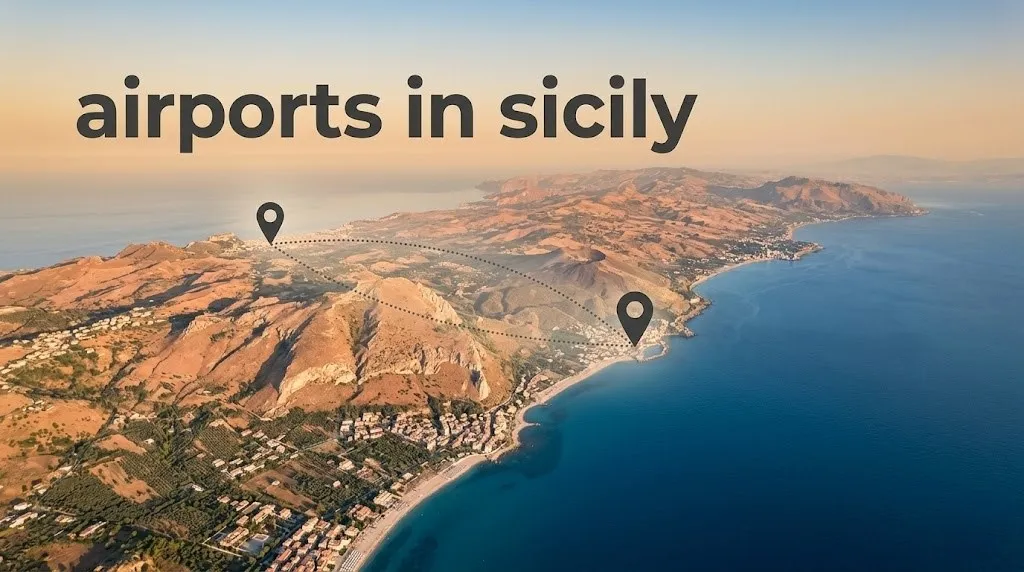
Comiso Pio La Torre Airport operates in the southeast near Ragusa with limited seasonal service.
Lampedusa Airport serves the Pelagie Islands south of Sicily with domestic Italian connections and summer tourist flights.
First-time international travelers should focus exclusively on Catania or Palermo for the best airline choice and ground transfer options.
The three smaller airports lack reliable public transit connections and offer very limited international flight schedules.
Budget travelers willing to navigate bus transfers from Trapani or Comiso can find the lowest fares on European routes.
The savings on a Ryanair fare into Trapani can offset a long bus transfer to Palermo depending on your final destination.
Sicily’s airport network covers the island adequately. The key is matching your airport to your specific Sicilian destination.
Flying into Catania when your hotel is in Marsala adds a four-hour drive across the island before your vacation starts.
How Many Airports in Sicily
Sicily has five commercial airports with scheduled passenger service as of the most recent data.
The five airports are Catania (CTA), Palermo (PMO), Trapani (TPS), Comiso (CIY), and Lampedusa (LMP).
Catania Fontanarossa Airport ranks as the busiest airport in Sicily by passenger volume and flight movements.
Palermo Falcone Borsellino Airport follows as the second busiest with strong European network connections.
Trapani Birgi Airport handles significantly fewer passengers. It relies almost entirely on Ryanair budget service.
Comiso Pio La Torre Airport operates the fewest flights of the mainland Sicily airports with highly seasonal schedules.
Solo travelers on flexible itineraries can use all five airports to build creative island-wide travel routes.
A solo traveler can fly into Palermo, travel across Sicily by train, and depart from Catania without backtracking.
Families with children should limit airport choice to Catania or Palermo for direct transfers and reliable facilities.
The regional airports lack family-friendly amenities like play areas, child meal options, and easy stroller navigation.
Sicily has no other operational commercial airports beyond these five as of recent airport authority reporting.
Confirm current airport operational status directly with ENAC, the Italian civil aviation authority, before booking.
Major Airports in Sicily
The two major airports in Sicily are Catania Fontanarossa Airport (CTA) and Palermo Falcone Borsellino Airport (PMO).
These two airports handle the vast majority of international and domestic passenger traffic to the island.
Catania Fontanarossa Airport serves the eastern half of Sicily including Taormina, Syracuse, and the Mount Etna region.
It operates a single terminal building with arrivals on the ground floor and departures on the upper level.
Palermo Falcone Borsellino Airport serves the northwestern coast including Palermo city, Cefalu, and the beach resorts west of the capital.
The airport operates a single terminal with separate Schengen and non-Schengen departure areas.
Business travelers should prioritize Catania for the east coast industrial areas and Palermo for the capital’s commercial district.
Catania airport sits closer to the industrial zones around the city and the oil refineries to the south.
First-time international travelers will find both major airports manageable with clear signage in Italian and English.
Neither airport is overwhelming. Both are single-terminal operations that process passengers efficiently during peak summer months.
The major airports offer full services. Car rental desks, currency exchange, duty-free shopping, and multiple dining options operate year-round.
Regional airports Trapani and Comiso offer far fewer services with some closing completely outside peak summer hours.
Sicily International Airports
Sicily has two true international airports with year-round scheduled service from multiple European and intercontinental carriers.
Catania Fontanarossa Airport (CTA) and Palermo Falcone Borsellino Airport (PMO) both handle international flights from across Europe and beyond.
Catania Airport receives the broadest international route network including seasonal long-haul service from North American and Middle Eastern hubs.
European network carriers serve Catania from major hubs including Frankfurt, Munich, Paris Charles de Gaulle, Amsterdam Schiphol, and London Heathrow.
Palermo Airport connects to a similar European network with strong service from Italian hubs Rome Fiumicino and Milan airports.
Seasonal US flights operate to both Catania and Palermo from select East Coast hubs on US legacy carriers.
First-time international travelers from the US should fly into Catania or Palermo depending on their final Sicilian destination.
Neither Trapani nor Comiso handles flights from outside Europe. Lampedusa only connects domestically within Italy.
Budget travelers from within Europe can use Trapani for Ryanair connections but must accept limited facilities and ground transfer options.
The international airports offer passport control desks for non-Schengen arrivals and departures at both CTA and PMO.
Schengen area travelers from within Europe pass through a separate channel with no passport stamp required.
Confirm your specific airline’s terminal assignment before departure. Terminal allocations can change between seasons at both international airports.
Catania Airport
Catania Fontanarossa Airport (CTA) is Sicily’s busiest airport serving the east coast and the city of Catania.
The airport sits approximately 6 kilometers southwest of Catania city center with views of Mount Etna from the runway.
Catania Airport operates a single terminal handling both domestic and international flights on two levels.
The arrivals level houses baggage claim, car rental desks, currency exchange, and the exit to ground transportation.
Departures occupy the upper level with check-in desks, security screening, and the departure gate area.
Airlines operating at Catania include ITA Airways, Ryanair, easyJet, Lufthansa, Air France, KLM, and Delta Air Lines on seasonal US routes.
European network carriers connect Catania to their respective hubs for onward connections worldwide.
Families with children flying into Catania can reach Taormina in roughly 50 minutes by pre-booked private transfer.
The Mount Etna region and the beaches near Giardini Naxos sit within an hour’s drive of the airport.
Solo travelers can take the AMT Alibus from Catania Airport to Catania Centrale train station in about 20 minutes.
From Catania Centrale station, trains connect to Syracuse, Taormina, and Messina with regular departures.
Catania Airport’s honest limitation is summer crowding. The single terminal can feel overwhelmed during August peak travel days.
Arrive at least two hours before a domestic flight and three hours before international departures during peak summer months.
Catania Airport ground transfer options:
| Destination | Transport | Travel Time | Cost Range |
|---|---|---|---|
| Catania city center | AMT Alibus | 20 minutes | Low |
| Taormina | Bus or private transfer | 50-60 minutes | Low to moderate |
| Syracuse | Direct bus or train via Catania | 70-90 minutes | Low |
| Mount Etna | Rental car or tour shuttle | 60-90 minutes | Moderate |
| Palermo | FlixBus or train via Messina | 3-4 hours | Low to moderate |
Key Takeaway: Catania serves eastern Sicily best. Taormina and Syracuse are within an hour.
Palermo Airport
Palermo Falcone Borsellino Airport (PMO) serves Sicily’s capital city and the entire northwestern coast of the island.
The airport sits approximately 35 kilometers west of Palermo city center along the coast toward the town of Cinisi.
Palermo Airport operates a single terminal with separate areas for Schengen and non-Schengen departures.
The arrivals level includes baggage claim, multiple car rental counters, and the exit to the train station and bus stops.
Airlines serving Palermo include ITA Airways, Ryanair, easyJet, Lufthansa, Swiss International Air Lines, and United Airlines on seasonal US routes.
European budget carriers operate heavily at Palermo with Ryanair and easyJet maintaining significant bases at the airport.
Business travelers heading to central Palermo should take the Trinacria Express train from the airport station.
The train reaches Palermo Centrale station in approximately 45 to 60 minutes with departures roughly every 30 minutes during peak hours.
Families with children can reach the beach resort town of Mondello in about 50 minutes by taxi or pre-booked transfer.
The Cefalu coast sits roughly one hour east of Palermo Airport by rental car or train via Palermo Centrale.
Palermo Airport’s honest limitation is its distance from the city. The 35-kilometer transfer is longer than most travelers expect.
Budget an hour from landing to city center arrival by train. Taxis cost significantly more than the train on this route.
Solo travelers should take the Trinacria Express train for the cheapest and most reliable city center connection.
The train station entrance sits directly across from the arrivals hall exit. Tickets are available from machines and the ticket office.
Palermo Airport ground transfer options:
| Destination | Transport | Travel Time | Cost Range |
|---|---|---|---|
| Palermo city center | Trinacria Express train | 45-60 minutes | Low |
| Mondello beach | Taxi or bus via Palermo | 50-60 minutes | Moderate |
| Cefalu | Train via Palermo Centrale | 90-120 minutes | Low to moderate |
| Trapani | FlixBus or rental car | 90 minutes | Low to moderate |
| Agrigento | Train or bus via Palermo | 2.5-3 hours | Low to moderate |
Key Takeaway: Palermo Airport sits 35 kilometers from the city. The Trinacria Express train is the best transfer.
Trapani Airport
Trapani Birgi Airport (TPS) serves the far western coast of Sicily roughly 15 kilometers south of Trapani city.
This airport operates almost exclusively as a Ryanair base with very limited service from other carriers.
Trapani Airport handles significantly fewer passengers than Catania or Palermo with a single terminal and basic facilities.
The terminal offers a small cafe, a duty-free shop, and car rental desks that close during low-season periods.
Flights from Trapani connect to major Italian cities and select European destinations on Ryanair’s network.
Service frequency drops sharply outside the May to September peak season. Some routes suspend entirely in winter.
Budget travelers flying Ryanair into Trapani can reach the city center by AST city bus in approximately 30 minutes.
The bus meets most arriving flights. Confirm the schedule on the AST website before travel as service reduces on Sundays.
Solo travelers can use Trapani as a gateway to the Egadi Islands with ferries departing from Trapani port.
The port sits a short bus ride or taxi transfer from the airport with summer ferry service to Favignana and Levanzo.
Trapani Airport’s honest limitation is the lack of reliable public transit for onward travel beyond Trapani city.
Reaching Palermo from Trapani Airport requires a bus to Trapani city then a connecting bus or train adding two or more hours.
Trapani serves western Sicily destinations like Marsala, Erice, and San Vito Lo Capo better than Palermo Airport.
The drive from Trapani Airport to Marsala takes roughly 30 minutes compared to over 90 minutes from Palermo Airport.
Comiso Airport
Comiso Pio La Torre Airport (CIY) serves southeastern Sicily near the city of Ragusa and the baroque towns of the Val di Noto.
This airport operates with a very limited flight schedule. Service is highly seasonal and subject to change.
Comiso Airport handles a small number of Ryanair and seasonal charter flights to Italian and select European destinations.
The single terminal building offers basic facilities. Car rental desks and a small cafe operate during flight hours only.
Budget travelers with flexible itineraries can find very low Ryanair fares into Comiso during peak summer months.
The cost savings can be significant compared to Catania. The tradeoff is limited flight frequency and sparse ground transport.
Families with children should avoid Comiso Airport for arrival. The limited services and long transfers create logistical stress.
Ragusa sits roughly 20 minutes from the airport. Most other southeast Sicily destinations require a rental car or pre-booked transfer.
Comiso Airport’s honest limitation is unreliable public transportation and skeleton staffing outside flight arrival windows.
Do not count on taxis waiting at the airport unless you have pre-booked one. The taxi rank is often empty.
Comiso works as a departure airport if your itinerary ends in Ragusa, Modica, or Scicli in the Val di Noto region.
For arrival into Sicily, Catania Airport serves the southeast nearly as conveniently with far better ground transport connections.
Lampedusa Airport
Lampedusa Airport (LMP) serves the island of Lampedusa in the Pelagie archipelago south of mainland Sicily.
This airport handles domestic Italian flights almost exclusively with seasonal service from ITA Airways, Volotea, and other Italian carriers.
Lampedusa Airport operates a single small terminal that processes passengers efficiently during the summer beach tourism peak.
Flights connect Lampedusa to Catania, Palermo, and major mainland Italian cities with increased frequency June through September.
Solo travelers visiting Lampedusa for its beaches will land at this airport with no alternative arrival options.
The island has no ferry service from mainland Sicily. Flying into Lampedusa Airport is the only practical arrival method.
Budget travelers should book Lampedusa flights well in advance. Summer fares spike as the island’s limited seats fill quickly.
Last-minute August flights to Lampedusa from mainland Italy can cost more than a transatlantic fare.
Lampedusa Airport sits roughly 2 kilometers from the main town of Lampedusa and the island’s famous Rabbit Beach.
Taxis and local buses connect the airport to the town center and beach areas during the tourist season.
The honest limitation is that Lampedusa Airport serves only one purpose. You fly here solely to visit Lampedusa island.
No traveler passes through Lampedusa Airport en route to mainland Sicily or any other destination.
Airlines That Fly to Sicily
Major European network carriers and low-cost airlines serve Sicily’s two primary airports at Catania and Palermo year-round.
ITA Airways operates the most frequent domestic Italian connections to Sicily from Rome Fiumicino and Milan Linate.
Ryanair maintains the largest low-cost presence with bases at Catania, Palermo, and Trapani serving destinations across Europe.
easyJet competes strongly at both Catania and Palermo with routes from major UK and European cities.
Full-service European carriers including Lufthansa, Air France, KLM, Swiss, Austrian Airlines, and British Airways connect Sicily to their hubs.
These hub connections allow one-stop itineraries from North America, Asia, and the Middle East to Sicily.
US legacy carriers operate seasonal direct service to Sicily. Delta Air Lines flies to Catania. United Airlines serves Palermo.
American Airlines connects to Sicily through its European partner hubs on one-stop itineraries from US gateways.
Budget travelers should search Ryanair and easyJet separately. These airlines do not appear on most US-based flight search platforms.
Google Flights now includes some Ryanair fares. Search directly on the Ryanair website for the most complete schedule.
Business travelers should book ITA Airways or a major European network carrier for reliable schedules and rebooking protection during disruptions.
Low-cost carriers offer limited support during cancellations. A missed connection on Ryanair means buying a new ticket.
Flights to Sicily from US
Direct flights from the United States to Sicily operate on a seasonal basis from select East Coast hubs.
Delta Air Lines has operated seasonal direct service to Catania Fontanarossa Airport from New York JFK in recent summer schedules.
United Airlines has offered seasonal direct service to Palermo Falcone Borsellino Airport from Newark Liberty International Airport.
These direct seasonal routes typically operate between late May and early October coinciding with peak Sicily tourism months.
Most US travelers reach Sicily year-round via one-stop connections through major European hubs.
ITA Airways offers connections through Rome Fiumicino from its US gateways including New York JFK, Boston, Miami, and Los Angeles.
Lufthansa connects through Frankfurt and Munich. Air France connects through Paris Charles de Gaulle. KLM connects through Amsterdam.
First-time international travelers from the US should book a one-stop connection through a European hub rather than waiting for seasonal direct flights.
The European hub connection offers daily frequency and rebooking flexibility that a twice-weekly seasonal direct flight cannot match.
Budget travelers can sometimes find lower fares by booking a cheap US-to-Europe flight and a separate European budget carrier to Sicily.
This strategy carries risk. Separate tickets mean no protection if the first flight delays and you miss the second booking.
Confirm current direct flight availability before booking. US to Sicily direct routes are seasonal and subject to change.
Check the official airline websites and the airport route maps on the Catania and Palermo airport websites for current service.
Best Airport to Fly Into Sicily
The best airport to fly into Sicily depends entirely on your final destination on the island and your arrival logistics.
Fly into Catania Fontanarossa Airport (CTA) if your trip focuses on the east coast, Mount Etna, Taormina, Syracuse, or the southeast baroque towns.
Catania Airport positions you within an hour of most eastern Sicily destinations with the best ground transport options.
Fly into Palermo Falcone Borsellino Airport (PMO) if your trip centers on Palermo city, Cefalu, or the northwestern beach resorts.
Palermo Airport serves the capital region and connects well to the western coast through the Trinacria Express train.
Fly into Trapani Birgi Airport (TPS) if your destination is specifically Trapani, Marsala, Erice, or the Egadi Islands in summer.
Trapani Airport only makes sense for travelers whose final destination sits in the far western corner of Sicily.
Families with children heading to east coast beach resorts should fly into Catania for the shortest transfer to Taormina and Giardini Naxos.
The 50-minute private transfer from Catania Airport to Taormina minimizes car time with tired children after a long flight.
Solo travelers exploring Sicily broadly should fly into one airport and depart from the other for a linear island route.
Arrive at Palermo, travel east by train through Cefalu and Milazzo, and depart from Catania without backtracking.
Comiso and Lampedusa are rarely the best airport for a first-time Sicily visitor.
These airports serve specific niches. Choose Catania or Palermo unless your itinerary specifically requires a regional airport.
Catania vs Palermo Airport
Catania Fontanarossa Airport and Palermo Falcone Borsellino Airport compete as Sicily’s two international gateways with different strengths.
Catania Airport handles more total passengers annually and offers more flight frequency on European and seasonal long-haul routes.
Palermo Airport connects better to western Sicily destinations and offers the Trinacria Express train link to the city center.
Catania Airport sits closer to its city than Palermo. The 6-kilometer transfer to Catania takes 20 minutes by bus.
Palermo Airport sits 35 kilometers from Palermo city center. The train transfer takes 45 to 60 minutes.
Catania Airport serves the Mount Etna region, Taormina, Syracuse, and the baroque southeast more conveniently than Palermo.
Palermo Airport serves Cefalu, Mondello, the western beach resorts, and the city of Palermo itself best.
Business travelers should choose based on meeting location. Catania for east coast industry. Palermo for capital business districts.
Neither airport is universally better. The wrong choice adds hours of unnecessary ground travel on arrival day.
Budget travelers should compare fares to both airports. A cheaper fare to one airport can vanish after factoring in ground transfer costs.
A low fare into Catania loses its advantage if your hotel is in Trapani and you need a four-hour transfer across the island.
Both airports offer similar facilities. Car rental, currency exchange, cafes, and duty-free shopping operate at both locations year-round.
The departure experience is comparable. Both airports process security efficiently outside the August peak travel week.
Cheapest Airport to Fly Into Sicily
Trapani Birgi Airport (TPS) and Comiso Pio La Torre Airport (CIY) typically offer the lowest fares to Sicily on Ryanair service from European cities.
These regional airports serve almost exclusively budget carriers with base fares far below Catania or Palermo on comparable routes.
The fare savings come with significant tradeoffs in flight frequency, ground transport availability, and airport facilities.
Trapani Airport sits approximately 90 minutes from Palermo by bus. The transfer cost can offset the fare savings on shorter trips.
Comiso Airport serves only a handful of destinations with limited weekly frequencies even during peak summer months.
Budget travelers should calculate the total cost including ground transfer before booking the cheapest airfare to a regional Sicily airport.
A Ryanair fare to Trapani that saves money on the flight can cost more overall after paying for a bus to Palermo and a connecting train.
Solo travelers with light luggage and flexible timing can genuinely save by using Trapani or Comiso for arrival or departure.
The savings work best for travelers heading directly to destinations near the regional airport rather than onward across Sicily.
Catania and Palermo compete on price for budget carriers too. Ryanair and easyJet serve both airports with competitive fares.
Compare total door-to-door cost and time before choosing a regional airport purely on the basis of a low flight price.
Sicily Airport Transfers
Sicily airport transfers range from direct train connections at Palermo to bus and taxi options at all five airports.
Palermo Falcone Borsellino Airport offers the Trinacria Express train from the airport station to Palermo Centrale in 45 to 60 minutes.
This is the best airport-to-city rail connection in Sicily. Trains run every 30 minutes during peak daytime hours.
Catania Fontanarossa Airport connects to Catania city center by the AMT Alibus service in approximately 20 minutes.
Trains do not serve Catania Airport directly. The Alibus or a taxi are the only practical city transfer options.
Trapani Birgi Airport connects to Trapani city by AST bus timed to meet arriving flights with a roughly 30-minute journey.
The bus schedule reduces on Sundays and outside summer months. Confirm current times on the AST website.
Comiso Pio La Torre Airport offers limited bus service to Ragusa and nearby towns. Rental car or pre-booked transfer is recommended.
Taxis at Comiso are unreliable. Book a transfer in advance rather than counting on an available taxi at the airport.
Solo travelers should use public buses and trains for the lowest transfer costs at all airports.
Train and bus tickets are available from machines at the airport or from the driver on board some bus services.
Families with children should pre-book a private transfer for the fastest and most reliable airport-to-hotel journey with luggage and strollers.
Private transfers cost more than public transport. The door-to-door service eliminates navigating buses with tired children.
Sicily airport transfer summary:
| Airport | Best Transfer | Travel Time to City | Public Transport Available |
|---|---|---|---|
| Catania (CTA) | AMT Alibus | 20 minutes | Bus, no train |
| Palermo (PMO) | Trinacria Express | 45-60 minutes | Train and bus |
| Trapani (TPS) | AST bus | 30 minutes | Bus only |
| Comiso (CIY) | Pre-booked transfer | 20 minutes to Ragusa | Limited bus |
| Lampedusa (LMP) | Local bus or taxi | 10 minutes | Bus and taxi |
Key Takeaway: Palermo has the train. Catania has the bus. Pre-book transfers at Comiso and Trapani.
Important Accuracy Notes for Sicily Airport Travel
Seasonal flight schedules, ground transport timetables, and airport facility hours change frequently in Sicily without advance public notice.
Verify the following directly before booking:
- Current flight routes on the official Catania Airport (aeroporto.catania.it) and Palermo Airport (aeroporto.palermo.it) websites. Airlines add and cancel routes between seasons.
- Ground transport schedules on the official Trenitalia website for Trinacria Express service and on the AMT Catania website for Alibus service. Sunday and holiday schedules differ from weekday service.
- Trapani and Comiso airport operating hours before booking flights to these regional airports. Facilities close between flight banks.
- US direct flight seasonal dates on the airline’s official website. These routes operate limited summer seasons subject to schedule changes.
- Car rental availability at regional airports. Book in advance for Trapani and Comiso. Walk-up availability is limited outside summer.
- Entry requirements for Italy on the U.S. State Department travel page for current passport validity and visa requirements.
Confirm flight schedules and transfer timetables within one week of departure for the most current operating information.
Frequently Asked Questions About Airports in Sicily
How many airports are there in Sicily?
Sicily has five commercial airports with scheduled passenger flights year-round or seasonally.
The five airports are Catania (CTA), Palermo (PMO), Trapani (TPS), Comiso (CIY), and Lampedusa (LMP).
Catania and Palermo are the two major international airports handling the majority of passenger traffic to the island.
Which is the main international airport in Sicily?
Catania Fontanarossa Airport (CTA) is Sicily’s busiest airport by passenger volume and flight movements annually.
Palermo Falcone Borsellino Airport (PMO) is the second major international gateway serving the capital and northwestern coast.
Both airports handle international flights from Europe, seasonal US service, and year-round domestic Italian connections.
Is it better to fly into Catania or Palermo?
Fly into Catania if your destination is the east coast, Taormina, Syracuse, Mount Etna, or the southeast baroque towns.
Fly into Palermo if your destination is Palermo city, Cefalu, Mondello, or the northwestern beach resorts.
Choose based on your final Sicilian destination. The wrong airport adds three or more hours of ground travel on arrival day.
What airlines fly direct to Sicily from the United States?
Delta Air Lines operates seasonal direct service to Catania (CTA) from New York JFK in recent summer schedules.
United Airlines has offered seasonal direct service to Palermo (PMO) from Newark Liberty International Airport.
Most US travelers reach Sicily year-round via one-stop connections through European hubs like Rome, Frankfurt, Paris, or Amsterdam.
What is the cheapest airport to fly into in Sicily?
Trapani Birgi Airport (TPS) and Comiso Pio La Torre Airport (CIY) typically offer the lowest base fares on Ryanair from European cities.
The fare savings must be weighed against ground transfer costs to your final destination and limited flight frequency.
Catania and Palermo offer competitive fares from budget carriers Ryanair and easyJet on many European routes.
How do I get from Catania airport to Palermo?
Take the AMT Alibus from Catania Airport to Catania Centrale train station in approximately 20 minutes.
From Catania Centrale, trains to Palermo Centrale run regularly with a journey time of approximately three to four hours.
FlixBus offers direct bus service from Catania Airport to Palermo on some routes with comparable travel time to the train.
Sicily’s five airports give travelers options. Catania and Palermo serve almost every traveler need with reliable facilities and connections.
Fly into Catania for the east coast and Mount Etna. Fly into Palermo for the capital and the northwestern beaches.
Use Trapani, Comiso, or Lampedusa only when your itinerary specifically requires those regions or when the savings justify the logistics.
Airline routes, seasonal schedules, and ground transport timetables change without notice. Verify current flight availability on the official airport websites and confirm transfer times directly with the transport operator before booking.
Choose your airport based on your Sicilian destination. Book your flight. Confirm your transfer. Your Sicily trip starts with the right runway.