
Texas has more airports than any other state in the United States. The total count exceeds 1,500 airports, heliports, and seaplane bases combined.
Most of these are private strips and general aviation fields that commercial passengers never use. Only about 25 airports across Texas offer scheduled commercial airline service.
This guide explains the full airport count with a breakdown of what each category means for travelers. It names the major hubs, international gateways, and which airport works best for your specific Texas trip.
How Many Airports Are in Texas: The Total Count
Texas has approximately 1,500 total aviation facilities according to the Federal Aviation Administration. This number includes public-use airports, private airfields, heliports, and seaplane bases combined.
The count regularly exceeds every other US state because of Texas’s geographic size and aviation culture. Alaska and California rank second and third in total airport facilities.
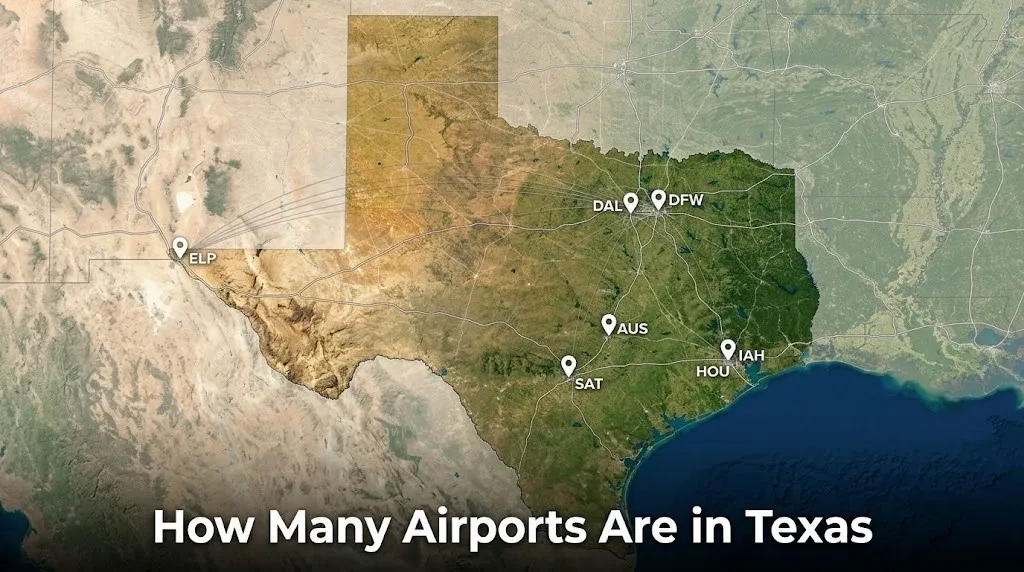
Around 300 of these are public-use airports open to general aviation and in some cases commercial service. The remaining 1,200 or so are private strips, corporate aviation facilities, and agricultural airstrips.
The FAA updates the count periodically as airports open, close, or change classification. The total fluctuates by several dozen facilities year to year.
Business travelers with access to private aviation benefit from this density with landing options near almost any Texas business destination. Commercial passengers need to focus on a much smaller subset of airports.
Key Takeaway: Texas has roughly 1,500 total aviation facilities. Only about 25 offer scheduled commercial airline service.
How Many Airports in Texas: Category Breakdown
Texas airports fall into distinct FAA categories that determine their role in the national airspace system. The categories range from large-hub primary airports to basic general aviation strips.
Large-hub primary airports in Texas include Dallas/Fort Worth International Airport (DFW), George Bush Intercontinental Airport (IAH), and Dallas Love Field (DAL). These handle the majority of Texas commercial passenger traffic.
Medium-hub airports include Austin-Bergstrom International Airport (AUS), San Antonio International Airport (SAT), and William P. Hobby Airport (HOU). El Paso International Airport (ELP) also falls into this category.
Small-hub airports include Midland International Air and Space Port (MAF), Lubbock Preston Smith International Airport (LBB), and McAllen International Airport (MFE). These serve regional populations with connections to the major hubs.
Non-hub primary airports handle limited scheduled service to smaller Texas communities. Reliever airports around major cities absorb general aviation traffic away from the primary commercial runways.
How Many Airports Does Texas Have: Public vs Private
Texas has approximately 300 public-use airports available to general aviation pilots and commercial operators. These airports receive federal funding and must meet FAA safety and maintenance standards.
Private-use airports account for the vast majority of the 1,500 total Texas aviation facilities. These include corporate flight departments, ranch airstrips, agricultural operations, and private pilot fields.
Public-use airports are the only ones a commercial passenger will ever encounter when booking a flight. Private airports generally require prior permission and are not accessible to scheduled airline service.
The Texas Department of Transportation Aviation Division tracks and supports public-use airport development across the state. Grant programs fund runway improvements, safety upgrades, and infrastructure projects.
Solo travelers flying general aviation aircraft have extraordinary access to Texas through the public-use airport network. Commercial passengers interact with only a fraction of the state’s total aviation infrastructure.
Budget travelers should understand that small public-use airports do not equate to cheap commercial flights. Most of the 300 public airports have zero airline service and exist solely for general aviation.
How Many Airports Are There in Texas: FAA Data
The Federal Aviation Administration counts Texas airports through the National Plan of Integrated Airport Systems. This database tracks all facilities that meet minimum criteria for inclusion.
The FAA lists Texas with the largest number of NPIAS airports of any state at over 290 facilities in the integrated system plan. This reflects the state’s commitment to maintaining a comprehensive aviation network.
The NPIAS includes all commercial service airports, reliever airports, and selected general aviation airports deemed important to the national air transportation system. Smaller private strips are excluded from the NPIAS count.
The FAA classification system assigns each airport a hub designation based on passenger boardings as a percentage of total US boardings. This classification determines funding eligibility and regulatory oversight level.
Data accuracy for airport counts depends on the reporting cycle with updates published annually. The Texas airport count is broadly stable with gradual additions and occasional closures of smaller facilities.
Airports in TX: The Complete Picture
Texas airports reflect the state’s geography with hub airports concentrated in the Texas Triangle connecting Dallas, Houston, and San Antonio with Austin. This region contains most of the commercial air service in the state.
West Texas airports serve vast distances with fewer passengers and longer gaps between commercial facilities. El Paso International Airport (ELP) sits over 600 miles from Houston with a drive time exceeding 10 hours.
The Gulf Coast region features airports serving the energy industry and international trade with Mexico. Valley International Airport (HRL) and Brownsville South Padre Island International Airport (BRO) connect the Rio Grande Valley.
The Panhandle relies on Lubbock Preston Smith International Airport (LBB) and Amarillo Rick Husband International Airport (AMA) for regional connectivity. These airports feed passengers into the DFW and IAH hub networks.
Texas airport geography means that the airport closest to your destination on a map may still be hours away. Always check drive times from your chosen airport to your final destination before booking.
Key Takeaway: Texas airports follow population density with hubs in the Texas Triangle and sparse coverage in West Texas and the Panhandle.
All Airports in Texas: Understanding the Network
The Texas airport network operates as a tiered system with DFW and IAH at the top as global gateways. These two airports connect Texas to every inhabited continent with nonstop service.
Secondary international airports at AUS, SAT, DAL, and HOU provide limited international service to Mexico, Central America, and select long-haul destinations. These airports primarily handle domestic traffic.
Regional commercial airports at ELP, MAF, LBB, AMA, MFE, and BRO connect smaller markets to the major hubs. Most regional airport flights are operated by regional affiliates of American, United, and Delta.
General aviation reliever airports around Dallas, Houston, and Austin absorb private and corporate traffic away from the busy commercial runways. These include airports like Addison Airport (ADS) and David Wayne Hooks Memorial Airport (DKD).
The network functions as a hub-and-spoke system with American Airlines dominating DFW and United Airlines controlling IAH. Southwest Airlines operates point-to-point service from DAL and HOU with significant AUS presence.
What Airports Are in Texas: The Ones Travelers Use
The commercial airports travelers actually use in Texas number about 25 facilities with scheduled passenger service. These range from the global hubs at DFW and IAH to Essential Air Service communities with subsidized flights.
The Texas Triangle airports handle the vast majority of passenger traffic. DFW, DAL, IAH, HOU, AUS, and SAT together account for over 90 percent of all Texas commercial passenger boardings.
West Texas commercial airports include ELP, MAF, LBB, AMA, and San Angelo Regional Airport (SJT). These airports offer regular service to DFW, IAH, DAL, or PHX on regional aircraft.
South Texas airports include MFE, BRO, HRL, CRP, and Laredo International Airport (LRD). These facilities connect the border region and Gulf Coast to the Texas hub network.
East Texas airports include Tyler Pounds Regional Airport (TYR), Easterwood Airport (CLL) in College Station, and Jack Brooks Regional Airport (BPT) near Beaumont. These smaller airports feed Houston and Dallas flights.
Major Airports in Texas: The Commercial Hubs
Dallas/Fort Worth International Airport (DFW) is the busiest airport in Texas and the primary hub for American Airlines. The airport operates five terminals with over 165 gates serving roughly 260 destinations worldwide.
George Bush Intercontinental Airport (IAH) serves as the primary Texas hub for United Airlines with five terminals and extensive international service. IAH connects Houston to Latin America, Europe, Asia, and the Middle East.
Dallas Love Field (DAL) is Southwest Airlines’ headquarters airport with 20 gates serving domestic destinations under Wright Amendment perimeter restrictions. The airport sits just six miles from downtown Dallas.
William P. Hobby Airport (HOU) functions as Southwest’s Houston focus city with significant domestic service and limited international flights to Mexico and the Caribbean. HOU is closer to downtown Houston than IAH.
Austin-Bergstrom International Airport (AUS) has experienced the fastest growth of any Texas airport with new international routes and terminal expansion. The airport serves as a focus city for Southwest with growing service from American, Delta, and United.
San Antonio International Airport (SAT) operates two terminals with domestic service from major carriers and international flights primarily to Mexico. The airport handles steady military and leisure traffic to the Alamo City.
Key Takeaway: DFW and IAH are the global hubs. DAL and HOU are Southwest strongholds. AUS and SAT serve fast-growing central Texas.
How Many International Airports in Texas
Texas has 13 airports with the word international in their official name that handle scheduled passenger service with customs facilities. Not all of these airports offer regular international flights despite the designation.
DFW and IAH are the only true global gateways with nonstop service to destinations across Europe, Asia, South America, and the Middle East. These two airports handle the vast majority of Texas international passenger traffic.
AUS offers growing international service to London, Amsterdam, Frankfurt, and multiple Mexican and Central American destinations. The airport’s international route map has expanded significantly in recent years.
SAT, DAL, and HOU provide international service limited primarily to Mexico with seasonal Caribbean flights. These airports have full customs facilities but limited international airline commitments.
ELP, MAF, LBB, AMA, MFE, and BRO carry international in their names and have customs capabilities. Most of these airports see minimal or no scheduled international passenger flights on a regular basis.
First-time international travelers should focus on DFW and IAH for global connections. Travelers heading to Mexico have more options including AUS, SAT, DAL, and HOU.
Commercial Airports in Texas: Full Scheduled Service List
Texas commercial airports with scheduled passenger service number approximately 25 facilities across the state. Each airport offers varying levels of service from multiple daily hub flights to a handful of regional departures.
The full list of Texas commercial airports includes the major hubs plus regional facilities throughout the state. Regional airports are served primarily by regional affiliates of American Eagle, United Express, and Delta Connection.
Commercial airports in the Panhandle and West Texas include ELP, MAF, LBB, AMA, SJT, and Abilene Regional Airport (ABI). These airports depend heavily on DFW and IAH connections.
South Texas and Rio Grande Valley airports include MFE, BRO, HRL, CRP, and LRD. Service patterns shift seasonally with winter Texas travel bringing additional frequencies to the Valley.
Central Texas airports beyond AUS and SAT include GRK serving Killeen and Fort Hood, ACT serving Waco, and CLL serving College Station and Texas A&M University. These airports operate limited schedules primarily to DFW and IAH.
Verify current airline service directly with each airport before booking. Regional commercial routes in Texas change more frequently than service at the major hubs.
Texas International Airports List: Global Gateways
The full list of Texas airports with international designation and customs facilities includes 13 passenger airports. Each operates a Federal Inspection Services station for processing international arrivals.
DFW is the primary international gateway with American Airlines operating a global hub connecting to Asia, Europe, South America, and the Middle East. The airport’s Terminal D serves as the primary international terminal.
IAH serves as United Airlines’ gateway to Latin America with extensive service to Mexico, Central America, and South America. European and Asian routes operate from Terminal D and Terminal E.
AUS international service has grown to include British Airways to London, KLM to Amsterdam, and Lufthansa to Frankfurt in recent years. The airport’s South Terminal and main terminal both process international arrivals.
SAT international flights focus on Mexico with service to Mexico City, Monterrey, Cancun, and seasonal destinations. The airport’s Terminal A processes international arrivals with connecting bus service to the customs facility.
Border airports including ELP, MFE, and BRO technically offer international service but primarily handle general aviation border crossings. Scheduled passenger international flights from these airports are limited or nonexistent.
Key Takeaway: DFW and IAH are true global gateways. AUS is growing internationally. Most other Texas international airports serve Mexico only.
Texas Regional Airports: Beyond the Big Hubs
Texas regional airports connect smaller communities to the national air transportation system through hub feeder service. These airports are essential for business travel and economic development in cities outside the Texas Triangle.
Midland International Air and Space Port (MAF) serves the Permian Basin energy industry with flights to DFW, IAH, DAL, PHX, and DEN. The airport handles significant business traffic related to oil and gas operations.
Lubbock Preston Smith International Airport (LBB) connects the South Plains region to DFW, DAL, IAH, and AUS. Texas Tech University generates steady passenger demand during the academic year.
El Paso International Airport (ELP) stands apart from most Texas regional airports with its geographic isolation and binational passenger base. The airport serves West Texas and southern New Mexico with flights to multiple hubs.
Killeen-Fort Hood Regional Airport (GRK) serves one of the largest military installations in the United States. Military personnel and their families generate consistent passenger demand year-round.
Business travelers heading to energy, agriculture, or military destinations in Texas will likely use regional airports. These airports offer faster ground transit to their final destination than the major hubs.
General Aviation Airports Texas: Private and Business Flying
Texas general aviation airports number roughly 275 facilities open to the public with no scheduled commercial airline service. These airports serve private pilots, flight training, corporate aviation, and agricultural operations.
Reliever airports around Dallas include Addison Airport (ADS), Dallas Executive Airport (RBD), and Fort Worth Alliance Airport (AFW). These facilities handle corporate jets and flight training away from DFW and DAL traffic.
Houston area relievers include David Wayne Hooks Memorial Airport (DKD), Sugar Land Regional Airport (SGR), and Conroe-North Houston Regional Airport (CXO). These airports support the energy industry and corporate flight departments.
Austin general aviation is served by Austin Executive Airport (EDC) and San Marcos Regional Airport (HYI). These facilities handle overflow from busy AUS and provide maintenance and flight training services.
General aviation airports are irrelevant to commercial passengers booking airline tickets. They matter for private pilots, charter operators, and business aviation users evaluating Texas airport infrastructure.
Budget travelers sometimes assume general aviation airports offer cheap flights, which is incorrect. These airports have no ticket counters, no scheduled airlines, and no commercial passenger amenities.
Airports in North Texas: Dallas and Beyond
North Texas is anchored by DFW Airport and Dallas Love Field with several regional airports serving the broader metroplex. This region handles more passenger traffic than any other part of Texas.
DFW Airport straddles Dallas and Tarrant counties serving both Dallas and Fort Worth with five terminals. The airport is American Airlines’ largest hub and the primary international gateway for the central United States.
Dallas Love Field sits six miles from downtown Dallas with Southwest Airlines dominating all 20 gates. The airport serves domestic routes under the Wright Amendment perimeter restrictions.
Fort Worth Alliance Airport (AFW) handles cargo operations and general aviation with no scheduled commercial passenger service. The airport is a major FedEx and Amazon Air sorting hub.
Regional airports in North Texas include Wichita Falls Regional Airport (SPS), Tyler Pounds Regional Airport (TYR), and Easterwood Airport (CLL). These airports feed passengers into the DFW and DAL networks.
Business travelers with destinations in Fort Worth should consider DFW for proximity. Downtown Dallas travelers should prioritize DAL for the shortest ground transit time.
Airports in South Texas: Houston to the Valley
South Texas aviation centers on Houston’s two commercial airports with regional airports serving the Gulf Coast, Rio Grande Valley, and border communities. The region’s energy industry drives significant business aviation demand.
George Bush Intercontinental Airport (IAH) sits 23 miles north of downtown Houston with United Airlines operating its largest hub. The airport connects Houston to global energy markets across six continents.
William P. Hobby Airport (HOU) is seven miles southeast of downtown Houston with Southwest Airlines operating the majority of flights. HOU offers limited international service to Mexico and the Caribbean.
Corpus Christi International Airport (CRP) serves the Coastal Bend region with flights to DFW, IAH, and HOU. The airport handles military and energy industry traffic alongside leisure travelers to Padre Island.
Valley International Airport (HRL) and McAllen International Airport (MFE) serve the Rio Grande Valley with flights to Texas hubs and seasonal service to Mexican destinations. Winter Texas migration increases passenger demand significantly.
Brownsville South Padre Island International Airport (BRO) serves the southern tip of Texas with connections to DFW and IAH. The airport is the closest commercial facility to SpaceX Starbase near Boca Chica.
Key Takeaway: IAH and HOU serve Houston with different airlines and route networks. South Texas airports connect the Valley and Gulf Coast to the hub system.
Best Airport to Fly Into Texas: Choosing Your Gateway
The best airport to fly into Texas depends entirely on your final destination within the state. Texas spans over 800 miles east to west and nearly 800 miles north to south.
For Dallas and Fort Worth, DFW offers the most flight options and airline choices. DAL is better for Southwest loyalists and travelers heading specifically to downtown Dallas.
Houston-bound travelers should choose IAH for international arrivals and United Airlines connectivity. HOU works best for Southwest domestic passengers and those heading to Galveston or the southeast Houston metro.
Austin travelers have one primary option at AUS with growing route options from most major US carriers. The airport’s proximity to downtown Austin makes ground transit fast and straightforward.
San Antonio is best served by SAT with domestic flights from all major carriers. Some Austin-bound travelers use SAT when AUS fares are high, accepting the 80-mile drive between cities.
West Texas destinations require careful airport selection. El Paso is a 10-hour drive from Houston and closer to San Diego than to the Texas Triangle airports.
Which Texas Airport Is Cheapest: Fare Comparison Guide
Dallas Love Field (DAL) and William P. Hobby Airport (HOU) often offer the lowest average domestic fares among major Texas airports. Southwest Airlines’ dominance at both airports drives fare competition downward.
Austin-Bergstrom International Airport (AUS) has seen fare decreases as low-cost carriers including Spirit Airlines and Frontier Airlines have expanded service. The airport’s carrier diversity now rivals the legacy hubs.
DFW and IAH carry the highest average fares in the Texas Triangle due to hub carrier dominance. American Airlines at DFW and United Airlines at IAH face less low-cost competition on many routes.
San Antonio International Airport (SAT) fares typically fall between the hub premium and the Southwest discount airports. The airport benefits from competition but lacks the low-cost carrier density of DAL or HOU.
The cheapest Texas airport for any given trip depends on your departure city and which airlines serve that route. Search all relevant Texas airports simultaneously using a flexible airport search tool.
Budget travelers should always compare DAL versus DFW and HOU versus IAH before booking a Texas trip. The airports are in the same cities but can have dramatically different fares.
Important Accuracy Notes for Texas Airport Information
Airline service at smaller Texas commercial airports changes more frequently than at the major hubs. Routes at regional airports may be added or dropped seasonally without broad public notice.
Verify the following directly before traveling:
Current flight schedules and airline service at your chosen airport directly on the airline’s website, particularly for regional airports where route networks shift.
Terminal assignments and parking availability at the specific airport you are flying into, as construction and expansion projects are ongoing at AUS, DFW, and IAH.
Ground transportation options from your arrival airport to your final Texas destination, with specific attention to the drive times between airports and cities in different regions of Texas.
TSA PreCheck and Clear availability at your specific terminal, as not all terminals at major airports offer the same expedited screening options.
The most important action is confirming your final destination’s proximity to your chosen airport. A flight to the wrong Texas city can add five to ten hours of driving to your itinerary.
Frequently Asked Questions About Texas Airports
How many total airports are in the state of Texas?
Texas has approximately 1,500 total aviation facilities including public-use airports, private airfields, heliports, and seaplane bases.
Roughly 300 of these are public-use airports and about 25 offer scheduled commercial airline service.
The Federal Aviation Administration updates airport counts periodically with the total fluctuating as facilities open and close.
What are the major international airports in Texas?
The major international airports in Texas are Dallas/Fort Worth International Airport (DFW) and George Bush Intercontinental Airport (IAH).
Austin-Bergstrom International Airport (AUS) has growing international service to Europe and Latin America.
San Antonio International Airport (SAT), Dallas Love Field (DAL), and William P. Hobby Airport (HOU) offer limited international flights primarily to Mexico.
Which Texas airport is the busiest?
Dallas/Fort Worth International Airport (DFW) is the busiest airport in Texas by total passenger traffic and aircraft movements.
George Bush Intercontinental Airport (IAH) ranks second in passenger volume with significant international traffic.
Dallas Love Field (DAL) and Austin-Bergstrom International Airport (AUS) round out the top passenger airports in the state.
What is the difference between DFW and Dallas Love Field?
DFW is the larger global hub airport serving Dallas and Fort Worth with five terminals and American Airlines as the dominant carrier.
Dallas Love Field (DAL) is the smaller close-in airport dominated by Southwest Airlines with domestic flights only.
DFW handles international long-haul routes while DAL operates under Wright Amendment perimeter restrictions limiting nonstop destinations.
How many commercial airports serve Texas?
Approximately 25 airports in Texas offer scheduled commercial airline passenger service across the state.
The major hubs at DFW, IAH, DAL, HOU, AUS, and SAT handle the vast majority of passenger traffic.
Regional commercial airports in West Texas, South Texas, and East Texas connect smaller communities to the hub network.
What is the cheapest airport to fly into in Texas?
Dallas Love Field (DAL) and William P. Hobby Airport (HOU) often offer the lowest average domestic fares due to Southwest Airlines competition.
Austin-Bergstrom International Airport (AUS) has competitive fares with multiple low-cost carriers serving the airport.
The cheapest airport varies by departure city and travel dates so compare all relevant Texas airports when searching for flights.
Your Texas Airport Decision
Texas has roughly 1,500 airports but only about 25 of them sell tickets to commercial passengers. Focus your search on the six major hubs, DFW, IAH, DAL, HOU, AUS, and SAT, for the most flight options and competitive fares.
Match your airport to your final destination before you book anything. Flying into Houston when your meeting is in El Paso adds a full day of driving that no fare savings can justify.
Confirm which specific airport serves your Texas destination by searching both the city name and the airport code together. Verify current schedules directly with airlines before booking and lock in your ground transportation from the airport as soon as your flight is confirmed.