Chicago has two major commercial airports and a third regional option worth considering. O’Hare International and Midway International serve most travelers. Rockford International offers a budget leisure alternative.
The Chicago Department of Aviation operates both ORD and MDW, handling over 100 million passengers combined annually. This guide maps all three airports with terminal-level detail, airline assignments, and real transfer logistics to downtown.
We will compare ground transportation costs, CTA train lines, and lounge access. The goal is to help you choose the right airport for your specific traveler profile before you book your flight.
Chicago Airports Map
The Chicago airport system is centered on two primary commercial airports. O’Hare International Airport (ORD) sits 17 miles northwest of the Chicago Loop. Chicago Midway International Airport (MDW) is 10 miles southwest of downtown.
A third commercial option, Chicago Rockford International Airport (RFD), sits 85 miles northwest of the city center. Milwaukee Mitchell International Airport (MKE) is sometimes marketed as a Chicago-area alternative but is 80 miles north in Wisconsin.
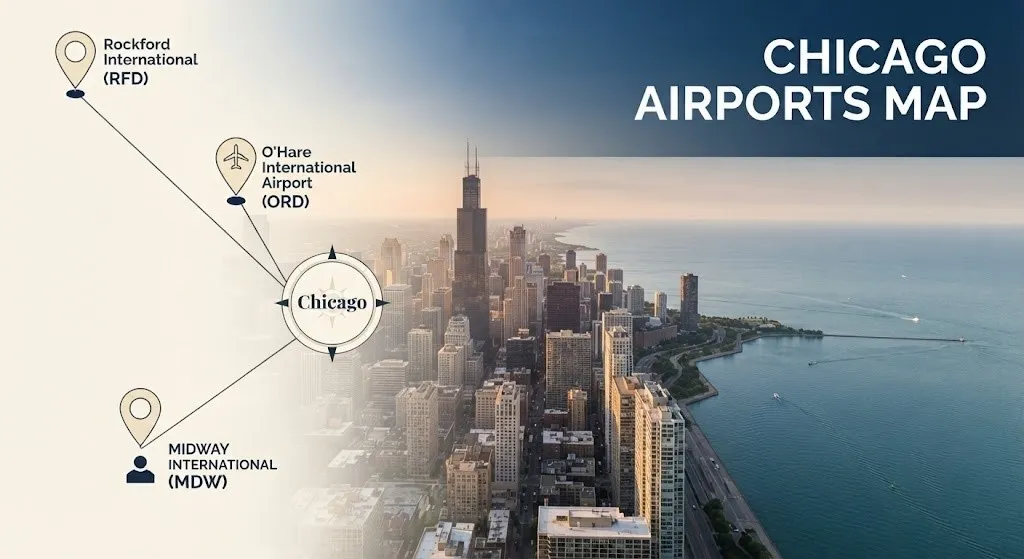
The geographic spread means your airport choice significantly impacts ground transfer time and cost. ORD is the global hub with the most flight options. MDW is the domestic workhorse dominated by Southwest Airlines. RFD is the low-cost outlier.
A first-time international traveler should default to ORD. It is the only airport with customs and immigration facilities for arriving international flights. A domestic budget traveler should compare total trip cost across all three airports, including the ground transfer expense from each.
Airports in Chicago
There are two major international airports and one regional airport serving the Chicago metropolitan area. ORD and MDW are located within the city limits of Chicago proper.
RFD is in Rockford, Illinois, a separate city requiring a long ground transfer. A fourth airport, Gary Chicago International Airport (GYY), sits in Gary, Indiana, but offers no scheduled commercial passenger service as of 2026.
The two primary airports serve distinctly different roles. ORD is a massive global hub for United Airlines and a major operation for American Airlines. MDW is a Southwest Airlines fortress hub with limited service from other low-cost carriers.
A business traveler needing lounge access and frequent flight options should choose ORD. A budget traveler flying domestically should compare Southwest fares at MDW against ultra-low-cost carrier options at both ORD and RFD.
Key Takeaway: Chicago has three commercially relevant airports. ORD is the global hub. MDW is the Southwest stronghold. RFD is the budget outlier.
Chicago O’Hare International Airport
Chicago O’Hare International Airport (ORD) is one of the world’s busiest airports, handling over 80 million passengers annually across four passenger terminals. Terminal 1, Terminal 2, Terminal 3, and the international Terminal 5 form the passenger complex.
O’Hare is the primary hub for United Airlines and a major operating base for American Airlines. The airport offers nonstop flights to over 200 destinations worldwide, including extensive service to Europe, Asia, and South America. This is the only Chicago airport with international arrivals facilities.
The terminal complex is connected by the O’Hare people mover, the Airport Transit System, an automated train that runs 24 hours. Terminal 5, the international terminal, is physically separated from the domestic core and requires a people mover ride for connections to Terminals 1 through 3.
A business traveler connecting through Chicago on United Airlines will spend their time in Terminal 1. A family with an international arrival will clear customs in Terminal 5. The people mover connection is reliable but adds 15 to 20 minutes to any Terminal 5 connection.
Chicago Midway International Airport
Chicago Midway International Airport (MDW) is a compact, single-terminal airport complex just 10 miles from downtown Chicago. It processes over 20 million passengers annually with a focus on domestic point-to-point service.
Southwest Airlines operates a dominant fortress hub at Midway, controlling over 90 percent of the airport’s passenger traffic. The airport has three concourses labeled A, B, and C, all connected post-security. The walk from the CTA Orange Line station to the security checkpoint takes under five minutes.
The compact footprint is a genuine advantage for travelers who value speed and simplicity. Curb to gate time can be under 20 minutes with TSA PreCheck on a normal day. The limitation is the nearly complete absence of international service, lounge facilities, and premium airline amenities.
A solo traveler flying Southwest with only a carry-on bag will love Midway’s efficiency. A business traveler expecting a United Club or Admirals Club will find none. Midway is a functional, no-frills airport that excels at getting you from the train to the departure gate quickly.
Chicago Rockford International Airport
Chicago Rockford International Airport (RFD) is a small commercial airport located 85 miles northwest of downtown Chicago. It serves a niche role as an ultra-low-cost leisure gateway to the Chicago metropolitan area.
Allegiant Air is the primary scheduled passenger carrier at RFD, offering low-frequency service to leisure destinations in Florida, Arizona, and the Southeast. The airport has a single small passenger terminal with basic amenities. There is no lounge, no premium check-in, and very limited food and beverage beyond vending machines.
The ground transfer to downtown Chicago or the northern suburbs takes approximately 90 minutes by car without traffic. There is no direct rail connection from RFD to Chicago. A rental car or pre-booked shuttle is essential. The cost of the ground transfer can exceed the savings on the airfare for a solo traveler.
A budget leisure traveler flying as a family of four with checked bags may find the total trip cost lower at RFD. The Allegiant Air base fare can be low enough to offset the long ground transfer expense. A business traveler should not consider RFD for any trip with a time-sensitive downtown commitment.
| Airport Comparison | IATA | Distance to Loop | Transfer Time | Primary Airlines | Best For |
|---|---|---|---|---|---|
| O’Hare International | ORD | 17 miles | 40-60 min | United, American | International, business, lounges |
| Midway International | MDW | 10 miles | 25-35 min | Southwest | Domestic, CTA convenience |
| Rockford International | RFD | 85 miles | 90+ min | Allegiant | Ultra-budget leisure only |
ORD vs MDW Chicago
The ORD versus MDW decision turns on airline preference, international requirements, and the value of airport amenities. ORD offers the full global network. MDW offers Southwest efficiency.
O’Hare is the only choice for international arrivals, premium cabin lounges, and business traveler amenities. The United Club, Admirals Club, and Delta Sky Club are all present. Midway has no airline-operated lounge. The waiting experience is a standard gate-area chair for all passengers.
Midway counters with a faster, less stressful curb-to-gate experience. The CTA Orange Line station is integrated into the terminal. At O’Hare, you may need the people mover to reach your terminal or rental car facility. The complexity penalty at O’Hare is real, especially for infrequent flyers.
A business traveler flying international should always choose ORD. A domestic traveler flying Southwest to a city served from both airports should price both. The CTA train from Midway is faster and more predictable than the Blue Line from O’Hare during peak traffic hours.
Key Takeaway: ORD for international, business, and lounges. MDW for Southwest domestic simplicity. RFD for budget leisure only with a car.
Which Chicago Airport Is Closest to Downtown
Chicago Midway International Airport is geographically closest to downtown Chicago at 10 miles from the Loop. O’Hare International Airport sits 17 miles from downtown.
The distance advantage of Midway is partially offset by the faster average speed of the CTA Blue Line from O’Hare compared to the Orange Line from Midway. The door-to-door transfer time from O’Hare to downtown hotels can be only 10 to 15 minutes longer than from Midway despite the greater distance.
For a destination in the South Loop or near McCormick Place, Midway is the clear geographic winner. For the North Side or the northern suburbs near Evanston, O’Hare is actually closer. The Loop is roughly equidistant when factoring in CTA travel time on each respective line.
A family heading to a downtown Michigan Avenue hotel should not base their airport decision purely on distance. The total cost of the flight plus transfer, and the availability of a direct flight on their preferred airline, matters more than the seven-mile geographic difference between ORD and MDW.
Chicago Airport Ground Transportation
All three Chicago airports offer distinct ground transportation options. The CTA train serves ORD and MDW directly. RFD requires a private vehicle or pre-arranged shuttle.
From O’Hare, the CTA Blue Line runs 24 hours to the Loop with a travel time of approximately 40 to 45 minutes. A taxi or rideshare to downtown takes 30 to 60 minutes depending on traffic. The cost of a taxi is on a metered fare structure. Rideshare pricing surges during peak demand periods.
From Midway, the CTA Orange Line reaches the Loop in approximately 25 to 30 minutes. Taxi and rideshare times are 20 to 35 minutes. The shorter distance makes Midway the cheaper and faster road transfer to most downtown locations. Verify current CTA fares on the official Chicago Transit Authority website before traveling, as fares adjust annually.
From RFD, a rental car or pre-booked shuttle is the only practical option. The drive to downtown Chicago takes 90 minutes or more. The transfer cost can exceed a one-way domestic airfare. A solo traveler without a rental car should not fly into RFD. A family renting a car for a broader Illinois road trip can make RFD work as a first stop.
Airlines at Chicago O’Hare
O’Hare International Airport is a major hub for United Airlines, which operates its largest global gateway from Terminal 1. United offers extensive domestic and international service from O’Hare.
American Airlines operates a large hub from Terminal 3. Delta Air Lines has a significant presence in Terminal 2, though it does not hub at ORD. International carriers including British Airways, Lufthansa, ANA, Japan Airlines, Emirates, and Qatar Airways operate from Terminal 5.
Budget carriers including Spirit Airlines and Frontier Airlines operate from O’Hare, primarily from Terminal 2 and Terminal 3. The presence of both legacy and low-cost carriers makes ORD the most diverse airline airport in the Chicago system. A traveler can fly nearly any major global airline from O’Hare.
A frequent flyer with United MileagePlus status should prioritize Terminal 1 connections. An international business class passenger on a Star Alliance carrier will clear security in their departure terminal and may have lounge access based on ticket class and status. Verify your airline’s current terminal assignment on the official Chicago Department of Aviation website before departure.
Airlines at Chicago Midway
Southwest Airlines operates a dominant fortress hub at Chicago Midway International Airport, controlling the vast majority of daily departures. Southwest serves over 70 domestic destinations nonstop from MDW, plus a limited number of near-international leisure routes to Mexico and the Caribbean.
Delta Air Lines operates a small number of mainline flights from Midway. Frontier Airlines and Volaris also maintain a limited presence. The airline diversity is a fraction of O’Hare’s. If you are not flying Southwest, you are probably flying from O’Hare.
The Southwest Rapid Rewards loyalty program is the only meaningful frequent flyer program operating at scale from Midway. A business traveler loyal to United, American, or Delta will find Midway useless. A Southwest loyalist will find it a faster and more pleasant experience than O’Hare for domestic routes.
A family flying Southwest to Orlando or Las Vegas should actively prefer Midway over O’Hare. The CTA Orange Line drops you at the terminal door. The security checkpoint is manageable. The gate-area seating is adequate. The entire experience is simpler and less overwhelming for children than the scale of O’Hare.
Key Takeaway: O’Hare has every airline. Midway is a Southwest fortress. Your loyalty program dictates your airport in Chicago.
Chicago O’Hare Terminal Map
O’Hare’s passenger complex consists of four terminals. Terminal 1 is the United Airlines domestic and international hub. It contains Concourses B and C with the United Club and Polaris Lounge.
Terminal 2 houses Delta Air Lines, Spirit Airlines, and several regional carriers. The Delta Sky Club is located here. Terminal 3 is the American Airlines terminal with Concourses G, H, K, and L. The Admirals Club and Flagship Lounge serve premium American passengers.
Terminal 5 is the international terminal, processing all foreign-flag carrier arrivals and departures. It has its own TSA security checkpoint and customs facility. The terminal contains a collection of contract lounges and a USO lounge. The ATS people mover connects Terminal 5 to the domestic core and the Multi-Modal Facility for rental cars and ride-hailing pickups.
A connecting passenger arriving at Terminal 5 on an international flight and departing from Terminal 1 on United must clear customs, collect bags, re-clear TSA, and ride the ATS. This process takes a minimum of 90 minutes. A solo traveler with Global Entry and carry-on only can cut this to 60 minutes on a good day.
Chicago Midway Terminal Map
Midway’s single terminal building contains three concourses. Concourse A serves Southwest Airlines and a small number of Frontier and Delta flights. Concourse B is exclusively Southwest. Concourse C is a smaller Southwest concourse with a few Volaris gates.
All three concourses are connected post-security by a central food court and seating area. The walk from the farthest A gate to the farthest C gate takes approximately 10 to 12 minutes at a normal pace. The compact layout means tight connections are less stressful than at O’Hare.
The security checkpoint feeds directly into the central atrium. TSA PreCheck is available in a dedicated lane during peak hours. The checkpoint can back up significantly during the 5 a.m. to 7 a.m. Southwest departure bank on weekdays. A business traveler with PreCheck should arrive 60 minutes before departure. A family without PreCheck on a Monday morning should allow 90 minutes.
The terminal has no airline-operated lounges. The USO operates a small lounge for active military personnel and their families. All other passengers wait at the gate seating areas. The food options are concentrated in the central food court and include Chicago-style hot dog and deep-dish pizza outposts.
Chicago Airport Lounges
Airport lounge access in Chicago is concentrated at O’Hare International Airport. Midway has no airline-operated lounges. RFD has no lounge facilities of any kind.
At O’Hare Terminal 1, the United Club and United Polaris Lounge serve United premium passengers and Star Alliance Gold members. The Polaris Lounge is a flagship facility with a full-service restaurant, private shower suites, and quiet nap rooms. Access requires a Polaris business class same-day international boarding pass.
Terminal 2 houses the Delta Sky Club for Delta premium passengers and SkyTeam Elite Plus members. Terminal 3 has the Admirals Club and the Flagship Lounge for American Airlines premium passengers and oneworld Sapphire and Emerald members. Terminal 5 has contract lounges including a Swissport Lounge and the Aer Lingus Lounge, accessible via Priority Pass.
A business traveler with a long layover at ORD should factor lounge access into their terminal and airline choice. A family with a Priority Pass membership from a premium credit card can access the contract lounges in Terminal 5 but will find no lounge access if flying Southwest from Midway. Verify current lounge access policies and hours directly with your airline or lounge network before traveling.
Chicago Rockford Airport Allegiant
Allegiant Air is the anchor airline at Chicago Rockford International Airport, operating a low-frequency leisure schedule to warm-weather destinations. Service typically runs two to three times per week on each route, not daily.
The Allegiant business model at RFD targets budget leisure travelers who live in the far western and northwestern Chicago suburbs. For a traveler in Rockford, Belvidere, or the Fox River Valley, RFD is a genuinely closer and easier airport than ORD or MDW. For a traveler in the city of Chicago, the 85-mile drive negates the fare savings.
Allegiant charges separately for everything beyond the seat. Carry-on bags, checked bags, seat selection, and even a printed boarding pass at the airport incur steep fees. Verify the total bundled fare including all desired add-ons on the official Allegiant Air website before comparing against a Southwest fare from MDW with free carry-ons.
A budget family of four living in the northwest suburbs may find an Allegiant vacation package from RFD to Florida cheaper overall. The bundled package with a rental car and hotel can offset the airline’s ancillary fees. A solo business traveler should not consider RFD under any practical scenario.
Key Takeaway: Lounges are at ORD only. RFD has zero amenities. MDW has no lounges but excellent CTA access.
CTA Blue Line O’Hare to Downtown
The CTA Blue Line is the direct rail connection from O’Hare International Airport to downtown Chicago. The station is located in the lower level of the main terminal complex, accessible via escalators from the baggage claim level.
Trains run 24 hours a day, seven days a week. During daytime hours, service frequency is every 5 to 10 minutes. Late-night service runs every 15 to 20 minutes. The ride to Clark/Lake station in the heart of the Loop takes approximately 40 to 45 minutes. The train makes several stops through Chicago’s Northwest Side neighborhoods before reaching downtown.
The Blue Line is the most cost-effective transfer from O’Hare to downtown. A taxi or rideshare can cost many times the CTA fare. The train avoids all expressway traffic, which can add 30 minutes or more to a road transfer during peak afternoon congestion on the Kennedy Expressway.
A solo traveler with a single carry-on bag will find the Blue Line the smartest choice. A family with multiple large suitcases and a stroller may find a taxi or pre-booked car service worth the extra cost for door-to-door hotel convenience. Verify current CTA fares and any service advisories on the official Chicago Transit Authority website before traveling.
Frequently Asked Questions About Chicago Airports
How many airports are in Chicago?
Chicago has two major commercial airports: O’Hare International Airport (ORD) and Chicago Midway International Airport (MDW).
A third regional airport, Chicago Rockford International Airport (RFD), serves the broader metro area.
Milwaukee Mitchell International Airport (MKE) is sometimes used as a distant Chicago-area alternative.
Which Chicago airport is better, O’Hare or Midway?
O’Hare is better for international travel, business class lounges, and airline choice.
Midway is better for Southwest Airlines domestic flights and a faster curb-to-gate experience.
Your airline loyalty and destination determine which airport is better for your specific trip.
How do I get from O’Hare to downtown Chicago?
The CTA Blue Line train runs 24 hours from O’Hare to the Loop in approximately 40 to 45 minutes.
A taxi or rideshare takes 30 to 60 minutes depending on traffic conditions.
The CTA is the most cost-effective option for solo travelers and light packers.
What airlines fly out of Midway Airport?
Southwest Airlines is the dominant carrier at Chicago Midway, operating over 90 percent of flights.
Delta Air Lines, Frontier Airlines, and Volaris also operate a limited schedule from Midway.
If you are not flying Southwest, you are likely flying from O’Hare instead.
Is there a train from Chicago airports to downtown?
Yes, the CTA Blue Line serves O’Hare International Airport to the Loop 24 hours a day.
The CTA Orange Line connects Midway International Airport to the Loop in 25 to 30 minutes.
There is no direct rail connection from Chicago Rockford International Airport to downtown.
What lounges are at Chicago O’Hare?
O’Hare has United Club and Polaris Lounge in Terminal 1, Delta Sky Club in Terminal 2, and Admirals Club and Flagship Lounge in Terminal 3.
Terminal 5 has contract lounges accessible via Priority Pass membership.
Chicago Midway has no airline-operated lounges for any carrier.
Closing
Chicago’s airport system offers a clear hierarchy for travelers. O’Hare International Airport is the global gateway with every airline, every lounge, and the full international customs and immigration facility. Midway International Airport is the Southwest Airlines fortress that delivers a simpler, faster domestic travel experience with excellent CTA rail access to downtown. Chicago Rockford International Airport is the niche budget option that only works for leisure travelers starting from the far western suburbs.
Your smartest move before booking is to calculate the total trip cost, not just the airfare. Add the airport transfer time and cost to your downtown hotel or final destination. Verify your airline’s current terminal assignment on the official Chicago Department of Aviation website. Check the CTA Blue Line or Orange Line fare and any service advisories on the Chicago Transit Authority website before you arrive. The best Chicago airport is the one that minimizes your total door-to-door cost and time for your specific trip, and that calculation is different for every traveler profile. Run the numbers for your exact dates and airline preference before clicking purchase.