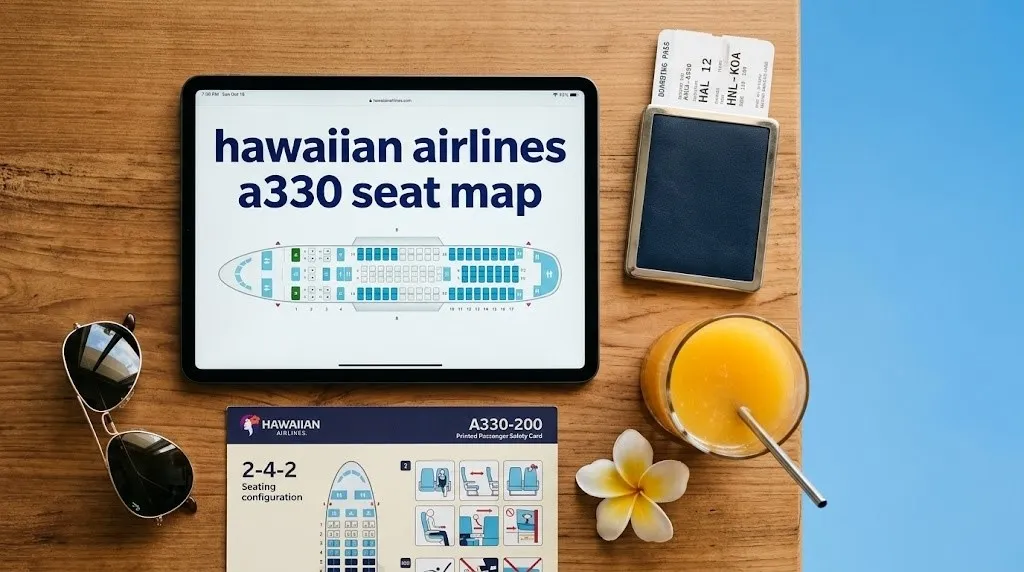
The Hawaiian Airlines Airbus A330-200 seat map reveals a classic wide-body layout ideal for long-haul comfort. Selecting the right seat transforms your six-hour flight across the Pacific Ocean.
This aircraft operates the backbone of the airline’s West Coast and international routes. A single row choice separates a restful red-eye from an exhausting ordeal.
This guide analyzes the 2026 cabin across First Class, Extra Comfort, and Main Cabin. You will learn which specific seats to book and which to avoid at all costs.
Hawaiian Airlines A330-200 Overview
Hawaiian Airlines has long relied on the Airbus A330-200 for its premier long-haul missions. In 2026, this fleet connects Hawaii to over a dozen major US and international cities.
The A330-200 offers an intimate wide-body experience without the crowding of a larger Boeing 777. The cabin feels spacious thanks to a generous 2-4-2 Main Cabin configuration.
The airline uses the aircraft’s belly cargo space efficiently for checked bags and freight. This logistical choice means fewer passenger bag restrictions compared to narrow-body jets.
Solo travelers benefit from the many window-aisle pairings in the A330. Families with children appreciate the center section of four seats for staying close together.
The aircraft underwent cabin refreshes in the past, but some older configurations still fly. A sharp-eyed traveler inspects the seat map for minor layout differences before booking.
Airbus A330-200 Seat Map Hawaiian Airlines Layout
The Hawaiian Airlines A330-200 seat map is split into a three-cabin layout. First Class features 18 lie-flat seats in a 2-2-2 arrangement at the front.
Behind First Class sits the Extra Comfort section with about 68 premium economy seats. These seats offer priority boarding and more legroom in a still-standard economy width.
The rest of the plane comprises the Main Cabin with standard economy seating. All Main Cabin rows follow the traveler-friendly 2-4-2 configuration except a few narrow spots.
A traveler’s main decision point is choosing between the quiet of the front cabin zones. The trade-off is proximity to the forward galley and lavatory.
Row numbering typically starts after the First Class and Extra Comfort cabins. The over-wing exit rows offer a massive legroom increase in the Main Cabin.
Budget travelers will target Main Cabin seats far from the premium cabin dividers. Business travelers should select seats nearer the front for a faster exit upon landing.
Key Takeaway: The 2-4-2 layout in Main Cabin is superior to the 3-3-3 found on many competitors, making window-duo travel pleasant.
Hawaiian Airlines A330 First Class Cabin
Hawaiian Airlines First Class on the A330 delivers a decidedly domestic premium experience. The cabin sports 18 wide, lie-flat seats spread across five rows in a 2-2-2 layout.
You get a seat 20.5 to 21 inches wide with a solid 76-inch pitch in bed mode. This beats any domestic narrow-body first-class recliner by a very large margin.
The forward cabin position means you are first to board and the first off the plane. This dedicated space feels exclusive but lacks the privacy doors of true international business class.
Couples and vacationers on a special trip will find the paired seats highly romantic. Solo business travelers seeking privacy will be disappointed by the lack of a single-window seat.
A hot meal service with complimentary alcoholic beverages defines the First Class catering. A signature mai tai sets the Hawaiian mood shortly after reaching cruising altitude.
The window-side “A” and “H” seats in Row 1 offer a slightly larger footwell. Avoid the “E” and “F” center seats if you dislike stepping over a stranger’s legs.
The 2-2-2 layout is generous for a domestic product but dated for an international one. For a West Coast flight to Maui, it is the most comfortable way to fly.
Hawaiian Airlines Extra Comfort Seats Review
Extra Comfort is Hawaiian Airlines’ premium economy product and a significant step up. You receive a generous 36 inches of seat pitch instead of the standard 31 inches.
The seat itself is the same width as Main Cabin but with enhanced cushioning and a legrest. This makes a dramatic difference in knee strain on a five or six-hour flight.
You also board immediately after First Class with an exclusive dedicated bin space benefit. An amenity kit and priority service at the airport complete the value package.
Tall travelers and frequent flyers will find Extra Comfort a non-negotiable for knee space. Budget families should price out an entire row of Extra Comfort versus a standard row.
The seats are typically in rows 11 through 17 and a small forward section behind Row 1. Row 11 bulkhead Extra Comfort seats offer phenomenal legroom with no seat in front of you.
The downside of Row 11 is the fixed armrest tray table and an immovable leg barrier. Many travelers dislike the lack of under-seat storage for their personal item during takeoff.
Extra Comfort is worth the premium if the cash or miles price feels manageable for you. It is not a lie-flat bed, so manage expectations on a red-eye flight from Las Vegas.
Hawaiian Airlines A330 Main Cabin Seats
The Hawaiian Airlines A330 Main Cabin provides a comfortable standard economy experience. Seat width measures 18 inches and the pitch is a reasonable 31 to 32 inches.
Every Main Cabin seat has a seatback entertainment screen and shared power outlets. The 2-4-2 layout means the cabin never feels like a tightly packed commuter train.
The headrests are adjustable, and the seats have a slight recline for napping. This recline is not dramatic, but enough to open a laptop screen comfortably.
Budget travelers will find Main Cabin a good value relative to other legacy carriers. Larger-bodied travelers should know the 18-inch width is a standard not a generous measurement.
The quietest Main Cabin zone is the mini-cabin behind Row 11 on the left side of the plane. This section behind the forward lavatories often gets overlooked during the booking rush.
Two over-wing exit rows offer Main Cabin travelers a massive legroom bonus. These seats come with the responsibility of assisting the crew in an emergency.
Standard Main Cabin seats near the back lavatories are the loudest and most cramped. People congregate there, the seats may have limited recline, and the smell spreads.
Best Seats on Hawaiian Airlines Airbus A330
The best seat on the Hawaiian Airlines A330 is the 1A or 1H First Class window. You get a slightly larger footwell, a hot meal, and total lie-flat privacy.
For Extra Comfort, the bulkhead Row 11 E and F center seats are excellent. You have an endless legroom advantage and direct aisle access for a standing stretch.
The Main Cabin exit rows provide the best value seat on the entire aircraft. Row 29 A and B, along with 29 H and J, give you massive legroom at no first-class cost.
Any Main Cabin duo should book a left or right window-aisle combination. The “AB” or “HJ” pairs in rows 20 through 25 offer a shared space with a view.
Solo travelers in Main Cabin should target the single “G” seats in the center section. Row 22G avoids the galley and is a perfect strategic pick for a lone flier.
Couples will love the 2-2-2 First Class window pairs for a celebratory flight. Families must consider the bulkhead for bassinet access but should pack light for takeoff.
The seat map changes slightly by aircraft tail number, so verify your specific flight. A last-minute aircraft swap can move you from a throne to a tight spot.
Hawaiian Airlines A330-200 Seats to Avoid
The worst seats on this jet are the last row Main Cabin seats before the lavatories. Row 43 A, B, H, and J offer minimal recline and constant foot traffic.
Avoid the center “D” and “G” seats in the standard 2-4-2 Main Cabin block. You will be two full seats from the aisle with a stranger on each side of you.
Steer clear of Row 10 A and H windows in Extra Comfort directly in front of the bulkhead. You may have a misaligned window view or reduced storage near the galley wall.
Any First Class seat might be a poor choice if you booked a last-minute paid upgrade. You risk getting a middle “D” or “E” seat that requires climbing over a neighbor.
Light sleepers must absolutely avoid the Main Cabin seats near the forward galley. The crew’s clattering and chatting during overnight meal prep destroys any hope of rest.
Motion sickness-prone travelers should choose a wing-adjacent seat in the middle of the plane. Seats near the far rear can feel the tail’s sway more acutely during turbulence.
Missing a window is a real risk in certain Extra Comfort rows near the exit. A misaligned seat means you stare at a plastic wall for a five-hour trip.
Hawaiian Airlines A330 In-Flight Experience and Amenities
Every seatback on the A330 features a touch-screen entertainment system loaded with content. You get dozens of new-release movies, TV box sets, and Hawaiian cultural programming.
The meal service in the Main Cabin includes a complimentary hot sandwich or pasta entree. A famous Pau Hana snack mix and a glass of POG juice complete the island vibe.
WiFi is available on most of the A330 fleet for a fee in 2026. The connection is strong enough for email and messaging but struggles with video streaming services.
Families value the large library of free kids’ content on the seatback screens. Business travelers can plug in and work for hours with the shared A/C and USB power ports.
A complimentary rum punch or mai tai service kicks off the meal in Main Cabin. This small touch sets Hawaiian apart from the nickel-and-diming of mainland US carriers.
The lavatories are basic and can get messy on full flights in the rear sections. A wise traveler visits the forward lavatory before the post-meal rush hits Row 12.
A soft pillow and a mid-weight blanket are provided on all trans-Pacific A330 flights. Bring a warm sweater, as the cabin air conditioning often runs very cold overnight.
Key Takeaway: Hawaiian’s complimentary meal, entertainment, and island-inspired beverage service outshines typical domestic first class, even in economy.
Hawaiian Airlines A330-200 Routes and Destinations
In 2026, you will find the Airbus A330-200 on Hawaiian’s most important routes. The aircraft connects Daniel K. Inouye International Airport (HNL) in Honolulu to major West Coast hubs.
Primary US mainland destinations include Los Angeles (LAX), San Francisco (SFO), and Seattle (SEA). You will also see it serving Portland (PDX), San Diego (SAN), and Sacramento (SMF).
The A330 also flies long-haul to New York (JFK) and Boston (BOS) on the East Coast. These are the true test cases where a lie-flat First Class seat becomes essential.
International routes flying the A330 include flights to Japan, South Korea, Australia, and New Zealand. Papeete (PPT) in Tahiti and Pago Pago (PPG) in American Samoa also see service.
East Coast travelers gain the most from the A330’s First Class lie-flat bed. A Main Cabin seat works fine for the short five-hour hop from Los Angeles (LAX).
Aircraft assignments can change, so the A321neo is slowly taking over some West Coast routes. Always check the equipment type on your ticket before investing in a seat selection.
The on-time performance for these A330 routes is generally strong according to DOT data. Hawaiian Airlines consistently ranks near the top of the U.S. domestic punctuality charts.
Hawaiian Airlines A330 vs A321neo for Hawaii Flights
The main difference is the Airbus A330 is a wide-body jet and the A321neo is a narrow-body. The A330 offers a roomier 2-4-2 economy layout versus the tighter 3-3 on the A321neo.
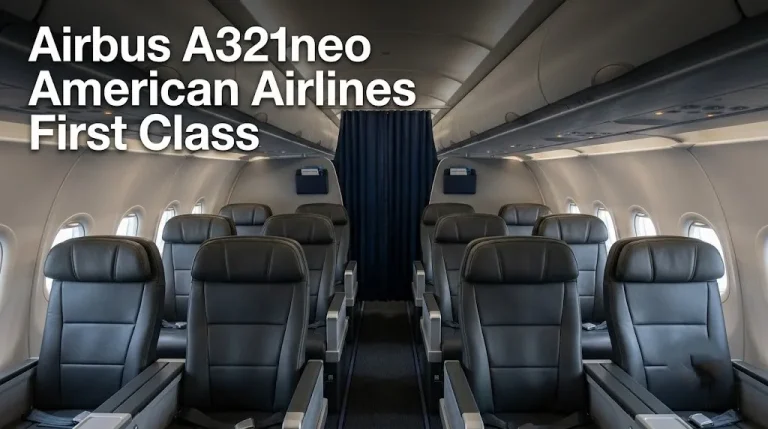
First Class on the A330 has 18 lie-flat seats, while the A321neo has 16 recliners. The A321neo seat is a standard domestic first-class chair, not a bed for sleeping.
For a red-eye, the A330 is a non-negotiable choice if you are paying for a premium cabin. The A321neo’s First Class is fine for a daytime West Coast flight but tough overnight.
The in-flight experience is similar, with excellent meal service and seatback screens on both. However, the A330 cabin feels less claustrophobic on a full six-hour trans-Pacific haul.
Claustrophobic travelers should target the A330 flights specifically, even if times are slightly off. Budget travelers on a short LAX to HNL hop will survive perfectly fine on the A321neo.
The A321neo is more fuel-efficient and often serves smaller markets like Long Beach (LGB). The A330 is the heavy lifter for cargo-heavy and high-demand premium routes.
If you have a choice, always pick the A330 for the comfort of its dual-aisle cabin. The extra elbow room and ability to walk around make a big difference.
Hawaiian Airlines A330 Family and Special Needs Seating
Hawaiian Airlines prioritizes families, but the A330 seat map has specific tricks for parents. The best family strategy is to book the center section of four seats in Main Cabin.
Rows 20 through 24 in the “DEFG” block put two kids between two adults. The 2-4-2 layout eliminates the stranger-in-the-third-seat problem you get on a Boeing 737.
The forward Main Cabin bulkhead seats have pull-out bassinet attachment points for infants. You must call Hawaiian Airlines directly after booking to secure these specific basket seats.
Wheelchair-bound passengers or those with mobility issues should request an aisle seat near the front. The crew can provide an aisle wheelchair to reach the lavatory during the flight.
Families with strollers can gate-check a compact stroller at the jetbridge. It will be waiting for you on the arrival jetbridge at HNL, OGG, KOA, or LIH.
Never book the last row for a family with a car seat and a sleeping toddler. The limited recline and lavatory noise will wake the child repeatedly on a long flight.
The FAA prohibits car seats in the exit row, so families must sit elsewhere. A window seat is ideal for securing a FAA-approved child safety seat in place.
Making Connections on Hawaiian Airlines at HNL
Your seat choice on the A330 can make or break a tight Honolulu connection. Inter-island flights to Maui, Kauai, or the Big Island often leave 60 to 90 minutes after a mainland arrival.
Sitting in First Class or Extra Comfort Rows 11-14 gives you a massive head start. Being in the front third of the plane puts you first in the jetbridge dismbarkation line.
Daniel K. Inouye International Airport (HNL) has a main Overseas Terminal and an Inter-Island Terminal. The wiki-wiki shuttle bus connects them, but it can take ten minutes with a wait.
Nervous flyers making a 45-minute connection should only book seats in the forward cabins. A Main Cabin seat in Row 44 will guarantee you miss the shuttle bus’s first load.
The HNL open-air walkways are beautiful but can be a hot, humid walk. Moving fast from your seat beats missing your Kona flight and waiting three hours for the next one.
Hawaiian and the new Alaska Airlines partnership are streamlining terminal operations in 2026. Check your connecting flight’s terminal and gate before you even board the first A330.
Gate-checked items slow you down if you sit at the very back. The crew brings strollers up last, so a front-cabin seat gets you on your way faster.
Key Takeaway: A front-cabin seat on the A330 is a strategic weapon for conquering the connection dash at HNL’s sprawling terminal complex.
Hawaiian Airlines A330 Seat Map FAQs
What is the seat configuration on a Hawaiian Airlines Airbus A330?
The Hawaiian Airlines Airbus A330-200 has a three-class configuration.
First Class has 18 lie-flat seats in a 2-2-2 layout at the front.
The rest of the plane has 68 Extra Comfort and about 192 Main Cabin seats in a 2-4-2 layout.
Does Hawaiian Airlines A330 First Class have lie-flat seats?
Yes, Hawaiian Airlines A330 First Class seats are fully lie-flat beds.
They convert into a sleeping surface with a 76-inch seat pitch.
This is standard on all A330s flying between Hawaii and the US mainland.
Is Extra Comfort worth it on Hawaiian Airlines’ A330?
Extra Comfort is worth it for tall travelers or anyone on a flight over five hours.
You get 36 inches of seat pitch, a legrest, and priority boarding.
Budget travelers on a short flight will find Main Cabin acceptable for the price.
Where are the worst seats on a Hawaiian Airlines A330-200?
The worst seats are in the last Main Cabin row before the rear lavatories.
These seats, in Row 43, have limited recline and constant passenger traffic.
The forward Extra Comfort Row 10 also risks a misaligned window view.
What are the best seats on a Hawaiian Airlines A330 for families?
The best family seats are the center section four-seat blocks in Main Cabin.
Rows 20 through 24 in the “DEFG” seats keep kids between two parents.
A forward bulkhead seat with a bassinet is essential for infant travelers.
Does Hawaiian Airlines’ A330 have seatback entertainment screens?
Yes, every seat on the Hawaiian Airlines A330 has a personal touch-screen monitor.
You get a large library of movies, shows, and live TV on all trans-Pacific routes.
WiFi is available for purchase, but seatback screens are free for all classes.
Closing
The Hawaiian Airlines A330 remains a passenger-friendly workhorse in a world of shrinking seats. Its 2-4-2 layout and island hospitality create a superb flying experience.
Your mission is simple. Avoid the rear Main Cabin at all costs and book a forward cabin seat. This single move guarantees a faster exit and a quieter ride.
Hawaiian’s 2026 integration with Alaska Airlines means loyalty program rules are shifting. Always verify your specific aircraft’s seat map on the airline’s official site 24 hours before departure.
The perfect A330 seat makes the difference between landing exhausted and arriving ready for the beach. Choose wisely, and the vacation starts the moment you buckle in.