Turkish Airlines operates the Boeing 787-9 Dreamliner as its most modern twin-aisle aircraft. The 787 business class features a 1-2-1 configuration with direct aisle access for every passenger. This is a significant upgrade over the older Boeing 777-300ER fleet.
The Dreamliner airframe itself provides a measurable comfort advantage on a long flight from Istanbul. The cabin pressure is lower and the humidity is higher. You land feeling noticeably less dehydrated and fatigued after a 10-hour crossing.
This guide details the exact seat specifications, the route network, and the honest passenger experience. You will know exactly which seat to select and whether booking this specific aircraft is worth the effort.
Turkish Airlines 787
Turkish Airlines 787 refers to the Boeing 787-9 Dreamliner variant currently operating in the airline’s wide-body fleet. The airline uses this aircraft on high-value, long-haul routes where passenger comfort and fuel efficiency justify the deployment.
The 787-9 is a carbon-composite aircraft with a modern twin-aisle cabin. Turkish Airlines configures its 787-9 with 30 business class seats and 270 economy class seats. The total passenger count is 300, with the business cabin occupying the entire forward section between the first and second set of boarding doors.
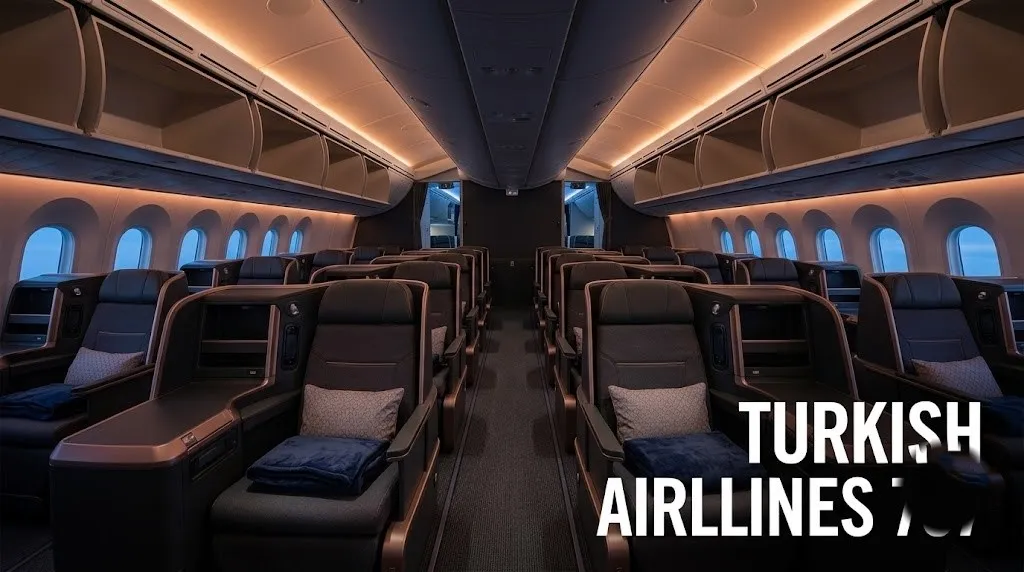
The aircraft features large electrochromic windows that dim electronically instead of using a physical plastic shade. The LED lighting system simulates sunrise and sunset to combat jet lag. The overhead bins are among the largest in the industry and accommodate a standard roll-aboard suitcase turned on its side.
Solo travelers should focus on booking this specific aircraft for any transatlantic trip from Istanbul. Business travelers will appreciate the quieter cabin and the lower effective cabin altitude. Families with young children should know that the dimmable windows are controlled centrally and cannot be forced dark by a passenger during taxi, takeoff, and landing.
The Boeing 787-9 is a distinct hard product upgrade within the Turkish Airlines fleet. It is not simply a newer version of an old plane.
Key Takeaway: The Turkish Airlines 787-9 is a modern composite aircraft with superior cabin pressure, humidity, and window technology.
Boeing 787 Turkish Airlines
The Boeing 787 Turkish Airlines fleet consists exclusively of the 787-9 variant, with a growing number of airframes in active service. The airline took delivery of its first Dreamliner in 2019 and has steadily expanded the fleet to replace older Airbus A330-300 aircraft on flagship routes.
Turkish Airlines uses the 787-9 as a strategic premium product to compete against Gulf carriers and European legacies on long-haul trunk routes. The aircraft’s range and fuel efficiency allow the airline to profitably serve destinations on the West Coast of the United States and deep into Asia. The Dreamliner’s composite structure also reduces cabin noise, which is noticeably lower than on the aluminum 777-300ER.
The 787 features a distinctive nose profile and raked wingtips that are easy to spot from the terminal window. The aircraft’s exterior is painted in the standard Turkish Airlines livery with the tulip logo on the tail. The cabin interior is illuminated with mood lighting that transitions through soft blue, warm amber, and calming pink phases during the flight.
First-time international travelers on a long-haul flight should prioritize booking the 787-9 over the 777-300ER for the superior cabin environment. Business travelers who fly frequently will recognize the lower fatigue level after a 12-hour sector. Budget travelers in economy class will benefit from the improved air quality even if they are not in a premium seat.
Conde Nast Traveler has consistently recognized the Dreamliner’s cabin environment as a meaningful improvement for passenger wellness on ultra-long-haul flights.
Turkish Airlines 787-9
The Turkish Airlines 787-9 is the specific subtype of the Dreamliner operated by the airline, with a fuselage stretched 6 meters longer than the 787-8. This stretch accommodates the 30 business class seats and the 270 economy seats in a comfortable density. The aircraft is not a high-density configuration like some competing airlines operate.
The 787-9 has a maximum range of approximately 14,000 kilometers, allowing Turkish Airlines to fly nonstop from Istanbul to destinations across the Americas and the Far East. The aircraft is powered by General Electric GEnx engines that are quieter and more fuel-efficient than the engines on the older Airbus A330. The Dreamliner’s wing flex is a visible design feature that contributes to a smoother ride in turbulence.
The cabin is divided into two distinct sections with a galley and lavatory complex separating the business and economy cabins. The forward business cabin is a single large space with no bulkheads dividing the 30 seats. The economy cabin feels spacious due to the sculpted sidewalls and the large overhead bins.
Solo travelers in business class will find the window seats to be genuinely private and quiet. Couples traveling together in economy should select a pair of seats on the side of the cabin rather than the center section. Families with infants should request the bulkhead bassinet seats in row 11 of the economy cabin.
SeatGuru documents the specific seat map for the Turkish Airlines 787-9, but always confirm your aircraft type on the airline’s official seat map tool before booking.
Boeing 787-9 Dreamliner Turkish Airlines
The Boeing 787-9 Dreamliner Turkish Airlines product is defined by the airline’s specific cabin design choices layered on top of the aircraft’s technical advantages. The business class cabin features the Stelia Symphony seat model in a 1-2-1 configuration with a privacy shell around each seat.
The Turkish Airlines 787-9 business class seat is upholstered in a warm charcoal fabric with rose gold accent trim and a white marble-effect side table. The cabin feels modern and distinctly Turkish, with design cues drawn from the airline’s award-winning Istanbul Airport lounge. The color palette is warmer and more residential than the stark white and chrome found on some Gulf carrier aircraft.
The economy class cabin features 18.5-inch wide seats with 31 inches of pitch in a 3-3-3 configuration. The seat back is a slimline design that creates more knee space than a traditional padded seat. The headrest is adjustable with folding wings, and the seat cushion is firm but supportive for a 10-hour flight.
Business travelers with connecting flights from Istanbul to Asia will find the 787-9 a superb platform for a productive work trip. Solo leisure travelers will enjoy the privacy and the excellent inflight entertainment system loaded with Turkish and international content. Families should note that the 3-3-3 economy configuration means a family of four will occupy two seats on one side and two seats on the other, split by an aisle.
The Turkish Airlines 787-9 is a top-tier implementation of the Dreamliner platform and competes directly with the best business class products in the Star Alliance.
Key Takeaway: The Turkish Airlines 787-9 design combines Stelia Symphony seats with a warm, residential aesthetic that is superior to the older 777-300ER cabins.
Turkish Airlines 787 Business Class
Turkish Airlines 787 business class is a 1-2-1 configuration that provides direct aisle access for all 30 passengers in the cabin. The seat is the Stelia Symphony model, a fully lie-flat product that converts into a bed measuring 193 centimeters in length.
The cabin is arranged with window seats that alternate between being closer to the window or closer to the aisle. The “true” window seats, designated as odd-numbered rows, position the side table between the seat and the aisle. This creates an exceptionally private cocoon for solo travelers who want to sleep without being disturbed by passing carts or foot traffic.
The center seats in the 1-2-1 configuration are a matched pair that work well for couples traveling together. A privacy divider between the two center seats can be lowered to create a shared space for dining and conversation. The divider must be raised during taxi, takeoff, and landing as per crew instructions.
Business travelers who need to work should select an even-numbered window seat that positions the side table against the aisle for easier laptop use. Solo travelers who prioritize sleep should select an odd-numbered window seat for the maximum privacy configuration. Families with an infant in business class should select a center pair of seats to share the caregiving duties.
The official Turkish Airlines website states the exact seat pitch and bed length, but the privacy difference between the two window seat types is only obvious after you study the seat map.
Turkish Airlines 787-9 Business Class Seat
The Turkish Airlines 787-9 business class seat is the Stelia Symphony, which offers a fully lie-flat bed, an 18-inch HD touchscreen, and a deep ottoman footwell. The seat width is approximately 21 inches between the armrests, providing generous shoulder space compared to older reverse herringbone designs.
The seat controls are on a touchscreen panel set into the side console, with preset positions for taxi, dining, lounging, and bed mode. The massage function is a subtle vibration and lumbar adjustment that is not as strong as a dedicated massage chair. The footwell is a single large space, not a cramped cubby, and a tall traveler can sleep comfortably without contorting their feet into a narrow triangle.
The dining table slides out from the side console and is large enough to hold a full meal tray and a laptop side by side. The privacy shell around the seat is high enough that you cannot see the face of the person seated across the aisle. The seat feels like a small, private compartment, not a seat with a token privacy wing attached.
Solo travelers over six feet tall should select a window seat and confirm that the footwell is fully open in the bed position. Couples traveling together should select center seats and lower the privacy divider for a shared experience. Business travelers should sit in an even-numbered window seat for the most convenient laptop setup.
The honest limitation of the Stelia Symphony seat is the exposed position of the feet in the aisle on certain window seats, which can be bumped by a passing cart.
Turkish Airlines 787-9 Economy
Turkish Airlines 787-9 economy class features a 3-3-3 configuration with a seat pitch of 31 inches and a width of 18.5 inches. The seat is a modern slimline design with a four-way adjustable headrest, a USB charging port, and a 12-inch HD touchscreen embedded in the seatback.
The Dreamliner’s cabin environment provides a distinct comfort advantage in economy class on a long flight. The higher cabin pressure and increased humidity reduce the classic symptoms of jet lag, including dry eyes and fatigue. The larger windows with electrochromic dimming give every passenger a view of the outside world, even from a center seat in the middle section.
The seat cushion firmness is moderate and most passengers will find it comfortable for a flight of 10 to 12 hours. The legroom is standard for an international economy class product and is neither generous nor cramped. A six-foot-tall passenger will find their knees a few inches from the seatback in front, which is typical for this class of service.
Solo travelers should select a window seat for a wall to lean against during sleep. Couples should choose a pair of seats on the left or right side of the aircraft to avoid a stranger in the third seat. Families of three should select a full row of three seats in the center section for a private cocoon.
Budget travelers will find the Turkish Airlines 787-9 economy product a superior value compared to a European legacy carrier’s economy product on the same route.
Key Takeaway: The 787-9 economy cabin is comfortable and modern, with the Dreamliner’s air quality making a genuine difference on long flights.
Turkish Airlines 787 Routes
Turkish Airlines 787 routes connect Istanbul Airport (IST) to key destinations in the Americas, including Washington Dulles International Airport (IAD), Hartsfield-Jackson Atlanta International Airport (ATL), and San Francisco International Airport (SFO).
The airline also deploys the 787-9 on select routes to Miami International Airport (MIA) and to destinations in the Far East such as Bali and Tokyo. The route map shifts between the summer and winter schedules, with the 787-9 appearing more frequently on North American routes during the peak summer travel season.
The 787-9 is a priority aircraft for routes where the airline competes directly against Gulf carriers and wants to showcase its best hard product. The aircraft is also used on routes with long stage lengths where the fuel efficiency of the Dreamliner provides a significant operating cost advantage. A flight from Istanbul to the West Coast of the United States is an ideal mission for the 787-9.
Business travelers departing from Washington Dulles should specifically search for the Turkish Airlines flight operated by the 787-9. Solo leisure travelers heading to Istanbul from Atlanta can reliably find the Dreamliner on this route. Families traveling from the West Coast should check the aircraft type at booking because the San Francisco route occasionally sees a different widebody.
Confirm your specific flight’s aircraft type on the Turkish Airlines website during the booking process because the route map changes between seasons.
Turkish Airlines Dreamliner Destinations
Turkish Airlines Dreamliner destinations include a mix of North American gateway cities and premium leisure markets in Asia. The Dreamliner serves Washington D.C., Atlanta, San Francisco, and Miami from Istanbul. The aircraft also flies to Denpasar and Tokyo.
The selection of 787-9 destinations is driven by a combination of passenger demand, competitive pressure, and aircraft range requirements. The Dreamliner is the only widebody in the Turkish Airlines fleet that can efficiently operate the 12-hour-plus flight from Istanbul to San Francisco with a full payload. The A350-900 is deployed on other ultra-long-haul routes to destinations like Los Angeles and Buenos Aires.
The list of Dreamliner destinations is fluid and changes with each IATA season. A route operated by the 787-9 in July may be operated by an A350-900 or 777-300ER in January. The airline publishes its official timetable on the Turkish Airlines website with the specific aircraft type for each flight number.
First-time international travelers should prioritize the 787-9 for a flight over 10 hours to experience the best cabin environment in the fleet. Business travelers connecting beyond Istanbul to a final destination in Asia should verify the aircraft type for the long-haul segment specifically. Budget travelers searching for award availability should target the Dreamliner routes for the best value in business class.
Check the current Dreamliner destinations list on the Turkish Airlines website or a flight tracking platform before you book.
Turkish Airlines 787 vs 777
The Turkish Airlines 787 vs 777 comparison is a contest between a modern composite aircraft and an aging aluminum workhorse. The 787-9 business class offers a 1-2-1 configuration with direct aisle access for every passenger. The older 777-300ER business class features a 2-3-2 configuration that requires two passengers to step over a third to reach the aisle.
The 787-9 cabin pressure is set to a lower altitude equivalent than the 777-300ER, resulting in measurably less physical fatigue. The 787-9 cabin is quieter, with the engine noise reduced by the composite fuselage and the advanced engine nacelle design. The windows on the 787-9 are larger and dim electronically, while the 777-300ER uses traditional pull-down plastic shades.
The 777-300ER business class seat is wider on paper but feels less private because of the dense configuration and the lack of a full privacy shell on some seats. The 787-9 economy class offers a 3-3-3 configuration with 18.5-inch-wide seats, while the 777-300ER economy features a 3-3-3 layout with similar dimensions. The Dreamliner’s environmental advantages make the identical seat dimensions feel more comfortable after 10 hours.
Solo travelers should avoid the Turkish Airlines 777-300ER business class entirely if they value privacy and direct aisle access. Couples traveling together on the 777-300ER can select a pair of seats on the side of the cabin. Families of four will find the 777-300ER economy cabin more spacious due to the wider fuselage.
| Feature | Turkish Airlines 787-9 | Turkish Airlines 777-300ER | Verdict |
|---|---|---|---|
| Business Configuration | 1-2-1 | 2-3-2 | 787 wins decisively |
| Direct Aisle Access | Yes, every seat | No, only certain seats | 787 wins |
| Cabin Altitude | 6,000 ft equivalent | 8,000 ft equivalent | 787 more comfortable |
| Economy Layout | 3-3-3 | 3-3-3 | Comparable |
| Best For | Solo & Business Travelers | Couples & Families | 787 for privacy |
Turkish Airlines 787 vs A350
The Turkish Airlines 787 vs A350 comparison is a battle between the two most modern widebodies in the fleet. Both aircraft offer a 1-2-1 business class configuration with direct aisle access, lie-flat beds, and privacy shells. The A350-900 business class seat is slightly wider at the shoulder, but the difference is marginal.
The cabin environment on the A350-900 is whisper-quiet and the air management system is excellent. The 787-9 offers larger windows and a cabin altitude that is physiologically superior on paper. Both aircraft provide a significantly better experience than the 777-300ER, and the choice between them comes down to personal preference and seat selection.
The Turkish Airlines A350-900 business class cabin is slightly longer and holds more seats, which can make the service feel slightly less personalized. The 787-9 business cabin feels more intimate with only 30 seats and a dedicated crew of two or three flight attendants. The economy class on both aircraft is comparable, with 3-3-3 seating and 18.5-inch-wide seats.
Solo travelers should choose the aircraft that offers the better seat assignment for the specific flight. Business travelers should select the 787-9 for the shorter cabin and more attentive service. Families will find both aircraft equally comfortable and should prioritize schedule and price over the specific widebody type.
The Points Guy identifies both the Turkish Airlines 787-9 and A350-900 business class as excellent products that represent the best of the airline’s premium offering.
Turkish Airlines Business Class 1-2-1
Turkish Airlines business class 1-2-1 refers to the seat configuration on the 787-9 Dreamliner and the A350-900 aircraft. This layout provides a single seat by the window, a pair of seats in the center, and another single seat by the opposite window in each row. Every passenger has direct access to the aisle without stepping over anyone.
The 1-2-1 configuration is the gold standard for modern business class cabins because it eliminates the worst part of the old 2-3-2 layout. On the 787-9, the window seats alternate between a privacy-focused design and an aisle-focused design depending on the row number. The center pair is ideal for couples traveling together, with a divider that can be raised or lowered.
The 1-2-1 layout on the Turkish Airlines 787-9 is consistently rated as one of the best implementations of the Stelia Symphony seat. The cabin feels spacious and uncrowded because the seats are arranged in a staggered pattern that avoids a dense, linear appearance. The galley and lavatory placement at the front and rear of the cabin keeps foot traffic away from sleeping passengers.
Solo travelers should select a window seat in an odd-numbered row for maximum privacy in the 1-2-1 configuration. Couples should select a center pair in any row and lower the divider after takeoff. Business travelers who need to work should select an even-numbered window seat for the best laptop setup.
SeatGuru maps the exact 1-2-1 configuration for the Turkish Airlines 787-9 and marks the best window seats for privacy-conscious travelers.
Turkish Airlines Dreamliner Seat Pitch
Turkish Airlines Dreamliner seat pitch in economy class is 31 inches, which is the standard international economy class measurement. The seat pitch in business class is approximately 78 inches in the bed position, with the seat fully reclined to a flat 193-centimeter sleeping surface.
The 31-inch pitch in economy class is adequate for an adult of average height on a flight up to 12 hours. A passenger over six feet tall will find the knee clearance acceptable but not generous. The slimline seat design reclaims a small amount of space at knee level that a traditional thick seat cushion would occupy.
The business class seat pitch, measured from the back of one seat to the back of the next seat in the same row type, is roughly 44 inches in the upright position. This translates to a fully lie-flat bed of 193 centimeters, which fits a traveler up to six feet four inches in height without the feet extending into the aisle. The ottoman footwell provides a deep, enclosed space for the feet during sleep.
Solo travelers over six feet tall should select a window seat in an odd-numbered row where the footwell is slightly larger. Families with tall teenagers should note that the economy class pitch is not generous and an exit row may be worth the extra fee. Business travelers should confirm the bed length is adequate for their height before booking.
Confirm the exact seat pitch for your specific aircraft on the Turkish Airlines official seat map before booking.
Key Takeaway: The 31-inch economy pitch is standard, while the business class bed is a generous 193 centimeters in length.
Is the Turkish Airlines 787 Worth It
Is the Turkish Airlines 787 worth it to seek out specifically is a definitive yes for business class travelers and a qualified yes for economy passengers on ultra-long-haul flights. The 1-2-1 business class configuration alone justifies choosing a 787-9 flight over a 777-300ER flight on the same route.
The premium for a business class ticket on the 787-9 is typically justified by the privacy, the direct aisle access, and the superior cabin environment. The lie-flat bed, the excellent inflight entertainment, and the award-winning Turkish Airlines catering combine to create a genuinely competitive product. The same flight on the older 777-300ER business class is a noticeably inferior experience for a solo traveler.
In economy class, the value proposition is more nuanced. The 787-9 economy seat is comfortable but not revolutionary, with a standard 31 inches of pitch. The real value is the Dreamliner cabin environment, which reduces fatigue on a flight longer than 10 hours. A daytime flight from Istanbul to the East Coast of the United States is perfectly comfortable on any widebody.
Solo business travelers should pay a fare premium to secure the 787-9 business class for any transatlantic flight. Budget travelers in economy should choose the 787-9 if the price is equal to other aircraft types on the same route. Families with young children will find the 787-9 economy cabin comfortable and the crew welcoming.
The honest verdict is that the Turkish Airlines 787-9 is the best hard product in the airline’s fleet and the one you should actively seek out.
Important Accuracy Notes for Turkish Airlines 787 Bookings
Turkish Airlines frequently changes aircraft assignments between the 787-9, A350-900, and 777-300ER based on seasonal demand. A flight that shows a 787-9 at booking may be operated by a 777-300ER on the day of departure.
Verify the following directly before traveling:
- Your specific flight’s current aircraft assignment on the Turkish Airlines official website or mobile app
- The exact seat map and your assigned seat’s location relative to the galley and lavatories
- Current Miles & Smiles award availability and upgrade pricing for the 787-9 on your specific route
- The current IST airport terminal and lounge access policy for your class of service
Check the aircraft type 48 hours before departure and again on the day of the flight. An equipment swap can change your seat from a private suite to a middle seat.
Frequently Asked Questions About Turkish Airlines 787
What is the business class seat on the Turkish Airlines 787 like?
Turkish Airlines 787-9 business class features the Stelia Symphony seat in a 1-2-1 configuration with direct aisle access for every passenger.
The seat converts to a fully lie-flat bed measuring 193 centimeters in length.
The privacy shell, 18-inch HD screen, and large ottoman footwell create a comfortable private suite.
Does Turkish Airlines 787-9 have lie-flat seats?
Turkish Airlines 787-9 business class seats are fully lie-flat and convert to a 193-centimeter bed.
The economy class seats recline but do not offer a lie-flat function on any Turkish Airlines aircraft.
The business class lie-flat bed is a genuine horizontal sleeping surface, not an angled-flat compromise.
What US destinations does the Turkish Airlines 787 fly to?
The Turkish Airlines 787-9 flies to Washington Dulles International Airport, Hartsfield-Jackson Atlanta International Airport, and San Francisco International Airport.
Miami International Airport is also served by the 787-9 on select seasonal schedules.
Confirm the current aircraft type for your specific flight on the Turkish Airlines website.
Is Turkish Airlines 787 economy comfortable?
Turkish Airlines 787-9 economy is comfortable for a long-haul flight due to the Dreamliner’s superior cabin pressure and humidity.
The seat pitch is 31 inches and the seat width is 18.5 inches in a 3-3-3 configuration.
The slimline seat design and adjustable headrest provide adequate support for a 10-hour flight.
How does the Turkish Airlines 787-9 compare to the 777?
The Turkish Airlines 787-9 business class is a superior 1-2-1 product compared to the 2-3-2 layout on the 777-300ER.
The 787-9 cabin environment is quieter, more humid, and pressurized to a lower altitude equivalent.
The 777-300ER is wider but the dense business class configuration is a significant downgrade for solo travelers.
Where does Turkish Airlines fly the Boeing 787 Dreamliner?
Turkish Airlines flies the Boeing 787-9 Dreamliner from its Istanbul Airport hub to destinations in North America and Asia.
Key routes include Washington D.C., Atlanta, San Francisco, and Tokyo.
Check the Turkish Airlines official timetable for the current list of Dreamliner destinations.
Seek Out the 787 for Your Next Trip
The Turkish Airlines 787-9 Dreamliner is the airline’s best widebody product and a genuine competitor to the best European and Gulf carrier business class cabins. The 1-2-1 configuration, the Stelia Symphony seat, and the Dreamliner cabin environment combine to create a superior passenger experience on a long-haul flight.
Book the 787-9 for any transatlantic route where it is available, especially if you are a solo traveler who values privacy and direct aisle access. Confirm the aircraft type at booking and verify it again 48 hours before departure. Your seat selection strategy depends entirely on the specific row number and the alternating window seat configuration.
Confirm your flight’s current aircraft assignment, seat map, and any Miles & Smiles upgrade availability directly with Turkish Airlines before departure. A well-chosen seat on the right aircraft makes a 12-hour flight feel like a genuine premium experience.