Northeast Airlines was a United States airline based in Boston that operated from 1931 until its merger with Delta Air Lines in 1972. The carrier pioneered the New England to Florida route corridor and was known for its distinctive Yellowbird livery.
The Delta Flight Museum preserves Northeast Airlines history including aircraft, uniforms, and memorabilia from the Yellowbird era. Many of the routes Northeast established continue today as Delta Air Lines flights.
This guide covers the complete history of Northeast Airlines from its founding through the Delta merger. You will learn what happened to the airline, why the Yellowbird brand disappeared, and where former Northeast routes operate today.
What Was Northeast Airlines
Northeast Airlines was a US trunk carrier based at Boston Logan International Airport that operated scheduled passenger service along the East Coast of the United States. The airline was known for its distinctive yellow aircraft livery.
The carrier began as Boston-Maine Airways in 1931 before becoming Northeast Airlines in 1940. It grew from a small New England regional operation into a transcontinental and Florida-focused carrier.
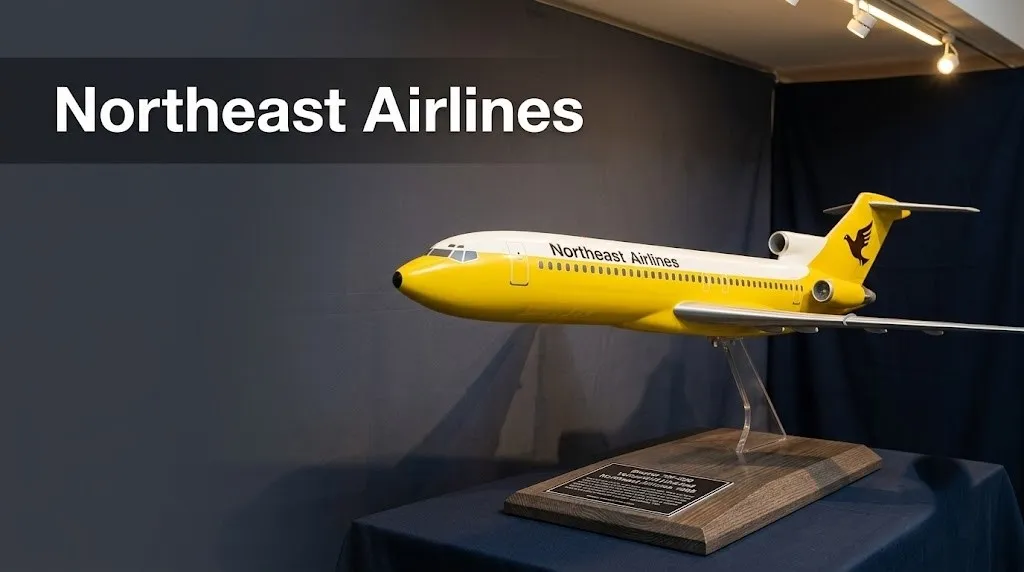
Northeast Airlines served major cities including Boston, New York, Philadelphia, Washington DC, Miami, Fort Lauderdale, Tampa, Orlando, Chicago, and Los Angeles. The Boston to Florida route was the airline’s signature service.
The airline operated Boeing 727 and Douglas DC-9 jet aircraft in its later years alongside turboprop and piston aircraft in earlier decades. The fleet grew from small single-engine planes to modern jets.
Aviation enthusiasts remember Northeast Airlines for the Yellowbird livery that made its aircraft instantly recognizable at airports across the Eastern United States. The yellow and white color scheme was unique among US carriers.
Does Northeast Airlines Still Exist Today
Northeast Airlines does not exist today as an operating airline. The carrier ceased operations in 1972 when it merged into Delta Air Lines.
The Northeast Airlines name, operating certificate, and brand were absorbed into Delta. The Yellowbird livery was painted over with Delta colors after the merger completion.
No current airline operates under the Northeast Airlines name in the United States. The name occasionally appears in confusion with other similarly named entities or as a historical reference.
Travelers who encounter the Northeast Airlines name online or in historical contexts should understand the airline is defunct. Book Delta Air Lines for routes that were historically served by Northeast.
Aviation history enthusiasts can visit the Delta Flight Museum in Atlanta to see Northeast Airlines memorabilia including a restored aircraft section and historical exhibits.
What Happened to Northeast Airlines
Northeast Airlines merged into Delta Air Lines on August 1, 1972, after a competitive acquisition battle. The merger gave Delta access to Northeast’s valuable New England and Florida route network.
The merger process began when Northwest Airlines initially sought to acquire Northeast Airlines in the late 1960s. Delta entered the bidding and ultimately won approval from the Civil Aeronautics Board.
The CAB approved the Delta-Northeast merger after determining it would provide better service to the public than the Northwest-Northeast combination. The merger became effective in mid-1972.
Northeast Airlines shareholders received Delta Air Lines stock in exchange for their Northeast shares. The Northeast brand was retired and all aircraft were repainted in Delta livery.
The merger was one of several airline consolidations during the regulated era before deregulation. It gave Delta a strong presence in the Northeast and strengthened its Florida route network.
Business travelers today fly former Northeast routes on Delta Air Lines metal. The Boston to Florida corridor that Northeast pioneered remains one of Delta’s important domestic markets.
Northeast Airlines History and Founding
Northeast Airlines began as Boston-Maine Airways founded in 1931 by the Boston and Maine Railroad and Maine Central Railroad. The airline started with small single-engine aircraft serving New England communities.
Boston-Maine Airways became Northeast Airlines in 1940 reflecting the carrier’s expanded route network beyond its original New England focus. The name change signaled broader ambitions.
The airline survived the difficult years of the Great Depression by providing essential air service to communities with limited transportation alternatives. Rail connections supplemented early air routes.
Northeast transitioned from piston aircraft to turboprops and eventually jets during the 1950s and 1960s. The introduction of the Boeing 727 and Douglas DC-9 modernized the fleet.
The Civil Aeronautics Board designated Northeast as a trunk carrier in the regulated airline system. This designation placed Northeast alongside larger carriers like United, American, and Eastern.
Aviation historians consider Northeast Airlines an important part of New England aviation heritage. The airline connected Boston to the rest of the country during aviation’s formative decades.
The Northeast Airlines Delta Merger
The Northeast Airlines merger into Delta Air Lines was finalized on August 1, 1972, after a multi-year regulatory review process. The merger was valued as one of the largest airline combinations of its era.
Northwest Airlines initially pursued the Northeast acquisition in the late 1960s. Northwest saw Northeast’s Boston hub and Florida routes as valuable additions to its Midwest-focused network.
Delta Air Lines entered the bidding for Northeast Airlines and ultimately won CAB approval. The CAB determined Delta provided better service guarantees and network benefits than the Northwest proposal.
The merger gave Delta Air Lines a major presence in the Northeast for the first time. Delta gained Boston Logan Airport gates, New England routes, and the established Boston to Florida corridor.
Northeast Airlines aircraft were gradually repainted in Delta livery after the merger. The distinctive Yellowbird paint scheme disappeared from US airports as the Delta widget tail logo replaced it.
The Delta acquisition of Northeast Airlines was part of a broader consolidation trend in the regulated airline industry. Multiple smaller carriers merged into larger ones during this period.
Northeast Airlines Yellowbird Brand and Livery
The Northeast Airlines Yellowbird brand was one of the most distinctive airline identities in US aviation history. Aircraft were painted in a bright yellow and white color scheme with the Yellowbird name.
The Yellowbird livery featured a predominantly yellow fuselage with white upper sections and blue cheat lines. The tail displayed a stylized bird logo in yellow and blue colors.
Northeast Airlines marketed itself as the Yellowbird airline in advertising and promotional materials. The brand emphasized warmth, Florida sunshine, and the airline’s southern route network.
The Yellowbird name and livery were introduced in the 1960s as Northeast modernized its image. The previous livery had been more conventional with a blue and white color scheme.
After the Delta merger, all Yellowbird aircraft were repainted in Delta’s widget livery. The Yellowbird brand disappeared completely from US aviation within months of the merger completion.
Aviation enthusiasts and airline memorabilia collectors prize Yellowbird items. Original Northeast Airlines timetables, postcards, and model aircraft are sought-after collectibles today.
| Era | Livery Description | Years |
|---|---|---|
| Early | Blue and white, conventional | 1940s to 1950s |
| Yellowbird | Yellow fuselage, white top, blue trim | 1960s to 1972 |
| Post-merger | Delta widget livery | 1972 onward |
Northeast Airlines Fleet and Aircraft
Northeast Airlines operated a diverse fleet of aircraft through its history from small single-engine planes to modern jet airliners. The fleet evolved with aviation technology over four decades.
Early aircraft included the Douglas DC-3 and Convair 240 piston aircraft serving New England routes. These rugged aircraft connected small communities to Boston.
Turboprop aircraft including the Fairchild FH-227 and Lockheed L-188 Electra served Northeast during the transition from piston to jet power. Turboprops offered improved speed and reliability.
The Boeing 727-100 and 727-200 formed the backbone of Northeast’s jet fleet in the late 1960s and early 1970s. The 727 was the most numerous jet type operated by the airline.
The Douglas DC-9-30 joined the fleet as a smaller jet complement to the 727. The DC-9 served routes with lower passenger demand where the 727 was too large.
The Convair 880 was briefly operated by Northeast on transcontinental routes. The 880 was one of the fastest subsonic airliners but was expensive to operate.
| Aircraft Type | Role | Era |
|---|---|---|
| Douglas DC-3 | Regional piston | 1930s to 1950s |
| Convair 240 | Regional piston | 1940s to 1950s |
| Fairchild FH-227 | Regional turboprop | 1960s |
| Lockheed L-188 Electra | Turboprop | 1960s |
| Boeing 727-100/200 | Mainline jet | 1960s to 1972 |
| Douglas DC-9-30 | Mainline jet | 1960s to 1972 |
| Convair 880 | Transcontinental jet | 1960s |
Key Takeaway: Northeast transitioned from small piston aircraft to modern Boeing and Douglas jets in its final decade before the Delta merger.
Northeast Airlines Route Network and Destinations
Northeast Airlines operated routes along the US East Coast from New England to Florida with additional transcontinental service to the West Coast. Boston was the primary hub.
The route network connected Boston, New York, Philadelphia, Baltimore, and Washington DC in the Northeast corridor. Multiple daily frequencies served these business markets.
Florida destinations including Miami, Fort Lauderdale, Tampa, Orlando, and Jacksonville received extensive Northeast service during the winter season. The Boston to Florida routes were the airline’s signature.
Transcontinental routes extended from the East Coast to Los Angeles, San Francisco, and Seattle. These routes competed with larger trunk carriers on coast-to-coast service.
The CAB regulated which routes Northeast could serve and what fares it could charge. Route awards were granted through regulatory proceedings rather than competitive market entry.
Aviation historians note that Northeast’s route network was valuable enough to attract competing acquisition bids from both Northwest and Delta. The routes were the primary asset in the merger.
Northeast Airlines Boston Hub Operations
Northeast Airlines operated its primary hub at Boston Logan International Airport with gates concentrated in the terminal that later became Delta’s Logan operation. Boston was the airline’s headquarters and operational center.
The Boston hub connected New England communities to Northeast’s route network. Flights from smaller New England cities fed into Boston for connections to New York, Florida, and beyond.
Northeast Airlines was the largest carrier at Boston Logan during the 1960s with the most flights and destinations. The airline dominated the Boston market before jet age competition intensified.
The Boston maintenance base handled aircraft overhauls and line maintenance for the Northeast fleet. Skilled mechanics and technicians worked at the Logan facility.
After the Delta merger, the Boston operations became a major Delta station. Delta continues to serve many of the same routes from Boston that Northeast pioneered.
Business travelers flying Delta from Boston today are using gates and routes with lineage tracing to Northeast Airlines. The Yellowbird legacy continues in the Boston market.
Northeast Airlines Florida Routes and the Snowbird Corridor
Northeast Airlines pioneered the Boston to Florida route corridor that became known as the snowbird route. Winter seasonal service carried New England residents to Florida sunshine.
Florida destinations from Boston and New York included Miami, Fort Lauderdale, Tampa, Orlando, and several smaller Florida cities. The airline marketed heavily to winter vacation travelers.
The Florida routes generated disproportionate revenue for Northeast because winter demand exceeded summer demand on other parts of the network. Florida was the airline’s most profitable market.
The snowbird corridor that Northeast established continues today as one of Delta Air Lines’ important domestic markets. Boston to Florida remains a competitive route with multiple daily frequencies.
The Yellowbird branding aligned perfectly with the Florida route network. The sunny yellow livery suggested warmth and vacation destinations to passengers booking winter escapes.
Aviation historians note that the Northeast Florida routes were the primary asset that attracted Delta’s acquisition interest. Delta wanted the Boston to Florida market presence that Northeast had built.
Who Bought Northeast Airlines and Why
Delta Air Lines acquired Northeast Airlines through merger in 1972 after a competitive bidding process with Northwest Airlines. The merger was approved by the Civil Aeronautics Board.
Delta wanted Northeast Airlines primarily for its route network connecting Boston and New York to Florida. These routes gave Delta access to markets where it had limited presence.
The Northeast acquisition also gave Delta a major position at Boston Logan Airport. Delta gained gates, facilities, and market presence in New England through the merger.
Northwest Airlines had initially pursued the Northeast acquisition but lost to Delta in the regulatory review. Northwest saw similar value in the Northeast route network.
The merger was one of several airline combinations that consolidated the US airline industry before deregulation in 1978. Smaller carriers were absorbed by larger ones seeking route expansion.
First-time airline history readers should understand that airline acquisitions in the regulated era were primarily about route authorities, not aircraft or brand value. Northeast’s routes were the prize.
Northeast Airlines Legacy at Delta Air Lines
The Northeast Airlines legacy at Delta Air Lines continues through routes, facilities, and historical preservation at the Delta Flight Museum. The Yellowbird brand lives on in aviation history.
Delta continues to operate many of the Boston and New York to Florida routes that Northeast pioneered. The snowbird corridor remains a core Delta market decades after the merger.
Boston Logan Airport remains an important Delta station with lineage tracing to Northeast Airlines. Delta’s Boston presence grew from the Northeast acquisition.
The Delta Shuttle between Boston, New York-LaGuardia, and Washington National traces partial lineage to Northeast’s Northeast corridor frequencies. The shuttle concept evolved from those routes.
Former Northeast Airlines employees became Delta employees after the merger. Their careers continued with the acquiring carrier, and some retired from Delta after decades of service.
The Delta Flight Museum preserves Northeast Airlines aircraft sections, uniforms, and memorabilia for aviation history. Visitors can see Yellowbird artifacts alongside Delta heritage exhibits.
Former Northeast Airlines Routes Today on Delta
Delta Air Lines operates many former Northeast Airlines routes from Boston and New York to Florida destinations. The route network that Northeast built remains active on Delta metal.
Boston to Miami, Fort Lauderdale, Orlando, and Tampa are all current Delta routes with multiple daily frequencies. These are the direct descendants of Northeast’s Florida snowbird service.
Boston to New York-LaGuardia and Boston to Washington National continue as high-frequency Delta routes. The Northeast corridor that Northeast served remains a competitive business market.
Transcontinental routes that Northeast operated from the East Coast to Los Angeles and San Francisco are now Delta mainline routes from Boston and New York. The markets endure.
The Northeast route network was integrated into Delta’s larger system after the merger. Some routes were maintained while others were adjusted as Delta’s network evolved.
Travelers flying Delta from Boston to Florida are flying the same basic route that Northeast Airlines passengers flew in the 1960s. The Yellowbird spirit continues on Delta.
| Former Northeast Route | Current Delta Service |
|---|---|
| Boston to Miami | Multiple daily Delta flights |
| Boston to Fort Lauderdale | Multiple daily Delta flights |
| Boston to Orlando | Multiple daily Delta flights |
| Boston to Tampa | Multiple daily Delta flights |
| Boston to New York-LaGuardia | Frequent Delta Shuttle |
| Boston to Washington National | Frequent Delta service |
| Boston to Los Angeles | Delta nonstop service |
Key Takeaway: The core Northeast Airlines routes from Boston to Florida and the Northeast corridor continue today as Delta Air Lines flights.
Northeast Airlines vs Modern Regional Airlines
Northeast Airlines was a trunk carrier under CAB regulation, not a regional airline in the modern sense. The carrier operated mainline aircraft on routes comparable to major airlines today.
Modern regional airlines like SkyWest Airlines, Republic Airways, and Endeavor Air operate smaller aircraft under contract to mainline carriers. Northeast operated its own flights under its own brand.
The distinction between trunk carriers and regional airlines in the regulated era was regulatory, not operational. Northeast competed directly with United, American, and Eastern on many routes.
Today’s airline industry structure with mainline carriers and regional affiliates did not exist during Northeast’s era. Each airline operated independently under CAB route awards.
Aviation history enthusiasts comparing Northeast to modern carriers should understand the different regulatory environment. CAB regulation shaped airline competition differently than today’s deregulated market.
Business travelers familiar with modern regional jets would find Northeast’s Boeing 727 and DC-9 aircraft comparable to today’s mainline narrow-body flights, not regional jet service.
Northeast Airlines Memorabilia and Aviation History
Northeast Airlines memorabilia is collected by aviation enthusiasts and airline historians. Original timetables, postcards, model aircraft, and crew uniforms are sought-after items.
The Yellowbird brand produced distinctive marketing materials including posters, advertisements, and in-flight menus. These items command premium prices among collectors.
The Delta Flight Museum in Atlanta houses the largest public collection of Northeast Airlines artifacts. Visitors can see Yellowbird memorabilia in person.
Online auction sites and aviation collectible dealers list Northeast Airlines items regularly. Prices vary based on rarity and condition.
Aviation museums in New England also feature Northeast Airlines exhibits given the airline’s Boston heritage. Local historical societies preserve the Yellowbird legacy.
First-time aviation memorabilia collectors should research Northeast Airlines through the Delta Flight Museum and reputable aviation history sources before purchasing items.
Why Travelers Still Search for Northeast Airlines
Travelers search for Northeast Airlines today primarily due to confusion with the historical airline name. Some searchers wonder if the airline still operates.
The Northeast Airlines name occasionally resurfaces in aviation news, historical articles, or discussions of airline mergers. This causes travelers to search for current information.
Some travelers encounter the name in family history or old travel documents. A grandparent’s ticket stub or photograph sparks curiosity about the defunct carrier.
Aviation enthusiasts and airline history researchers search for Northeast Airlines to learn about the Yellowbird era and the Delta merger. Historical interest drives many searches.
The Northeast name appears in lists of defunct airlines and aviation history resources. Travelers researching airline history encounter the name in these contexts.
The answer for all searchers is the same: Northeast Airlines does not exist today. The airline merged into Delta Air Lines in 1972. Book Delta for former Northeast routes.
Important Accuracy Notes for Northeast Airlines
Northeast Airlines is a historical subject. The airline does not exist today. All operational information is historical reference only.
Verify the following when researching Northeast Airlines:
- Current Delta Air Lines routes and schedules on delta.com, as routes change seasonally and historical Northeast routes may not match current Delta service exactly.
- Northeast Airlines historical information at the Delta Flight Museum or reputable aviation history sources, as online information varies in accuracy.
- Aviation memorabilia authenticity through reputable collectors and dealers, as reproduction items exist in the market.
The single most important fact: Northeast Airlines merged into Delta Air Lines in 1972 and no longer operates. Travelers should book Delta for routes historically served by Northeast.
Frequently Asked Questions About Northeast Airlines
Does Northeast Airlines still fly today?
Northeast Airlines does not fly today and has not operated since August 1, 1972.
The airline merged into Delta Air Lines and the Northeast brand was retired.
No current airline operates under the Northeast Airlines name in the United States.
What happened to Northeast Airlines?
Northeast Airlines merged into Delta Air Lines in 1972 after a competitive acquisition battle.
Delta won Civil Aeronautics Board approval for the merger over a competing bid from Northwest Airlines.
The Northeast brand, aircraft, and routes were absorbed into Delta Air Lines.
Who bought Northeast Airlines?
Delta Air Lines acquired Northeast Airlines through merger in 1972.
Northwest Airlines also bid for Northeast but Delta won regulatory approval.
Northeast shareholders received Delta Air Lines stock in exchange for their shares.
What was the Northeast Airlines Yellowbird?
The Northeast Airlines Yellowbird was the airline’s distinctive yellow and white aircraft livery introduced in the 1960s.
Aircraft were painted bright yellow with white upper sections and blue trim.
The Yellowbird brand was retired after the Delta merger in 1972.
What routes did Northeast Airlines fly?
Northeast Airlines flew routes along the US East Coast from Boston to Florida.
The airline also operated transcontinental service to Los Angeles, San Francisco, and Seattle.
Boston Logan Airport was the airline’s primary hub.
Can I book a flight on Northeast Airlines?
You cannot book a flight on Northeast Airlines because the airline ceased operations in 1972.
Delta Air Lines operates many of the same routes today from Boston to Florida and along the Northeast corridor.
Book flights on delta.com for routes historically served by Northeast Airlines.
Northeast Airlines was a well-regarded carrier that pioneered the Boston to Florida route corridor and served New England with distinctive Yellowbird aircraft. The airline does not exist today. Delta Air Lines acquired Northeast in 1972 and absorbed its routes, aircraft, and employees.
The legacy of Northeast Airlines continues through Delta Air Lines which still operates many of the same routes from Boston to Florida and along the Northeast corridor. The Delta Flight Museum preserves Yellowbird memorabilia for aviation history. The name lives on in aviation heritage.
Book Delta Air Lines for routes historically served by Northeast. Visit the Delta Flight Museum in Atlanta to see Northeast Airlines exhibits. Verify current Delta routes and schedules on delta.com as route networks evolve seasonally.