The China Airlines Airbus A330-300 features a two-class cabin with Dynasty Business Class and economy class. The aircraft does not have a premium economy cabin on any configuration.
The business class cabin uses a 2-2-2 configuration with angled-flat seats that do not go fully horizontal. This is an older seat product compared to the lie-flat 1-2-1 reverse herringbone seats on the China Airlines A350-900.
The economy class cabin uses a 2-4-2 configuration that seats eight passengers per row. This layout is standard for the A330-300 and is also used by Cathay Pacific and other Asian carriers on this aircraft type.
Budget travelers will encounter the A330-300 on shorter regional Asia routes of roughly two to five hours. The aircraft is not typically deployed on long-haul trans-Pacific routes to North America.
Business and frequent flyers should know this is a dated product that does not represent the best of China Airlines. The Dynasty Business Class experience on the A350-900 is a dramatically superior product.
First-time travelers flying the A330-300 on a regional route will find the cabin clean and functional. The aircraft feels older than the A350 but remains comfortable for short to medium-haul flights.
China Airlines A330-300 Business Class Seat Map
China Airlines A330-300 Dynasty Business Class seats are arranged in a 2-2-2 configuration across the forward cabin. The cabin typically spans rows 1 through 6, with approximately 30 to 36 business class seats.
The seat pitch measures roughly 60 to 63 inches in business class with a width of approximately 21 to 22 inches. The seat reclines to an angled-flat position of roughly 160 to 170 degrees, not a true 180-degree lie-flat bed.
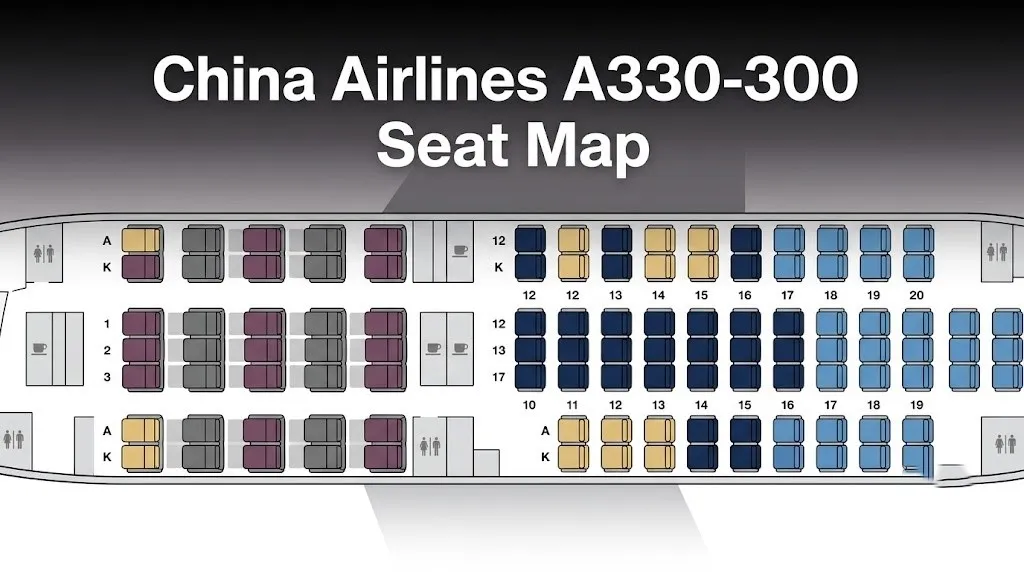
Window seats in the 2-2-2 configuration lack direct aisle access. The passenger in the window seat must step over the aisle seat passenger to reach the lavatory or move around the cabin.
Business and frequent flyers who value direct aisle access should avoid the China Airlines A330-300 entirely. The A350-900 offers the 1-2-1 reverse herringbone layout with aisle access from every seat.
Solo travelers in business class should select a window seat for the most privacy despite the lack of direct aisle access. The center pair of seats is best for couples traveling together.
The IFE screen in business class measures approximately 15 inches and is seat-back mounted. The system is functional but older than the A350 IFE interface.
Key Takeaway: The 2-2-2 angled-flat business class is adequate for regional flights under four hours but disappointing on longer routes.
China Airlines A330-300 Economy Class Seat Map
China Airlines A330-300 economy class uses a 2-4-2 configuration across the main cabin behind the business class section. The economy cabin typically spans rows 10 through 44, depending on the specific aircraft tail number.
The seat pitch in economy class measures approximately 31 to 32 inches with a width of around 17 to 18 inches. These dimensions are standard for the A330-300 and comparable to economy class on other Asian carriers.
Window seats in rows with the A and K designation offer the best privacy for solo travelers. The two center seats in the D and G positions of the 2-4-2 layout are the least desirable because they are flanked by passengers on both sides.
Budget travelers should select an aisle seat in the C or H position for easy access to the lavatory and galley. The window seat A or K provides a wall to lean against for sleeping on longer regional flights.
Families with children should book the center section seats across the D, E, F, and G positions. Two adults and two children can sit across the middle four seats with easy access to each other.
The economy cabin lacks a premium economy section, so all economy seats offer the same seat pitch and width. Exit row and bulkhead seats provide extra legroom but may have fixed armrests and limited under-seat storage.
China Airlines A330-300 Seat Dimensions and Specifications
The China Airlines A330-300 business class seat is approximately 21 to 22 inches wide with 60 to 63 inches of pitch. The seat extends to an angled-flat position of roughly 160 to 170 degrees recline.
Economy class seats measure approximately 17 to 18 inches wide with 31 to 32 inches of pitch. The recline in economy is standard for the A330-300 at approximately 4 to 6 inches of recline.
Tall passengers over six feet should select a bulkhead or exit row in economy class. The standard economy seat pitch of 31 to 32 inches will feel tight for longer-legged travelers on flights over three hours.
First-time travelers will find the economy seat width adequate for a regional Asia flight. The 2-4-2 layout is less cramped than the 3-3-3 configuration on the A350 because one fewer seat per row creates slightly more personal space.
Solo travelers in economy should select a window seat A or K for the best combination of view, wall support, and minimal disturbance. The aisle seat C or H provides easier access at the cost of being bumped by passing carts and passengers.
The seat cushion firmness on the A330-300 is moderate and comfortable for flights up to five hours. The seat padding shows its age on older airframes in the fleet.
| Feature | Business Class | Economy Class |
|---|---|---|
| Configuration | 2-2-2 | 2-4-2 |
| Seat Width | 21 to 22 inches | 17 to 18 inches |
| Seat Pitch | 60 to 63 inches | 31 to 32 inches |
| Bed Type | Angled-flat, 160 to 170 degrees | Standard recline |
| Direct Aisle Access | No, window seats blocked | Depends on seat selection |
| IFE Screen | 15 inches | 10 to 11 inches |
China Airlines A330-300 Best Seats in Business Class
The best business class seats on the China Airlines A330-300 are row 1 window seats A and K. These bulkhead seats offer the most legroom and no passenger reclining into your space from the row ahead.
Row 2 and 3 window seats A and K are the next best choices for solo travelers. Avoid row 6 if it is the last row before the galley or economy cabin bulkhead.
Solo travelers should select the A or K window seats in rows 1 through 3 for the best privacy on this aircraft. The 2-2-2 configuration means the window passenger must climb over the aisle passenger, but the privacy trade-off is worthwhile.
Couples traveling together should select center seats D and G in any row. The paired center seats allow both passengers to have direct aisle access while sitting together.
Business and frequent flyers who value workspace should select a bulkhead row 1 seat. The larger footwell and absence of a forward seat make it easier to open a laptop and work during the flight.
Avoid the last row of business class if it directly borders the economy cabin curtain. Galley noise and lavatory traffic from economy can disturb sleep on overnight regional flights.
China Airlines A330-300 Best Seats in Economy Class
The best economy class seats on the China Airlines A330-300 are exit row and bulkhead row seats with extra legroom. The exact exit row numbers vary by aircraft tail number but are typically in the mid-20s row range.
Window seats A and K in rows 10 through 20 offer the quietest economy experience away from galley and lavatory noise. These forward economy rows board earlier and deplane faster than the rear rows.
Solo travelers should select a window seat A or K in rows 12 through 18 for the best cabin position. The forward economy section is quieter and the window seat provides a wall to lean against.
Families with children should select the center section seats D, E, F, and G in a forward economy row. The middle four seats allow parents to sit with two children without strangers in the same row block.
Tall passengers over six feet should book an exit row seat or a bulkhead row seat for the additional legroom. Exit row seats have limited under-seat storage and fixed armrests that may not lift.
Budget travelers should avoid paying extra for a standard seat assignment on short regional flights. The difference between a forward and rear economy seat is marginal on a two-hour flight from Taipei to Okinawa.
Key Takeaway: Forward economy window seats A and K offer the best solo traveler experience, while center section D through G suits families.
China Airlines A330-300 Seats to Avoid
The worst seats on the China Airlines A330-300 are the last rows of economy before the rear galley and lavatories. These rows have limited recline, constant foot traffic, and lavatory noise and odor.
Avoid the window seats in the last row of business class if the row borders the economy cabin galley. Curtain noise and early morning meal preparation sounds disturb sleep on overnight flights.
Solo travelers should avoid the center seat E and F in the 2-4-2 economy layout. These middle seats have no wall support and passengers on both sides create a cramped feeling.
First-time travelers should avoid row 10 if it is the bulkhead row directly behind the business class cabin. Bulkhead bassinet positions often place crying infants in this row, disrupting the flight for nearby passengers.
Business class passengers should avoid the center seats D and G if traveling solo. The center pair requires sitting next to a stranger when the cabin is full, and the window seat offers more privacy.
The seats directly adjacent to the lavatories in economy are the absolute worst seats on the aircraft. The constant door opening, flushing noise, and congregating passengers make these rows unbearable on full flights.
| Seat Location | Problem | Who It Affects Most |
|---|---|---|
| Last row economy | Limited recline, lavatory noise | Light sleepers, tall passengers |
| Row 10 bulkhead | Bassinet position, infant noise | Business travelers, solo travelers |
| Center E and F seats | No wall support, two seatmates | Solo travelers, tall passengers |
| Window near lavatory | Odor, foot traffic, door noise | All passengers |
| Business class last row | Galley noise, curtain disturbance | Light sleepers |
China Airlines A330-300 Lavatory and Galley Locations
The China Airlines A330-300 typically has a forward galley and lavatory near the boarding door and cockpit area. This lavatory is primarily for business class passengers and crew use.
A mid-cabin galley and lavatory complex sits between the business class and economy class cabins. This creates a natural noise buffer between the two cabins.
The rear galley and lavatory cluster sits at the very back of the economy cabin. The rear galley typically has two to three lavatories that serve the entire economy cabin.
Business class passengers should select seats in rows 1 through 3 to stay furthest from the mid-cabin galley noise. Row 6 is closest to the mid-cabin galley and suffers the most disturbance.
Economy passengers should avoid the rows directly adjacent to the rear lavatories. The last three to four rows of the cabin experience constant foot traffic and occasional queue lines beside the seats.
Families with children should select seats near the mid-cabin lavatories for easier access. The mid-cabin location is closer to most economy seats than the rear lavatory cluster.
China Airlines A330-300 Inflight Experience
The China Airlines A330-300 inflight experience is functional and comfortable for regional flights but dated compared to the A350 and 777 fleet. The cabin design, IFE system, and seat materials are a generation behind the airline’s newer aircraft.
Business class meal service on regional A330-300 flights is plated and includes Taiwanese and Western options. The food quality is good but the dining experience lacks the refinement of the A350 Dynasty Business Class service.
Economy class meal service on regional routes includes a hot meal with rice or noodles and a dessert. The tray table is sturdy and the meal presentation is standard for regional Asian carriers.
Budget travelers will find the A330-300 economy experience perfectly adequate for a three-hour flight. The seat padding, IFE screen, and meal service meet expectations without exceeding them.
Business and frequent flyers accustomed to the A350 product will notice the downgrade immediately on the A330-300. The angled-flat seat, older IFE, and dated cabin materials feel like a different airline.
First-time travelers on a regional Asia flight will enjoy the Taiwanese hospitality of the cabin crew. The crew service is consistently professional and warm regardless of the aircraft age.
China Airlines A330-300 vs A350 Seat Comparison
The China Airlines A350-900 offers a dramatically superior cabin product compared to the A330-300 in every cabin class. The A350 Dynasty Business Class features a 1-2-1 reverse herringbone lie-flat seat with direct aisle access.
The A330-300 business class uses a 2-2-2 angled-flat configuration that lacks direct aisle access for window passengers. This is the single biggest product gap in the China Airlines fleet.
The A350 economy class uses a 3-3-3 configuration with 31 to 32 inches of pitch and modern seat architecture. The A330-300 economy uses a 2-4-2 configuration with similar pitch but an older seat design and IFE system.
Business and frequent flyers should actively avoid the A330-300 on routes where an A350 alternative exists. The price difference between the two aircraft types is often minimal, but the product gap is enormous.
Solo travelers in business class should never choose the A330-300 over the A350 if both options are available. The direct aisle access and fully flat bed on the A350 transform the flight experience.
Budget travelers in economy will notice the difference less than premium cabin passengers. The A350 economy seat is slightly better designed, but the gap is modest on a two-hour regional flight.
| Feature | A330-300 Business | A350-900 Business |
|---|---|---|
| Configuration | 2-2-2 | 1-2-1 reverse herringbone |
| Bed Type | Angled-flat | Fully lie-flat |
| Direct Aisle Access | No, window blocked | Yes, every seat |
| IFE Screen | 15 inches, older system | 18 inches, modern system |
| Cabin Atmosphere | Dated | Modern, quiet, higher humidity |
| Best For | Short regional flights | Long-haul, overnight flights |
China Airlines A330-300 Routes and Destinations
China Airlines deploys the A330-300 on regional routes from Taiwan Taoyuan International Airport to destinations across Asia. Common routes include Taipei to Tokyo, Osaka, Seoul, Bangkok, Singapore, and Manila.
The A330-300 also serves select routes to Australia and New Zealand on a seasonal basis. The aircraft does not operate long-haul trans-Pacific routes to North America, which are served by the A350-900 and 777-300ER.
Budget travelers will encounter the A330-300 on popular Asia vacation routes during peak travel seasons. Cherry blossom season in Japan and winter holidays in Southeast Asia see heavy A330-300 deployment.
Business and frequent flyers on Asia regional routes should check the aircraft type during booking. A route like Taipei to Tokyo may operate with either an A330-300 or an A350-900 depending on the specific flight time.
First-time travelers flying regionally within Asia will likely board an A330-300 on China Airlines routes. The aircraft is the workhorse of the regional fleet and serves the most frequent city pairs.
Solo travelers on a multi-city Asia trip should note which segments use the A330-300. A short hop from Taipei to Hong Kong on the A330-300 is fine, but a longer flight from Taipei to Sydney is better served by the A350.
China Airlines A330-300 Seat Selection Tips
Select a window seat A or K in business class rows 1 through 3 for the best privacy on the China Airlines A330-300. These seats offer the most legroom and the least galley disturbance.
Select an economy window seat A or K in rows 12 through 18 for the quietest ride with the best forward cabin position. Avoid the last three rows of the economy cabin near the rear lavatories.
Business and frequent flyers who booked the A330-300 by accident should try to change to an A350-operated flight on the same route. The product difference justifies a schedule change if the A350 operates at a different departure time.
Solo travelers should never select a center seat D or G in business class when traveling alone. A window seat A or K provides more privacy even without direct aisle access.
Families with children should select center section seats D through G in a forward economy row for the best family seating arrangement. The 2-4-2 layout allows a family of four to sit together across the middle section.
First-time travelers should use the China Airlines mobile app to view the seat map during booking. The seat map display is accurate and clearly shows the 2-2-2 business class and 2-4-2 economy configuration.
Important Accuracy Notes for China Airlines A330-300 Seat Map
Aircraft assignments change without notice and specific tail numbers may have slightly different cabin configurations.
Verify the following directly before selecting your seat:
The exact aircraft type operating your flight on the China Airlines website or mobile app within 24 hours of departure
The specific seat map for your flight during online check-in to confirm row numbers and exit row locations
The seat selection availability and any associated fees for your fare class on the China Airlines manage booking portal
Key Takeaway: Window seats A or K are the best choice in both cabins, and avoid the A330-300 entirely if an A350 operates the same route.
Frequently Asked Questions About China Airlines A330-300 Seat Map
What is the seat configuration on the China Airlines A330-300?
The China Airlines A330-300 has a 2-2-2 configuration in Dynasty Business Class and a 2-4-2 configuration in economy class.
The aircraft does not have a premium economy cabin on any configuration.
Business class seats are in rows 1 through 6, and economy seats span approximately rows 10 through 44.
Does the China Airlines A330-300 have lie-flat seats in business class?
The China Airlines A330-300 business class seats are angled-flat and do not lie fully horizontal.
The seats recline to approximately 160 to 170 degrees, which is not a true 180-degree lie-flat bed.
For lie-flat business class seats, book a China Airlines flight operated by the Airbus A350-900 or Boeing 777-300ER.
What are the best seats in China Airlines A330-300 economy?
The best economy seats are window seats A or K in rows 12 through 18 for the quietest forward cabin position.
Exit row and bulkhead seats provide extra legroom for tall passengers.
Avoid the last three to four rows near the rear lavatories due to noise and foot traffic.
Does the China Airlines A330-300 have premium economy?
The China Airlines A330-300 does not have a premium economy cabin.
The aircraft is configured with only Dynasty Business Class and economy class.
For premium economy, book a China Airlines flight operated by the Airbus A350-900 or Boeing 777-300ER.
Where are the lavatories on the China Airlines A330-300?
Lavatories are located at the front of the aircraft near the cockpit, between the business and economy cabins, and at the rear of the economy cabin.
The forward lavatory is primarily for business class passengers.
The rear lavatory cluster serves the economy cabin and creates noise for the last few economy rows.
How does the China Airlines A330-300 compare to the A350?
The China Airlines A350-900 offers a far superior product with lie-flat 1-2-1 business class seats and direct aisle access.
The A330-300 has an older 2-2-2 angled-flat business class and a more dated overall cabin design.
Choose the A350 over the A330-300 on any route where both aircraft types are available.
Your China Airlines A330-300 Seat Selection Strategy
The China Airlines A330-300 is an older aircraft with a dated 2-2-2 angled-flat business class and a standard 2-4-2 economy cabin. The best seats in business are row 1 window seats A and K for maximum legroom and privacy. The best economy seats are forward cabin window seats A or K in rows 12 through 18 away from galley and lavatory noise.
Your single best move is to check whether an A350-900 operates the same route at a different time. The product gap between the A330-300 angled-flat seat and the A350-900 lie-flat 1-2-1 suite is larger than the fare difference. If you must fly the A330-300, secure a window seat A or K as far forward as possible and avoid the last three rows of the economy cabin.
Aircraft assignments change without notice, and specific A330-300 tail numbers may have slight cabin variations. Confirm your exact aircraft type and seat map on the China Airlines website or mobile app within 24 hours of departure. A window seat A or K in the forward cabin turns an aging aircraft into a comfortable regional flight, while a rear cabin center seat makes the same journey feel far longer than it is.