Spirit Airlines set a personal item maximum size of 18 x 14 x 8 inches (45 x 35 x 20 cm) on all flights. That policy defined one of the strictest free-bag allowances in American aviation.
Spirit Airlines ceased all operations on May 2, 2026, after financial difficulties made continued flying impossible. Travelers who searched for Spirit baggage rules before that date, and those now choosing a budget airline replacement, still need this information.
This guide covers exactly what Spirit’s personal item policy was, how it was enforced, and which current ultra-low-cost carriers use the same or nearly identical rules. Read this before you pack for any budget airline in 2026.
Spirit Airlines Personal Item: The Complete Size Rule
Spirit Airlines allowed one free personal item per passenger, with maximum dimensions of 18 x 14 x 8 inches including handles and wheels.
The bag had to fit under the seat in front of you. This rule was enforced on domestic and international routes alike.
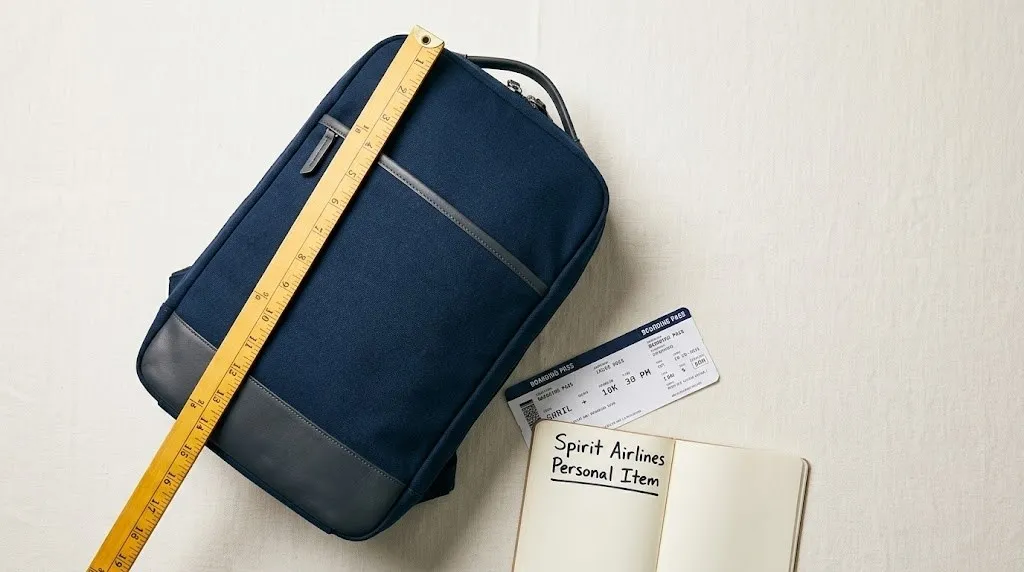
Eligible bag types included a purse, laptop bag, or small backpack, and the item had to be small enough to store under the seat. A standard rolling carry-on did not qualify.
Spirit did not specify a weight limit for personal items. The focus was entirely on dimensions and whether the bag fit under the seat.
Budget travelers planning any domestic flight should note this: Spirit’s 18 x 14 x 8-inch standard is now the de facto benchmark for ultra-low-cost carrier personal item rules across the US.
Insider Tip:
The 18 x 14 x 8 measurement is a packed-bag measurement. A bag that measures correctly when empty may exceed the limit once full. Measure your bag after you’ve packed it, not before.
Verify any current personal item allowance directly with your airline before traveling. Policies change without public announcement.
Personal Item on Spirit Airlines: What Was Included Free
A personal item on Spirit Airlines was the only bag included at no extra charge with every fare type, including the cheapest Bare Fare ticket.
One personal item fitting within the smaller sizer box was included with every ticket. Anything larger, such as a standard carry-on or checked bag, required a paid add-on.
Under the ultra-low-cost model, passengers received only a seat and a personal item in the base fare. Carry-on bags, checked luggage, seat selection, and priority boarding were all sold separately.
This is the core trade-off of the ULCC model. The base fare was genuinely low; the total cost rose quickly if you needed more than a small under-seat bag.
First-time budget airline travelers often missed this distinction. The advertised fare did not include a carry-on. Adding one at the gate cost significantly more than adding it during booking.
Key Takeaway: On Spirit Airlines, only the personal item was free. Every other bag cost extra, and gate prices were always the highest prices available.
What Size Is a Personal Item for Spirit Airlines
The personal item size for Spirit Airlines was 18 x 14 x 8 inches, or 45 x 35 x 20 centimeters, measured across all dimensions including handles and wheels.
The personal item had to fit under the seat in front of you. Any bag over the limit would be checked at the gate with a fee charged on the spot.
The 18 x 14 x 8 measurement covered the entire bag. Every part counted: outer pockets, handles, wheels, and any bulge from overpacking.
That last point catches most travelers off guard. A soft backpack that fits empty may bulge past 8 inches deep once loaded. The sizer box does not compress bags.
Solo travelers carrying a single bag for a weekend trip typically managed within this limit using a slim 18-to-20-liter daypack. Travelers packing for longer trips often found the personal item too restrictive without a paid carry-on add-on.
| Dimension | Inches | Centimeters |
|---|---|---|
| Length | 18 in | 45 cm |
| Width | 14 in | 35 cm |
| Depth | 8 in | 20 cm |
| Handles/wheels | Included in total | Included in total |
| Weight limit | None specified | None specified |
Verify current personal item dimensions directly with your airline. These were Spirit’s published dimensions before its May 2026 shutdown.
Spirit Airlines Personal Item Size in Inches and Centimeters
Spirit Airlines published the personal item size as 18 x 14 x 8 inches (45 x 35 x 20 cm) on its official site and at gate sizer stations.
American Airlines, Allegiant Air, Frontier Airlines, and Spirit Airlines all shared the same standard personal item size limit of 18 x 14 x 8 inches. This alignment made one compliant bag useful across multiple carriers.
The 8-inch depth dimension was the strictest constraint. Standard daypacks and backpacks sold at general retail often run 10 to 12 inches deep. A bag designed for the 18 x 14 x 8 standard is typically marketed as an underseat or slim-profile bag.
Business travelers flying budget carriers occasionally used a slim laptop bag to stay within the 8-inch depth limit. A standard laptop backpack typically does not fit.
Insider Tip:
The depth dimension (8 inches) is the number that fails most travelers. Length (18 inches) and width (14 inches) are easier to meet. When shopping for a compliant bag, confirm the depth spec first.
Confirm the current personal item depth limit directly with your carrier before travel. Frontier Airlines uses the same 8-inch depth standard, but verify before flying.
Spirit Airlines Backpack Size: What Fits Under the Seat
A backpack qualified as a Spirit Airlines personal item only if its packed dimensions did not exceed 18 x 14 x 8 inches in all directions, including outer pockets and compression straps.
Compact day packs in the 13-to-28-liter range typically fit within the 18 x 14 x 8 limit. Bags in this size range are generally described in retail as daypacks or slim carry-ons.
Eligible bags included a travel backpack, purse, or laptop bag that fits under the seat. The bag had to slide into the gate sizer without being pushed or forced.
Standard school backpacks, 30-liter hiking daypacks, and most “carry-on backpacks” sold at outdoor retailers exceed the 8-inch depth requirement once packed. They did not qualify as Spirit personal items.
Budget travelers packing for a two-to-three-night trip often found 18-to-22-liter packs gave enough room for a change of clothes, toiletries, and a laptop. Anything beyond that typically required a paid carry-on upgrade.
- Bags that generally fit: slim laptop bags, 13-20 liter daypacks, structured purses, small tote bags
- Bags that generally do not fit: 30+ liter backpacks, standard school bags, rolling personal items with wide frames, puffy overfilled soft-sides
- What always triggers the sizer: outer pockets loaded to full capacity, hydration bladder compartments, and frameless bags that change shape when packed
Note for families: Children’s backpacks used as personal items follow the same dimensional rule. A toddler’s small school bag typically fits; a child’s standard rolling bag does not count as a personal item.
Key Takeaway: The 8-inch depth is the number that fails most backpacks. Measure your packed bag’s depth before going to the airport, not after.
What Counts as a Personal Item on Spirit Airlines
On Spirit Airlines, a personal item was any bag small enough to fit within the 18 x 14 x 8-inch sizer and store completely under the seat in front of you.
A personal item could be a purse, laptop bag, or small backpack that stored under the seat. Small items like an umbrella, coat, or infant diaper bag were also allowed at no additional charge.
If you were traveling with young children, you could check one car seat and one stroller per child for free. A car seat could also come on board, but only if you purchased a separate seat for your child.
Coats, umbrellas, and FAA-approved assistive devices such as canes and CPAP machines did not count against the personal item allowance at Spirit. These were permitted in addition to the free bag.
Families with children benefited from the stroller and car seat exception. One child traveling with a parent got one stroller and one car seat checked free, separate from the parent’s personal item. Verify whether current carriers you fly maintain this same exception.
The practical rule: if it couldn’t slide under the seat without forcing it, it wasn’t a personal item, regardless of what the traveler called it.
Spirit Airlines Carry-On vs Personal Item: Key Differences
A personal item was the one free bag stored under the seat; a carry-on at Spirit Airlines was a paid upgrade stored in the overhead bin, with a maximum size of 22 x 18 x 10 inches.
The carry-on bag maximum on Spirit was 22 x 18 x 10 inches (56 x 46 x 25 cm) including handles and wheels. The personal item maximum was 18 x 14 x 8 inches.
The size difference matters because Spirit charged for the carry-on and included the personal item at no cost. Travelers who brought a bag sized between the two limits faced gate charges at the higher airport rate.
If purchased online during check-in, the carry-on fee typically increased to around $45. At the airport or gate, the fee was typically $55 to $65 or higher. Always verify current fee tiers directly with any airline before flying.
Budget travelers who genuinely needed a carry-on-sized bag found it significantly cheaper to add the fee during the initial booking rather than at the airport. A bag added at the gate was always the most expensive option.
| Bag Type | Max Size | Cost | Storage Location |
|---|---|---|---|
| Personal item | 18 x 14 x 8 in | Free | Under the seat |
| Carry-on | 22 x 18 x 10 in | Paid (varies by when added) | Overhead bin |
| Checked bag | 62 linear inches | Paid (varies by route) | Cargo hold |
Verify current carry-on fees with any ULCC directly before booking. Gate prices are consistently the highest price tier available.
Key Takeaway: The cheapest way to fly Spirit with a carry-on was to add the bag fee at booking. Gate prices ran significantly higher than booking prices.
Does Spirit Airlines Measure Personal Items at the Gate
Spirit Airlines used physical sizer boxes at the gate to measure personal items before boarding, and gate agents actively checked bags that appeared oversized.
As of 2026, Spirit Airlines had increased gate enforcement of personal item dimensions. At many airports, gate agents used physical sizers to verify bags before boarding.
The bag had to slide into the airport metal sizer without being pushed or forced in any way. If it did not fit completely, the traveler was charged a carry-on fee on the spot.
Unlike some legacy carriers like Delta and United, which sometimes allowed soft bags that were slightly over the limit to pass through, Spirit did not offer that discretion. One inch over triggered the full fee.
The sizer was not a formality. Gate agents at Spirit were known to check bags that looked borderline during boarding. Full flights, peak travel periods, and busy hub airports saw the most active enforcement.
Budget travelers should understand this: the personal item sizer is a hard test, not an estimate. Bring a tape measure on travel days if your bag is close to the limit.
Insider Tip:
If you’re unsure whether your bag will pass, load it fully before going to the airport and measure it after packing. A bag that just barely fits empty may not fit once loaded with a laptop, water bottle, and change of clothes.
Spirit Airlines Gate Fee for an Oversized Personal Item
If your personal item exceeded the 18 x 14 x 8-inch limit and failed the gate sizer, Spirit Airlines charged the carry-on fee at the gate rate, which was the highest fee tier the airline charged.
If a bag did not fit the metal sizer at the gate, the traveler was charged $65 on the spot. There were no exceptions and no time to repack.
The airport gate rate for a carry-on at Spirit was often $79 or higher. Fee tiers at the time of this article’s publication should be verified with any replacement carrier you fly, as fees change without notice.
The key consequence: gate enforcement meant no negotiation and no second chances. There was no option to return to check-in and pay a lower fee. The gate rate applied immediately.
First-time budget airline travelers are most at risk here. Travelers accustomed to legacy carriers like American Airlines or Delta, where gate agents often exercise discretion on borderline bags, were frequently caught off guard by Spirit’s rigid sizer test.
Important: Spirit Airlines ceased operations on May 2, 2026. These fee amounts reflect the airline’s last published policy. Any ULCC you fly today, including Frontier Airlines or Allegiant Air, has its own current gate fee structure. Verify directly before flying.
Spirit Airlines Bare Fare Personal Item Policy
Spirit Airlines’ Bare Fare was the airline’s cheapest ticket tier, and it included one personal item at no additional charge, the same allowance as every other Spirit fare.
The personal item was always free, including on the cheapest Bare Fare tickets. Eligible bags included a travel backpack, purse, or laptop bag that fit under the seat.
The Bare Fare included nothing beyond a seat and that one under-seat personal item. No carry-on, no checked bag, no seat selection, and no change or refund flexibility were included at the base price.
Additional services including carry-on bags, checked luggage, seat selection, and priority boarding were all sold separately under the unbundled fare model.
Budget travelers who genuinely packed light got real value from the Bare Fare. A traveler flying one-way with only a slim 20-liter daypack paid the advertised base fare and nothing more. Most travelers, however, added at least one extra service and raised their total cost.
The honest assessment: the Bare Fare was a good deal for one specific traveler type. A solo weekend traveler with a compliant personal item and no seat preference could genuinely fly at the advertised low fare. Everyone else paid more once they added necessities.
Key Takeaway: Spirit’s Bare Fare was only as cheap as advertised if your bag fit the personal item limit and you needed no other services.
Spirit Airlines vs Frontier Personal Item Size
Frontier Airlines uses the same personal item size limit as Spirit Airlines used: 18 x 14 x 8 inches, enforced via physical sizers at the gate.
Frontier Airlines’ personal item dimensions were 14 inches tall, 18 inches wide, and 8 inches deep. Items had to fit completely within the personal item portion of the bag sizer.
Frontier brought in approximately $861.6 million in baggage fees in 2024. Like Spirit, Frontier gate agents were incentivized to catch non-compliant bags. The enforcement culture at Frontier closely mirrored what Spirit operated.
The practical result: a bag that fit Spirit’s sizer also fits Frontier’s sizer. Travelers who bought compliant bags for Spirit travel can use the same bag on Frontier flights without any change.
Business travelers evaluating whether to fly Frontier as a Spirit replacement should note that Frontier’s Big Front Seat upgrade (comparable to Spirit’s former Big Front Seat) offers around 32-to-38 inches of seat pitch on select rows. Verify current upgrade options directly with Frontier before booking.
| Airline | Personal Item Max | Carry-On Included Free | Gate Enforcement | Gate Fee Tier |
|---|---|---|---|---|
| Spirit Airlines (ceased) | 18 x 14 x 8 in | No | Active sizers | High |
| Frontier Airlines | 18 x 14 x 8 in | No | Active sizers | High |
| Allegiant Air | 18 x 14 x 8 in | No | Active sizers | High |
| Southwest Airlines | Fits under seat | Yes (carry-on also free) | Moderate | N/A |
| American Airlines (Basic Economy) | 18 x 14 x 8 in | No (carry-on paid) | Moderate | High |
Verify current policies and fee structures directly with each airline before booking. This table reflects general policy positions as of mid-2026 reporting and is subject to change.
Budget Airline Personal Item Size Comparison 2026
The standard personal item size across major US budget carriers in 2026 is 18 x 14 x 8 inches, a dimension shared by the three strictest enforcers in the market.
According to 2026 airline policy tracking, the standard US personal item size at most major airlines is 18 x 14 x 8 inches. Budget carriers including Frontier Airlines and Allegiant Air enforce this aggressively.
On Spirit, Frontier, and Allegiant Air, a carry-on bag could cost $70 to $100 each way. That is exactly why travelers tried to pack everything into a personal item, and exactly why airlines watched those bags closely.
Not every US airline uses the same standard. United Airlines allows a smaller personal item of approximately 17 x 10 x 9 inches. Alaska Airlines enforces a 6-inch depth limit, which is more restrictive than Spirit’s 8-inch limit. Southwest Airlines allows personal items to fit under the seat but does not publish a specific size limit, and its enforcement is gentler than budget carriers.
Solo travelers who fly multiple carriers should buy a bag sized at 18 x 14 x 8 inches or smaller. That size clears the strictest US carriers and works on virtually every domestic airline.
- Frontier Airlines: 18 x 14 x 8 inches; active sizer enforcement
- Allegiant Air: 18 x 14 x 8 inches; active sizer enforcement
- American Airlines: 18 x 14 x 8 inches; moderate enforcement
- United Airlines: approximately 17 x 10 x 9 inches; stricter depth and width than most
- Southwest Airlines: under-seat fit required; no published hard dimensions; lighter enforcement
Verify every airline’s current published dimensions before you fly. Policies at all carriers are subject to change without advance notice.
Key Takeaway: A bag measuring 18 x 14 x 8 inches or smaller clears virtually every US domestic airline’s personal item requirement, including the strictest budget carriers.
Spirit Airlines Shut Down: Alternatives for Budget Travelers
Spirit Airlines announced on May 2, 2026 that it had started an orderly wind-down of operations, effective immediately. All flights were canceled and customer service was shut down.
Spirit was the first major US airline in 25 years to go out of business due to financial problems. The closure affected approximately 17,000 workers and stranded passengers holding future tickets.
The airline cited high oil prices, driven in part by rising global energy costs, as the primary factor making continued operations impossible.
For budget travelers who relied on Spirit routes, the two primary ULCC replacements are Frontier Airlines and Allegiant Air. Both carriers operate personal item policies nearly identical to Spirit’s former rules.
JetBlue Airways offered $99 one-way fares for passengers traveling on the same routes as their canceled Spirit flights in the immediate aftermath of the shutdown. United Airlines capped fares at $199 for many Spirit-served routes for displaced passengers.
Budget travelers evaluating Frontier or Allegiant as Spirit replacements should compare total costs including bags, seat selection, and any bundle add-ons before booking. The base fare is rarely the final price at either carrier.
Steps to rebook after Spirit’s shutdown:
- Check whether Frontier Airlines or Allegiant Air serves your original Spirit route directly on their websites
- Price the full cost including one personal item, any carry-on you need, and a selected seat
- Compare that all-in cost against Southwest Airlines, which includes two free checked bags and a carry-on
- If price-matching is your priority, use Google Flights to compare base fares and add bag fees manually for each ULCC option
- Book directly on the airline’s website where possible; booking-time bag fees are always lower than airport fees
Verify current route availability and fare structures directly with Frontier Airlines and Allegiant Air. Route coverage and pricing change frequently at both carriers.
Spirit Airlines Personal Item Rules for Families
Families with children traveling on Spirit Airlines received one additional benefit beyond the standard personal item allowance: free stroller and car seat check-in per child.
Spirit Airlines allowed one car seat and one stroller to be checked for free per traveling child. A car seat could also come on board, but only if a separate seat was purchased for the child.
Each adult still received one personal item under the standard 18 x 14 x 8-inch limit. Children old enough to have their own ticket were also entitled to one personal item each.
A family of four with two children had four personal items (one per ticket) plus two strollers and two car seats checked for free. The critical catch: if any adult in the group wanted a carry-on, they paid the carry-on fee per person.
Families planning trips should note that Frontier Airlines maintains a similar stroller and car seat policy. Allegiant Air also allows free stroller check-in, but verify the exact current terms directly with either airline before packing. Policies at both carriers are subject to change.
Insider Tip:
For a family of four on a short domestic flight, packing each family member’s belongings into four compliant personal item bags is genuinely achievable for trips of one to two nights. For longer trips, prepaying carry-on fees at booking is significantly cheaper than paying at the gate.
Best Backpack Size for Former Spirit Airlines Routes
The best backpack for any route formerly served by Spirit Airlines is one that measures 18 x 14 x 8 inches or smaller when fully packed, since Frontier Airlines and Allegiant Air use that same standard on the routes they now serve.
Any backpack that measures 18 x 14 x 8 inches or smaller when fully packed qualifies as a free personal item. Compact day packs in the 13-to-28-liter range typically fit within this limit.
A bag sized at the 18 x 14 x 8-inch limit works on strict budget carriers like Frontier Airlines, Allegiant Air, and Spirit Airlines, and also passes on more relaxed carriers where enforcement is lighter.
The most useful bag in this category is a slim-profile backpack or underseat bag in the 18-to-22-liter range. Bags specifically sold as “18x14x8 airline approved” are manufactured to this standard and are available from multiple brands at various price points.
Business travelers should prioritize a bag with a dedicated padded laptop sleeve. The 18 x 14 x 8-inch envelope can hold a 15-to-16-inch laptop, one day’s change of clothes, and a toiletry bag, which suits most short business trips without needing a carry-on upgrade.
- Look for: bags marketed as “18x14x8 airline approved” or “underseat personal item”
- Look for: bags with a structured frame that holds shape when packed (reduces bulge past the depth limit)
- Avoid: bags with large protruding external pockets that add depth beyond 8 inches when loaded
- Avoid: hydration packs or hiking daypacks not specifically designed for airline underseat dimensions
- Avoid: soft frameless bags that deform when packed full, since these often bulge past the sizer limits
Verify dimensions of any specific bag you purchase against the current published limit of your actual carrier before traveling.
Important Accuracy Notes for Spirit Airlines Personal Item Policy
Spirit Airlines permanently ceased operations on May 2, 2026. No Spirit flights operate as of the publication of this article.
Verify the following directly before traveling to any budget carrier:
- Spirit Airlines flights: Spirit is no longer operating. Do not book Spirit flights. The former Spirit website now directs to restructuring information only.
- Refunds for Spirit tickets: Customers who paid by credit card were eligible for refunds, but passengers who paid via voucher, credit, or Free Spirit points may face uncertainty resolved through bankruptcy court proceedings.
- Frontier Airlines personal item dimensions: Frontier currently uses the same 18 x 14 x 8-inch standard. Verify current dimensions at the Frontier Airlines official website before your specific travel date.
- Allegiant Air personal item dimensions: Allegiant currently uses the same 18 x 14 x 8-inch standard. Verify at the Allegiant Air official website before flying.
- Gate fee amounts: Gate fee amounts at all ULCCs change without advance notice. Any dollar figure in this article reflects past reporting and may not reflect current policy.
- The single most important step before traveling on any budget airline: Check the current baggage policy page of your specific carrier and price your total cost with bags before booking. The base fare is never the complete price at a ULCC.
Frequently Asked Questions About Spirit Airlines Personal Item
What size is a personal item for Spirit Airlines?
Spirit Airlines required personal items to be no larger than 18 x 14 x 8 inches (45 x 35 x 20 cm), including handles and wheels.
The bag had to fit completely under the seat in front of you without being forced into place.
Spirit Airlines ceased all operations on May 2, 2026, so this policy is now historical. Frontier Airlines and Allegiant Air currently use the same 18 x 14 x 8-inch standard, but verify directly with your carrier before flying.
Does Spirit Airlines still fly in 2026?
Spirit Airlines announced on May 2, 2026 that it had started an orderly wind-down of operations, effective immediately, with all flights canceled.
Spirit is no longer operating any flights as of that date.
Travelers who held Spirit tickets should seek refunds through their credit card company or the Spirit restructuring process at spiritrestructuring.com.
What happens if your personal item is too big on Spirit Airlines?
If a personal item did not fit inside the gate sizer box, the traveler was charged the carry-on fee at the gate rate, the highest fee tier Spirit charged.
There were no exceptions, and there was no time to repack at the gate.
At budget carriers like Frontier Airlines and Allegiant Air, the same outcome applies today: an oversized personal item triggers an on-the-spot carry-on charge, often in the $65-to-$99 range depending on timing and route.
Can I use a backpack as my personal item on Spirit Airlines?
Yes, a backpack qualified as a Spirit Airlines personal item if it fit within the 18 x 14 x 8-inch limit when fully packed.
Compact day packs in the 13-to-28-liter range typically fit within this limit.
Standard school backpacks and 30-liter hiking daypacks typically do not fit once packed, particularly on the 8-inch depth dimension.
How does Spirit Airlines personal item size compare to Frontier Airlines?
Spirit Airlines and Frontier Airlines used identical personal item dimensions: 18 x 14 x 8 inches.
Both carriers enforced this standard actively at the gate using physical sizer bins, and both operated under the same incentive structure for gate agents to catch non-compliant bags.
A bag that passed Spirit’s sizer will pass Frontier’s sizer. Verify current Frontier dimensions at the Frontier Airlines official site before your travel date.
What budget airline should I fly now that Spirit Airlines has shut down?
Frontier Airlines and Allegiant Air are the two primary ultra-low-cost carrier alternatives for most Spirit routes.
Frontier Airlines is a strong choice for travelers flying into or out of Denver, traveling with only a personal item, and booking six or more weeks in advance.
Southwest Airlines is worth comparing on total cost, since it includes two free checked bags and a carry-on, which often makes its all-in fare competitive with Frontier or Allegiant once bag fees are counted.
Final Guidance for Budget Travelers in 2026
Spirit Airlines defined the budget air travel experience for millions of Americans for more than three decades. Its personal item rule — 18 x 14 x 8 inches, enforced at the gate with no exceptions — became the standard that shaped how budget carriers across the US operate today.
That rule did not disappear when Spirit did. Frontier Airlines and Allegiant Air use the same dimensions and the same enforcement culture. Any traveler who learned to pack for Spirit is already prepared for those carriers.
The most important step before flying any budget airline in 2026 is to verify the current personal item policy on your specific carrier’s website, compare the all-in cost with bags and seat selection included, and measure your packed bag before leaving home. The gate sizer does not negotiate.