Hooters Airlines was a short-lived US charter airline that operated from 2003 until its complete shutdown in 2006.
It flew mostly leisure travelers to golf and beach destinations from a single hub in South Carolina.
Hooters of America launched the airline as an extension of its restaurant brand with two Hooters Girls on every flight.
The concept drew media attention but never achieved sustainable passenger loads or profitable operations.
This article covers the full history of Hooters Airlines, its routes, fleet, flight experience, and failure.
You will also find current flight alternatives for the Myrtle Beach area the airline once served.
What Was Hooters Airlines
Hooters Airlines was a restaurant-branded US charter passenger airline operating primarily from 2003 through early 2006.
It flew scheduled and charter service to leisure destinations with a Myrtle Beach, South Carolina base.
The airline operated as a business unit of Hooters of America under founder Robert H. Brooks.
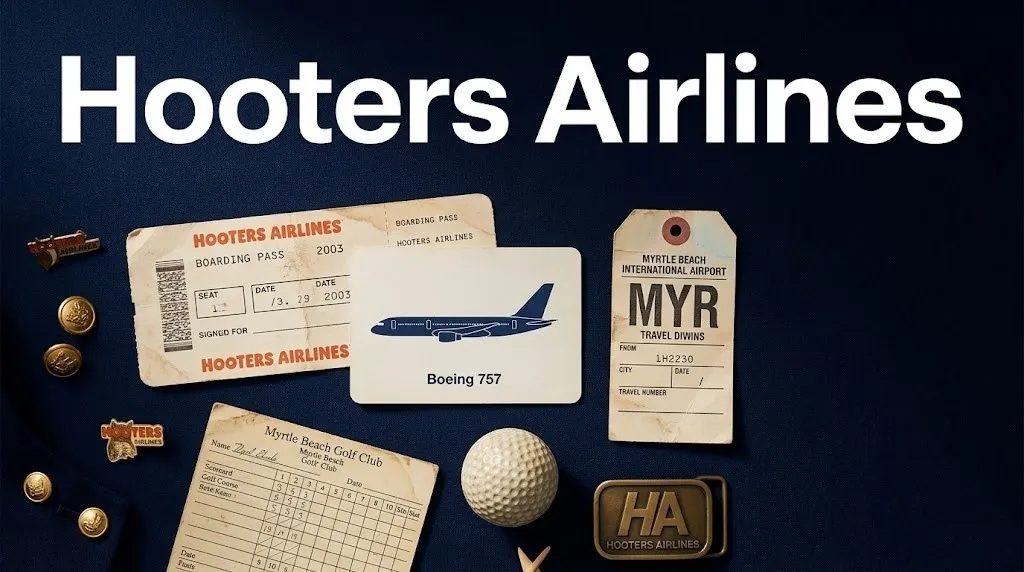
It never held its own FAA operating certificate and relied entirely on Pace Airlines for aircraft and crews.
This arrangement made Hooters Airlines a marketing concept layered on top of an existing charter carrier.
The actual flying, maintenance, and regulatory compliance sat entirely with Pace Airlines.
For budget leisure travelers, the concept offered low fares to golf destinations and beach towns.
For business and frequent flyers, the airline offered no loyalty program, upgrades, or premium cabin.
First-time travelers to Myrtle Beach in the early 2000s might have encountered Hooters Airlines as a cheap direct option.
Today, those same travelers need to know this airline vanished nearly two decades ago.
Key Takeaway: Hooters Airlines was a three-year marketing experiment wrapped around another carrier’s aircraft and crews.
Hooters Airlines History and Launch
Hooters of America founder Robert Brooks purchased Pace Airlines in 2002 to create a branded charter operation.
Pace Airlines was a Winston-Salem, North Carolina charter carrier with an existing FAA operating certificate and Boeing fleet.
The Hooters Air brand launched publicly in March 2003 with flights from Myrtle Beach to Atlanta and other cities.
Brooks positioned the airline as a fun, casual, low-cost leisure option with the restaurant’s signature branding.
Initial routes served golf destinations across the southeastern United States and select Midwest cities.
The airline added seasonal service to destinations like Nassau, Bahamas and Las Vegas during its run.
Aviation industry observers at the time noted the extreme difficulty of launching a new airline post-9/11.
Consumer demand for air travel had dropped sharply and fuel prices were climbing throughout the early 2000s.
Budget travelers who booked introductory fares got genuine value on direct routes to leisure destinations.
Business travelers found no viable product here at all with zero frequency, lounges, or schedule reliability.
The airline’s launch generated significant free media coverage due entirely to its restaurant-brand novelty.
That media attention never translated into the sustained passenger numbers required for airline viability.
Hooters Airlines Destinations and Route Map
Hooters Airlines flew a limited network of domestic US routes centered entirely on Myrtle Beach as its sole hub.
The route map connected the South Carolina coast to cities in the Midwest, Northeast, and Southeast.
Destinations included Atlanta, Georgia and Baltimore/Washington International serving the D.C. and Maryland markets.
The airline also served Newark, New Jersey and Pittsburgh, Pennsylvania on a seasonal or limited-frequency basis.
Midwest markets included Gary/Chicago International Airport in Indiana and Columbus, Ohio for golf travelers.
Golf packaging made these routes work by bundling airfare with resort stays and tee times at Myrtle Beach courses.
Gary, Indiana served as a secondary focus city offering an alternative Chicago-area airport with lower operating costs.
The airline avoided major hub competition by flying to smaller secondary airports like Gary instead of Chicago O’Hare.
Families with children bound for Myrtle Beach vacations found the direct flights from regional cities convenient.
Solo travelers and business passengers found the limited frequency and sparse route map completely impractical.
Seasonal flight reductions meant many routes operated only during peak spring golf and summer beach seasons.
Travelers who needed year-round reliable service to Myrtle Beach had to look at other carriers even then.
Key Takeaway: The entire route network depended on Myrtle Beach golf and vacation traffic with no business or connecting utility.
Where Did Hooters Airlines Fly
Hooters Airlines flew from Myrtle Beach International Airport to approximately six to eight destinations at its operational peak.
The airline also operated limited service from Gary/Chicago International Airport to Florida leisure markets.
Myrtle Beach to Atlanta operated as one of the first and most consistent routes in the Hooters Air network.
Myrtle Beach to Baltimore/Washington International served the mid-Atlantic market with a direct leisure flight option.
Gary to destinations like St. Petersburg/Clearwater, Florida connected Midwest travelers to Gulf Coast beaches.
Nassau, Bahamas appeared as a seasonal international destination though frequency remained very limited.
Gary/Chicago International Airport offered budget-conscious Chicago-area travelers a lower-cost departure point.
Solo travelers from Chicago could use the Gary flights for cheap winter escapes to Florida golf and beach resorts.
First-time visitors to Myrtle Beach from Pittsburgh or Columbus could book direct flights that no longer exist.
Today those same city pairs require connecting flights or driving because the direct service disappeared with Hooters Air.
The airline’s route map never expanded beyond this small cluster of eastern and midwestern US leisure markets.
International service to the Bahamas remained purely seasonal and represented a tiny fraction of total operations.
Hooters Airlines Myrtle Beach Hub
Myrtle Beach International Airport (MYR) served as the sole hub and operational headquarters for all Hooters Airlines flights.
The airport sits approximately three miles from the Atlantic Ocean and the Myrtle Beach resort strip.
Hooters of America selected Myrtle Beach because founder Robert Brooks owned a home there and knew the tourism market.
The Myrtle Beach area attracts over 19 million visitors annually with golf as a primary tourism driver.
MYR handled the airline’s aircraft maintenance, crew base operations, and passenger connections for its limited network.
Ground transfer from MYR to beachfront hotels took approximately 10 to 15 minutes by taxi or shuttle in the mid-2000s.
Families flying into Myrtle Beach on Hooters Air found the airport proximity to resorts genuinely convenient.
The short transfer distance saved vacation time and ground transportation costs compared to alternative airports in Charleston.
Solo golf travelers could reach Myrtle Beach courses within 30 minutes of landing at MYR.
Business travelers attending conferences at Myrtle Beach convention hotels also benefited from the close airport location.
Today MYR serves multiple airlines with significantly more destinations than during the Hooters Air era.
The airport remains the best arrival point for Myrtle Beach travelers and the closest option to the Grand Strand.
Key Takeaway: Myrtle Beach was the operational center of gravity and the only airport where Hooters Airlines maintained meaningful daily presence.
Hooters Airlines Aircraft Fleet
Hooters Airlines never owned its own aircraft. All flying operated under Pace Airlines’ FAA certificate using Pace aircraft.
The primary fleet type was the Boeing 757-200 configured in an all-economy single-class cabin layout.
Pace Airlines also operated Boeing 737-300 aircraft that served shorter routes and lower-demand frequencies for Hooters Air.
The Boeing 757-200 typically seated approximately 189 to 210 passengers in standard charter configuration.
The Boeing 737-300 offered roughly 128 to 148 seats depending on the specific Pace Airlines interior configuration.
Seat pitch on these aircraft was standard for charter operations at approximately 30 to 31 inches in the all-economy cabin.
No premium seating, no business class, and no extra-legroom options existed on any Hooters Airlines flight.
The inflight product was strictly single-class with identical seating for every passenger regardless of fare paid.
Taller passengers or anyone seeking extra legroom found no accommodation available on these charter-configured aircraft.
Families with small children could manage the short flights to Myrtle Beach from most origin cities.
Solo travelers over six feet tall faced real discomfort on the 757 routes exceeding two hours of block time.
The Pace Airlines fleet was maintained to FAA standards but represented older aircraft with basic charter interiors.
Hooters Airlines Flight Experience
The Hooters Airlines flight experience centered on the brand’s restaurant concept with two Hooters Girls working each flight.
These employees handled in-flight service in the standard Hooters uniform serving complimentary snacks and beverages.
Meals were not served on any Hooters Airlines flight regardless of route length or departure time.
The snack service consisted of packaged items and soft drinks distributed by the Hooters Girls during the flight.
No in-flight entertainment system existed on Hooters Airlines aircraft beyond crew announcements and basic safety demonstrations.
The cabin atmosphere was deliberately casual and themed with Hooters branding visible throughout the aircraft interior.
Passengers on golf packages received destination information and sometimes tee-time reminders from the flight crew.
The experience was fundamentally a charter bus with wings wrapped in restaurant marketing and logo apparel.
Budget travelers and bachelor-party groups found the themed service entertaining for the short leisure flights the airline operated.
Families with children needed to consider whether the restaurant-branded cabin environment suited their family travel preferences.
Business travelers and anyone seeking a quiet cabin or productive flight environment found zero compatibility with this product.
The flight experience was inseparable from the brand identity and that identity limited the airline’s addressable market significantly.
The novelty drew initial bookings but repeat passengers rarely materialized because the product was a one-time curiosity.
Key Takeaway: The flight experience was pure brand marketing executed on charter aircraft with no meaningful passenger comfort differentiation.
Why Did Hooters Airlines Go Out of Business
Hooters Airlines failed because of unsustainable operating economics, low passenger loads, and a business model without a path to profitability.
The airline never reached the passenger volume or route density required to cover its aircraft lease and crew costs.
Fuel prices rose sharply between 2003 and 2006 increasing operating expenses at the worst possible time for the startup carrier.
The airline’s narrow route map offered zero protection when leisure travel demand softened during shoulder seasons.
Pace Airlines, the underlying operating carrier, faced its own financial pressures and operational reliability challenges.
The Hooters Air brand attracted media attention but media attention does not fill seats consistently across an entire year.
Budget travelers who tried the airline once often chose other carriers for repeat trips because frequency and schedules were limited.
Families booking Myrtle Beach vacations found more reliable service and better schedules on established carriers like AirTran.
Solo travelers and business passengers simply never had a reason to book this airline at all.
The addressable market shrank to a narrow slice of leisure travelers willing to prioritize brand novelty over schedule reliability.
Robert Brooks pulled financial support in early 2006 and Hooters Air ceased all scheduled operations by April of that year.
Pace Airlines continued charter operations briefly before itself entering bankruptcy and ceasing flights in 2009.
The fundamental lesson is that airline startups require route density, operational reliability, and repeat passengers.
A restaurant brand layered on charter aircraft delivers none of those things at the scale aviation economics demand.
What Happened to Hooters Airlines
Hooters Airlines ceased all scheduled passenger operations in April 2006 and never flew again under the Hooters Air brand.
Robert Brooks, the airline’s founder and financial backer, decided the losses could not continue and terminated the operation.
Pace Airlines continued flying charter and contract flights without the Hooters branding until its own bankruptcy filing in 2009.
No airline ever acquired the Hooters Air brand or attempted to revive the concept after the 2006 shutdown.
The brand intellectual property remained with Hooters of America which focused entirely on its restaurant operations after the airline failure.
The US Department of Transportation shows no active air carrier certificate under the Hooters Air or Hooters Airlines name.
Travelers searching for Hooters Airlines in 2026 will find no current flights, no booking website, and no successor operation.
The airline exists only as an aviation history footnote and a case study in themed-brand marketing limitations.
Aviation enthusiasts researching defunct carriers can find historical route maps and aircraft photos online.
Current Myrtle Beach travelers need to look at airlines actively serving MYR today, not the defunct Hooters Air.
Budget travelers should explore Allegiant Air and Spirit Airlines which now serve the leisure markets Hooters once targeted.
Families planning Myrtle Beach vacations will find significantly more flight options and frequency today than Hooters Air ever offered.
Key Takeaway: The airline vanished completely in 2006 with no revival, no successor, and no operational footprint remaining anywhere in US aviation.
Flights to Myrtle Beach Today
Myrtle Beach International Airport (MYR) currently serves approximately 50 destinations through multiple major and low-cost carriers.
Allegiant Air, Spirit Airlines, Southwest Airlines, Delta Air Lines, and American Airlines all operate regularly at MYR.
Current carriers offer far more frequency, route diversity, and schedule reliability than Hooters Air ever provided during its brief existence.
Seasonal flight schedules mean summer and spring offer the most nonstop options to Myrtle Beach from cities across the US.
Airline service to Myrtle Beach changes seasonally with additional routes added during peak spring golf and summer beach periods.
Travelers should verify current airline availability directly with MYR’s official website or individual airline booking platforms.
Families flying to Myrtle Beach today can choose from multiple carriers with varying price points and baggage policies.
Budget travelers should compare Allegiant Air and Spirit Airlines base fares carefully because baggage fees add significant cost.
Business travelers will find more suitable schedules and frequency on Delta and American through their respective hubs.
Solo travelers heading to Myrtle Beach for golf trips can book direct flights on multiple carriers from major eastern US cities.
First-time visitors should know that MYR is the closest airport to Myrtle Beach resorts by a wide margin.
Charleston International Airport sits approximately two hours south and is not a practical alternative for Myrtle Beach vacations.
Today’s airline options at MYR represent a mature, competitive leisure market that Hooters Air briefly touched but never matched.
| Airline | Hub Cities for MYR Service | Price Tier | Bag Policy Note | Seasonal Availability | Best For |
|---|---|---|---|---|---|
| Allegiant Air | Pittsburgh, Cincinnati, Indianapolis, others | Ultra-low-cost | Fees for carry-on and checked bags | Highest in summer | Budget travelers with personal items only |
| Spirit Airlines | Atlantic City, Baltimore, Boston, others | Ultra-low-cost | Fees for all bags beyond personal item | Year-round with peaks | Price-first travelers who pack light |
| Southwest Airlines | Chicago Midway, Nashville, Baltimore, others | Mid-range | Two free checked bags included | Year-round | Families with luggage and flexible dates |
| Delta Air Lines | Atlanta hub connection | Mainline | Carry-on included, checked bag fee applies | Year-round | Business travelers and SkyMiles members |
| American Airlines | Charlotte, Dallas, Philadelphia hubs | Mainline | Carry-on included, checked bag fee applies | Year-round | AAdvantage loyalists and connecting travelers |
Budget Airlines Myrtle Beach SC
Allegiant Air and Spirit Airlines are the two primary ultra-low-cost carriers serving Myrtle Beach International Airport today.
Southwest Airlines offers mid-range fares with two free checked bags and no change fees on any fare type.
Allegiant Air operates point-to-point leisure routes to MYR from smaller regional airports across the eastern and midwestern US.
Spirit Airlines connects Myrtle Beach to major Northeast hubs including Atlantic City, Baltimore, and Boston on a year-round or seasonal basis.
Allegiant’s fare structure charges separately for carry-on bags, checked bags, seat selection, and onboard beverages.
Spirit Airlines uses a similar model where the base fare covers only a personal item and anything else costs extra.
Budget travelers must read the full fare breakdown before booking because the cheapest displayed price rarely reflects the total cost.
Families carrying multiple bags will find Southwest Airlines’ two free checked bags policy reduces the all-in cost significantly.
Solo travelers with one small bag can genuinely save money on Allegiant and Spirit if they understand the rules before booking.
First-time budget airline travelers make expensive mistakes by not pre-paying for baggage online before airport arrival.
Gate-check fees on budget airlines typically run higher than online pre-purchase rates by a substantial margin.
Business travelers should look to Delta and American for schedules and flexibility rather than chasing the lowest possible fare.
| Airline | Free Carry-On | Free Checked Bag | Personal Item | Gate Bag Fee | Price Model |
|---|---|---|---|---|---|
| Allegiant Air | No (fee applies) | No (fee applies) | One small item free | Higher than online | Base fare plus add-ons |
| Spirit Airlines | No (fee applies) | No (fee applies) | One small item free | Higher than online | Base fare plus add-ons |
| Southwest Airlines | Yes (one) | Yes (two free) | Yes (one) | No gate bag fee | All-inclusive fare |
| Delta Air Lines | Yes (one) | First bag fee applies | Yes (one) | Standard policy | Mainline fare structure |
| American Airlines | Yes (one) | First bag fee applies | Yes (one) | Standard policy | Mainline fare structure |
Important Accuracy Notes for Myrtle Beach Budget Flights
Baggage policies on Allegiant Air and Spirit Airlines change periodically and directly affect the true cost of your trip.
Verify the following directly before booking:
Current Allegiant Air baggage fees and dimensions on allegiantair.com because fees increase without notice.
Current Spirit Airlines baggage fees and dimensions on spirit.com because policies update seasonally.
Southwest Airlines two-free-bag policy confirmation on southwest.com though this has remained consistent for years.
Current airlines serving MYR on the airport’s official website because seasonal routes appear and disappear.
Book baggage online at least 24 hours before departure for the lowest rate on Allegiant and Spirit.
Key Takeaway: The cheapest advertised fare to Myrtle Beach is rarely the cheapest all-in cost once baggage and seat fees are added.
Themed Airline Concepts That Failed
Hooters Airlines belongs to a small group of themed or entertainment-branded airline concepts that launched and failed in US aviation.
Braniff International attempted a radical rebrand in the 1980s with designer uniforms and aircraft painted in bold solid colors.
Eastern Air Lines operated a “Moonlight Special” late-night cargo-and-passenger hybrid service that could not sustain profitability.
PeoplExpress pioneered no-frills flying in the 1980s before rapid expansion and service quality collapse drove it into a Continental merger.
MGM Grand Air offered an all-first-class luxury airline experience between Los Angeles and New York in the late 1980s and early 1990s.
That concept failed because the market for ultra-premium domestic first-class-only flights was far too small for viability.
Hooters Air attempted something different by tying an airline identity directly to a casual dining restaurant brand with no aviation experience.
Every themed airline concept shares the same structural problem: branding cannot overcome the brutal economics of aircraft leases, fuel costs, and seasonal demand.
Budget travelers searching for novelty experiences will not find airline products built on restaurant or entertainment brands today.
Aviation enthusiasts can study these failures as evidence that airline viability requires operational fundamentals first and marketing second.
Families and first-time travelers should focus on airline reliability, safety history, and schedule consistency rather than branding gimmicks.
The themed airline graveyard is full because marketing concepts do not fly planes profitably over the long term.
According to DOT air carrier records, no entertainment-branded US airline has ever survived more than five years of continuous scheduled operations.
The Hooters Air failure is the shortest-lived major-brand attempt and the clearest example of why airline branding requires aviation expertise.
Key Takeaway: Restaurant brands and entertainment concepts cannot replace operational competence, route density, and repeat-customer economics in aviation.
Novelty Airlines in Aviation History
Novelty airlines occupy a small corner of aviation history defined by unusual branding, themed service, or unconventional business models.
Hooters Air represents the most prominent US example of a restaurant chain attempting to extend its brand into scheduled air service.
MGM Grand Air demonstrated that an all-first-class domestic US carrier could operate but could not scale or sustain profitability.
Smokers Express proposed a smokers-rights airline in the 1990s after US smoking bans on domestic flights but never launched actual service.
Baltia Air Lines spent decades attempting to launch US-Russia service with minimal aircraft and never completed certification.
Aviation historians classify these ventures as “paper airlines” or “marketing airlines” to distinguish them from operationally substantive carriers.
The common thread across all novelty airline concepts is a founder with brand enthusiasm but insufficient aviation operational expertise.
Leisure travelers drawn to novelty concepts may enjoy the initial experience but rarely become repeat customers at sustainable volumes.
Business travelers and frequent flyers universally ignore themed airlines because schedule reliability and network utility matter far more than cabin gimmicks.
Families should understand that airline safety oversight does not vary by brand theme because all carriers must meet identical FAA standards.
The FAA certification process ensures that even the most marketing-driven airline concept operates under the same safety regulations as major carriers.
The novelty airline category exists today only in aviation history archives and case studies for business school airline management courses.
No current US carrier operates a themed or entertainment-branded passenger experience at any meaningful scale.
Travelers who encounter references to defunct novelty airlines online should verify whether an airline actually operates before attempting to book.
Key Takeaway: Aviation novelty concepts consistently fail because operational reality overwhelms marketing creativity every single time.
Frequently Asked Questions About Hooters Airlines
Does Hooters Airlines still exist in 2026?
Hooters Airlines does not exist and has not operated any flights since ceasing all operations in April 2006.
No successor airline, revival attempt, or rebrand has occurred in the two decades since the shutdown.
Travelers searching for Hooters Airlines flights in 2026 will find no current service under that name.
What was the Hooters Airlines flight experience like?
Hooters Airlines flights featured two Hooters Girls working the cabin in standard restaurant uniforms serving snacks and beverages.
Seats were standard economy charter configuration with approximately 30 to 31 inches of pitch and no premium cabin option.
The experience was a basic charter flight with restaurant branding applied to the cabin interior and crew uniforms.
Why did Hooters Airlines fail?
Hooters Airlines failed because of unsustainable financial losses, low passenger loads outside peak season, and rising fuel costs between 2003 and 2006.
The business model relied entirely on leisure travelers to a single hub and generated no repeat-customer loyalty.
The founder terminated financial support in early 2006 and all flights stopped by April of that year.
Where was the Hooters Airlines hub?
Hooters Airlines operated its sole hub at Myrtle Beach International Airport (MYR) in South Carolina.
A secondary focus city operated at Gary/Chicago International Airport in Indiana for a limited period.
All flights connected through Myrtle Beach making the airline entirely dependent on leisure demand to that single destination.
What kind of planes did Hooters Airlines use?
Hooters Airlines used Boeing 757-200 and Boeing 737-300 aircraft operated by Pace Airlines under a wet-lease arrangement.
The aircraft were configured in all-economy single-class cabins with no premium seating or business class sections.
The airline never owned its own aircraft and relied completely on Pace Airlines for fleet and maintenance operations.
What airlines fly to Myrtle Beach now?
Multiple airlines serve Myrtle Beach International Airport (MYR) including Allegiant Air, Spirit Airlines, Southwest Airlines, Delta Air Lines, and American Airlines.
Allegiant and Spirit offer ultra-low-cost options while Southwest provides mid-range fares with two free checked bags.
Verify current airline service directly on the Myrtle Beach International Airport website or individual airline booking platforms before purchasing tickets.
Current airline policies, baggage fees, and seasonal route availability at Myrtle Beach International Airport change regularly.
Verify flight schedules, fare rules, and baggage terms directly with your chosen airline and Myrtle Beach International Airport before booking any ticket.
The airline industry rewards travelers who confirm operational details before purchase rather than after.
Hooters Airlines is aviation history but your Myrtle Beach flight options are better today than they ever were under that brief novelty experiment.
Book direct with current carriers serving MYR and know exactly what your fare includes before you pay.