Hawaiian Airlines operates the Airbus A330 as the backbone of its long-haul fleet connecting the U.S. mainland to Hawaii. The A330 delivers above-average economy comfort and a solid premium cabin for transpacific routes.
Most travelers do not realize Hawaiian flies two distinct A330 variants with different cabin configurations and seat counts. The A330-200 and A330-300 serve different routes with meaningful differences in passenger experience.
This guide breaks down every seat type, cabin configuration, route assignment, and booking strategy for Hawaiian Airlines A330 flights. You will find specific seat-row recommendations, honest value assessments, and clear guidance on using Alaska miles for A330 bookings in 2026.
Hawaiian Airlines A330 Overview
The Airbus A330 forms the core of Hawaiian Airlines’ wide-body fleet serving transpacific and select Asia-Pacific routes. Hawaiian operates 24 A330-200 aircraft and a smaller A330-300 subfleet configured for higher-density routes.
SeatGuru documents two distinct A330 configurations in Hawaiian’s active fleet as of recent data. The A330-200 seats 278 passengers while the A330-300 accommodates approximately 294 travelers in a denser layout.
Business travelers connecting through Honolulu International Airport will find the A330 on most U.S. mainland routes. Families headed to Maui or Kona should verify whether their flight operates on an A330 or the newer A321neo narrow-body.
The A330 remains Hawaiian’s most widely available wide-body product for coast-to-Hawaii flying. It offers wider seats and twin-aisle access compared to narrow-body alternatives on the same routes.
Key Takeaway: Hawaiian Airlines A330 is the airline’s primary wide-body workhorse for U.S. mainland to Hawaii routes with two distinct variants affecting seat choice.
Airbus A330 Hawaiian Airlines Fleet Details
Hawaiian Airlines took delivery of its first Airbus A330-200 in 2010 as part of a fleet modernization strategy. The airline now operates one of the largest A330 fleets among U.S. carriers focused exclusively on Pacific routes.
Conde Nast Traveler ranks Hawaiian Airlines among the top carriers for Hawaii service based partly on the A330’s passenger comfort metrics. The aircraft features a 2-4-2 economy configuration that reduces middle-seat count compared to 3-3-3 layouts on competing wide-bodies.
Budget travelers comparing Hawaiian against Southwest Airlines Hawaii flights will notice the A330 offers wider seats and more overhead bin space. Southwest’s 737 MAX aircraft cannot match the cabin width of Hawaiian’s A330 twin-aisle design.
First-time Hawaii travelers unfamiliar with wide-body aircraft will appreciate the A330’s spacious cabin feel and twin-aisle boarding efficiency. The aircraft feels significantly less cramped than single-aisle alternatives on five-hour transpacific segments.
Business travelers who fly United Airlines or Delta Air Lines Hawaii routes should know Hawaiian’s A330 fleet offers competitive seat width in economy. The difference often comes down to loyalty program preference and Alaska Mileage Plan integration in 2026.
Key Takeaway: Hawaiian operates one of the largest A330 fleets among U.S. carriers with 24 A330-200s forming the backbone of long-haul Hawaii service.
Hawaiian Airlines A330 Interior and Cabin Layout
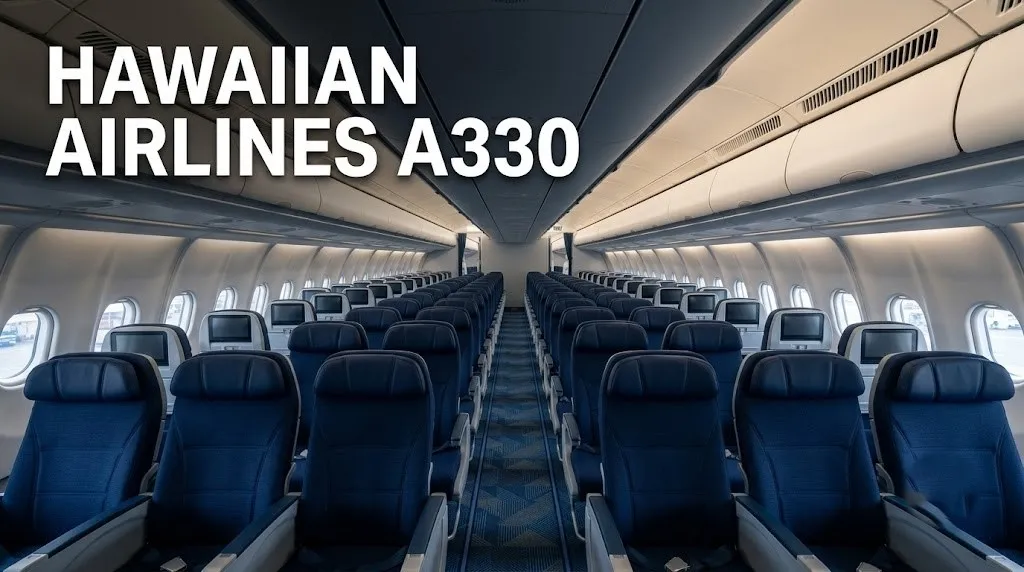
The Hawaiian Airlines A330 interior features a three-cabin configuration on most aircraft. First Class occupies the forward cabin, Extra Comfort seats fill the forward economy section, and Main Cabin economy seats complete the aft cabin.
Hawaiian employs a distinctive interior design with deep blue seat upholstery and island-inspired accent details throughout the cabin. The 2-4-2 economy layout on A330 variants reduces the number of middle seats compared to competing 3-3-3 configurations.
Families with children benefit directly from the A330’s twin-aisle design and 2-4-2 seating arrangement. Two parents can sit together with a child in the window pair without a stranger in the same row grouping.
Solo travelers will find the A330 window pairs ideal for avoiding middle-seat assignments on transpacific flights. The 2-seat window groupings mean only one seat neighbor instead of two on 3-3-3 configured wide-bodies.
Business travelers accustomed to Delta One or United Polaris lie-flat products should note Hawaiian’s A330 First Class offers recliner seats rather than full lie-flat beds. This is a meaningful distinction for red-eye flights from Hawaii to the U.S. mainland.
The overhead bin design on Hawaiian’s A330 provides adequate space for standard carry-on bags but fills quickly on full flights. Board early if you need guaranteed bin space near your seat, especially in Main Cabin economy.
Key Takeaway: The A330 interior uses a 2-4-2 economy layout that reduces middle-seat count and benefits families, couples, and solo travelers on long Hawaii flights.
Hawaiian Airlines A330-200 Configuration and Specs
The Hawaiian Airlines A330-200 seats 278 passengers in a three-cabin configuration. First Class holds 18 seats in a 2-2-2 layout, Extra Comfort occupies 68 seats, and Main Cabin economy fills the remaining 192 seats.
Seat pitch in Main Cabin economy measures approximately 31 inches on most A330-200 configurations. Seat width reaches roughly 18 inches in economy, slightly wider than the 17-inch standard on many competing narrow-body aircraft.
First-time international travelers accustomed to domestic narrow-body flights will notice the A330-200’s wider cabin immediately upon boarding. The extra width translates to wider aisles and a less claustrophobic cabin environment on five-hour flights.
Business travelers should verify whether their specific A330-200 flight features Hawaiian’s updated interior or the older cabin product. Seat condition and in-flight entertainment screen quality vary noticeably between aircraft based on retrofit status.
The A330-200 serves as Hawaiian’s primary aircraft for premium routes including Honolulu to Los Angeles, Seattle, and Portland. These routes benefit from the A330-200’s range capability and passenger comfort advantages over narrow-body alternatives.
Aircraft configuration may shift as Hawaiian integrates with Alaska Airlines operations through 2026. Verify your specific flight’s seat map directly on Hawaiian’s website during booking.
Key Takeaway: Hawaiian A330-200 seats 278 passengers with 18 First Class recliner seats, 68 Extra Comfort seats, and 192 Main Cabin economy seats in a 2-4-2 layout.
Hawaiian Airlines Airbus A330-200 Routes and Destinations
The Airbus A330-200 operates on Hawaiian’s longest and most premium transpacific routes from Honolulu International Airport. Primary U.S. mainland destinations include Los Angeles, Seattle, Portland, San Diego, and San Francisco.
The Points Guy identifies Hawaiian’s A330-200 routes as some of the most competitive Hawaii flight options for comfort-conscious travelers. The aircraft also serves select Asia-Pacific destinations including Tokyo, Osaka, Seoul, and Sydney.
Solo female travelers arriving into Honolulu on late-night A330-200 flights will find the airport well-lit with active ground transportation options through midnight. Pre-book your airport transfer before departure for peace of mind on late arrivals.
Budget travelers flying from secondary West Coast cities like San Diego or Portland will typically find the A330-200 as their only wide-body option to Hawaii. Prices on these routes often run slightly lower than LAX and SFO departures.
Route assignments change seasonally based on demand with peak winter and summer schedules adding A330-200 frequencies. Spring and fall shoulder seasons may see A330-200 substitutions for the smaller A321neo on certain thinner routes.
Always verify your specific aircraft type during booking as Hawaiian occasionally swaps aircraft based on operational needs. The seat map visible during seat selection confirms which variant operates your flight.
Key Takeaway: Hawaiian A330-200 serves primary West Coast to Honolulu routes plus select Asia-Pacific destinations with seasonal frequency adjustments.
Hawaiian Airlines Plane Seats Across All Cabins
Hawaiian Airlines plane seats span three distinct cabin classes on the A330: First Class, Extra Comfort, and Main Cabin economy. Each cabin offers different seat dimensions, recline characteristics, and included amenities.
First Class seats on Hawaiian’s A330 measure approximately 20 inches wide with around 42 inches of pitch. These recliner seats offer generous legroom but do not convert to fully lie-flat beds like competing premium products on United or Delta Hawaii routes.
Extra Comfort seats provide approximately 36 inches of pitch with the same seat width as Main Cabin economy at roughly 18 inches. The primary upgrade is legroom, priority boarding, and earlier meal and beverage service on flights offering complimentary dining.
Main Cabin economy seats deliver standard coach dimensions with roughly 31 inches of pitch and 18 inches of width. Seat cushion comfort rates above average for economy class according to passenger surveys cited by SeatGuru.
Families with young children should target Extra Comfort bulkhead rows where bassinet positions exist on certain A330 configurations. Confirm bassinet availability directly with Hawaiian Airlines reservations before booking specific seats.
Business travelers on daytime transpacific flights may find Extra Comfort perfectly adequate for working during the flight. The extra legroom enables comfortable laptop use while the seat width matches Main Cabin economy dimensions.
Key Takeaway: Hawaiian A330 offers three cabin classes with First Class recliners at 20 inches wide, Extra Comfort at 36-inch pitch, and Main Cabin economy at 31-inch pitch.
Hawaiian Airlines A330 Seat Map Breakdown
The Hawaiian Airlines A330 seat map reveals specific row characteristics that significantly impact passenger comfort. Window seats in the 2-4-2 economy configuration come in pairs, meaning solo travelers can select window seats with only one seat neighbor.
Rows 11 through 15 in the Extra Comfort section offer the best combination of legroom and forward-cabin quiet. Row 11 sits directly behind the First Class bulkhead with unlimited legroom but fixed armrests due to tray table storage design.
Window alignment on the A330-200 is inconsistent across certain economy rows. Rows 33 through 36 on many configurations feature misaligned windows that force passengers to lean forward for an outside view.
Families with children should consider rows 34 through 36 in the rear Main Cabin economy section. These rows sit closer to lavatories and galley access, which reduces the walking distance for restless young travelers.
Business travelers who need to work during the flight should avoid rows directly adjacent to lavatories. Rows 29 and 43 on many A330-200 seat maps sit near galley and lavatory areas with higher foot traffic and occasional noise throughout the flight.
Seat maps vary between individual aircraft based on retrofit status and configuration version. Always consult the seat map displayed during booking on Hawaiian’s official site rather than third-party maps that may reference older configurations.
Key Takeaway: Hawaiian A330 seat maps show window misalignment in certain rows, with Extra Comfort rows 11 through 15 offering the best overall passenger experience.
Hawaiian Airlines A330 Best Seats by Traveler Type
The Hawaiian Airlines A330 best seats depend entirely on your travel profile and priorities for the flight. A couple seeking a quiet flight will select differently than a family with young children or a business traveler needing to work.
Couples and leisure travelers should target window-side pairs in rows 20 through 25 of Main Cabin economy. These rows sit ahead of the wing, offering unobstructed views and distance from galley and lavatory traffic concentrated in the rear cabin.
Extra Comfort row 11 bulkhead seats deliver unlimited legroom but come with fixed armrests and no under-seat storage during takeoff and landing. Tall travelers will appreciate the legroom while passengers carrying personal items may find the lack of immediate storage frustrating.
Budget travelers who decline seat selection fees should check in exactly 24 hours before departure to maximize complimentary seat assignment quality. Hawaiian assigns remaining seats at check-in with earlier check-in typically yielding better positions on the seat map.
SeatGuru documents that window seats in rows 33 through 36 on many A330-200 configurations have misaligned windows. Solo travelers who want an outside view should confirm window alignment before selecting these specific rows on the seat map.
Families with bassinet-age infants should contact Hawaiian Airlines reservations directly rather than booking online. Bassinet positions exist on specific A330 aircraft and must be requested and confirmed in advance of travel.
Avoid rows 43 and 44 in the extreme rear of Main Cabin economy if you want a quiet flight. Proximity to rear lavatories and galley areas generates continuous foot traffic and occasional odor issues on full transpacific flights.
Key Takeaway: Couples should choose window pairs in rows 20 through 25, tall travelers benefit from Extra Comfort row 11, and all passengers should avoid rear rows 43 through 44.
Hawaiian Airlines A330 Routes and Network Coverage
Hawaiian Airlines A330 routes concentrate on high-demand transpacific corridors between Hawaii and the U.S. West Coast. Primary A330 destinations include Los Angeles, Seattle, Portland, San Diego, San Francisco, and Las Vegas.
The A330 also operates Hawaiian’s international long-haul network to Tokyo, Osaka, Seoul, Sydney, and Auckland. These Asia-Pacific routes represent some of Hawaiian’s most competitive and strategically important services.
First-time Hawaii travelers departing from West Coast hubs will find the A330 on most Hawaiian Airlines flights to Honolulu. Flights from secondary California cities and smaller West Coast airports may operate on the narrow-body A321neo instead.
Business travelers flying from Honolulu to Asia should verify whether their specific route operates on the A330 or the newer Boeing 787-9 Dreamliner. The 787-9 features Hawaiian’s newest cabin product with updated seat designs and larger in-flight entertainment screens.
The U.S. Department of Transportation reports Hawaiian Airlines maintains strong on-time performance on A330-operated West Coast routes. Transpacific A330 flights benefit from Hawaiian’s Honolulu hub advantage and consistent aircraft utilization patterns.
Route networks continue evolving through 2026 as Hawaiian and Alaska Airlines integrate their operations and fleet planning. Codeshare availability on A330 routes expands as the merger integration progresses.
Key Takeaway: Hawaiian A330 serves primary West Coast to Hawaii routes plus Asia-Pacific international destinations with expanding Alaska Airlines codeshare availability through 2026.
Hawaiian Airlines A330 Extra Comfort Review
Hawaiian Airlines A330 Extra Comfort provides approximately 36 inches of seat pitch and priority boarding benefits. The upgrade delivers meaningful legroom improvement over Main Cabin economy without reaching First Class pricing levels.
Extra Comfort occupies rows 11 through 15 on most A330-200 configurations directly behind the First Class cabin. The forward position means earlier meal service and faster deplaning compared to Main Cabin economy passengers seated further aft.
Tall travelers and business flyers working during the flight will find Extra Comfort worth the upgrade cost on five-hour West Coast routes. The extra 5 inches of pitch over Main Cabin economy enables comfortable laptop use without the seatback pressing into your knees.
Budget travelers should compare Extra Comfort pricing against First Class fares before purchasing. On some off-peak flights, the price gap between Extra Comfort and First Class narrows enough to justify the full premium cabin upgrade instead.
Families with young children should note Extra Comfort does not offer additional seat width compared to Main Cabin economy. The upgrade delivers legroom only, which matters less for children who cannot reach the floor anyway.
Meal service in Extra Comfort mirrors Main Cabin economy with no upgraded dining component on most routes. You are paying for space and boarding priority, not a different food and beverage experience.
Purchase Extra Comfort at booking for the best availability on popular routes and peak travel periods. Upgrades sell out regularly on Friday and Sunday flights between Honolulu and Los Angeles.
Key Takeaway: Extra Comfort on Hawaiian A330 delivers 36-inch pitch and priority boarding for tall travelers and working professionals, but does not include upgraded meal service.
Hawaiian Airlines A330 First Class Experience
Hawaiian Airlines A330 First Class offers 18 recliner seats in a 2-2-2 configuration with approximately 42 inches of pitch. Seat width measures roughly 20 inches, providing generous personal space on five to six-hour transpacific flights.
The First Class seat reclines significantly but does not convert to a fully lie-flat bed. This distinction matters most on overnight red-eye flights from Hawaii to the U.S. mainland where true lie-flat competitors like United Polaris offer sleep advantages.
Conde Nast Traveler ranks Hawaiian Airlines premium cabin service highly for daytime Hawaii routes. The cabin crew delivers attentive service with Hawaiian cultural touches including mai tai service and island-inspired meal presentations.
Business travelers who typically fly Delta One or American Airlines Flagship First on other routes should set appropriate expectations for Hawaiian’s A330 First Class. The product sits closer to domestic first class than international long-haul business class in seat hardware.
Couples traveling to Hawaii for special occasions will find Hawaiian’s A330 First Class delivers a genuinely celebratory experience. The 2-2-2 configuration pairs naturally, the meal service includes multiple courses, and the cabin atmosphere reflects Hawaiian hospitality.
First Class fares on A330 West Coast routes typically run two to three times higher than Main Cabin economy pricing. The value proposition strengthens on daytime flights where full lie-flat capability matters less than space and service quality.
The Points Guy identifies Hawaiian Airlines First Class as a solid value for Alaska Mileage Plan redemptions on A330 routes. Award availability fluctuates seasonally with better access during spring and fall shoulder periods.
Key Takeaway: Hawaiian A330 First Class offers 20-inch-wide recliner seats with excellent service for daytime flights, but lacks true lie-flat beds for overnight red-eye routes.
Hawaiian Airlines A330 Economy Review and Value Assessment
Hawaiian Airlines A330 economy delivers above-average seat comfort with approximately 31 inches of pitch and 18 inches of width. The 2-4-2 configuration reduces middle-seat density compared to competing 3-3-3 wide-body layouts on the same routes.
Passenger comfort in Main Cabin economy on Hawaiian’s A330 rates as competitive with premium economy products on some other carriers according to SeatGuru documentation. Seat cushion quality and cabin maintenance standards exceed typical domestic economy expectations.
Budget travelers comparing Hawaiian A330 economy against Southwest Airlines Hawaii flights should weigh seat comfort against fare flexibility. Southwest offers free checked bags and no change fees while Hawaiian’s A330 delivers wider seats and twin-aisle boarding.
Solo travelers benefit most from Hawaiian’s 2-4-2 economy layout with window pairs limiting seat neighbors to one person. The configuration eliminates the dreaded “double middle seat” situation common on 3-3-3 Boeing 777 layouts used by competitors.
Families with children will find Hawaiian A330 Main Cabin economy perfectly adequate for daytime West Coast flights. Five hours passes quickly with the in-flight entertainment system and complimentary meal service keeping young travelers occupied.
Fare pricing on Hawaiian A330 routes varies significantly by season with peak winter holiday and summer vacation periods commanding substantial premiums. Book three to four months ahead for the best value on Main Cabin economy seats.
Key Takeaway: Hawaiian A330 economy delivers 18-inch-wide seats in a 2-4-2 layout that outperforms most narrow-body competitors on West Coast to Hawaii routes.
Hawaiian Airlines A330 In-Flight Experience and Entertainment
The Hawaiian Airlines A330 in-flight experience centers on seat-back entertainment screens available at every seat across all cabins. Screen size and interface quality vary between aircraft based on retrofit status and specific A330 variant.
Hawaiian offers a selection of Hollywood films, television programming, music channels, and Hawaii-focused destination content throughout the flight. The entertainment library includes Hawaiian cultural programming that provides genuine destination context for visitors.
First-time Hawaii travelers will appreciate the destination content available on A330 in-flight entertainment systems. Arrival guides, island overviews, and activity information play on seat-back screens during the descent into Honolulu.
WiFi connectivity varies across Hawaiian’s A330 fleet with some aircraft offering full-flight internet access. Verify WiFi availability on your specific aircraft before relying on connectivity for work or streaming during the flight.
Business travelers should download critical work files before departure as A330 WiFi service on Hawaiian remains inconsistent across the fleet. Do not plan mission-critical video calls during transpacific A330 segments.
The in-flight entertainment system accepts standard 3.5mm headphone jacks on most A330 seat-back screens. Bring wired headphones rather than relying on Bluetooth connectivity, which is not supported on Hawaiian’s current IFE systems.
Key Takeaway: Hawaiian A330 offers seat-back entertainment at every seat with island-focused destination content, but WiFi consistency varies across the fleet.
Hawaiian Airlines A330 Meal Service and Dining Quality
Hawaiian Airlines A330 meal service includes complimentary meals and beverages in all cabins on transpacific routes between the U.S. mainland and Hawaii. The dining program incorporates Hawaiian ingredients and island-inspired menu items distinctive among U.S. carriers.
First Class meal service features multiple courses with appetizer, entree choice, and dessert served on ceramic dishware. Mai tai service begins shortly after departure as a signature Hawaiian Airlines premium cabin touch.
Main Cabin economy passengers receive a complimentary hot meal on West Coast to Hawaii A330 flights exceeding certain duration thresholds. Menu items rotate seasonally with Hawaiian-inspired options appearing alongside standard airline catering selections.
Vegetarian, vegan, and gluten-free special meals are available on Hawaiian A330 flights when requested at least 48 hours before departure. Request special meals through Hawaiian Airlines reservations or the manage booking portal online.
Families with picky eaters should pack backup snacks as Hawaiian’s complimentary meal may not suit every child’s preferences. The meal portion size is adequate for adults but young children accustomed to specific foods may refuse unfamiliar menu items.
Buy-on-board snack and beverage options supplement the complimentary meal service on longer A330 transpacific flights. Bring a credit or debit card as Hawaiian accepts electronic payment for onboard purchases.
Meal service quality rates as above average for U.S. domestic carriers according to passenger satisfaction data tracked by the DOT Air Travel Consumer Report. The inclusion of complimentary meals distinguishes Hawaiian from competitors who charge for food on Hawaii routes.
Key Takeaway: Hawaiian A330 provides complimentary meals and beverages in all cabins on transpacific routes with First Class multi-course dining and Hawaiian-inspired menu items.
Hawaiian Airlines A330 vs A350 Comparison
The Hawaiian Airlines A330 vs A350 comparison addresses a common traveler question about Hawaiian’s wide-body fleet strategy. Hawaiian does not currently operate the Airbus A350 in its active fleet as of 2026.
Travelers confusing Hawaiian’s A330 with other carriers’ A350 aircraft should know the A330 serves as Hawaiian’s primary wide-body while the airline evaluates future fleet options. The Boeing 787-9 Dreamliner represents Hawaiian’s newest wide-body aircraft, not the A350.
Competitor airlines including Delta Air Lines and United Airlines operate the A350 on select international routes, but not on Hawaii services. Hawaiian’s fleet strategy prioritizes the A330 family and 787-9 for current and near-future wide-body operations.
The 787-9 Dreamliner in Hawaiian’s fleet offers a newer cabin product than the A330 with larger windows, improved cabin pressurization, and updated seat designs. Travelers seeking Hawaiian’s most modern wide-body experience should target 787-9 operated routes.
The A330-200 remains Hawaiian’s most numerous wide-body type and appears on the broadest selection of West Coast to Hawaii routes. The aircraft is familiar, reliable, and delivers consistent passenger comfort that most travelers find perfectly acceptable.
Verify your specific aircraft type during booking on Hawaiian’s website to confirm whether you are flying on an A330-200, A330-300, or 787-9 Dreamliner. Each type offers slightly different seat dimensions and cabin configurations.
Key Takeaway: Hawaiian Airlines does not operate the A350 in 2026, relying on A330 variants and Boeing 787-9 Dreamliners for wide-body Hawaii and Asia-Pacific service.
Hawaiian Airlines Alaska Miles A330 Booking Guide
Hawaiian Airlines Alaska miles A330 booking reflects the integration of HawaiianMiles into the Alaska Mileage Plan loyalty program through 2026. Alaska Airlines’ acquisition of Hawaiian Airlines created a combined loyalty ecosystem that affects award bookings on A330 routes.
Mileage Plan members can book Hawaiian Airlines A330 award flights through Alaska’s booking platform as codeshare integration progresses. Award pricing follows Alaska’s distance-based or region-based charts depending on the specific route and booking date.
The U.S. Department of Transportation approved the Alaska-Hawaiian merger with conditions that include loyalty program consumer protections. Mileage balances transfer between programs with favorable conversion rates during the integration period.
Budget travelers who collect Alaska miles through the Alaska Airlines Visa credit card or Mileage Plan shopping portal can apply those miles directly to Hawaiian A330 bookings. Award availability on popular West Coast routes often exceeds what legacy carriers offer to Hawaii.
Business travelers who previously split loyalty between Alaska and Hawaiian programs now benefit from unified earning and redemption on A330 Hawaii flights. Elite status recognition and benefits transfer between programs as the integration proceeds.
Redeem miles for Hawaiian A330 Extra Comfort or First Class seats through Alaska’s platform when award space is available. Premium cabin awards offer better value per mile than economy redemptions on longer A330 routes.
Award availability and mileage pricing change continuously as the merger integration advances through 2026. Verify current redemption rates and blackout dates directly on Alaska Airlines’ Mileage Plan portal before transferring points.
Key Takeaway: Alaska Mileage Plan members can book Hawaiian A330 awards through Alaska’s platform with elite benefits transferring between programs during the ongoing 2026 merger integration.
Important Accuracy Notes for Hawaiian Airlines A330 Travel
Hawaiian Airlines policies, fleet configurations, and Alaska Airlines merger integration details change actively through 2026. Verify the following directly before traveling.
Verify the following directly before traveling:
- Seat map for your specific flight on Hawaiian Airlines’ official booking portal as aircraft substitutions occur operationally
- Alaska Mileage Plan award redemption rates and blackout dates on Alaska Airlines’ website as integration continues
- Meal service details and special meal availability through Hawaiian Airlines reservations at least 48 hours before departure
- WiFi availability on your specific A330 aircraft by checking Hawaiian’s fleet information page
- Lounge access policies at your departure airport as Alaska-Hawaiian lounge reciprocity evolves through 2026
- Checked bag fees and weight limits on Hawaiian’s official site as Alaska merger policies standardize
Seat pitch, width, and configuration details described here represent typical Hawaiian A330 measurements but vary by individual aircraft age and retrofit status. Always confirm your specific aircraft’s layout during seat selection.
Frequently Asked Questions About Hawaiian Airlines A330
Is Hawaiian Airlines A330 comfortable for long flights?
Hawaiian Airlines A330 delivers above-average comfort for five to six-hour transpacific flights with 18-inch-wide economy seats in a 2-4-2 configuration.
Seat cushion quality and cabin maintenance standards rate higher than typical domestic U.S. carrier economy products.
The twin-aisle design reduces crowding compared to narrow-body alternatives on the same Hawaii routes.
Does Hawaiian Airlines A330 have lie-flat seats in first class?
Hawaiian Airlines A330 First Class does not offer true lie-flat seats on current configurations.
First Class seats recline significantly with approximately 42 inches of pitch but remain angled recliners rather than fully flat beds.
Travelers seeking true lie-flat seats to Hawaii should consider United Polaris or Delta One on competing wide-body routes.
What is the seat configuration on Hawaiian Airlines A330?
Hawaiian Airlines A330 uses a 2-4-2 economy configuration with 2-2-2 in First Class and Extra Comfort sections.
The 2-4-2 layout reduces middle seat count compared to 3-3-3 configurations on competing wide-body aircraft.
A330-200 aircraft seat 278 passengers while A330-300 variants accommodate approximately 294 travelers.
How does Hawaiian Airlines A330 Extra Comfort compare to regular economy?
Extra Comfort provides approximately 36 inches of seat pitch compared to 31 inches in Main Cabin economy.
The upgrade includes priority boarding and earlier meal service but does not offer wider seats than Main Cabin economy.
Legroom improvement matters most for tall travelers and anyone working on a laptop during the flight.
Which Hawaiian Airlines A330 seats have the best window views?
Window pairs in rows 20 through 25 ahead of the wing offer the best unobstructed views on Hawaiian A330 flights.
Rows 33 through 36 on many A330-200 configurations have misaligned windows requiring passengers to lean forward for outside views.
Extra Comfort row 11 bulkhead windows provide excellent forward views but come with fixed armrests.
Can I use Alaska Airlines miles to book Hawaiian Airlines A330 flights?
Yes, Alaska Mileage Plan members can book Hawaiian Airlines A330 award flights through Alaska’s booking platform in 2026.
Award pricing follows Alaska’s charts with premium cabin redemptions offering better value on longer A330 routes.
Verify current redemption rates directly on Alaska Airlines’ Mileage Plan portal as merger integration continues through the year.
Hawaiian Airlines A330 remains the most reliable and widely available wide-body option for West Coast to Hawaii travel. The 2-4-2 economy layout, competitive seat width, and complimentary meal service set it apart from narrow-body competitors on the same routes.
Book Extra Comfort if you value legroom and boarding priority. Choose First Class for daytime flights where recliner comfort and Hawaiian hospitality create a genuinely premium experience. Select Main Cabin economy window pairs in rows 20 through 25 for the best value proposition.
Verify your specific aircraft type, seat map, and Alaska Mileage Plan redemption options directly with Hawaiian Airlines and Alaska Airlines before booking. Fleet configurations, loyalty program integration, and route assignments continue evolving through 2026. Confirm everything at the official source.