The single best travel tip for Italy in 2026 is radical advance planning. Showing up without pre-booked tickets means you will wait in brutal heat for hours.
The country has fully digitized entry, ticketing, and transit in the post-pandemic era. Your smartphone is now the master key to the Vatican, the Uffizi, and the train platform.
This guide delivers specific, hard-won logistics that go beyond the generic tourism brochure. You will learn how to dodge the new entry bureaucracy and eat like a local.
Essential Pre-Trip Planning for Italy
The 2026 entry landscape changed with the full implementation of the European Travel Information and Authorization System (ETIAS) . US passport holders must apply online before flying.
The ETIAS application costs a small fee and links electronically to your passport. The authorization is valid for three years or until your passport expires.
First-time international travelers must complete this step at least 96 hours before departure. Business travelers on a last-minute trip should carry a printed copy of the confirmation PDF.
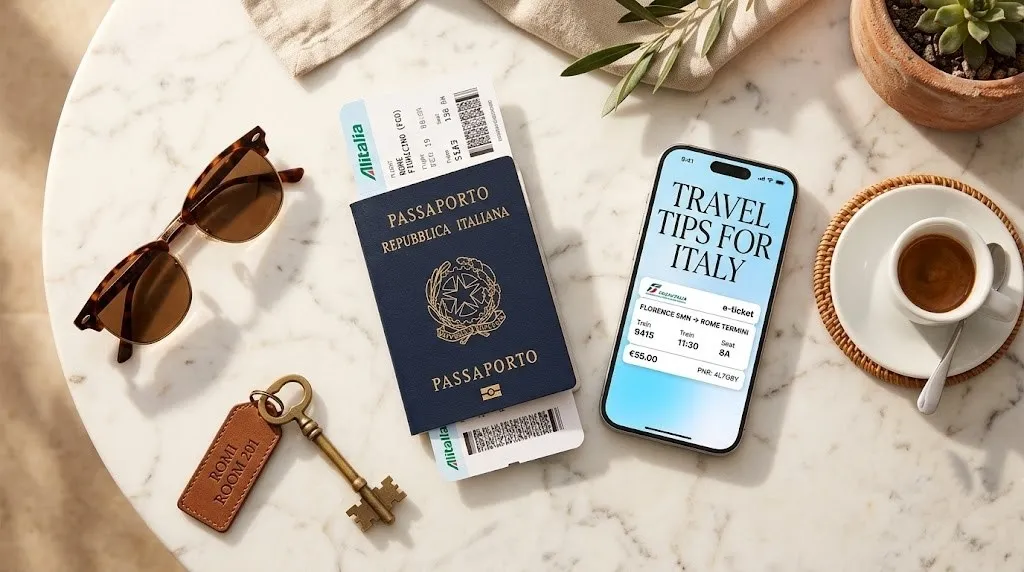
Always verify your passport has at least six months of validity remaining past your intended exit date. Italian border police in Rome Fiumicino strictly enforce this rule.
Book your flights to arrive at Rome Fiumicino Airport (FCO) for a classic first-timer itinerary. Flying into Milan Malpensa (MXP) is smarter for a Lakes and Alps trip.
The U.S. State Department maintains an updated advisory page for Italy. Check it for any specific regional alerts regarding strikes or transportation disruptions the day you depart.
Key Takeaway: ETIAS is not a visa, but you will be denied boarding without it.
Navigating Italian Airports and Ground Transport
Every major Italian airport has a dedicated express train to the city center. The Leonardo Express connects FCO to Roma Termini station in exactly 32 minutes.
Avoid the unregulated taxi touts directly outside the baggage claim doors. Use the official taxi stand with a fixed flat-rate price for your central city zone.
Milan Linate Airport (LIN) is the best and closest airport for business travelers flying in from other European hubs. It is a quick 20-minute metro ride from the Duomo.
Budget travelers flying a low-cost carrier will often land at a secondary airport far from the city. A Ryanair flight to “Milan” might actually land at Bergamo (BGY) an hour’s bus ride away.
- FCO to Rome: Use the Leonardo Express train, departing every 15 minutes for the 32-minute nonstop ride.
- MXP to Milan: Use the Malpensa Express train, a 50-minute ride to Cadorna or Centrale station. Taxis are a flat, higher rate.
- VCE to Venice: Take the Alilaguna water bus from the dock for the iconic arrival. A private water taxi is a luxury splurge.
Families with strollers and heavy luggage should pre-book a private car transfer from FCO. Managing a stroller on a crowded express train after a red-eye flight is a nightmare.
The last express train from FCO to Rome departs around 11:35 p.m. in 2026. A late-night arrival forces you into a taxi or a pre-booked shuttle van.
Italian Train Travel Tips for 2026
Trenitalia and Italo are the two primary high-speed rail operators connecting Italy’s major cities. They are modern, fast, and the smartest way to avoid traffic jams.
A high-speed Frecciarossa train covers the Rome to Milan route in under three hours. This is significantly faster and more comfortable than a short-haul flight.
You must physically validate regional paper train tickets at a green machine on the platform. A forgotten validation earns an instant fine from the ticket inspector on board.
Solo travelers should sit in a window seat in a forward-facing car near their luggage. Families will find the quiet car too restrictive for a child who wants to chat.
All high-speed tickets include a specific seat assignment and do not require validation. Book them directly on the Trenitalia or Italo app to avoid third-party service fees.
Never buy a regional train ticket from a stranger “helping” you at a Rome ticket machine. This is a common scam where they demand a cash tip for their assistance.
The Italian word for strike is sciopero, and it is announced weeks in advance. Check local news sites for planned transit strikes and avoid booking travel on those dates.
Money and Connectivity Tips for Italy
The Italian bancomat is the local automated teller machine network with the lowest fees. Never use a freestanding “Euronet” ATM, which charges predatory exchange rates.
Always choose to be charged in local euros, not your home currency, at a payment terminal. The dynamic currency conversion “service” is a massive hidden markup fee.
Cash is still mandatory in Italy for small purchases under a few euros. Many family-run cafes, market stalls, and beach clubs refuse card payments entirely.
Budget travelers should withdraw a week’s worth of cash from a bank-owned bancomat for maximum savings. Luxury travelers can exist almost entirely on a premium travel credit card.
An Italian eSIM from Vodafone or TIM provides blazing fast 5G data across the country. Buy a data-only eSIM online before your flight, and activate it instantly upon landing at FCO.
Your home carrier’s international roaming plan is far too slow for mapping and translating. A local eSIM is the single biggest digital upgrade for a stress-free 2026 trip.
The aperitivo tradition is the best budget hack in the country. A ten-euro cocktail often comes with a sprawling free buffet of pasta, bruschetta, and small bites.
Key Takeaway: Declare euros at the bancomat, use a local eSIM, and live on aperitivo buffets.
Safety and Cultural Etiquette Advice
Italy is safe, but petty theft is an industry in the major tourist hubs. Pickpockets work the crowded Termini station, the 64 bus in Rome, and the Trevi Fountain steps.
A cross-body bag with a zippered closure is mandatory travel gear. Never hang a purse on the back of your chair at a sidewalk cafe on a busy piazza.
Dress codes are strictly enforced at Italian churches and the Vatican Museums. Shoulders and knees must be covered, or you will be turned away at the security checkpoint.
Solo female travelers will generally find Italy welcoming, but street harassment happens in big cities. A firm “No, grazie” and ignoring the individual is the correct local tactic.
Italians take their restaurant culture very seriously, with rigid meal times. A cappuccino ordered after 11:00 a.m. will horrify your waiter and mark you as an outsider.
Tipping is not a percentage-based custom as it is in the United States. The coperto or servizio charge on your bill is the service fee, and a small euro extra is a bonus.
Never touch the produce at a fresh market stall with your bare hands. The vendor will hand you a plastic glove or bag to select the items yourself.
Eating in Italy Without Falling for Tourist Traps
The golden rule of eating in Italy is to avoid restaurants with plastic menus in English. A “tourist menu” with photos of the food is always overpriced and microwaved.
A true local trattoria will have a handwritten daily specials menu only in Italian. The pasta is made fresh that morning, and the wine is the house label.
The coperto is a per-person cover charge for bread and table service. It is a legal, standard practice, and you cannot refuse to pay it.
Families with picky eaters can find a simple “pasta in bianco” (pasta with butter) off-menu. Budget travelers should stick to pizza al taglio shops for cheap, world-class squares.
Gelato shops with massive fluffy mounds of brightly colored gelato are a scam. Real artisanal gelato is stored in covered metal tins and looks flat and muted.
To find a good coffee bar, walk one block away from the main piazza. The price of an espresso drops by half, and the quality of the roast doubles.
The house wine served in a carafe is always the best value on the table. It is a local bulk wine that pairs perfectly with the house pasta dish.
Smart Sightseeing and Booking Tickets
You can no longer buy a Colosseum, Vatican Museum, or Uffizi ticket at the door in 2026. Dynamic timed-entry tickets sell out days or weeks in advance during peak season.
Only use the official museum website to buy tickets, never a third-party reseller. A “skip the line” tour on Viator is often a scam for a ticket you could have bought yourself.
- Step 1: Identify the exact official ticketing portal. For the Colosseum, it is the official Parco archeologico del Colosseo site.
- Step 2: Create an account and log in 15 minutes before the release window. Tickets drop 30 days in advance on a rolling basis.
- Step 3: Select an early morning entry slot. The 8:30 a.m. entry slot gets you inside before the tour groups converge.
- Step 4: Have your credit card and passport numbers pre-loaded. You need a passport name for each ticket.
Art lovers should pay a premium for a private, official after-hours tour of the Vatican. It is expensive but worth it for a silent Sistine Chapel without a crowd.
History buffs on a budget should visit the Roman Forum on a free first-Sunday-of-the-month ticket. Just be prepared to stand in a massive, unmanageable line in the summer heat.
The Firenze Card is no longer a good value for a fast-paced traveler. The pre-booking requirements now defeat the purpose of the “pass” model.
Dressing and Packing for Italian Style
Italians dress in a tailored, intentional way, even for casual errands. Wearing gym shorts and flip-flops instantly pegs you as a target for every scammer.
Pack a capsule wardrobe of well-fitted, neutral-colored clothing items. A navy blazer, a crisp white shirt, and slim dark jeans will get you into any fine restaurant.
Comfortable walking shoes are non-negotiable, but they must be stylish. A pair of sleek, all-leather white sneakers is the perfect compromise for miles of cobblestone.
Solo female travelers should pack a large, elegant silk scarf for instant church shoulder coverage. Families should not pack a stroller with tiny plastic wheels that shatter on cobblestone.
A compact travel umbrella and a lightweight rain jacket are essential for the spring and fall. A sudden thunderstorm in Venice will flood St. Mark’s Square within an hour.
Pack a universal power adapter with multiple USB-C ports for all your devices. Italian wall outlets are recessed and often refuse to hold a heavy, hanging power brick.
The summer heat in Rome is brutal, reaching the high 90s in July. A reusable metal water bottle is essential to fill at the thousands of free public nasone fountains.
Key Takeaway: Dress like a local, buy great sneakers, and carry a scarf for instant church respectability.
Regional Differences Across Italy
Italy is a patchwork of independent city-states that only unified recently. The culture, food, and pace of life differ radically between regions.
Milan in the North is a fast-paced, formal business capital. An espresso at the bar is a standing, two-minute affair, not a lingering social session like in Naples.
Sicily in the South operates on a relaxed, slower rhythm with a mid-afternoon riposo. Many shops and restaurants will close for several hours after lunchtime and reopen late.
First-time travelers should stick to the well-trodden path of Rome, Florence, and Venice. Return visitors should head straight to Puglia or the Dolomites for a completely different Italy.
The food in Emilia-Romagna revolves around rich, decadent pork, parmesan, and butter. The cuisine in Campania is lighter, with fresh seafood, bright tomatoes, and creamy buffalo mozzarella.
Never ask for a caffè latte in Venice if you just want a morning coffee with milk. A “latte” is a glass of cold milk, and you will confuse the barista.
The sirocco wind in Sicily can ruin a beach day with hot, gritty Saharan sand. Check the local weather app for wind direction before planning an excursion to San Vito Lo Capo.
Italy Travel Tips for Families with Children
Italy adores children, but the infrastructure in historic city centers is not stroller-friendly. A baby carrier is far more practical for navigating the cobblestones of Florence.
Most hotels will not have a dedicated kids’ club or a pool in the city center. For a family beach holiday, book an agriturismo farm stay in the countryside instead.
Trattorias are very accommodating, even with a noisy toddler. The kitchen will often cook a simple bowl of plain pasta even if it is not on the menu.
Families should book a private, guided “Gladiator School” tour for the Colosseum for young kids. It keeps restless children engaged with hands-on activities while you enjoy the history.
Book connecting train tickets with enough time to manage a slow bathroom break. The Frecciarossa trains have excellent changing tables in the accessible lavatory cars.
Avoid the first Sunday of the month free museum days with young, impatient children. The massive crowds are not worth the free entry for a screaming toddler on a hot day.
Pharmacies in Italy are well-stocked with diapers, formula, and baby essentials. A pharmacy is identifiable by a large green cross sign outside the shop.
Italy Travel Tips for Solo and Female Travelers
Italy is a fantastic solo travel destination, especially outside the crowded peak summer. A solo traveler at a bar easily finds a seat at a busy restaurant.
Book a seat in the “Business” quiet car on high-speed trains when traveling alone. It offers a calmer, less chaotic environment to protect your luggage and your peace.
Solo female travelers should book well-reviewed, central accommodations, not a remote budget hostel. Paying extra for a 24-hour front desk in a safe, lit neighborhood is worth it.
The “caffè sospeso” tradition in Naples allows you to feel less alone at a bar. It is a pre-paid coffee left by a previous customer for someone who cannot afford one.
Learn to confidently say a firm “No” or “Basta” to persistent street vendors. A single word and a refusal to break your stride stops them far faster than polite English.
Never accept a drink from a stranger at a bar unless you watch the bartender pour it. A standard safety practice applies here just as much as it does back home in the U.S.
Join a group food tour on your first day in a new city. It is the best way to make new friends and learn the local geography without staring at a phone map.
Digital Nomad and Work-Cation Italy Guide
The 2026 digital nomad infrastructure in Italy has improved dramatically. Rome, Milan, and Florence are now full of fast, reliable fiber-connected co-working spaces.
A local Italian eSIM with an unlimited data plan is your most important tool. You can hotspot from your phone and work from a surprisingly remote cliffside terrace in Amalfi.
The Italy Digital Nomad Visa is now an official pathway for remote non-EU workers. Research the required income threshold and application portal on the official consular website.
Freelancers and remote employees should base themselves in an affordable university town. Bologna, with its 25-mile-long covered walkway, is the perfect beautiful outdoor office.
A typical Italian cafe is not a laptop-friendly “camping” environment like a U.S. Starbucks. You buy your coffee, drink it fast, and leave the table for the next paying customer.
Co-working spaces like Talent Garden in Milan offer a dedicated office with blazing internet. A day pass is affordable and essential on a day with a critical video conference call.
The afternoon riposo is the perfect time to sync your work with U.S. East Coast hours. Work through the quiet siesta, then knock off when the locals come back to life.
Key Takeaway: Buy a local eSIM, skip the cafe laptop camp, and base yourself in a buzzing university town.
Italy Travel Tips FAQs
What is the number one travel tip for Italy?
Pre-book every major museum, train, and restaurant reservation weeks before your trip.
The days of spontaneously walking into the Vatican or the Uffizi are over.
A smartphone with a local eSIM and pre-loaded tickets is your survival kit.
How do I avoid pickpockets in Italy?
Use a zippered cross-body bag and keep it in front of you on all public transit.
Never place your phone or wallet on an outdoor table at a cafe.
Ignore strangers who offer unsolicited “help” at a busy train ticket machine.
Do I need to pre-book everything in Italy for 2026?
Yes, you must pre-book all major museums, attractions, and high-speed train tickets.
A timed-entry Colosseum or Uffizi ticket in July sells out online weeks in advance.
You can still be spontaneous with local trattorias and exploring a small village.
What is the new ETIAS requirement for Italy?
ETIAS is a new digital travel authorization for US citizens visiting the Schengen Area.
You apply online for a small fee and it links electronically to your passport.
Apply at least 96 hours before your flight to avoid boarding denial at your home airport.
How do I validate a train ticket in Italy?
You must stamp a paper regional ticket at a green machine on the station platform.
A high-speed ticket with a printed seat assignment does not need manual validation.
An unstamped regional ticket results in a stiff fine from the conductor on board.
Is Italy safe for solo female travel in 2026?
Italy is generally very safe and welcoming for solo female travelers.
Use firm “No, grazie” phrases to dismiss unwanted attention from persistent men.
Book well-reviewed, centrally located hotels with a 24-hour front desk.
Closing
A successful 2026 trip to Italy demands a mix of old-world cultural respect and new digital tools. The traveler who masters the official museum portals and the bancomat machine wins.
Your first action step is to complete the ETIAS application right after booking your flight. Print a copy of the confirmation and keep it with your passport for the border police.
Book your high-speed train and major museum tickets directly on the official Italian sites. This single habit saves you hundreds of dollars in scalper and third-party fees.
Verify the current strike schedule and museum opening hours on the official website before departing. Italy rewards the prepared traveler and punishes the winging-it tourist with a vengeance.