Family travel tips that actually work come from parents who have navigated airports with strollers and survived long flights with toddlers. The best advice is specific, practical, and honest about what fails.
The Points Guy identifies airline family seating policies as the single most important factor for family travel success. Southwest Airlines and JetBlue Airways consistently rank among the best carriers for families.
This guide covers every aspect of family travel in 2026. You will find airline-specific seating policies, packing strategies by child age, and clear guidance on saving money without sacrificing the quality of your family vacation.
Family Travel Tips Overview
Family travel tips that make the biggest difference focus on advance planning and realistic expectations. The right airline, airport strategy, and packing approach transform a stressful experience into a manageable one.
Delta Air Lines, American Airlines, and United Airlines each have different family seating policies. Understanding these differences before booking prevents the most common family travel frustration.
Budget travelers with children should compare total trip cost including baggage and seat selection across multiple airlines. Southwest Airlines’ two free checked bags per person provide substantial savings for family travel.
First-time family travelers often underestimate how much extra time children add to every step of the journey. Arrive at the airport earlier than you think necessary for every flight.
Solo parents traveling with children face additional documentation requirements. Carry notarized consent letters from the absent parent for international travel to avoid entry issues.
Families with children of different ages need strategies that work across age groups. What entertains a teenager will not occupy a toddler on the same flight.
Key Takeaway: The most impactful family travel tips focus on airline selection, advance seat assignments, and realistic airport timing.
Family Travel Planning Tips
Family travel planning tips start with booking flights at times that match children’s sleep schedules. Red-eye flights work for some families and backfire completely for others.
Book international family flights 4 to 6 months ahead for the best combination of fare pricing and seat availability. Adjacent seats disappear faster than low fares on popular family routes.
Google Flights price tracking helps families monitor fares across multiple airlines simultaneously. Set alerts for your specific dates and book when prices drop into the expected range.
Budget travelers with children should consider shoulder season travel for better pricing. Spring and fall offer pleasant weather at most destinations with lower airfare than peak summer periods.
First-time family international travelers should verify passport requirements for every family member. Children of all ages need individual passports for international air travel.
Families with school-age children face date restrictions that limit flexibility. Accept the higher fares during school breaks as the cost of date constraints.
Key Takeaway: Book family flights 4 to 6 months ahead, match flight times to children’s sleep patterns, and verify documentation requirements early.
Best Airlines for Families
Best airlines for families ranking prioritizes seating policies, baggage allowances, and family-friendly boarding procedures. Different carriers excel for different family sizes and ages.
Southwest Airlines leads family-friendly carriers with two free checked bags per person and family boarding after the A group. The open seating policy allows families to find seats together without fees.
JetBlue Airways offers family-friendly seating with no fee for adjacent seat assignments. The airline’s seat-back entertainment and complimentary snacks appeal to children on longer flights.
Delta Air Lines provides family seating assistance through reservations with policies that prioritize keeping children with parents. Gate agents have discretion to adjust seating for families.
American Airlines basic economy fares do not guarantee family seating without additional seat selection fees. Main cabin fares include seat selection that allows parents to choose adjacent seats.
United Airlines family seating policy has improved with gate agent assistance for children under 12. The airline’s policy does not guarantee free adjacent seating on basic economy fares.
| Airline | Family Boarding | Free Checked Bags | Seat Together Policy | Best For |
|---|---|---|---|---|
| Southwest | After A group | 2 free | Open seating | Budget families |
| JetBlue | Early boarding | 1 free | No fee for adjacent | Entertainment |
| Delta | Early boarding | Varies by fare | Gate agent assistance | Service quality |
| American | Group 5 | Varies by fare | Main cabin selectable | Route network |
| United | Group 3 | Varies by fare | Under 12 assistance | Hub coverage |
Key Takeaway: Southwest Airlines leads family-friendly carriers with free checked bags and open seating while JetBlue offers seat-back entertainment for kids.
Flying with Children Tips
Flying with children tips focus on managing the airport, boarding, and in-flight experience with kids of different ages. Preparation prevents the most common mid-flight crises.
Pack a change of clothes for each child and at least one adult in carry-on bags. Spills, motion sickness, and diaper incidents happen most often at cruising altitude.
Board early when family boarding is offered to secure overhead bin space near your seats. Gate-check strollers and car seats at the jet bridge rather than at the check-in counter.
Budget travelers flying Spirit Airlines or Frontier Airlines should purchase seats and bags during initial booking. Airport pricing for family necessities significantly exceeds pre-purchased rates.
Solo parents flying with multiple children should request gate agent assistance for boarding. Most airlines permit an escort pass for one adult to help a solo parent through security.
Families with children who have never flown should prepare them with videos and books about air travel. Familiarity with the process reduces anxiety for first-time young flyers.
Children’s ears may hurt during descent due to pressure changes. Encourage swallowing through drinks, snacks, or pacifiers for infants during the final 30 minutes of flight.
Key Takeaway: Pack extra clothes in carry-ons, use family boarding for bin space, and prepare first-time flyers with advance education about air travel.
Family Airline Seating Policies
Family airline seating policies vary significantly by carrier and fare class. Understanding these policies before booking prevents the stress of separated families at the gate.
Southwest Airlines open seating policy allows families with children under 6 to board during family boarding. Families typically find adjacent seats together without additional fees.
Delta Air Lines gate agents have authority to reseat passengers to keep families together. The airline’s official policy prioritizes children under 12 sitting with at least one parent.
American Airlines basic economy fares do not guarantee family seating. Main cabin and higher fare classes include seat selection that allows parents to choose adjacent seats at booking.
United Airlines policy states children under 12 will be seated with at least one accompanying adult. Gate agents can make adjustments but basic economy fares may complicate the process.
Spirit Airlines and Frontier Airlines charge for seat selection with no guaranteed family seating without fees. Budget families must factor seat selection costs into total trip pricing.
Verify current family seating policies directly with your airline before booking as policies change through 2026.
Key Takeaway: Southwest and JetBlue offer the most family-friendly seating policies while budget carriers charge for adjacent seat assignments.
Airport Security with Kids
Airport security with kids requires advance preparation for smooth screening. TSA procedures accommodate families but knowledge of the rules reduces stress at the checkpoint.
Children under 12 do not need to remove shoes or light jackets at TSA screening. This exemption speeds the security process for families with young children.
Breast milk, formula, and baby food are exempt from the 3-1-1 liquids rule. Declare these items to TSA officers at the beginning of the screening process.
TSA officers will not separate children from parents during screening. Parents can carry infants through the metal detector and hold hands with toddlers walking through.
Families with strollers must remove children and fold strollers for X-ray screening. Practice folding your stroller one-handed before travel day for efficiency at security.
Budget travelers should verify TSA procedures at their specific departure airport. International terminals and smaller airports may have different screening processes.
Children with medical devices or special needs receive additional screening accommodations. Contact TSA Cares at least 72 hours before travel for assistance coordination.
Key Takeaway: Children under 12 keep shoes on at TSA, baby supplies are liquids-exempt, and families stay together through screening.
Family Travel Packing List
Family travel packing list organization by child age prevents overpacking while ensuring essential items make the trip. Each age group requires different carry-on essentials.
Infant carry-on essentials include diapers for the flight plus extras, wipes, changing pad, two changes of clothes, formula or breast milk, bottles, pacifiers, and a comfort blanket.
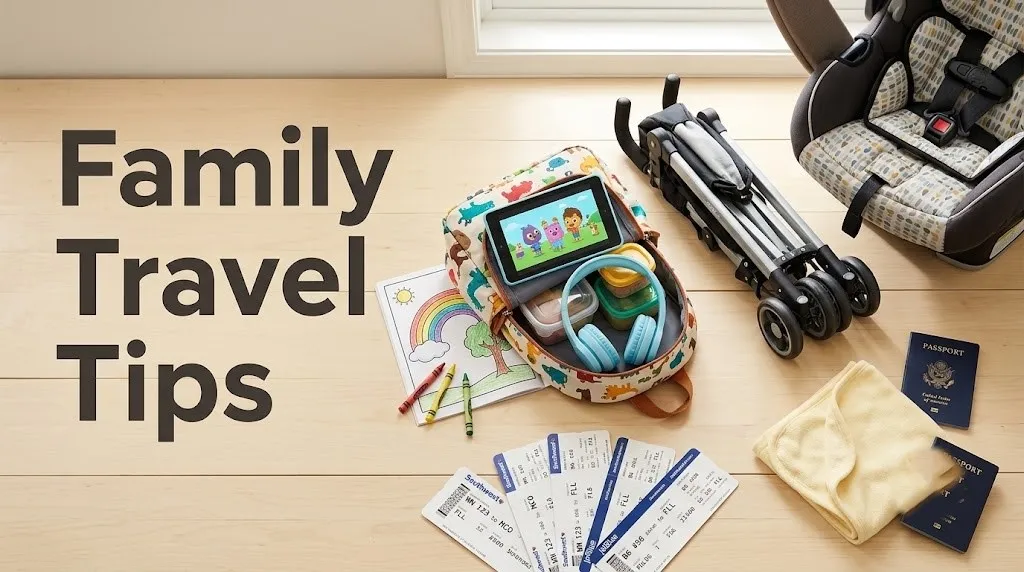
Toddler carry-on essentials include pull-ups or underwear, one change of clothes, favorite comfort item, spill-proof cup, packaged snacks, small toys, and a tablet with headphones.
School-age child carry-on essentials include a tablet with downloaded content, headphones, snacks, a water bottle, a light jacket, and one small comfort item from home.
Teen carry-on essentials include a phone with downloaded content, headphones, portable charger, snacks, water bottle, and any personal care items needed for the flight.
Budget travelers should pack all food and snacks from home to avoid airport pricing. Airport food costs for a family of four can exceed $60 for a single meal.
Families should pack one shared family bag with first aid supplies, medications, hand sanitizer, disinfecting wipes, and extra charging cables for all devices.
Key Takeaway: Pack age-specific carry-on bags for each child with extra clothes, snacks, and entertainment to avoid mid-flight crises.
Carry-On Essentials for Families
Carry-on essentials for families go beyond standard travel items. Parents need supplies for managing children in confined aircraft cabins for hours.
Sanitizing wipes for tray tables, armrests, and seat belt buckles reduce germ exposure. Aircraft surfaces receive minimal cleaning between flights.
Snacks that do not crumble, spill, or melt provide distraction without creating mess. Avoid chocolate, crumbly crackers, and sticky candy on aircraft.
Change of clothes for each child addresses spills and accidents. Pack a clean shirt at minimum for the adult holding the child during incidents.
Tablet with pre-downloaded content and child-safe headphones prevents boredom. Do not rely on in-flight WiFi or streaming services for children’s entertainment.
Empty water bottles through security fill at airport water fountains. Aircraft cabin air causes dehydration faster than ground-level environments.
Small surprise toys or activities wrapped individually create engagement milestones. Reveal one new item every 60 to 90 minutes during long flights.
Key Takeaway: Pack wipes, non-messy snacks, extra clothes, pre-downloaded content, empty water bottles, and surprise activities in family carry-on bags.
Stroller and Car Seat Travel Tips
Stroller and car seat travel tips help families navigate airports with bulky child equipment. Airlines handle these items differently than standard luggage.
Gate-check strollers at the jet bridge rather than the check-in counter. The stroller returns to the jet bridge at your destination for immediate use during connections.
Car seats can be gate-checked or used on board if you purchased a seat for your infant. Using the car seat on board is safer and more familiar for the child.
Stroller bags protect equipment from damage and dirt during gate checking. Budget travelers can use heavy-duty garbage bags as inexpensive stroller protection.
Southwest Airlines and JetBlue Airways gate-check strollers and car seats at no charge. Spirit Airlines and Frontier Airlines also allow free gate checking of these items.
Car seat travel carts convert car seats into wheeled carriers for airport navigation. Children can sit in the car seat while parents pull it through the terminal.
Rental car companies offer car seat rentals but availability and quality vary. Bringing your own car seat guarantees proper fit and familiarity for your child.
Key Takeaway: Gate-check strollers and car seats at the jet bridge for free on all airlines and use protective bags to prevent damage.
Keeping Kids Entertained on Flights
Keeping kids entertained on flights requires pre-planned activities that do not disturb other passengers. Screen time rules relax on travel days for most families.
Download movies, shows, and games before departure on personal devices. Aircraft WiFi is unreliable, expensive, and cannot support streaming on most airlines.
Child-safe headphones fit small ears and limit maximum volume. Adult headphones slip off children’s heads and may play audio too loudly for young ears.
Window clings and reusable stickers occupy toddlers without creating mess. These items stick to aircraft windows and tray tables without leaving residue.
Coloring books with triangular crayons prevent dropped art supplies. Round crayons roll off tray tables while triangular shapes stay in place.
Magnetic travel games provide entertainment for school-age children. Pieces stay contained on the magnetic board during turbulence.
Audiobooks and children’s podcasts downloaded before departure entertain without screen time. This option works well for children who experience motion sickness from screens.
Key Takeaway: Download all content before departure, use child-safe headphones, and pack mess-free activities suited to each child’s age.
Family Travel on a Budget
Family travel on a budget requires strategies that reduce costs without sacrificing the quality of the experience. Airline choice and booking timing make the biggest financial impact.
Book flights 3 to 6 months ahead for domestic family travel and 4 to 8 months for international trips. The optimal booking window delivers the best combination of price and seat availability.
Southwest Airlines two free checked bags per person saves families hundreds of dollars per trip. A family of four with two bags each saves compared to legacy carriers with bag fees.
Budget travelers with children should compare vacation rental costs against hotel rooms. Kitchen access in rentals saves restaurant meal costs for families.
Groceries delivered to your destination save dining expenses. Order breakfast foods, snacks, and beverages for delivery on arrival day.
Museums and attractions often offer family passes or children’s discounts. Research admission pricing online before travel to identify savings opportunities.
Credit card points and airline miles reduce family travel costs significantly. The Chase Ultimate Rewards and American Express Membership Rewards programs transfer to multiple airlines.
Key Takeaway: Book at optimal windows, choose Southwest for bag savings, use vacation rentals with kitchens, and leverage points and miles for family travel costs.
Points and Miles for Families
Points and miles for families strategies maximize reward programs for multi-traveler trips. The right credit card strategy compounds savings across family members.
Two-player mode allows both parents to earn separate credit card welcome bonuses. These bonuses convert to enough points for family award flights more quickly than single-earner strategies.
Chase Ultimate Rewards points transfer to United MileagePlus, Southwest Rapid Rewards, and JetBlue TrueBlue for family bookings. Transfer bonuses occasionally increase point values.
American Express Membership Rewards points transfer to Delta SkyMiles, Air France-KLM Flying Blue, and British Airways Avios for international family travel.
Authorized user cards for teenagers over 13 build credit history while earning points on family spending. American Express and Chase both allow authorized users on personal cards.
Award bookings for families require more seats than solo travelers. Search for award availability as soon as schedules open 330 to 360 days before travel.
Flexible date searches identify the lowest mileage pricing for family trips. Shifting travel by a day or two often reduces the miles required for each ticket.
Key Takeaway: Both parents earning bonuses doubles family point balances while flexible date searches and early booking maximize family award availability.
Avoiding Family Travel Fees
Avoiding family travel fees requires understanding airline fee structures and choosing carriers strategically. Fees compound quickly across multiple family members.
Seat selection fees on Spirit Airlines and Frontier Airlines apply per passenger per segment. A family of four on a connecting itinerary pays seat fees 16 times round-trip.
Checked bag fees add similar multiplicative costs on fee-charging airlines. Southwest Airlines’ free checked bags eliminate this family travel expense entirely.
Change fees on basic economy fares penalize families who need schedule flexibility. Main cabin fares on legacy carriers include change flexibility worth the price premium for families.
In-flight food and beverage purchases compound across family members on budget airlines. Pack snacks and empty water bottles to fill after security.
TSA PreCheck enrollment for adults expedites family security screening at no per-use cost. Children under 12 receive PreCheck benefits when traveling with enrolled adults.
Credit cards with airline fee credits offset baggage and seat selection expenses. American Express Platinum and Chase Sapphire Reserve offer annual travel credits that apply to airline fees.
Key Takeaway: Choose Southwest for no bag fees, pack snacks to avoid in-flight purchases, and use credit card credits to offset unavoidable airline fees.
Traveling with Babies Tips
Traveling with babies tips address the unique challenges of flying with infants under one year. Preparation and timing make the difference between manageable and miserable.
Book flights during the baby’s typical nap or sleep time when possible. A sleeping baby makes for a peaceful flight for parents and surrounding passengers.
Feed babies during takeoff and landing to help equalize ear pressure. Swallowing action opens eustachian tubes and reduces pain from pressure changes.
Lap infants under age two fly free domestically on most U.S. airlines. International lap infant tickets typically cost a percentage of the adult fare plus taxes.
Bassinet seats on bulkhead rows provide a sleeping surface for infants on long-haul international flights. Delta Air Lines, United Airlines, and British Airways offer bassinets on select aircraft.
Diaper changes on aircraft happen on the lavatory changing table above the toilet. Pack a small diaper kit in a separate bag for easy lavatory access.
Gate-check strollers allow airport navigation while the baby travels as a lap infant. The stroller returns at the jet bridge for immediate use upon arrival.
Key Takeaway: Book during baby’s sleep time, feed during takeoff and landing, request bassinet seats on long-haul flights, and gate-check strollers.
Traveling with Toddlers Tips
Traveling with toddlers tips address the most challenging age for family travel. Toddlers have mobility, opinions, and limited communication skills.
Pack more diapers and snacks than you think necessary for the flight duration. Flight delays extend travel time beyond the scheduled duration.
New small toys wrapped individually provide novelty and engagement. Reveal one new item when the toddler shows signs of restlessness or boredom.
Tablet time with pre-downloaded content serves as the ultimate toddler travel tool. Relax screen time rules on travel days to reduce stress for everyone.
Aisle access matters more for toddlers who need frequent bathroom breaks. Select aisle seats or seats near lavatories when traveling with potty-training children.
Burn energy during connections with active play in airport children’s areas. Many airports including Chicago O’Hare, Denver, and San Francisco have dedicated kids play spaces.
Car seat on board provides a familiar seating environment for toddlers. The car seat contains the child safely during turbulence and prevents seatmate intrusion.
Key Takeaway: Over-pack snacks and diapers, use new toys as engagement milestones, and let toddlers burn energy during connections.
TSA PreCheck Family Benefits
TSA PreCheck family benefits extend to children traveling with enrolled adults. The program provides faster security screening for the entire family.
Children under 12 receive TSA PreCheck benefits when traveling with an enrolled parent or guardian. No separate enrollment or fee is required for young children.
Children 12 and older need their own TSA PreCheck enrollment for benefits. The application process includes fingerprinting and a background check.
Global Entry includes TSA PreCheck and expedites international arrival customs processing. Families traveling internationally benefit from both programs combined.
Clear expedites the identity verification step of security screening. Children under 18 can use Clear for free when traveling with an enrolled adult at participating airports.
Enroll adults in trusted traveler programs at least two months before family travel. Application processing and interview scheduling require advance planning.
TSA PreCheck lanes keep shoes on, laptops in bags, and liquids packed. These benefits reduce stress significantly when managing children through security.
Key Takeaway: Enroll adults in TSA PreCheck before family travel to extend benefits to children under 12 at no additional cost.
Frequently Asked Questions About Family Travel
What is the best airline for families with children?
Southwest Airlines ranks as the best airline for families due to two free checked bags and open seating with family boarding.
JetBlue Airways offers excellent family amenities with seat-back entertainment and complimentary snacks for children.
The best airline depends on your route, budget, and children’s ages with specific carriers excelling for different family needs.
Do airlines have to seat families together?
No federal regulation requires airlines to seat families together without charging seat selection fees.
Some airlines including Delta and United have policies to assist families with children under 12.
Southwest Airlines open seating and JetBlue Airways free adjacent seat selection offer the most family-friendly approaches.
Can I bring a stroller on the plane?
Strollers can be gate-checked at the jet bridge on all U.S. airlines at no charge.
The stroller returns to the jet bridge at your destination for immediate use during connections.
Small collapsible strollers that fit in overhead bins can be carried on board if they meet carry-on dimensions.
Do children need TSA PreCheck?
Children under 12 receive TSA PreCheck benefits when traveling with an enrolled parent or guardian.
Children 12 and older require their own TSA PreCheck enrollment for screening benefits.
Global Entry includes TSA PreCheck and adds expedited customs processing for international family travel.
What documents do children need to fly?
Children under 18 do not need ID for domestic U.S. flights when traveling with an adult.
All children regardless of age need a valid U.S. passport for international air travel.
Solo parents traveling internationally with children should carry a notarized consent letter from the absent parent.
How do I keep my toddler calm on a flight?
Download favorite shows and games to a tablet before departure for offline entertainment.
Pack new small toys wrapped individually as engagement surprises throughout the flight.
Feed toddlers during takeoff and landing to help equalize ear pressure and reduce discomfort.
Southwest Airlines and JetBlue Airways lead family-friendly carriers with free checked bags, flexible seating, and entertainment options that make traveling with children more manageable. Book family flights 3 to 6 months ahead for domestic trips and 4 to 8 months ahead for international travel to secure adjacent seats at reasonable fares.
Enroll adults in TSA PreCheck before family travel to expedite security screening for the entire family. Pack age-specific carry-on bags for each child with extra clothes, snacks, and pre-downloaded entertainment to handle the unexpected during flights.
Verify airline family seating policies, baggage allowances, and trusted traveler program rules directly with airlines and government agencies before departure. Policies change through 2026 and the difference between a stressful family trip and a successful one often comes down to knowing current rules before you arrive at the airport.