Midwest Express Airlines built its entire reputation on a single radical decision: every seat would be a wide leather seat with no middle seats anywhere in the fleet. This was not a premium cabin, it was the entire airplane configured as what we would now call premium economy.
The airline launched in 1984 from Milwaukee and maintained an all-premium 2-by-2 seating configuration across its entire fleet for over two decades. Conde Nast Traveler consistently ranked it among the best domestic airlines in America throughout the 1990s and early 2000s.
This article examines exactly what Midwest Express offered, why its product earned such loyalty, what killed the airline, and which modern carriers come closest to replicating the experience for travelers seeking real comfort on domestic routes today.
Key Takeaway: Midwest Express proved that an all-premium regional carrier could earn intense loyalty, but the fare premium required to sustain it could not survive post-9/11 industry conditions.
Midwest Express Airlines: What Made It Different
Midwest Express eliminated the middle seat from every single aircraft in its fleet. No passenger on any Midwest Express flight ever sat in a middle seat during the airline’s entire operating history.
Every seat was a wide leather recliner with approximately 33 to 34 inches of pitch in the main cabin. This configuration placed Midwest Express far above standard economy seating of its era and ahead of most modern domestic first class legroom.
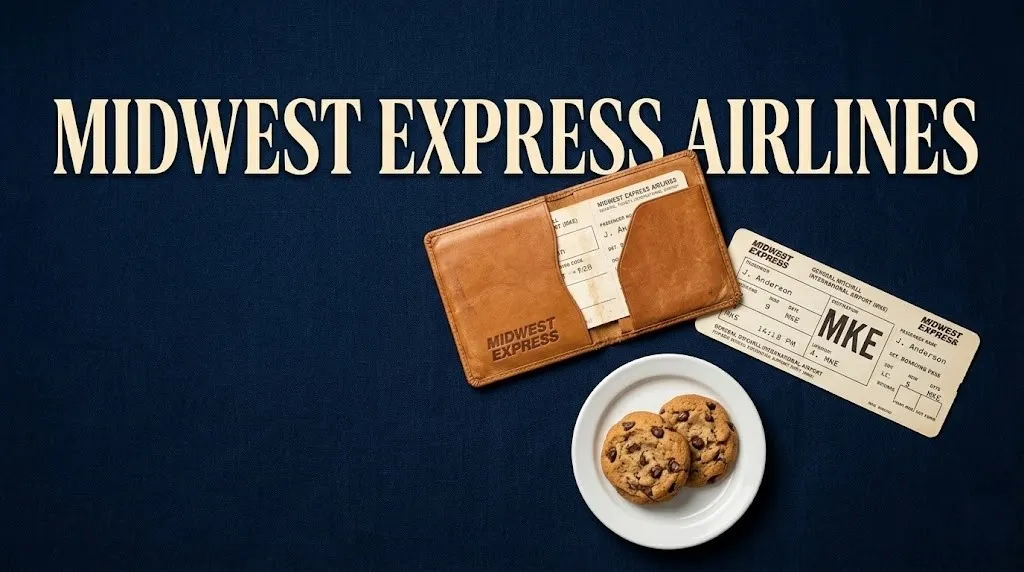
The airline served complimentary meals with real china, glassware, and stainless steel cutlery on flights longer than a certain duration. Freshly baked chocolate chip cookies became the airline’s signature service item on every flight.
Business travelers gravitated toward Midwest Express for its consistent all-premium product and convenient Milwaukee hub that avoided congested Chicago O’Hare connections. Budget travelers found the fares too high compared to standard economy on competing carriers serving the same routes.
Midwest Express maintained an obsessive focus on service quality and passenger comfort that no US carrier has replicated since at the same scale. The airline’s limitation was always its narrow route network centered on Milwaukee with limited coastal reach.
Key Takeaway: No middle seats, wide leather recliners, and full meal service defined a product no modern US airline offers on regional routes today.
Midwest Express History and Origins
Midwest Express launched in 1984 as a corporate aviation spinoff from Kimberly-Clark Corporation. The paper products giant operated an in-house flight department called K-C Aviation based in Appleton, Wisconsin.
Kimberly-Clark executives realized their corporate aircraft fleet was underutilized between executive trips. The company converted its corporate DC-9 aircraft to scheduled passenger service with the all-premium configuration that became Midwest Express’s trademark.
The airline’s first scheduled route connected Milwaukee to Appleton and eventually expanded to serve major Midwest business destinations. Early success on the Milwaukee-to-Detroit and Milwaukee-to-Chicago corridors proved business travelers would pay more for better seating.
First-time travelers encountering Midwest Express for the first time often expressed shock that an entire airplane could feel like a first-class cabin. The airline’s corporate aviation DNA shaped every aspect of its operation from maintenance standards to cabin service protocols.
Midwest Express remained closely tied to Milwaukee throughout its history with its hub at General Mitchell International Airport (MKE). The airline never successfully diversified its hub structure enough to reduce geographic risk.
Key Takeaway: Midwest Express began as a corporate flight department turned commercial carrier, and its aviation DNA shaped its premium product from day one.
Midwest Express Seats: The All-Premium Cabin
Every Midwest Express seat measured approximately 21 to 22 inches wide with leather upholstery and substantial recline compared to standard economy seats. Seat pitch ranged from 33 to 34 inches across the main cabin depending on the specific aircraft type.
The 2-by-2 configuration meant every row contained only two seats on each side of the aisle. No passenger ever climbed over a stranger to reach the lavatory or stretch their legs on any Midwest Express flight.
Modern Delta First Class and American Airlines First Class on domestic narrow-body aircraft offer seat pitch around 37 to 39 inches and width around 21 inches. Midwest Express delivered first-class width with slightly less pitch across the entire cabin.
Families loved the all-premium configuration because small children could sit next to a parent without strangers in the row. The two-seat arrangement meant every pair of seats functioned essentially as a private row.
Solo travelers appreciated never being squeezed between two strangers on a full flight. The cabin felt more like a regional business lounge than a standard commercial aircraft interior.
Business travelers today comparing the experience to modern premium economy will find seat width comparable but modern products lack Midwest Express’s consistent all-cabin premium treatment. Budget travelers would have found Midwest Express fares roughly 30 to 50 percent above standard economy on identical routes.
Key Takeaway: Midwest Express delivered domestic first-class seat width to every passenger in a 2-by-2 all-premium cabin that no modern carrier replicates fleet-wide.
Midwest Express Cookies and In-Flight Service
Freshly baked chocolate chip cookies defined Midwest Express service more than any other single element. Flight attendants baked the cookies onboard during flight and served them warm to every passenger on every flight regardless of duration.
The cookies were not a marketing gimmick that faded after the first few years of operation. Midwest Express maintained the onboard cookie service for its entire operating history as a genuine brand signature.
Beyond cookies, Midwest Express served full complimentary meals on flights exceeding approximately 500 miles. Meals arrived on real china with metal cutlery and glassware even though the airline operated no traditional first-class cabin.
Flight attendant training emphasized anticipatory service that exceeded passenger expectations rather than meeting minimum standards. The airline recruited heavily from corporate aviation and premium hospitality backgrounds rather than standard airline hiring pools.
Budget travelers who never flew Midwest Express often dismissed the meal service as unnecessary cost padding on short regional routes. Passengers who actually flew the airline consistently ranked the food and service among the best domestic airline experiences available.
The onboard service culture survived the airline’s transition from Midwest Express to Midwest Airlines branding in 2003. Service declined noticeably after the Frontier Airlines acquisition and integration began cutting costs on legacy Midwest routes.
Key Takeaway: Warm onboard-baked cookies and full china meal service created a brand loyalty that outlasted the airline’s financial viability by several years.
Midwest Express Fleet and Aircraft Types
Midwest Express launched operations with McDonnell Douglas DC-9 aircraft inherited from Kimberly-Clark’s corporate fleet. The DC-9-10 and DC-9-30 variants formed the backbone of early Midwest Express service with their distinctive rear-mounted engines.
The airline later introduced McDonnell Douglas MD-80 series aircraft to expand capacity on busier routes while maintaining the all-premium 2-by-2 configuration. The MD-80 offered a slightly wider cabin than the DC-9 and a modernized interior.
The most significant fleet decision came with the introduction of the Boeing 717-200 in the early 2000s. The 717, essentially a modernized DC-9 derivative built by Boeing, offered improved fuel efficiency and a quieter cabin.
Midwest Express configured its Boeing 717s with the same all-premium 2-by-2 seating that defined every other aircraft type in the fleet. The 717 delivered the best passenger experience in Midwest Express history with larger overhead bins and a more spacious cabin feel.
Regional subsidiary Skyway Airlines operated smaller turboprop and regional jet aircraft under the Midwest Connect brand. These regional aircraft used standard seating configurations and did not offer the signature all-premium cabin.
Fleet commonality around a single aircraft family kept maintenance costs manageable for an airline of Midwest Express’s size. The MD-80 and DC-9 fleets shared significant parts and maintenance procedure commonality that a more diverse fleet would have lacked.
Key Takeaway: Midwest Express operated DC-9, MD-80, and Boeing 717 aircraft, all in the same all-premium 2-by-2 configuration that defined the airline.
Midwest Express Routes and Destinations
Milwaukee General Mitchell International Airport (MKE) served as the airline’s primary hub throughout its entire operating history. Kansas City International Airport (MCI) functioned as a secondary hub with a smaller but significant route portfolio.
Core business routes connected Milwaukee to Detroit, Chicago, Minneapolis, Cleveland, and other Midwest business centers. These short-haul routes delivered the highest frequency and generated the airline’s most reliable revenue streams.
Leisure-focused routes expanded to Florida destinations including Orlando, Tampa, and Fort Lauderdale on a seasonal basis. Coast-to-coast service connected Milwaukee to Los Angeles, San Francisco, Seattle, and select Northeast destinations.
Omaha Eppley Airfield (OMA) received significant Midwest Express service due to the airline’s corporate origins and connections to the paper products industry. The Omaha-to-Milwaukee and Omaha-to-Kansas City routes connected key corporate offices with efficient direct service.
First-time travelers unfamiliar with Midwest geography sometimes struggled to understand why Milwaukee was a useful connecting point. Business travelers appreciated MKE’s manageable size and shorter security lines compared to Chicago O’Hare connections.
The route network’s heavy concentration on Milwaukee created geographic risk that became acute during regional economic downturns. Midwest Express never built enough route diversity to survive a sustained Midwest manufacturing recession or fuel price spike.
Key Takeaway: Midwest Express built a loyal business travel base on Milwaukee-centric routes but never diversified its network enough to reduce hub concentration risk.
Midwest Express Service Quality and Crew Training
Midwest Express maintained an obsessive service culture that began with flight attendant hiring and never let up. The airline recruited crew members who genuinely enjoyed hospitality work rather than viewing it as a mandatory job function.
Flight attendant training emphasized personalized service delivery over standardized scripts and procedures. Crew members learned passenger names on full flights and addressed frequent flyers by name without being prompted.
The airline’s corporate aviation roots shaped maintenance standards well above FAA minimum requirements. Aircraft interiors stayed cleaner and maintenance-related delays ran lower than industry averages throughout Midwest Express’s operating history.
Solo travelers frequently reported that Midwest Express flight attendants seemed to pay extra attention to passengers traveling alone. The cabin atmosphere on a full Midwest Express flight felt more like a premium restaurant than a commercial aircraft cabin.
Business travelers who split time between Midwest Express and major network carriers consistently rated the regional carrier’s service higher. The Points Guy and Conde Nast Traveler both documented Midwest Express’s service quality edge over major US carriers in the 1990s and early 2000s.
The airline’s service reputation survived the 2003 rebranding to Midwest Airlines with some erosion during cost-cutting phases. Service quality declined substantially after the Frontier merger eliminated most of the legacy Midwest Express product features.
Key Takeaway: Genuine hospitality culture and corporate aviation service standards made Midwest Express a consistent leader in passenger satisfaction rankings.
Why Did Midwest Express Fail
Midwest Express failed because the fare premium required to sustain its all-premium product could not survive the post-9/11 airline industry collapse and subsequent fuel price spikes. The airline’s cost structure assumed passengers would pay roughly 30 to 50 percent more than standard economy fares.
September 11, 2001 devastated business travel demand precisely when Midwest Express needed high-yield passengers most. The prolonged recovery in business travel spending forced the airline to discount heavily to fill seats.
Fuel price spikes in the mid-2000s made operating inefficient older DC-9 and MD-80 aircraft economically unsustainable. The airline’s small size prevented it from hedging fuel costs effectively compared to major network carriers.
Low-cost carriers including Southwest Airlines and AirTran Airways expanded aggressively into Milwaukee during Midwest Express’s weakest financial period. These competitors offered dramatically lower base fares that most leisure travelers chose over premium seating.
The 2008 financial crisis delivered the final blow by collapsing demand just as the airline attempted to restructure. Midwest Airlines filed for bankruptcy protection and was acquired by Republic Airways Holdings with operations eventually folded into Frontier.
Business travelers who would have paid the Midwest Express premium found fewer compelling reasons to do so as competing carriers improved their own first-class and premium products. The gap between Midwest Express and standard economy narrowed as seat pitch shrank industry-wide.
Key Takeaway: Post-9/11 demand destruction, fuel price spikes, and aggressive low-cost competition at MKE eliminated the fare premium Midwest Express needed to survive.
Midwest Express and Frontier Merger
Republic Airways Holdings acquired both Midwest Airlines and Frontier Airlines in separate transactions during 2009. The combined entity operated under the Frontier Airlines brand with Midwest’s Milwaukee operations phased into the Frontier network.
The merger eliminated virtually every product feature that distinguished Midwest Express from standard US carriers. All-premium seating disappeared from former Midwest routes as standard Frontier economy configurations replaced the legacy cabin layout.
Chocolate chip cookies survived the merger briefly as a marketing gesture on select former Midwest routes. The cookies eventually disappeared entirely as Frontier standardized its ultra-low-cost carrier product across the entire network.
Frequent Midwest Express flyers lost their primary Milwaukee hub service as Frontier shifted focus to its Denver base. Milwaukee never recovered its status as a meaningful airline hub after the Midwest Express collapse.
The Points Guy documented the merger as a case study in how airline consolidation destroys unique regional carrier cultures and product differentiation. Frontier’s current ultra-low-cost model represents the exact opposite of everything Midwest Express built its brand around.
Budget travelers who prioritize low base fares over service quality benefited from Frontier’s lower prices on former Midwest Express routes. Business travelers who valued the all-premium product found no comparable replacement on any carrier serving Milwaukee.
Key Takeaway: The Frontier merger systematically dismantled every Midwest Express product feature and left Milwaukee without any premium regional carrier.
Airlines Like Midwest Express Today
No US airline replicates the Midwest Express all-premium regional model at comparable price points in 2026. A handful of carriers approximate specific elements of the experience for travelers willing to pay a significant premium.
JSX operates a semi-private jet service with all-premium seating on regional routes in the western and southwestern United States. JSX passengers enjoy wide seats, no middle seats, and private terminal access that eliminates traditional TSA screening lines.
The JSX product exceeds Midwest Express comfort levels but at a substantially higher price point and on a much smaller route network. Solo travelers and business flyers on JSX routes find the private terminal experience transformative compared to commercial airport processing.
La Compagnie operates an all-business-class configuration on transatlantic routes between Newark and select European destinations. The carrier’s all-premium model mirrors Midwest Express’s philosophy on longer international routes rather than regional domestic service.
JetBlue Mint offers lie-flat seats and premium dining on transcontinental routes but the product is a traditional front-cabin premium offering. No JetBlue aircraft feature all-premium seating across the entire cabin the way Midwest Express did.
Delta First Class and American Airlines First Class on domestic narrow-body routes deliver seat width comparable to Midwest Express but only in a small front cabin. Budget travelers can occasionally find premium economy deals that approximate the comfort but not the service culture.
Key Takeaway: JSX comes closest to the Midwest Express model with all-premium regional seating, but at a significantly higher price point and much smaller scale.
Midwest Express Business Class vs Modern Premium Economy
Midwest Express did not technically offer business class because the entire aircraft was configured to a standard exceeding modern premium economy. The distinction matters because Midwest Express never charged different fares for different cabin sections.
Modern premium economy products on Delta Premium Select and United Premium Plus offer seat pitch around 38 inches and width around 19 inches. These products sit in dedicated cabin sections with upgraded meal service but share the aircraft with standard economy and first-class cabins.
Midwest Express seat width of roughly 21 to 22 inches exceeds modern premium economy width by a meaningful margin. The all-cabin consistency meant no passenger felt like they were sitting in an inferior section.
Premium economy meals on modern US carriers involve upgraded catering served on real dishware similar to Midwest Express standards. The cabin environment difference is substantial because premium economy passengers still walk through standard economy to reach their seats.
Business travelers comparing the experiences should understand that Midwest Express delivered a unified cabin atmosphere that no modern segmented cabin can replicate. First-time flyers accustomed to modern premium economy would find the all-premium cabin concept genuinely novel and possibly surprising.
The Points Guy identifies that no current US carrier would attempt an all-premium configuration on regional routes because the economics do not support it. Fare unbundling and ancillary revenue now dominate airline strategy in ways that make an all-inclusive model harder to execute profitably.
Key Takeaway: Modern premium economy offers better seat pitch but narrower seats and a segmented cabin that Midwest Express’s all-premium concept deliberately avoided.
Domestic First Class vs Midwest Express Experience
Domestic first class on Delta, American, and United narrow-body aircraft delivers seat width comparable to Midwest Express but with greater pitch. Modern domestic first class seats typically measure around 21 inches wide with 37 to 39 inches of pitch.
The critical difference is that domestic first class occupies only a small forward cabin section. Midwest Express delivered that seat width to every passenger in every row across the entire aircraft.
Meal service in modern domestic first class on longer routes mirrors Midwest Express standards with china, glassware, and multi-course service. Shorter regional routes in domestic first class often receive only snacks and beverages where Midwest Express served full meals.
Families occupying an entire row of domestic first class can approximate the private-row feel of Midwest Express’s 2-by-2 configuration. The cost multiplies rapidly because every seat requires a first-class fare rather than the moderate premium Midwest Express charged.
Solo travelers booking last-minute domestic first class may find the experience comparable to a single Midwest Express flight. The key difference remains that every Midwest Express passenger shared the same premium experience regardless of what they paid.
Business travelers who expense first-class tickets today experience a better product than Midwest Express ever offered in terms of seat pitch and dedicated cabin service. Economy passengers on the same flight experience a dramatically worse product that Midwest Express never asked any passenger to endure.
Key Takeaway: Modern domestic first class exceeds Midwest Express seat pitch but replicates the width, while Midwest Express delivered that quality to every single passenger.
Legacy of Midwest Express Airlines
Midwest Express proved that an all-premium regional airline could earn intense passenger loyalty and consistent profitability during stable economic periods. The airline’s legacy lives on in passenger memories and in the broader conversation about airline product quality.
Conde Nast Traveler and Travel + Leisure both documented Midwest Express as a case study in how passenger experience can differentiate an airline in a commodity market. The airline’s product decisions continue to influence discussions about premium economy and all-premium carrier viability.
Milwaukee’s General Mitchell International Airport (MKE) never regained the hub status it enjoyed during Midwest Express’s peak. The airport remains served by major carriers but without a dominant based airline offering a differentiated product.
The airline’s failure provides a cautionary tale about the vulnerability of premium-focused business models to macroeconomic shocks. Fuel price spikes and demand collapses hit premium carriers harder than low-cost operators because premium passengers defect to cheaper options during crises.
JSX and La Compagnie demonstrate that the all-premium concept remains viable at smaller scale and higher price points than Midwest Express attempted. The broader airline industry absorbed the lesson that all-premium regional service cannot survive at a moderate price premium in sustained low-fare environments.
Travelers who remember Midwest Express fondly should understand that the economics that killed it are not temporary market conditions. The structural shift toward unbundled fares and ancillary revenue makes a true Midwest Express successor unlikely at comparable price levels.
Key Takeaway: Midwest Express demonstrated all-premium viability but also proved its vulnerability to economic shocks in a way that permanently reshaped airline product strategy.
Midwest Express Reviews and Passenger Memories
Former Midwest Express passengers consistently rank the airline among the best domestic US carriers they ever flew regardless of era. The combination of wide leather seats, no middle seats, and genuine service quality created an emotional loyalty that few airlines achieve.
Online aviation forums and Reddit communities including r/aviation and r/airlines feature recurring threads about Midwest Express with near-universal positive sentiment. Passengers who flew the airline as children or young adults describe the experience as formative to their expectations of air travel.
Business travelers who commuted weekly on Midwest Express routes recall the consistency of the product with particular appreciation for the cookie service. The ritual of a warm cookie on final descent became a reliable comfort during stressful business travel schedules.
Solo travelers frequently mention that Midwest Express flight attendants seemed genuinely attentive without being intrusive. The cabin atmosphere felt more like a private club than public transportation, a distinction that modern economy travel has erased almost entirely.
The Points Guy has documented Midwest Express as the most-mourned defunct US airline among frequent flyers in reader surveys. The emotional connection to the airline remains strong decades after its disappearance from US skies.
Budget travelers who never flew the airline sometimes dismiss the nostalgia as selective memory or exaggeration. Passengers who experienced the product firsthand generally maintain that the praise was earned and the loss was genuine.
Key Takeaway: Midwest Express earned a level of passenger loyalty and positive memory recall that few airlines in US aviation history have matched.
Important Accuracy Notes for Modern Comparisons
Midwest Express ceased operations under its original product model after the 2009 Republic Airways acquisition of Midwest Airlines. All modern airline comparisons reflect products available in 2026 that may change without notice.
Verify the following directly before booking any modern premium product:
Current seat dimensions for your specific aircraft on the operating airline’s seat map tool.
Premium economy and first-class meal service inclusions for your specific route and flight duration.
JSX route availability and pricing on the official JSX website, as the carrier’s network remains limited and subject to change.
Frontier Airlines current product offering on former Midwest Express routes, which operates as an ultra-low-cost carrier with no premium cabin.
Delta, American, and United first-class product details for your specific domestic route and aircraft type.
The modern airline products most closely resembling Midwest Express service exist at significantly higher real price points than Midwest Express charged in its operating era.
Frequently Asked Questions About Midwest Express Airlines
What was Midwest Express Airlines?
Midwest Express Airlines was a US regional carrier operating from 1984 to 2009 with an all-premium 2-by-2 seating configuration.
Every seat on every flight was a wide leather recliner with no middle seats anywhere in the fleet.
The airline served complimentary meals and freshly baked chocolate chip cookies on every flight from its Milwaukee hub.
Why was Midwest Express considered the best US airline?
Conde Nast Traveler consistently ranked Midwest Express among the top US airlines throughout the 1990s and early 2000s.
The all-premium cabin with wide leather seats, no middle seats, and full meal service exceeded every other domestic carrier’s standard product.
Flight attendant service quality and the signature onboard-baked cookie service created intense passenger loyalty.
What kind of seats did Midwest Express have?
Midwest Express configured every aircraft with wide leather seats measuring approximately 21 to 22 inches wide in a 2-by-2 arrangement.
Seat pitch ranged from 33 to 34 inches, comparable to modern premium economy products.
No passenger ever sat in a middle seat on any Midwest Express flight during the airline’s entire operating history.
What happened to Midwest Express Airlines?
Midwest Express rebranded as Midwest Airlines in 2003 and entered bankruptcy protection during the 2008 financial crisis.
Republic Airways Holdings acquired the airline in 2009 and merged its operations into Frontier Airlines.
The merger eliminated the all-premium product, cookie service, and Milwaukee hub operations that defined the original airline.
Is there any airline like Midwest Express today?
No US airline replicates the Midwest Express all-premium regional model at comparable price points in 2026.
JSX operates semi-private all-premium regional flights at significantly higher fares on a limited western US route network.
La Compagnie offers all-business-class transatlantic service that mirrors the all-premium philosophy on longer international routes.
Did Midwest Express serve cookies on every flight?
Freshly baked chocolate chip cookies were served warm to every passenger on every Midwest Express flight regardless of duration.
Flight attendants baked the cookies onboard during flight, filling the cabin with the aroma before landing.
The cookie service survived as the airline’s most recognized brand signature until Frontier eliminated it after the merger.
Midwest Express Airlines represents a genuine anomaly in US aviation history. No carrier before or since has delivered an all-premium experience at a moderate price premium on regional routes at comparable scale.
The airline’s disappearance was not a product failure. It was a business model failure driven by macroeconomic shocks that made the fare premium unsupportable in a market increasingly dominated by low-cost competition.
Travelers seeking comparable comfort in 2026 should evaluate JSX for regional routes where it operates and premium economy products on major carriers for longer domestic flights. Understand that both options cost substantially more than standard economy in the same way Midwest Express did.
Airlines evolve, merge, and disappear, and the products described here reflect the 2026 aviation landscape. Verify current seat configurations, service inclusions, and pricing directly with any carrier before booking if you are chasing the Midwest Express experience.
The cookie is gone. The all-premium cabin is gone. But the standard Midwest Express set for what regional air travel could feel like remains the benchmark against which premium domestic products are measured decades later.