The Hawaiian Airlines A321neo seat map reveals a dense 189-seat narrow-body layout. Selecting the right seat is critical for your five-hour Pacific crossing.
This single-aisle jet is a workhorse, not a spacious wide-body experience. A bad seat choice here feels far more punishing than on a larger plane.
This guide maps the 2026 cabin from First Class recliners to the tightest Main Cabin rows. You will learn exactly which seats to book and which to avoid.
Hawaiian Airlines A321neo Overview
Hawaiian Airlines utilizes the Airbus A321neo for its thinner West Coast-to-Hawaii routes. The aircraft allows the airline to serve smaller markets like Long Beach and Ontario profitably.
The A321neo is a single-aisle jet configured with a 3-3 seating layout in economy. This is immediately noticeable compared to the spacious 2-4-2 arrangement on the wide-body A330.
The cabin feels modern, with sleek mood lighting and clean design lines. Yet, it lacks the visual spaciousness of a dual-aisle aircraft on a long flight.
Budget travelers from secondary West Coast cities will inevitably fly this plane. Frequent flyers accustomed to the Airbus A330 wide-body may find the interior claustrophobic.
The aircraft has excellent range and fuel efficiency for the airline’s needs. It prioritizes operational efficiency over passenger personal space on these specific routes.
The key limitation is the single aisle for 189 passengers during meal and lavatory breaks. A queue inevitably forms in the forward galley, spilling into Row 1.
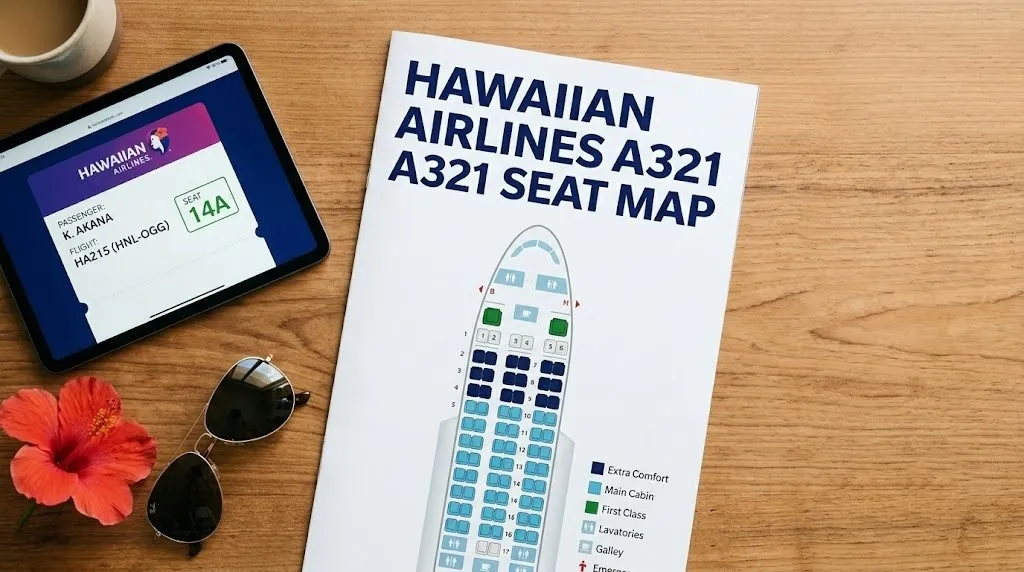
Airbus A321 Hawaiian Airlines Seat Map Layout
The Airbus A321 Hawaiian Airlines seat map is split into two distinct cabins. The front of the plane holds 16 First Class seats in a 2-2 arrangement.
Behind the cockpit divider, the Main Cabin starts with standard 3-3 rows. The plane also has a section of “Preferred Seats” offering a slightly better location.
The First Class cabin feels pleasantly intimate with only four rows of recliner seats. The Main Cabin stretches long and narrow all the way to the rear galley.
Solo travelers in economy will struggle with the 3-3 layout without a seatmate strategy. Couples benefit from the window-aisle pairs on the left or right side of the plane.
The lavatories are located at the front of the Main Cabin and the very rear. Mid-cabin passengers face a lengthy, awkward trek past slow-moving meal carts for a restroom break.
The over-wing exit rows offer a crucial legroom advantage in the Main Cabin. These are the most valuable real estate on the entire aircraft for tall travelers.
Key Takeaway: The single aisle and 3-3 seating make this feel like a commuter jet stretched to an endurance mission.
Hawaiian Airlines A321 First Class Cabin
First Class on the Hawaiian A321neo features 16 standard recliner seats. They are arranged in a standard 2-2 configuration across four rows at the front.
Do not expect lie-flat beds here. You get a comfortable 39 to 40 inches of seat pitch and plush cushioning.
The seat width is roughly 21 inches, which is generous for a domestic first-class product. A footrest extends from the seat bottom to support your legs.
Business travelers on a day flight will find the seat perfectly adequate for working. Overnight red-eye travelers will be disappointed by the steep recline angle for sleeping.
The solid IFE tablet screen is mounted on the bulkhead or seatback in front of you. The tray table folds out from the armrest, reducing some hip space compared to Main Cabin.
Choose Row 1 for a bulkhead with no under-seat storage but easy lavatory access. Row 4 sits nearest to the Main Cabin divider curtain and its associated boarding noise.
Meal service is the same elevated hot meal menu found on the wide-body fleet. A proper glass of champagne and a macadamia nut snack kick off the flight.
Hawaiian Airlines A321 Main Cabin Seats
The Main Cabin comprises roughly 173 seats in a tight 3-3 configuration. The standard seat width is a slim 18 inches, with 30 inches of pitch.
This is the same seat density you find on a short-haul commuter flight. Yet the A321neo flies these seats for five to six hours over water.
The seats use slimline cushions to maximize space, which can feel firm. A butterfly headrest helps cradle your head during an upright nap.
Larger-bodied travelers will find these seats restrictively narrow for a long flight. Solo travelers should avoid the middle seat in the center block at all costs.
The window seats on the left side (A seats) offer the best cabin-wall lean. The aisle seats (C and D) risk getting bumped by carts and passengers constantly.
There are no “free” Extra Comfort sections with extra legroom on this plane. The only legroom upgrade lies in buying a Preferred Seat at booking or an exit row.
The seat recline is minimal and can cause instant conflict on a full flight. Always check the seat map for the few rows with limited recline near exit rows.
Best Seats on Hawaiian Airlines Airbus A321neo
The best overall seat is the First Class window seat 1A or 1F. You get exclusive privacy with no seat reclining into your space at the bulkhead.
For Main Cabin, the best value seats are the exit row window seats. Row 14 A and F offer massive, limitless legroom for the entire six-hour flight.
Any Main Cabin window-aisle pair on the left side is excellent for a couple. The A-B seats in Rows 18 through 24 provide a private-feeling shared space.
- Seats 1A/1F: Best for ultimate privacy. Bulkhead row with full leg extension and nobody reclining into you.
- Seats 14A/14F: Best for long legs. Exit row with limitless legroom. The tray table is in the armrest, reducing seat width slightly.
- Seats 10A/10B: Best for early deplaning. This row is immediately behind First Class, so you exit first from Main Cabin.
Solo travelers who are elite members should book an aisle seat (C or D) near the front. You gain fast boarding and a faster exit, plus easy lavatory access.
Families should never book the exit row, as the FAA prohibits children under 15. You must select a standard window-aisle pair or the center D-E block.
The seat map can shift, so verify your specific tail number’s layout. A last-minute swap to a different A321 configuration is less common but possible.
Hawaiian Airlines A321neo Seats to Avoid
The absolute worst seats are the last row Main Cabin seats before the rear lavatories. Row 44 A, B, C, D, E, and F have almost zero recline and constant queue noise.
Avoid the middle “B” and “E” seats in any row at all costs. You will be trapped between two strangers for five hours with no shoulder rest.
Steer clear of Row 10 B and E seats directly behind the First Class divider. The fixed bulkhead means no under-seat storage, and the tray table is a narrow armrest fold-out.
Any aisle seat adjacent to the lavatory is a nightmare on a full red-eye flight. The constant flushing sound, door slamming, and smell ruin any attempt at sleep.
Light sleepers must avoid these rear zone seats on the overnight return from Maui. Motion sickness-prone travelers will suffer more in the very back, where tail sway is amplified.
Seats with “limited recline” warnings on the Hawaiian Airlines seat map tool are toxic. The row in front of the exit row always has a locked seatback to avoid blocking egress.
An aircraft swap is always a risk when flying a sub-fleet with many configurations. A wide-body A330 is a wonderful surprise, but a standard A321 without mood lighting is a downgrade.
Key Takeaway: Steer clear of any row that doesn’t let you recline and book exit row window seats for the best Main Cabin value.
Hawaiian Airlines A321neo In-Flight Experience
Every seatback, including in Main Cabin, features a high-resolution touch-screen entertainment system. You get a library of recent movies, TV shows, and a live flight tracker.
The in-flight WiFi on the A321neo fleet is robust for its 2026 upgrade package. It handles email, messaging, and light social media scrolling with ease.
A complimentary hot meal is served in the Main Cabin on all West Coast routes. The Pau Hana snack mix and a tropical rum punch define the island hospitality.
First-time flyers to Hawaii will appreciate the crew’s friendly, casual “island time” service. Families value the large kids’ movie section that loads instantly on the seatback screen.
The single aisle is the major in-flight experience bottleneck. It takes the cart service a very long time to reach the last row on a full plane.
Power outlets and USB ports are shared between seat pairs in the Main Cabin. You may need to negotiate with your neighbor to keep your dying phone alive.
The cabin air conditioning can run aggressively cold on night flights. Pack a warm hoodie, as the thin airline blanket is not enough for a five-hour cold soak.
Hawaiian Airlines A321 vs A330 for Hawaii Flights
The fundamental difference is the Airbus A321neo is a narrow-body, and the A330 is a wide-body. The A330 offers a 2-4-2 layout with two aisles, while the A321 uses a 3-3 single-aisle format.
The A330 features a true lie-flat bed in its First Class cabin for sleeping. The A321neo First Class is simply a wider recliner chair that does not go flat.
For a red-eye from the West Coast to Oahu, the wide-body A330 is the superior choice. The ability to lie completely flat changes a brutal redeye into a restful night.
The A321neo feels noticeably more claustrophobic during boarding and deplaning. A full 189-passenger load on a single aisle creates a 20-minute exit bottleneck.
- Aisle Width: A321 is single-aisle. A330 is dual-aisle, allowing for mid-flight stretching walks.
- Cabin Pressure: The A330’s carbon fiber frame offers a lower cabin altitude, reducing jet lag.
- IFE: Both have modern touchscreens, but the A330 screen is slightly larger.
- Winner: The A330 wins in every comfort metric, but the A321 wins on route access.
Claustrophobic travelers should pay the premium to route through an A330 hub. Budget travelers flying from a small airport like LGB have no choice but the A321.
The A321neo is a logistical tool for Hawaiian, not a passenger comfort upgrade. Route your flight through Los Angeles (LAX) or San Francisco (SFO) if you insist on a wide-body.
Hawaiian Airlines A321neo Routes and Destinations
The Airbus A321neo specializes in non-stop flights from secondary West Coast cities. You will find it flying from Long Beach (LGB) , Ontario (ONT) , and San Diego (SAN) to Honolulu.
It also serves the primary hubs of Los Angeles (LAX) and Portland (PDX) at lower frequency. From Hawaii, it connects these cities directly without a hub stop.
The aircraft is also used on popular inter-island routes between HNL and OGG or KOA . These short hops are perfectly suited for the dense 3-3 cabin layout.
West Coast travelers in secondary markets love the non-stop convenience to paradise. East Coast travelers will likely never see this plane unless they connect via the West.
The plane’s range makes it a perfect low-demand complement to the larger A330. Hawaiian can offer daily Long Beach service without flying a half-empty 300-seat aircraft.
Always verify the aircraft type on your ticket before committing to a paid seat upgrade. A seasonal schedule change might switch your LAX flight from an A330 to this A321neo without notice.
Hawaiian Airlines A321neo Seat Selection Tips
The first rule of the A321neo is to finalize your seat assignment immediately after booking. Waiting until check-in means you risk a middle B or E seat in the last row.
Use the official Hawaiian Airlines website’s seat map tool, not a third-party app. The airline’s map shows real-time availability and correctly identifies the exit rows.
To select your seat for free, wait for the check-in window to open 24 hours before departure. This is a high-risk gamble on a full flight, but it saves the Preferred Seat fee.
- Step 1: Log into your booking on the Hawaiian Airlines site and open the interactive seat map.
- Step 2: Identify the exit rows (typically Row 14) and click on an A or F window seat.
- Step 3: If the fee is too high, select the furthest-forward free window-aisle pair available.
- Step 4: Avoid any seat marked with a “limited recline” warning symbol at all costs.
- Step 5: Check back 72 hours before the flight to see if a better seat has opened up and make the switch.
AAdvantage elite members linked to the new Alaska Airlines program might get fee waivers. Verify your elite status benefits on the Hawaiian site before paying for a Preferred Seat.
The jump-seat and crew rest area are near the forward galley on some configurations. This adds to the noise in Row 1 of First Class, despite the privacy benefits.
Hawaiian Airlines A321 Family Seating Strategy
The 3-3 layout is inherently hostile to a family of four on the Hawaiian A321. You cannot book a single block of four seats together in any row.
The best strategy is to book two window-aisle pairs directly behind one another. Secure Row 20 A-B and Row 21 A-B, so you can pass snacks back over the seatback.
Never book the center block “D-E” and hope to squeeze a parent with two toddlers. The 3-seat block traps a stranger in an aisle seat next to your screaming child.
Families with infants should request the Main Cabin bulkhead Row 10 for the bassinet. You sacrifice underseat storage but gain a safe sleeping spot for the baby.
Hawaiian Airlines gate agents are generally helpful with proactive family seating requests. Arrive at the gate early and politely ask if two seats together have opened up.
The FAA prohibits car seats in the exit row, so families must sit elsewhere. A window seat is the only approved location to properly secure a car safety seat.
Gate-check a compact stroller in the jetbridge before boarding the single aisle. It will be waiting right outside the plane door upon landing, which is a lifesaver.
Key Takeaway: Two window-aisle pairs in consecutive rows is the only solid strategy for a family of four in this single-aisle jet.
Extra Comfort and Preferred Seats on Hawaiian A321
The A321neo does not have a dedicated “Extra Comfort” cabin with legrests. The premium economy section found on the wide-body A330 does not exist on this aircraft.
Instead, the airline sells “Preferred Seats” for a surcharge in Main Cabin. These are standard Main Cabin seats located closer to the front or in the exit rows.
The product offers zero extra legroom or amenity kit upgrades. The fee solely buys you a better geographic position in the same dense 3-3 cabin.
Tall travelers should only pay this fee for the exit row seats with actual legroom. Business travelers on a tight deadline benefit from Row 10 proximity to the boarding door.
The Preferred Seat near the front window is a deceptively good product for a solo sleeper. Being one of the first off the plane saves you 20 minutes at Hawaiian customs.
Do not pay a Preferred Seat fee for a middle “B” or “E” aisle seat. The product value entirely depends on a window or uninterrupted aisle exit.
Hawaiian Airlines A321neo Seat Map FAQs
What is the seat configuration on a Hawaiian Airlines A321neo?
The Hawaiian Airlines Airbus A321neo has a two-cabin configuration.
First Class features 16 seats in a 2-2 recliner layout.
The Main Cabin has about 173 seats in a dense 3-3 single-aisle layout.
Does Hawaiian Airlines A321neo have lie-flat seats in First Class?
No, the A321neo First Class seats are not lie-flat beds.
They are standard plush recliners with roughly 39 to 40 inches of seat pitch.
True lie-flat seats are only found on the Hawaiian Airlines A330 wide-body fleet.
What are the best seats on a Hawaiian Airlines A321neo?
The best overall seat is the First Class bulkhead window, 1A or 1F.
In Main Cabin, the over-wing exit row windows 14A and 14F offer massive legroom.
For couples, any standard window-aisle pair on the left side is an excellent choice.
How bad are the worst seats on the Hawaiian A321neo?
The worst seats are in the last row, 44, before the rear lavatories.
These seats have almost no recline and suffer from constant passenger traffic.
Main Cabin middle seats, the “B” and “E” chairs, are also a miserable experience.
Is the Hawaiian Airlines A321neo comfortable for a long flight?
It is acceptable for a day flight, but the dense 3-3 layout feels very tight.
First Class is comfortable with a wide seat, but the recliner is hard for sleeping.
Tall travelers will feel cramped in Main Cabin for the entire five-hour journey.
How do I select seats on Hawaiian Airlines A321neo without paying a fee?
Wait for the free seat selection window to open 24 hours before departure.
You can choose from all remaining standard Main Cabin seats at this time.
This is a gamble, as only middle seats might be left on a very full flight.
Closing
The Hawaiian Airlines A321neo is the airline’s efficient express bus to paradise. It delivers you to Hawaii from convenient secondary cities the wide-body fleet cannot serve.
Your mission is to avoid the dreaded middle seat and the zero-recline last row. Secure an exit row window or a forward window-aisle pair immediately after booking.
Verify your exact flight’s seat map on the official Hawaiian Airlines site before departure. A last-minute equipment change is always a possibility with this high-density fleet type.
Pay the Preferred Seat fee for the exit row legroom if you are tall. This single purchase transforms a torturous flight into a calm, comfortable Pacific crossing.