Washington State’s airport network is dominated by one giant and a few strategic alternatives. A wrong airport choice can add five hours of driving.
The state’s unique geography creates a hard split between the Western and Eastern air travel networks. Cascade Mountain weather makes this choice permanent on your travel day.
A flight into Spokane is not a Seattle trip. A budget ticket into Bellingham might strand you hours from downtown on a Sunday night.
This guide names every commercial airport, its primary airline, and the real ground transfer cost. You will know exactly which airport to book for which destination.
airports in washington state
Washington State operates a hub-and-spoke system centered on Seattle-Tacoma International Airport (SEA) . The state also has several commercial airports supporting regional routes.
The network includes two international ports of entry and multiple domestic commercial fields. General aviation airfields fill the gaps in rural and island communities.
Sea-Tac handles the vast majority of the state’s domestic and all long-haul international traffic. It is the anchor of all air service in the Pacific Northwest.
A cluster of secondary commercial airports surrounds the Puget Sound area. These include Paine Field (PAE) in Everett and Bellingham International Airport (BLI) .
Eastern Washington relies on Spokane International Airport (GEG) as its primary air link. Tri-Cities Airport (PSC) in Pasco serves the south-central agricultural and wine region.
Alaska Airlines and Delta Air Lines operate the most extensive route networks across all state airports. Low-cost carriers cluster at alternative airports to avoid Sea-Tac’s operating costs.
Key Takeaway: Sea-Tac is the state’s air travel backbone, but secondary airports serve specific budget and regional needs.
washington state international airport
Seattle-Tacoma International Airport (SEA) is the state’s only full-service international airport. It is the primary gateway for transoceanic and deep South American flights.
A few seasonal flights to Mexico and Canada operate from Spokane International Airport. Paine Field has a federal inspection station for limited international general aviation.
No other airport in the state clears wide-body aircraft for scheduled international passenger service. The physical Customs and Border Protection infrastructure is concentrated at SEA.
A first-time international traveler arriving in Washington must route through Sea-Tac’s South Satellite or Central Terminal. This is a non-negotiable logistical reality.
A business traveler connecting to Asia or Europe will always start at SEA. A tourist flying in from London or Tokyo has no other entry point.
IATA reports that international passenger traffic at SEA has steadily concentrated among alliance hub carriers. This reinforces the airport’s monopoly on global connections.
commercial airports in washington state
Eight airports offer scheduled commercial passenger service in Washington State. They connect the urban Puget Sound with the more rural eastern side.
The commercial airports are SEA, GEG, PAE, BLI, PSC, YKM, ALW, and EAT. Yakima Air Terminal (YKM) and Walla Walla Regional Airport (ALW) are the smallest with scheduled flights.
An airline’s presence at these smaller airports fluctuates by season and federal subsidy. Essential Air Service (EAS) contracts keep a few of them viable.
Alaska Airlines uses Embraer 175 and Bombardier CRJ-900 aircraft on these thinner regional routes. You will not see an Airbus or Boeing mainline jet at Walla Walla.
Budget travelers will find the lowest base fares at PAE and BLI. Business travelers stick to SEA and GEG for frequency and mainline aircraft reliability.
A family on a wine-tasting trip can fly directly into PSC or ALW. This avoids a multi-hour drive from the state’s western half.
washington airports map
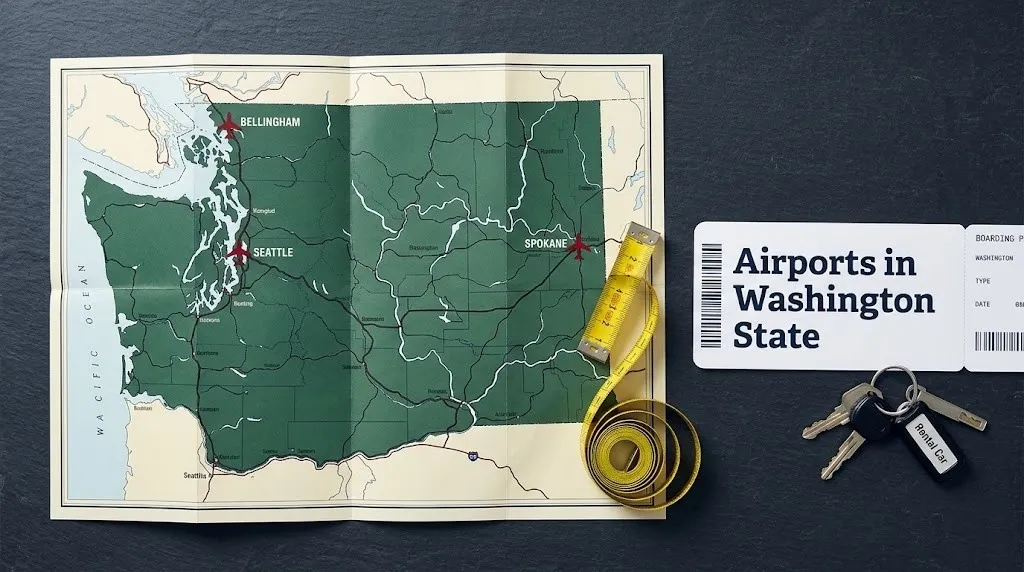
A Washington airports map reveals a sharp divide along the Cascade Mountain range. Western airports cluster along the I-5 corridor from Bellingham to Seattle.
Eastern airports are more isolated, serving vast geographic catchments. Spokane draws passengers from Idaho and Montana, not just eastern Washington.
Visualizing the map explains why a GEG booking for a Seattle trip is a critical error. The drive is over 280 miles and crosses a mountain pass.
A paper map shows the San Juan Islands with no bridges, making seaplane flights a unique necessity. The same map shows no commercial airport serving the Olympic Peninsula directly.
A first-time visitor to Olympic National Park must fly into SEA and drive. A solo traveler with a tight schedule cannot avoid this ground leg.
The Port of Seattle publishes an official airport map that includes all state-run and municipal fields. The Washington State Department of Transportation also maintains an aeronautical chart.
seattle tacoma international airport
Seattle-Tacoma International Airport (SEA) is the busiest airport in the Pacific Northwest. It handled over 50 million passengers in a recent pre-downturn year.
The airport operates a central terminal, two satellite terminals, and six concourses. The underground people mover connects all gate areas after security.
Delta Air Lines and Alaska Airlines run massive hub operations from SEA. Their combined schedules dictate most domestic and regional connection options.
Ground transport to downtown Seattle takes around 35 minutes on the Link Light Rail. A taxi from the airport to downtown typically costs a flat rate in a mid-tier price range.
A business traveler with a tight city meeting will find the train reliable and direct. A family with ski gear heading to Snoqualmie Pass must budget for a rental car.
Sea-Tac’s real limitation is terminal congestion and TSA checkpoint lines during the early morning bank. Arrive two hours before a 7:00 AM domestic departure.
Key Takeaway: SEA is the most connected but also the most congested airport in the state.
seattle alternative airports
The primary alternatives to Sea-Tac are Paine Field (PAE) and Bellingham International Airport (BLI) . Both offer commercial service to west coast and mountain west destinations.
Paine Field is 25 miles north of downtown Seattle in Everett. Bellingham Airport sits 90 miles north, just below the Canadian border.
Allegiant Air and Alaska Airlines use these airports to capture northern suburban passengers. A passenger living in Everett saves an hour of driving by choosing PAE over SEA.
The trade-off is destination selection. Neither airport comes close to offering the number of nonstop destinations Sea-Tac does.
A solo business traveler in north Seattle may find Paine Field an efficient luxury. A family connecting to an international flight must still use Sea-Tac for the long-haul leg.
The Points Guy highlights the low-stress terminal experience at PAE as a major product differentiator. The gate cap limits chaos, but it also limits backup options during irregular operations.
spokane international airport
Spokane International Airport (GEG) is the primary air hub for Eastern Washington and North Idaho. It is a joint civil-military airport with a significant Fairchild Air Force Base presence.
GEG operates two concourses with Alaska, Delta, Southwest, and United as its mainline tenants. The airport provides nonstop connectivity to most major western U.S. cities.
Ground transfer to downtown Spokane is a quick 10-minute drive. Public transit via Spokane Transit Authority Route 60 connects the airport to the city center.
A business traveler visiting the eastern side of the state should always book GEG. Driving from Seattle to a Spokane meeting wastes an entire workday.
A winter traveler must book a connection through a reliably ice-free hub. Spokane’s ground crews are experts in de-icing, but fog and snow can freeze the entire schedule.
GEG is the only logical airport for a trip to Coeur d’Alene, Idaho, or the Silver Valley ski resorts. Any other airport adds hours of stressful winter mountain driving.
paine field airport everett
Paine Field (PAE) operates a boutique two-gate passenger terminal in Everett, Washington. It is owned by Snohomish County and sits adjacent to the Boeing wide-body assembly plant.
Alaska Airlines is the anchor tenant, flying Embraer 175 aircraft to west coast hubs. The terminal features fireplaces, lounges, and floor-to-ceiling views of the runways.
The entire curb-to-gate experience can take under 15 minutes. The strict commercial flight cap creates a quiet, private-jet-like atmosphere.
A business traveler living in Snohomish County should treat PAE as a commuting hack. A budget traveler flying Spirit or Frontier will not find those carriers here.
The honest limitation is fragility. With only two gates and limited flights, a single cancellation leaves you scrambling to Sea-Tac for rebooking options.
Conde Nast Traveler has ranked Paine Field among the best small airports in the United States. The passenger experience at PAE genuinely outclasses the chaotic main terminal rush at SEA.
airports in eastern washington
The eastern half of the state has a sparse but functional commercial airport network. The anchors are Spokane International (GEG) and Tri-Cities Airport (PSC).
The smaller fields are Walla Walla Regional (ALW) and Yakima Air Terminal (YKM) . Grant County International Airport (MWH) in Moses Lake primarily runs cargo, not scheduled passengers.
Alaska Airlines uses Horizon Air branded regional jets to connect these small cities to Seattle. A missed Seattle connection means an overnight in a Puget Sound hotel.
A wine tourist heading to Walla Walla should absolutely pay the premium to fly directly into ALW. The alternative is a five-hour drive from Portland or Seattle.
A first-time visitor must understand that ground transport between these airports is nonexistent. There is no train or bus connecting Tri-Cities to Spokane airports.
The honest reality is that flying into a small eastern Washington airport in a storm is a gamble. Flights are often the first canceled when regional visibility drops.
Key Takeaway: Spokane and Tri-Cities are the only reliable Eastern Washington air points for tight schedules.
tri-cities airport pasco
Tri-Cities Airport (PSC) serves Kennewick, Pasco, and Richland in south-central Washington. It is a key airport for the state’s agricultural, wine, and scientific research communities.
The terminal is a single, modern building served by Alaska, Delta, and Allegiant. It runs a short list of direct western U.S. flights to hubs and leisure destinations.
Ground transfer to the Tri-Cities core is a 10-minute taxi ride costing a very low fare. There is limited bus service, so a rental car or rideshare is the real requirement.
A business traveler visiting the Pacific Northwest National Laboratory will use PSC. A budget leisure traveler can snag deeply discounted Allegiant Air tickets here.
The honest limitation is the extreme isolation without a car. A solo traveler who cannot rent a vehicle will find themselves stranded in a vast suburban landscape.
the official Tri-Cities Airport website posts real-time flight status for its limited departures. The surrounding fog from the Columbia and Snake rivers is a known winter cancellation trigger.
bellingham airport airlines
Bellingham International Airport (BLI) is served by Alaska Airlines, Allegiant Air, and Southwest Airlines. It is the most convenient air access point for the northern I-5 corridor near the Canadian border.
Alaska offers a consistent regional jet shuttle to Seattle and Portland. Allegiant flies ultra-low-cost leisure routes to Las Vegas, Phoenix, and California.
Many Canadian travelers drive across the Peace Arch border crossing to fly out of BLI. They avoid high taxes and fees on tickets purchased in Canada.
A family heading to Mt. Baker for a ski trip will find BLI far more convenient than SEA. A traveler connecting to a transpacific flight still needs a separate ticket from BLI to Seattle.
The honest limitation for a budget traveler is Allegiant’s ancillary fee trap. A cheap BLI-to-Vegas ticket can double in cost after a carry-on bag fee is added.
the official Bellingham International Airport schedules page lists current airlines and routes. Verify directly before booking because Allegiant’s route map at BLI changes seasonally.
allegiant washington state airports
Allegiant Air operates out of Bellingham, Spokane, and Tri-Cities airports in Washington. Its business model avoids the high costs of operating at Sea-Tac.
The airline flies a point-to-point leisure model with a thin schedule. A route might operate twice a week rather than multiple times daily.
A family on a summer vacation to Las Vegas or Los Angeles is Allegiant’s core customer. A business traveler with a firm Monday morning meeting should not risk the low frequency.
The critical Allegiant rule is that you buy a bare-bones seat. Everything from a carry-on bag to a soda costs extra fees at the airport.
A trip to the San Juan Islands using an Allegiant flight into Bellingham is a viable summer hack. The route to BLI might not exist after Labor Day.
the Bureau of Transportation Statistics reports Allegiant’s average ancillary fee revenue per passenger is among the highest in the industry. Build this added cost into your budget.
closest airport to mount rainier
Seattle-Tacoma International Airport (SEA) is the closest commercial airport to the southwest Nisqually entrance of Mount Rainier National Park. The drive is roughly 85 miles and takes two hours in clear traffic.
Yakima Air Terminal (YKM) provides secondary access to the park’s remote eastern side. It is a small, limited-service field on the dry side of the Cascades.
A trip to the popular Paradise visitor center area is a day trip directly out of Seattle’s airport car rental facility. There is no shuttle bus or public transit from SEA to the park entrance.
A family planning a summer hike must book a rental car well in advance. Mount Rainier timed-entry permits are also required during peak months.
A solo traveler with a backpacking goal should pack for self-sufficiency from the SEA baggage claim. There are no last-minute gear shops near the park’s gateway towns.
the National Park Service publishes current road status and entry reservation rules. Check the official NPS Mount Rainier page for the Gate 3 and Stevens Canyon timelines before you fly.
Key Takeaway: Sea-Tac is the only practical year-round airport gateway for Mount Rainier visitors.
washington state seaplane airports
Kenmore Air and San Juan Airlines operate the largest seaplane networks in the state. Their primary bases are Seattle’s Lake Union and Lake Washington.
The primary seaplane destination airports are Friday Harbor (FBS), Orcas Island (ESD), and Roche Harbor. A flight from Lake Union to Friday Harbor takes 45 minutes and lands on the water.
A tourist visiting the San Juan Islands for a long weekend will find the seaplane a genuine time-saver. The alternative is a drive to Anacortes followed by a lengthy ferry wait.
A family with a lot of luggage will struggle with the strict weight limits. Soft-sided bags are mandatory, and the weight allowance is far lower than on a commercial jet.
The honest limitation of seaplanes is weather cancellation and operating hours. Fog in Puget Sound grounds the fleet with zero alternate transport options.
Solo travelers with a light bag can walk onto the dock and step off in a completely different world. It is the only pure aerial experience left in commercial transport in the continental U.S.
Important Accuracy Notes for Washington State Airports
Secondary airport routes and airline ground transfer schedules change without regulatory notice. An Allegiant route operating this summer may not return next year.
Verify the following directly before traveling:
- Your chosen airline’s current route map for Paine Field (PAE) and Bellingham (BLI) on the official airline website.
- Link Light Rail hours and construction schedule on the Sound Transit website for late-night arrivals at SEA.
- Kenmore Air’s luggage allowance and weather policy for your specific seaplane flight.
The most critical step is checking your airline’s terminal assignment and schedule change policy directly with the carrier 24 hours before departure.
Frequently Asked Questions About Washington State Airports
What is the main international airport in Washington state?
Seattle-Tacoma International Airport (SEA) is the main international airport in Washington State. It handles almost all transoceanic and long-haul international flights for the region. Spokane International Airport (GEG) has very limited seasonal service to Canada and Mexico.
Are there alternatives to flying into Seattle Tacoma airport?
Yes, Paine Field (PAE) in Everett is a strong Seattle alternative. Bellingham International Airport (BLI) also serves the broader north Puget Sound region. Both offer a less chaotic terminal experience but far fewer nonstop destinations.
What commercial airports are in eastern Washington?
Spokane International Airport (GEG) is the primary commercial air hub for Eastern Washington. Tri-Cities Airport (PSC) is the main south-central option for Kennewick, Pasco, and Richland. Walla Walla (ALW) and Yakima (YKM) offer very limited scheduled regional services.
What airlines fly out of Bellingham, WA?
Alaska Airlines, Allegiant Air, and Southwest Airlines fly out of Bellingham International Airport. Alaska provides a mainline bridge to Seattle, while Allegiant and Southwest operate leisure-focused routes to warmer destinations. Flight schedules shift significantly between summer and winter.
Which airport is closest to Mount Rainier National Park?
Seattle-Tacoma International Airport (SEA) is the closest major commercial airport to the Mount Rainier National Park Nisqually entrance. The drive to Paradise is about two hours on a clear day with no mountain pass snow. Yakima Air Terminal (YKM) serves the less-visited eastern side of the park.
Does Allegiant Air fly in Washington state?
Yes, Allegiant Air flies from Bellingham, Spokane, and the Tri-Cities Airport in Pasco. It operates a low-frequency, point-to-point model to leisure destinations. All Allegiant flights are ultra-low-cost and carry heavy ancillary fees for bags and seats.
A smart Washington airport choice is based on your final destination, not the cheapest base fare. The state’s geography punishes a lazy airport selection with wasted driving time and missed connections. Write your destination city down. Match it to the closest commercial airport from the list above. Check the ground transfer distance and confirm a rental car or light rail schedule exists for your arrival time. This approach prevents a Spokane booking for a Seattle business meeting.
The single most important verification happens 24 hours before your flight. Pull up the official airport website for your departure and arrival points. Check for terminal changes, current airline status, and any ground transit disruptions. Airline schedules and especially low-cost carrier routes shrink or vanish between seasons. Treat your airport selection as a locked decision only after that final check.