US citizens do not need a visa for Singapore for tourism or short business trips. The Immigration and Checkpoints Authority (ICA) grants visa-free entry to US passport holders for stays of up to 90 days.
That stay limit is longer than what many other nationalities receive, and it applies to social visits, business meetings, and most family visits. Singapore still requires every traveler to submit a separate digital form before arrival, regardless of visa status.
This guide covers exactly what US travelers must prepare, from passport validity to the SG Arrival Card, plus how this compares to nearby destinations. It also breaks down requirements by traveler profile, including business flyers, families, and solo travelers.
Do US Citizens Need a Visa for Singapore?
US citizens do not need a visa to enter Singapore for tourism, family visits, or short business trips.
According to the Embassy of the Republic of Singapore in Washington DC, regular, official, and diplomatic US passport holders may enter for business or social visits without a visa. This exemption applies at air, sea, and land checkpoints alike.
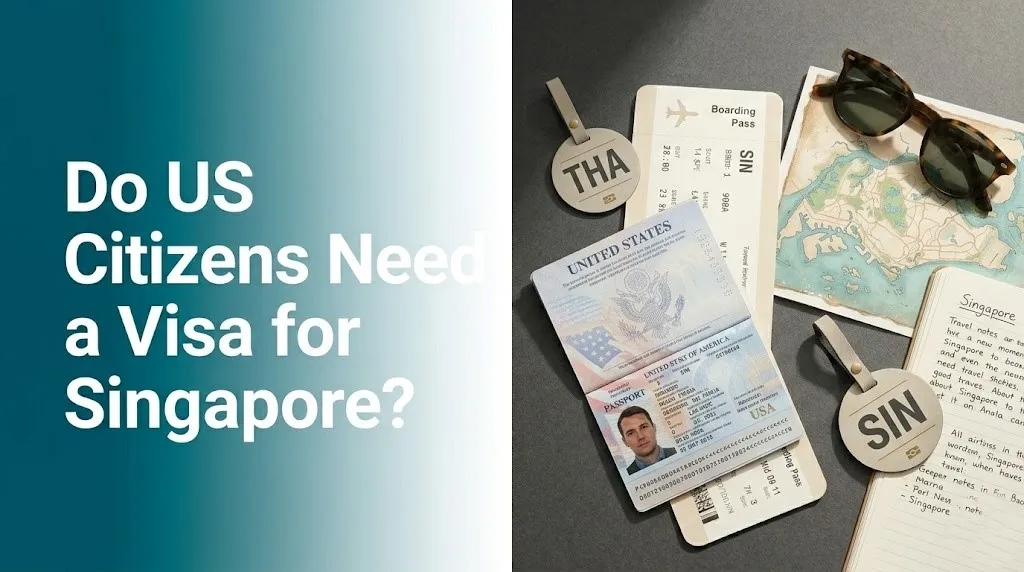
The exemption does not remove other entry requirements, including passport validity and the mandatory arrival declaration. Travelers still go through standard immigration clearance on arrival.
For first-time international travelers, this is one of the simplest entry processes in Southeast Asia. Many Americans expect a visa stamp or sticker and are surprised that none is required.
The exemption applies only to short visits for tourism or business meetings, not employment or study. Anyone planning to work in Singapore needs a completely different pass, covered later in this guide.
Booking timing rarely matters for the visa question itself, since there is no application to schedule. It does matter for the SG Arrival Card, which has its own short submission window.
Many travelers assume “visa-free” means “no paperwork at all,” and that assumption causes avoidable delays at Changi. The visa exemption and the arrival declaration are two separate requirements that both apply.
Key documents and rules to verify before booking:
- Passport validity: most sources recommend at least six months remaining beyond your travel dates
- Return or onward ticket: immigration officers may ask to see proof you plan to leave
- SG Arrival Card: a separate digital form required of nearly all foreign visitors
Does a US Citizen Need a Visa for Singapore for Business Travel?
A US citizen does not need a visa for short business trips to Singapore, including meetings, conferences, and negotiations.
The Embassy of the Republic of Singapore groups business visits under the same visa-free category as social visits for US passport holders. Both fall under what Singapore calls a visit pass at immigration.
Business travelers should still carry documentation that supports the trip’s purpose. This can include a letter from the host company, a conference registration, or meeting itinerary.
For business and frequent flyers, the practical difference from a tourist trip is mainly about documentation, not visa status. Carrying a clear paper trail helps if an immigration officer asks about the visit’s purpose.
Short notice business trips work fine under this exemption since there is no visa appointment to schedule in advance. The only fixed-window item remains the SG Arrival Card, submitted within three days of arrival.
Some American business travelers assume a business visa is required simply because the trip is work-related. According to the U.S. Embassy in Singapore, this is not the case for short visits under the visa-free allowance.
| Travel Purpose | Visa Required for US Citizens | Typical Stay Allowed | Extra Documentation Suggested |
|---|---|---|---|
| Tourism | No | Up to 90 days | Return ticket, hotel booking |
| Business meetings | No | Up to 90 days | Invitation letter, itinerary |
| Employment | Yes, work pass | Per pass terms | Employer sponsorship |
| Long-term study | Yes, student pass | Per pass terms | School enrollment proof |
Do Americans Need a Visa for Singapore on a Cruise or Layover?
Americans transiting through Singapore without clearing immigration generally do not need a visa or the SG Arrival Card.
According to ICA, travelers transiting or transferring through Singapore without seeking immigration clearance are exempt from the SG Arrival Card requirement. This typically applies to airside connections at Changi Airport.
The moment a traveler clears immigration, even briefly to leave the airport, the visa-free allowance and SG Arrival Card rules both apply. Cruise passengers on a Singapore port call usually clear immigration to disembark.
For solo travelers doing a long layover at Changi, staying airside avoids extra paperwork entirely. Anyone leaving the terminal for a city tour should plan for the standard entry process.
Layover length matters here. A short connection of a few hours rarely justifies leaving the airport, while a layover of eight hours or more often does.
Many travelers do not realize that a transit visa is essentially nonexistent for US passport holders at Singapore, since the visa exemption already covers entry. The real planning question is whether to clear immigration at all.
To plan a Changi layover:
- Check your connection time against Changi’s minimum connection guidance for your terminal
- Decide whether the layover is long enough to justify clearing immigration
- If leaving the airport, submit the SG Arrival Card within three days of arrival
- Carry your boarding passes for both flights through security
- A well-planned layover can include a quick visit to Jewel Changi without visa paperwork
Do US Citizens Need a Visa to Visit Singapore for Tourism?
US citizens do not need a tourist visa to visit Singapore for stays of up to 90 days.
Universal Passports & Visas confirms that tourist and business visas are not required for US citizens for stays up to 90 days, though passport validity rules still apply. This applies whether arriving by air, sea, or land.
Tourists should still prepare standard documentation: a valid passport, proof of accommodation, and a return ticket. None of this constitutes a visa application or fee.
For families with children, the visa-free policy applies equally to children traveling on their own US passports. Each family member, including infants, needs an individual passport and an individual SG Arrival Card.
Tourism to Singapore runs comfortably year-round given the tropical climate, though the dry season from February to April is often considered more pleasant for outdoor sightseeing. Peak periods like Chinese New Year bring higher demand and prices.
The most common tourist mistake is treating the visa-free policy as the only requirement, then arriving without having submitted the SG Arrival Card. That single missed step can cause delays at immigration even though no visa was ever needed.
Key Takeaway: US citizens get visa-free entry to Singapore for up to 90 days, but the SG Arrival Card is still mandatory for everyone.
How Long Can US Citizens Stay in Singapore Without a Visa?
US citizens can generally stay in Singapore visa-free for up to 90 days under the standard visit pass.
This 90-day allowance is longer than the 30-day allowance many other nationalities receive under Singapore’s visa exemption list. The exact duration granted is ultimately decided by the immigration officer at the checkpoint.
The 90-day figure represents the maximum, not a guarantee. Officers can grant a shorter period based on travel purpose, ticketing, or other factors reviewed at entry.
For business and frequent flyers making repeat short trips, staying within the granted period each visit matters more than the headline 90-day figure. Repeated back-to-back visits can draw extra questions from immigration.
Travelers planning a stay close to 90 days should build in buffer time for flight delays or itinerary changes. Overstaying, even briefly, can create problems for future entry to Singapore.
Many travelers assume the visit pass duration is fixed and printed automatically for 90 days every time. In practice, it is recorded electronically and can vary, so checking the date stamped or emailed at entry matters.
Important Accuracy Notes for Singapore Stay Duration
Overstaying your permitted period in Singapore can result in fines, detention, or future entry bans, so confirm your exact granted stay at arrival.
Verify the following directly before traveling:
- Current visa exemption duration for US passport holders on the ICA entry requirements page
- Any temporary changes to entry policy on the U.S. Department of State Singapore travel advisory
- The exact stay period granted to you, recorded electronically at immigration on arrival
Confirm your granted stay period immediately after clearing immigration, and plan your departure date around that confirmed number, not an assumed 90 days.
Singapore Arrival Card Requirements for US Citizens
US citizens must submit the SG Arrival Card online before arriving in Singapore, separately from the visa exemption.
According to ICA, all travelers must submit the SG Arrival Card within three days, including the day of arrival, except those transiting without immigration clearance. The form includes personal details, travel information, and a health declaration.
Submission is free and done through the official SGAC e-Service or the MyICA mobile app. No third-party paid service is endorsed by ICA for this process.
For first-time international travelers, this digital form replaces the old paper arrival card many guidebooks still describe. Skipping it can lead to delays or denied entry, even though no visa was required.
The three-day window means travelers should not submit too early. Submitting 24 to 48 hours before departure is a practical middle ground that avoids both expired windows and last-minute scrambling.
A common misunderstanding is treating the SG Arrival Card as optional for visa-exempt nationalities like the US. ICA states clearly that travelers who fail to submit it may be denied entry into Singapore.
Key items the SG Arrival Card requires:
- Passport details: number, issuing country, and expiry date
- Flight and accommodation details: arrival flight number and where you are staying
- Health declaration: a brief disease-control questionnaire required of all entrants
Singapore Passport Validity Requirements for US Travelers
US travelers should carry a passport valid for at least six months beyond their planned departure from Singapore.
While ICA’s official position focuses on validity at the point of entry, several visa service providers, including Universal Passports & Visas, recommend the six-month buffer along with at least one blank visa page. Airlines may also enforce this rule at check-in.
A passport nearing expiration can cause issues even when no visa is required, because airline check-in systems sometimes flag short validity automatically. This can happen before the traveler ever reaches Singapore immigration.
For solo travelers and solo female travelers, renewing a passport well before a Southeast Asia trip avoids being denied boarding at a US departure gate. This is a common and entirely avoidable problem.
Passport renewal through the US Department of State can take several weeks under routine processing, longer during peak renewal seasons in spring and summer. Expedited service is available for an additional cost.
Many travelers check passport expiry against their return date rather than against airline and destination buffer requirements. A passport that expires two months after a trip can still trigger a denied boarding decision.
To check passport readiness before booking:
- Confirm your passport expiry date against your planned return date from Singapore
- Add at least six months of buffer beyond that return date
- Check for at least one blank visa page, even though Singapore does not stamp a visa
- If renewal is needed, start through the US Department of State passport portal early
- A passport with sufficient validity removes one of the most common avoidable travel disruptions
Singapore Visa for Business Travel US Citizens
A separate business visa is not required for US citizens attending meetings, conferences, or negotiations in Singapore for up to 90 days.
The Embassy of the Republic of Singapore treats short business visits the same as social visits for US passport holders under the visit pass system. The distinction matters mainly for documentation, not for visa application.
Business travelers entering on the visit pass cannot be paid by a Singapore-based employer or take up local employment during the stay. Activities limited to meetings, training observation, or negotiations generally fall within the visa-free scope.
For business and frequent flyers attending recurring events such as trade shows, repeated visit-pass entries are normal. Spacing trips out and carrying consistent documentation each time helps avoid extra scrutiny.
Conferences clustered around certain months, such as major tech or finance events in Singapore, can mean higher hotel rates and busier immigration lines. Booking flights and arrival cards early in that window helps.
A frequent assumption is that a “business visa” stamp exists for US citizens visiting Singapore, similar to some other countries. For US passport holders, no such separate business visa stamp or category applies under the standard visit pass.
| Business Travel Element | US Citizen Requirement | Notes |
|---|---|---|
| Visa application | Not required | Visit pass covers business meetings |
| SG Arrival Card | Required | Submit within 3 days of arrival |
| Local employment | Not permitted on visit pass | Requires Employment Pass |
| Supporting documents | Recommended | Invitation letter, itinerary |
Singapore Transit Visa Requirements for US Citizens
US citizens do not need a transit visa for Singapore, and most short layovers require no additional entry paperwork.
The Outboundvisa guide notes that travelers who remain in transit and do not clear immigration are exempt from the SG Arrival Card. Once immigration is cleared, standard entry rules and the visa-free allowance apply instead.
Changi Airport’s airside transit areas, including Jewel Changi’s airside attractions, are accessible without clearing immigration on many layovers. Leaving for the city requires going through standard immigration and customs.
For families with children, airside transit can be a practical way to handle a long layover without the hassle of immigration lines, strollers, and luggage retrieval. Airside facilities at Changi include rest areas and play zones.
Layovers under roughly six hours rarely leave enough time to clear immigration, explore the city, and return comfortably. Longer layovers, especially overnight ones, are when leaving the airport becomes worth considering.
Some travelers mistakenly believe a transit visa exists as a distinct category for US passport holders, separate from the standard visa exemption. In practice, the visa-free allowance and the immigration clearance decision are the only relevant factors.
Key airside Changi options for long layovers:
- Jewel Changi Canopy Park: accessible from certain terminals without immigration clearance
- Transit hotels: located airside in several terminals for rest between flights
- Free city tours: offered by Changi for qualifying long-layover passengers who do clear immigration
Singapore Visa Exemption Extension for US Citizens
US citizens who need to stay in Singapore longer than their granted visit pass period must apply for an extension through ICA before it expires.
ICA is the agency responsible for extension applications, submitted online before the current visit pass expires. Extensions are not guaranteed and depend on the traveler’s stated reason and documentation.
The extension process involves submitting an application with supporting documents explaining the reason for the longer stay. Processing can take several business days, so applying close to the expiry date is risky.
For solo travelers on an open-ended Southeast Asia itinerary, building flexibility into a Singapore stay by applying early for an extension is safer than waiting until the last few days. Visa runs to nearby countries are not a reliable substitute.
Extension requests made well before the visit pass expires generally have more processing time available if additional documents are requested. Requests submitted in the final day or two carry higher risk of expiry before a decision.
A frequent misconception is that simply leaving Singapore and re-entering resets the visit pass clock indefinitely. ICA can scrutinize frequent re-entries and may grant a shorter stay or deny entry if a pattern suggests an attempt to live in Singapore without the correct pass.
To request a stay extension:
- Identify your current visit pass expiry date as recorded at entry
- Gather documentation supporting the reason for a longer stay
- Submit the extension request through ICA’s official online channel before expiry
- Avoid submitting in the final 24 to 48 hours before your pass expires
- An approved extension keeps your stay fully compliant with Singapore immigration rules
Key Takeaway: The SG Arrival Card, passport validity, and visit pass extensions are the three details that matter most for US travelers beyond the basic visa exemption.
Singapore Entry Requirements for US Travelers in 2026
In 2026, US travelers must combine the standard visa exemption with a mandatory SG Arrival Card and awareness of new pre-arrival enforcement measures.
According to Outboundvisa, from 30 January 2026, ICA may issue No-Boarding Directives to airlines for travelers identified as not meeting Singapore’s entry requirements. This makes pre-departure compliance more consequential than in prior years.
This directive means an airline could be instructed not to board a passenger who has not met entry conditions, before that passenger even reaches Singapore. For visa-exempt US citizens, the main exposure point is an incomplete or missing SG Arrival Card.
For first-time international travelers, 2026 is a good year to build in extra buffer time for online submissions rather than relying on doing everything at the airport. Airport WiFi and kiosks should be a backup, not the primary plan.
The safest approach in 2026 is completing the SG Arrival Card within the recommended 24 to 48 hour window before departure, using the official ICA e-Service or MyICA app. This avoids both the too-early submission error and last-minute departure-day stress.
Many travelers in past years treated Singapore’s entry process as effectively paperwork-free because of the visa exemption. The 2026 enforcement changes make that assumption riskier than it was even a year or two earlier.
Important Accuracy Notes for 2026 Singapore Entry Changes
The 2026 No-Boarding Directive system means incomplete pre-arrival paperwork can affect boarding, not just immigration clearance on arrival.
Verify the following directly before traveling:
- Current SG Arrival Card requirements on the ICA SGAC e-Service page
- Any new advisories on the U.S. Department of State Singapore travel advisory page
- Your airline’s specific check-in documentation requirements for Singapore-bound flights
Treat the SG Arrival Card as a pre-departure boarding requirement in 2026, not simply a post-arrival immigration step.
What Documents Do US Citizens Need to Enter Singapore?
US citizens need a valid passport, a completed SG Arrival Card, and proof of onward or return travel to enter Singapore.
Embassyinformation lists a valid passport with at least six months validity, recent passport photos, a round-trip itinerary, proof of accommodation, and proof of sufficient funds as commonly requested items. Not every traveler is asked for all of these at the checkpoint.
Immigration officers have discretion to ask for any combination of these documents, particularly proof of onward travel and accommodation. Having them readily available, even digitally, speeds up the process.
For families with children, each child needs their own passport and SG Arrival Card, plus any custody documentation if traveling with one parent. Some airlines also request this documentation at check-in.
These documents should be ready before departure, not assembled at the gate. Digital copies stored on a phone, alongside physical originals, cover most scenarios.
A common error is assuming that because no visa is needed, no documents beyond a passport are needed either. The visa-free policy reduces paperwork significantly but does not eliminate it.
Documents to have ready for Singapore entry:
- Valid US passport: with recommended six-month validity buffer
- Completed SG Arrival Card confirmation: email or app confirmation from ICA
- Return or onward ticket: proof you plan to leave Singapore
- Proof of accommodation: hotel booking or host details
- Proof of sufficient funds: bank statements or equivalent, if requested
Singapore Customs Rules US Travelers Should Know
US travelers entering Singapore must follow strict customs rules, including bans on items like chewing gum imports and tight controls on e-cigarettes.
Singapore enforces some of the strictest customs rules in Southeast Asia for items considered minor elsewhere, including significant restrictions on chewing gum and a ban on e-cigarettes and vaping devices. Penalties for violations can be severe by US standards.
Duty-free allowances apply to alcohol and tobacco within specific limits, and travelers exceeding these must declare items and pay duty. Declaring honestly avoids disproportionate penalties compared to the value of the goods.
For business and frequent flyers carrying medications, Traveloka recommends bringing copies of prescriptions and confirming medicines are permitted, since some common US medications are restricted in Singapore. Checking before departure avoids confiscation at customs.
Customs enforcement at Changi is consistent and well-staffed, so attempting to under-declare items carries real risk rather than being a low-priority issue. This differs from looser enforcement some travelers experience elsewhere.
Many American travelers underestimate how seriously Singapore treats items considered harmless at home, such as vape devices carried in a bag out of habit. Leaving these items at home entirely is the simplest solution.
Items requiring extra care for US travelers:
- E-cigarettes and vaping devices: banned, with confiscation and penalties possible
- Chewing gum: import restricted, generally limited to small personal quantities
- Certain prescription medications: may require documentation or be restricted entirely
- Alcohol and tobacco: subject to duty-free limits, declare anything over the allowance
Key Takeaway: Singapore’s visa exemption is generous, but customs rules on items like e-cigarettes are stricter than most US travelers expect.
Travel Insurance for a Singapore Trip from the US
Travel insurance is not legally required for US citizens to enter Singapore, but it is strongly recommended given high local medical costs.
The U.S. Department of State Singapore travel advisory encourages US citizens to consider medical evacuation insurance, noting that local emergency care is reliable but can be expensive without coverage. This applies even on short trips.
A useful Singapore travel insurance policy typically includes trip cancellation, medical and emergency evacuation, and baggage delay coverage. Comparing these categories across providers, rather than focusing only on price, helps match coverage to the trip.
For solo travelers, medical evacuation coverage matters more than it might for a group trip, since there is no companion to manage logistics during a medical emergency. Confirming the policy’s evacuation provider network before departure is worthwhile.
Travel insurance should be purchased close to when the trip is booked, since some benefits, such as pre-existing condition waivers, depend on purchase timing relative to the booking date. Waiting until departure week can reduce available options.
A common misconception is that a US-based health insurance plan automatically covers care abroad at the same cost as at home. Many domestic plans offer limited or no coverage in Singapore, making a dedicated travel policy worth comparing.
| Coverage Type | What It Typically Covers | What It Typically Excludes |
|---|---|---|
| Trip cancellation | Non-refundable costs if trip is canceled for covered reasons | Cancellations for excluded reasons listed in the policy |
| Medical evacuation | Emergency transport to adequate care | Routine care, pre-existing conditions unless added |
| Baggage delay | Essential items if bags are delayed | Items not listed as essential in the policy |
| Cancel for any reason | Broader cancellation flexibility | Often requires purchase soon after booking |
Compare policies through platforms like Squaremouth or InsureMyTrip, and read the exclusions section of any policy before purchasing.
Singapore Work Visa for US Citizens
US citizens who plan to work in Singapore need an Employment Pass or similar work pass, not the visa-free visit pass.
Pacific Prime notes that working legally in Singapore requires the correct permit through the Ministry of Manpower, while immigration visas more broadly are issued by ICA. The visit pass used for tourism and short business trips does not cover employment.
Work pass categories include the Employment Pass for professionals, the S Pass for mid-skilled workers, and the ONE Pass for high-earning individuals, each with different eligibility criteria. Employers typically initiate these applications on behalf of the worker.
For business and frequent flyers considering a longer-term move, the practical first step is securing a Singapore-based job offer, since most work passes require employer sponsorship. Arriving on a visit pass and seeking work locally is not the correct pathway.
Processing for immigration visas tied to long-term stays commonly runs three to five working days according to Pacific Prime, though this excludes weekends, holidays, and the submission day itself. Work pass processing timelines vary separately by pass type.
A frequent error is assuming the 90-day visa-free period can be used to start working informally while sorting out paperwork. Engaging in paid local employment without the correct pass falls outside the visa-free allowance entirely.
To pursue a Singapore work pathway:
- Secure a job offer from a Singapore-registered employer
- Have the employer apply for the appropriate pass through the Ministry of Manpower
- Wait for pass approval before beginning any local employment
- Use the visit pass only for the initial entry tied to interviews or onboarding, not paid work
- A correctly issued work pass allows legal employment and is the foundation for longer-term residency options
Singapore Visa Requirements for US Citizens vs Other Countries
US citizens face fewer visa requirements for Singapore than travelers from many other nationalities, who may need a visa or face shorter stay limits.
CALC Conference 2026 entry guidance notes that travelers from certain listed countries require a valid visa to enter Singapore, while others, including the US, do not. The exemption list and required-visa list both depend on the traveler’s passport, not on travel purpose alone.
Some ASEAN neighbors, such as Malaysia, also enjoy visa-free entry but typically receive shorter stay allowances of around 30 days compared to the 90 days commonly granted to US citizens. The underlying SG Arrival Card requirement applies to nearly everyone regardless of visa status.
For first-time international travelers comparing notes with friends who hold different passports, it is worth remembering that “Singapore is visa-free” is not universally true. The specific exemption depends entirely on the passport being used.
This comparison matters most for mixed-nationality groups, such as a US citizen traveling with a partner who holds a passport requiring a visa. Planning timelines around the slower-moving visa application, not the US citizen’s exemption, avoids last-minute scrambling.
A common misunderstanding is assuming that because a destination is broadly known as visa-friendly, every traveler in a group qualifies equally. Checking each traveler’s specific passport against ICA’s current lists is the only reliable approach.
| Passport Held | Visa Required for Singapore | Typical Stay Allowed |
|---|---|---|
| United States | No | Up to 90 days |
| Most EU countries | No | Typically 30 to 90 days |
| Malaysia | No | Typically 30 days |
| Countries on ICA’s visa-required list | Yes | Per visa terms |
Key Takeaway: A visa-free policy for US citizens does not automatically extend to travel companions holding different passports.
Best Time to Book Flights to Singapore from the US
The best time to book flights to Singapore from the US is typically several months ahead, avoiding major holiday periods for better availability.
Long-haul fares from major US gateways to Changi Airport tend to fluctuate with seasonal demand, with Chinese New Year and Singapore’s mid-year and year-end holiday periods often seeing higher fares. Booking outside these windows can offer more flexibility.
Carriers serving the US to Singapore route, including Singapore Airlines on long-haul aircraft like the Airbus A350-900, generally open booking windows well in advance for both economy and premium cabins. Comparing fare classes across booking windows helps identify value periods.
For families with children, booking during school holiday periods often means both higher fares and busier immigration queues at arrival, which compounds with SG Arrival Card timing planning. Off-peak school-term travel, where possible, eases both issues.
A practical sequence is booking the flight first, then timing the SG Arrival Card submission for the three-day window before departure, rather than trying to do both simultaneously. This separates a long-lead-time decision from a short-lead-time task.
Many travelers focus entirely on fare price and overlook that visa-free entry removes one major planning bottleneck other destinations impose. That freed-up time is better spent confirming passport validity and insurance coverage early.
| Booking Window | Demand Level | Price Tier | Verdict |
|---|---|---|---|
| 4 to 6 months ahead | Moderate | Often lower | Generally favorable for planning |
| Around Chinese New Year | High | Often higher | Book early or avoid if flexible |
| Mid-year and year-end holidays | High | Often higher | Expect premium pricing |
| Last-minute (under 2 weeks) | Variable | Often higher | Less predictable, fewer seat choices |
Frequently Asked Questions About Singapore Visas for US Citizens
Do US citizens need a visa for Singapore?
No, US citizens do not need a visa for tourism or short business trips to Singapore.
The ICA grants visa-free entry to US passport holders for stays of up to 90 days.
A separate SG Arrival Card is still required before arrival, even though no visa is needed.
How long can US citizens stay in Singapore without a visa?
US citizens can generally stay in Singapore for up to 90 days without a visa under the standard visit pass.
The exact period granted is determined by the immigration officer at entry, based on travel purpose and documentation.
Always confirm the specific date stamped or recorded electronically at arrival rather than assuming the full 90 days.
What is the Singapore Arrival Card and do Americans need it?
The Singapore Arrival Card, or SGAC, is a mandatory digital form including a health declaration that nearly all foreign visitors must submit before arrival.
Americans must submit it within three days, including the day of arrival, through ICA’s official e-Service or the MyICA app.
Failing to submit it can lead to delays or denied entry, even though no visa is required.
Do US citizens need a visa to transit through Changi Airport?
No, US citizens do not need a transit visa, and most layovers without immigration clearance require no additional paperwork.
The visa-free entry rules and SG Arrival Card requirement apply only once a traveler clears immigration to leave the airport.
Staying airside for a connection generally avoids both the SG Arrival Card and any entry documentation review.
Can US citizens extend their stay in Singapore past the visa-free limit?
Yes, US citizens can apply to ICA for an extension before their current visit pass expires.
Approval is not guaranteed and depends on the stated reason and supporting documentation submitted.
Applying well before the expiry date, rather than in the final day or two, gives more time for the request to be processed.
Do US citizens need travel insurance to enter Singapore?
No, travel insurance is not legally required for US citizens to enter Singapore.
The U.S. Department of State still recommends medical evacuation coverage, since emergency care in Singapore can be costly without it.
Comparing policies for trip cancellation, medical evacuation, and baggage delay coverage before booking is a practical step for any Singapore trip.
The Bottom Line on Singapore Entry for US Citizens
US citizens get one of the more generous visa-free arrangements available for Singapore, with up to 90 days allowed for tourism or business.
The single step that trips up the most travelers is the SG Arrival Card, which is mandatory regardless of visa status.
Before booking, confirm your passport has at least six months of validity, and complete the SG Arrival Card 24 to 48 hours before departure.
Visa exemption rules, SG Arrival Card requirements, and enforcement measures can change, so verify current details on ICA’s website and the U.S. State Department’s Singapore travel advisory before you fly. With the SG Arrival Card submitted and your passport in order, the rest of a Singapore trip is refreshingly paperwork-free.