
Tanzania’s airport network is anchored by three international gateways: Julius Nyerere International Airport (DAR) in Dar es Salaam, Kilimanjaro International Airport (JRO) near Arusha, and Abeid Amani Karume International Airport (ZNZ) in Zanzibar. Picking the wrong one can add hours of driving to a safari or beach itinerary.
According to the Tanzania Airports Authority, Julius Nyerere handles the largest share of the country’s international and cargo traffic. That single fact changes how most travelers should route their trip.
This guide covers every international and major regional airport in Tanzania. It breaks down which one fits your itinerary, how ground transfers actually work, and what first-time visitors consistently get wrong.
Airports in Tanzania
Tanzania operates three international airports and roughly a dozen regional airports serving safari and coastal routes. The three international gateways are Julius Nyerere (DAR), Kilimanjaro (JRO), and Abeid Amani Karume (ZNZ).
Regional airports include Songwe International Airport near Mbeya, Mwanza Airport on Lake Victoria, and Arusha Airport, a domestic-only strip. Smaller bush airstrips serve individual national parks like Seronera in the Serengeti.
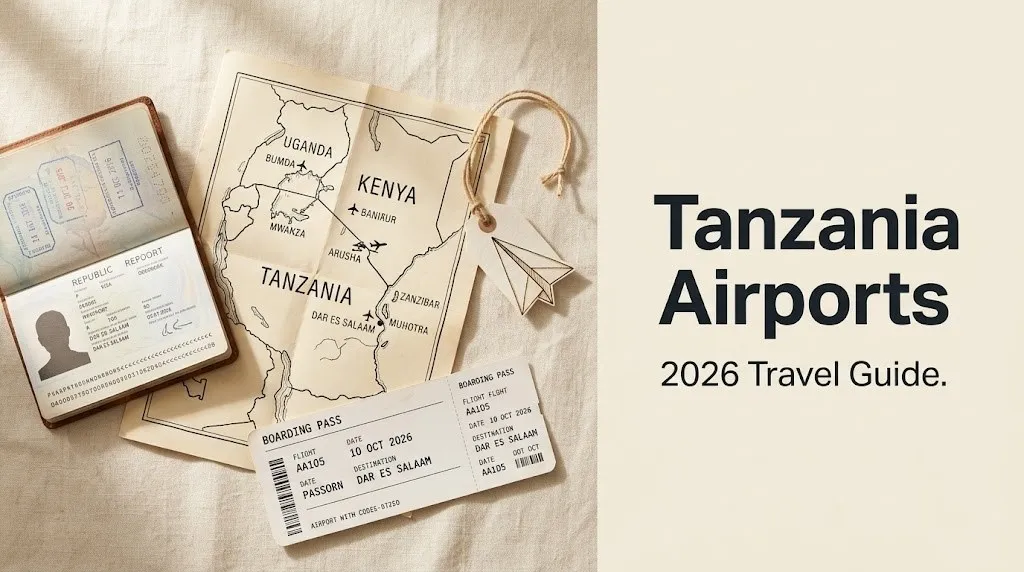
Most regional and bush airports only accept domestic or charter flights. Travelers arriving from abroad almost always land at one of the three international hubs first, then connect onward.
Budget travelers should note that domestic connections through Precision Air or Air Tanzania cost noticeably less than chartered bush flights. Business travelers connecting through Dar es Salaam get the widest choice of daily domestic departures.
| Airport | IATA Code | Region Served | International Flights |
|---|---|---|---|
| Julius Nyerere International | DAR | Dar es Salaam | Yes |
| Kilimanjaro International | JRO | Arusha and Moshi | Yes |
| Abeid Amani Karume International | ZNZ | Zanzibar | Yes |
| Songwe International | MBI | Mbeya, southern highlands | Regional only |
| Mwanza Airport | MWZ | Lake Victoria region | Regional only |
| Arusha Airport | ARK | Arusha city, bush flights | Domestic only |
Confirm which airlines fly which route directly with the carrier before booking, since domestic schedules shift often. Verify current routing with your airline or safari operator before finalizing flights.
International Airports in Tanzania
Tanzania has three international airports capable of receiving long-haul flights from Europe, the Middle East, and Africa. These are Julius Nyerere (DAR), Kilimanjaro (JRO), and Abeid Amani Karume (ZNZ).
Julius Nyerere International Airport is the busiest, with direct or one-stop connections from carriers including Qatar Airways, Turkish Airlines, Ethiopian Airlines, and Emirates. It’s the default entry point for Dar es Salaam city stays and southern safari circuits.
Kilimanjaro International Airport serves the northern safari circuit directly, cutting out a long road transfer from Dar es Salaam. First-time international travelers heading straight to Serengeti or Ngorongoro often save an entire travel day flying into JRO instead of DAR.
Abeid Amani Karume International Airport is Zanzibar’s dedicated gateway, with growing direct European charter service alongside regional connections. Families with children doing a beach-only trip rarely need to touch the mainland at all.
Choose your international airport based on your primary destination, not by default to the biggest hub. A Serengeti-first itinerary through DAR usually means a redundant domestic leg you could have skipped.
Key Takeaway: Fly into Kilimanjaro for northern safaris, Zanzibar direct for beach-only trips, and Dar es Salaam for the south or the capital.
Julius Nyerere International Airport (DAR)
Julius Nyerere International Airport is Tanzania’s largest and busiest airport, located about 20 minutes from central Dar es Salaam. It operates three terminals and handles the country’s heaviest volume of international traffic.
Terminal 3 handles most international arrivals and departures, Terminal 2 covers domestic and regional flights, and Terminal 1 is used for private and charter aircraft. A new VIP terminal came online in early 2026 for state and high-profile passengers.
Ground transfers into the city run by taxi, ride-hailing apps like Uber or Bolt, or hotel shuttle, typically taking 20 to 40 minutes depending on traffic. Solo travelers should prearrange a hotel pickup rather than negotiating with unofficial taxi touts outside arrivals.
DAR is the strongest choice for anyone splitting time between Dar es Salaam, Zanzibar, and southern parks like Nyerere National Park or Ruaha. It’s a weaker choice for northern-only safari itineraries, since it adds a domestic connection JRO would skip entirely.
To connect from DAR onward:
- Clear immigration and collect bags at Terminal 3, then confirm your onward gate at the domestic transfer desk.
- Allow at least two hours between an international arrival and a domestic Zanzibar or Kilimanjaro connection.
- Confirm which terminal your domestic carrier uses, since Terminal 2 and Terminal 3 are separate buildings.
- Verify baggage transfer policy with your airline rather than assuming bags carry through automatically.
Verify current terminal assignments directly with your airline before departure, since Tanzania Airports Authority has renovation work ongoing through 2026.
Kilimanjaro International Airport (JRO)
Kilimanjaro International Airport sits roughly 40 kilometers from Arusha and 50 kilometers from Moshi, making it the direct gateway to Tanzania’s northern safari circuit. It’s the closest international airport to Serengeti National Park and Ngorongoro Crater.
There’s no rail or express bus link, so ground transport runs entirely on private 4×4 transfer, prearranged safari shuttle, or taxi. Most tour operators already include this transfer in a booked safari package.
Business and frequent flyers researching direct UK routes should note that, as of recent reporting, no nonstop JRO to London service currently operates. Connections typically run through Doha, Dubai, Amsterdam, or Istanbul on Qatar Airways, Emirates, or KLM.
Families with children heading straight into a safari lodge benefit most from JRO, since it avoids the extra domestic leg required through Dar es Salaam. Business travelers with meetings in Dar es Salaam get little benefit from routing through JRO first.
Peak safari season runs roughly June through October and again in January and February, when JRO flight frequency and fares both rise noticeably. Booking three to four months ahead during these windows helps secure better fares and lodge availability together.
Insider Tip:
- Arusha and Kilimanjaro International Airport are not the same location; Arusha city sits about 40 kilometers away.
- Moshi, the usual base for Kilimanjaro climbs, is roughly 50 kilometers from the airport, not walkable or a short taxi hop.
- Solo female travelers arriving late at night should confirm a named driver and vehicle plate with their operator in advance rather than accepting airport touts.
Abeid Amani Karume International Airport (ZNZ)
Abeid Amani Karume International Airport is Zanzibar’s primary gateway, serving Unguja Island with both international and domestic flights. It’s the correct entry point for any beach-first Tanzania itinerary.
The airport connects onward to Pemba Island in roughly 30 minutes by air, compared to a multi-hour ferry crossing. Regional carriers and mainland connections through Dar es Salaam run multiple times daily.
Budget travelers flying in via Dar es Salaam first should compare the domestic connection cost against booking a direct international or charter flight into ZNZ. Sometimes the two-leg routing costs more once transfer time and a second airport fee are factored in.
Facilities include duty-free shopping, currency exchange, SIM card vendors, and a growing number of European charter arrivals during the northern hemisphere winter. First-time international travelers should expect a more compact, less automated arrivals process than at DAR.
The airport gets noticeably busier during the July through September and December through February peak beach seasons. Building in extra time for immigration queues during these windows avoids missed onward connections.
| Route from ZNZ | Typical Transfer | Approx. Duration |
|---|---|---|
| Zanzibar City center | Taxi or hotel shuttle | 15 to 25 minutes |
| Pemba Island | Domestic flight | About 30 minutes |
| Dar es Salaam (DAR) | Domestic flight | About 20 minutes |
According to the U.S. State Department, entry rules for Zanzibar mirror mainland Tanzania’s national requirements rather than operating as a separate visa jurisdiction. Verify current entry documentation directly on the official State Department travel page before booking.
Songwe International Airport
Songwe International Airport serves Mbeya and Tanzania’s southern highlands, near the Zambian border. It’s the largest airport in the country’s southwest but has limited route options.
As of recent reporting, Dar es Salaam is essentially the only scheduled route connecting into Songwe. There’s no nearby national park directly at the airport, though it can access Kitulo and nearby highland reserves by road.
Ground transport from Songwe is genuinely limited compared to the three main international hubs. Solo travelers and first-time international travelers should arrange a confirmed pickup in advance rather than expecting an easy taxi rank on arrival.
This airport suits travelers with specific business in Mbeya or those extending a Tanzania trip into Zambia or Malawi overland. It does not suit standard safari or beach itineraries, which have no practical reason to route through the southern highlands.
Confirm current flight frequency directly with Air Tanzania or Precision Air before building Songwe into an itinerary, since regional schedules change seasonally. Regional route changes happen with little advance public notice.
Mwanza Airport
Mwanza Airport sits on the shores of Lake Victoria and serves Tanzania’s northwestern region. It’s the practical entry point for travelers heading to western Serengeti or the lake region itself.
The airport handles domestic connections from Dar es Salaam, Kilimanjaro, and other regional hubs, but does not currently support scheduled long-haul international arrivals. Most international visitors reach Mwanza via a domestic connection rather than flying in directly.
Budget travelers combining a western Serengeti extension with a standard northern circuit safari often find flying into Mwanza cheaper than a long overland drive back through Arusha. It also cuts a full day of driving compared to a Serengeti-to-Arusha road transfer.
This airport is a poor fit for anyone doing a single, short Tanzania trip focused on Kilimanjaro, Ngorongoro, or Zanzibar alone. It only earns its place in longer, multi-region itineraries.
Key Takeaway: Songwe and Mwanza only make sense for specific regional detours, not standard safari or beach itineraries.
Arusha Airport
Arusha Airport is a domestic-only strip serving light aircraft and bush flights within Tanzania’s northern circuit. It should not be confused with Kilimanjaro International Airport, which sits roughly 40 kilometers away.
Small operators including Auric Air, Coastal Aviation, and Regional Air use Arusha as a hub for connections into Serengeti bush strips like Seronera. Business travelers on tight safari schedules sometimes fly Arusha to Seronera directly rather than driving.
Bush flights out of Arusha typically enforce strict soft-sided duffel baggage limits, commonly in the 15 to 20 kilogram range including carry-on. Families with children packing hard-shell suitcases should plan a separate bag-storage arrangement at their first lodge.
Arusha Airport does not accept international arrivals, so it never functions as a first point of entry into Tanzania. It’s strictly a domestic and charter connection point once you’re already in-country.
Verify baggage weight and bag-type rules directly with your specific charter operator before packing, since limits vary by aircraft type. Airlines enforce these limits strictly at check-in with no exceptions for oversized hard luggage.
Ground Transportation From Tanzania’s Airports
Ground transport options at Tanzania’s airports run mainly through taxis, ride-hailing apps, hotel shuttles, and prearranged private transfers. There’s no metro or express rail system connecting any Tanzanian airport to its city center.
At Julius Nyerere, Uber and Bolt both operate reliably, typically cutting cost compared to unofficial taxi stands outside arrivals. At Kilimanjaro and Songwe, ride-hailing coverage is thinner, making prearranged transfers the more dependable option.
Solo female travelers arriving at night should book a named driver through their hotel or operator rather than relying on airport curb hailing at any Tanzanian airport. This applies most strongly at JRO and Songwe, where lighting and staffing are lighter after dark.
Families with children on safari packages almost always have transfers bundled into the tour cost already. Confirming the exact pickup point and driver name with the operator beforehand avoids confusion in a crowded arrivals hall.
To arrange a safe airport transfer:
- Book through your hotel, lodge, or safari operator rather than an unaffiliated tout at arrivals.
- Confirm the driver’s name and vehicle details by message before landing.
- Keep a printed or offline copy of your confirmation in case local signal is weak.
- Have small denominations of Tanzanian shillings ready for tips or incidental costs.
Important Accuracy Notes for Ground Transfers
Missing a prearranged pickup at a Tanzanian airport, especially JRO or Songwe, can mean hours of delay with limited alternatives.
Verify the following directly before traveling:
- Confirm your transfer company’s current contact number with your hotel or operator, since details change between bookings.
- Check current ride-hailing app coverage at your specific arrival airport, since Uber and Bolt service varies by city.
- Confirm whether your transfer includes waiting time for a delayed international connection before booking.
Always keep a backup contact number for your accommodation saved offline before departure.
Choosing the Right Airport for Your Itinerary
The right Tanzania airport depends entirely on your primary destination, not on which one is largest. Kilimanjaro fits northern safaris, Zanzibar fits beach trips, and Dar es Salaam fits the capital or southern parks.
Multi-region trips combining safari and beach often benefit from a multi-city ticket routing into one airport and out of another. Business and frequent flyers booking through a single carrier alliance can sometimes lock this in at the same fare class as a round trip.
First-time international travelers should avoid routing through Dar es Salaam purely out of habit if their trip is northern-safari-only. That routing typically adds a redundant domestic leg and several hours of extra travel.
The table below summarizes which airport fits which itinerary type.
| Itinerary Type | Best Airport | Why |
|---|---|---|
| Northern safari (Serengeti, Ngorongoro) | Kilimanjaro (JRO) | Direct gateway, no extra domestic leg |
| Beach-only Zanzibar | Abeid Amani Karume (ZNZ) | Dedicated island gateway |
| Dar es Salaam city or southern parks | Julius Nyerere (DAR) | Largest hub, most connections |
| Western Serengeti / Lake Victoria | Mwanza (MWZ) | Cuts overland drive time |
| Southern highlands business | Songwe (MBI) | Only regional gateway to Mbeya |
According to the Tanzania Airports Authority, ongoing terminal renovations at Julius Nyerere through 2026 may affect specific gate and check-in locations. Confirm your terminal assignment directly with your airline close to departure.
Key Takeaway: Match the airport to your primary destination first, and only route through Dar es Salaam when it’s genuinely necessary.
Baggage Rules for Domestic Flights in Tanzania
Domestic baggage rules in Tanzania vary by airline, with bush and light-aircraft carriers enforcing the strictest limits. Most bush flights cap total baggage, checked plus carry-on, around 15 to 20 kilograms.
Soft-sided duffel bags are typically required on bush and light-aircraft routes, since hard-shell suitcases don’t fit small aircraft holds. Precision Air and Air Tanzania’s larger domestic jets allow more standard checked-bag allowances closer to international norms.
Families with children carrying strollers or hard-shell luggage should plan to store excess bags at their first lodge or a Dar es Salaam hotel. Most safari operators can arrange this storage as part of the itinerary.
Budget travelers flying multiple short domestic hops should weigh bags at home first, since overweight fees on small aircraft are charged strictly and immediately. There’s typically no leniency at check-in for bush routes given strict aircraft weight limits.
Verify current baggage weight and bag-type limits directly with your specific domestic or charter airline before packing. Policies differ by aircraft type and change without wide public notice.
Visa and Entry Basics at Tanzania’s Airports
US citizens and most nationalities can apply for a Tanzania visa through the eVisa system or on arrival at any of the three international airports. Processing and required documents can change, so confirming current rules before departure matters.
The standard tourist visa typically allows a defined single-entry stay, with the East Africa Tourist Visa offering combined entry across Tanzania, Kenya, and Uganda for eligible travelers. Requirements and validity periods are set by immigration authorities and can shift.
First-time international travelers should apply for the eVisa in advance rather than relying solely on visa-on-arrival, since on-arrival queues at DAR and JRO can run long during peak season. Carrying a printed eVisa approval speeds up the immigration line noticeably.
Solo travelers and business travelers on tight connection windows benefit most from pre-clearing a visa online before arrival. This avoids the added risk of a slow on-arrival queue causing a missed domestic connection.
Verify current visa requirements for your specific passport at the official U.S. State Department travel page or Tanzania’s official immigration portal before booking. Entry rules can change based on diplomatic relations and are not guaranteed to match prior-year information.
Frequently Asked Questions About Tanzania Airports
How many international airports does Tanzania have?
Tanzania has three international airports: Julius Nyerere (DAR) in Dar es Salaam, Kilimanjaro (JRO) near Arusha and Moshi, and Abeid Amani Karume (ZNZ) in Zanzibar.
Each serves a different primary itinerary, from city and southern park travel to northern safaris and beach trips.
Regional airports like Songwe and Mwanza support domestic connections only.
Which airport is closest to the Serengeti?
Kilimanjaro International Airport (JRO) is the closest major airport to the Serengeti and Ngorongoro Crater.
From JRO, travelers typically continue by road to Arusha and then onward by road or light aircraft into the park.
Mwanza Airport can also work for western Serengeti access on longer, multi-region itineraries.
Do I need a visa to fly into Tanzania?
Most nationalities, including US citizens, need a visa to enter Tanzania, available through the eVisa system or on arrival at the main international airports.
Requirements and processing times can change based on nationality and current immigration policy.
Verify current entry rules at the official U.S. State Department travel page or Tanzania’s immigration portal before booking.
What is the best airport for a Zanzibar-only trip?
Abeid Amani Karume International Airport (ZNZ) is the correct gateway for a Zanzibar-only trip, with direct international and regional connections.
Routing through Dar es Salaam first is only necessary if a connecting flight requires it.
Check current direct international route availability into ZNZ before booking a mainland connection you may not need.
How do I get from Julius Nyerere Airport to Dar es Salaam city center?
Julius Nyerere International Airport sits roughly 20 minutes from central Dar es Salaam by taxi, ride-hailing app, or hotel shuttle.
Uber and Bolt both operate reliably at this airport and typically cost less than unofficial taxi stands.
Traffic can extend this transfer significantly during peak commuting hours.
Can I fly directly between Tanzania’s national parks?
Yes, several charter and scheduled operators fly directly between bush airstrips serving Serengeti, Ngorongoro, and other parks.
These flights typically depart from hubs like Arusha, Kilimanjaro, or Mwanza rather than from Dar es Salaam directly.
Confirm routing and baggage limits with your specific safari operator, since bush flight schedules shift seasonally.
Final Word on Choosing Your Tanzania Airport
The single biggest routing mistake is defaulting to Dar es Salaam when your trip is actually northern-safari-only. Kilimanjaro International Airport exists specifically to skip that redundant leg.
Confirm your visa status, terminal assignment, and any domestic connection times directly with your airline before departure. Tanzania’s airport network is expanding and renovating through 2026, so specifics can shift.
Match the airport to the destination, book your eVisa ahead of arrival, and double check ground transfer arrangements with a named contact. That combination gives you the smoothest possible entry into Tanzania.