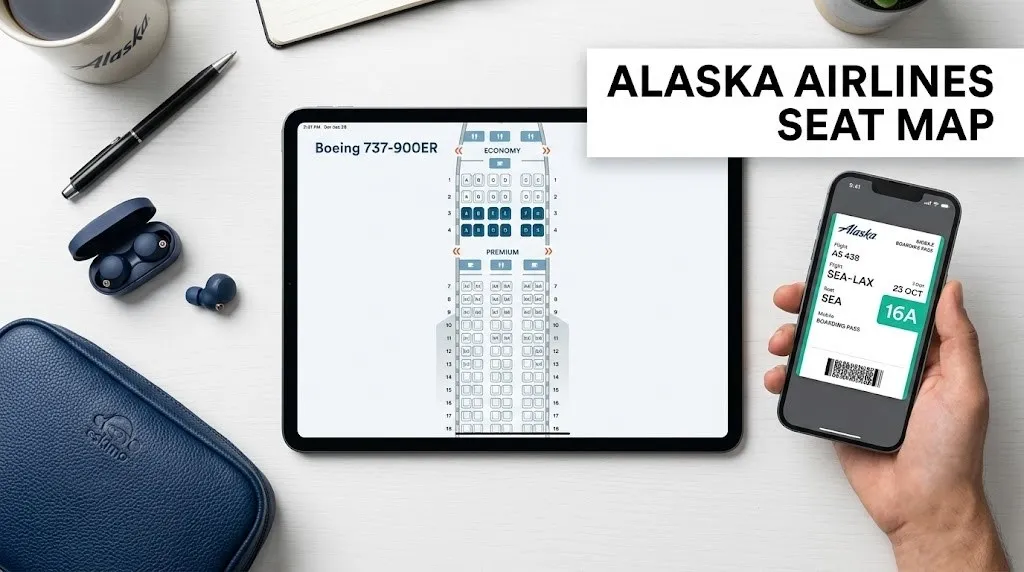
The Alaska Airlines seat map landscape in 2026 is dominated by the Boeing 737. You will also encounter the unique Embraer 175 regional jet on shorter hops.
Your comfort depends entirely on identifying the specific 737 subtype you are flying. The 737-900ER is the most common but also the most densely packed aircraft.
This guide cuts through the complexity to give you a tactical seat-selection strategy. You will learn which rows to book, which to avoid, and how to manage the Saver Fare system.
Alaska Airlines Fleet Overview for 2026
Alaska Airlines operates a simplified, modern, all-Boeing mainline fleet supplemented by regional jets. The Boeing 737 family is the absolute backbone of the operation.
The most common jets are the Boeing 737-900ER and the newer Boeing 737 MAX 9. You will also still find the smaller Boeing 737-800 and Boeing 737-700 on specific routes.
Regional flights are operated by Horizon Air and SkyWest using the Embraer 175. This jet is a passenger favorite thanks to its lack of middle seats.
Business travelers on a tight schedule should learn to spot the MAX 9 on the booking path. It is a much quieter and more comfortable ride than the older 737-900ER.
Families heading to Orlando or Hawaii will almost inevitably be on a dense 737-900ER. You must have a strategy for this specific cabin map to avoid a cramped flight.
The 2026 merger with Hawaiian Airlines will slowly introduce new complexities to the fleet. You might book an Alaska ticket and fly on an Airbus A330 to Hawaii.
Key Takeaway: The Boeing 737-900ER is the plane you need to master for a West Coast life.
Alaska Airlines Boeing 737 Seat Map Guide
Alaska configures its Boeing 737 family with a First Class, Premium Class, and Main Cabin layout. The core economy cabin uses a standard 3-3 seating arrangement.
You get between 31 and 32 inches of pitch in the Main Cabin depending on the row. Seat width is a standard 17.3 to 18 inches across the narrow-body fleet.
The airline does not have seatback video screens, using a streaming entertainment model. A sturdy phone or tablet holder is built into the seatback for your personal device.
- Boeing 737-800: 159 total seats, 12 in First, 30 in Premium, 117 in Main Cabin. Feels less crowded than the -900.
- Boeing 737-900ER: 178 total seats, 16 in First, 24 in Premium, 138 in Main Cabin. The densest and most common layout.
- Boeing 737 MAX 9: 178 total seats, but with a quieter, modern cabin with larger pivot bins and a more spacious feel.
Solo travelers should target the A or F window seats on the left or right side of the plane. Couples should book the window-aisle pairs on the left side (A-B) to avoid a stranger.
Budget travelers on a Saver Fare will likely be assigned the dreaded middle E or B seats. You must check in exactly 24 hours before departure for any hope of a better auto-assignment.
Alaska Airlines Boeing 737-900ER Seat Map Deep Dive
The Boeing 737-900ER is the workhorse of the fleet, but it comes with passenger density risks. It packs 178 seats into a stretched single-aisle tube.
The best seats on this plane are in the Premium Class cabin, specifically Row 6. You get 35 inches of pitch and you are first off the plane.
The exit rows offer the only massive legroom advantage in the Main Cabin. Row 16 A and F are the exit row window seats, and they provide essentially unlimited knee space.
- Rows 1 to 3: First Class recliners. Solid for a long flight but not lie-flat luxury.
- Rows 6 to 9: Premium Class. The sweet spot of value and comfort with early boarding.
- Row 10: Main Cabin bulkhead directly behind Premium Class. You get solid legroom but no under-seat storage.
- Row 16: Main Cabin over-wing exit row. The legroom hero of the plane.
- Rows 17 to 32: Standard Main Cabin. A 31-inch pitch that feels tight on a transcontinental flight.
Tall travelers must pay extra for Row 16 or risk a truly painful flight. Families with infants should not book Row 10, as the lack of under-seat storage is a critical failure with a baby bag.
The single greatest layout flaw is the rear lavatory cluster on the right side. This makes seats D, E, and F in the last three rows a busy, noisy, smelly nightmare zone.
Alaska Airlines Embraer 175 Seat Map Strategy
The Embraer 175 is a regional jet that offers a superior passenger experience. It features a 2-2 layout in economy with no middle seats on the entire aircraft.
Alaska outfits the E175 with a unique single-seat “throne” on the left side in First Class. Seat 1A is a solo traveler’s dream with both a window and direct aisle access.
Premium Class on the E175 is just the first few rows of the 2-2 cabin. The legroom upgrade is modest but worth a small fee for a quick hop from Seattle to Spokane.
- Seats 1A/2A: Solo thrones in First Class. The single best physical seat on any Alaska jet.
- Seats 8A/8B: Exit row window-aisle pair. The legroom champ for a couple on a budget.
- Seats 9C/9D: Standard aisle-aisle pair right behind the exit row. Quick exit without paying an upgrade fee.
Solo female travelers who want a secure, undisturbed flight should book 1A every time. Business couples flying to a client meeting should target the exit row A-B pair for a shared workspace.
The main limitation of the E175 is the tiny overhead bin space. A standard roll-aboard carry-on will not fit and must be gate-checked to the jetbridge.
Never book the seats directly in front of the lavatory on the E175. The galley-lav combo at the rear makes Row 22 the least desirable row on the plane.
Key Takeaway: Seat 1A on the E175 is the best single seat in the entire Alaska network.
Alaska Airlines Premium Class Seats Explained
Premium Class is Alaska’s premium economy product, located just behind First Class. It is not a lie-flat product, but it is a significant upgrade from Main Cabin.
You get 35 inches of seat pitch instead of the standard 31 inches in Main Cabin. That extra four inches of space is a game-changer for knee comfort.
The service includes free cocktails, beer, and wine, plus a premium snack box. You also board with Group B, right after First Class and elite status members.
Frequent flyers who earn MVP Gold status receive complimentary upgrades to this cabin. Budget travelers should monitor the paid upgrade price in the app 48 hours before the flight.
The best Premium Class seats are the bulkhead Row 6. You have a permanent footrest and nobody reclining into your lap.
The worst Premium seat is the last row of the cabin, which borders Main Cabin. You might get a screaming toddler kicking the back of your seat for the entire flight.
Verify your specific aircraft’s Premium Class layout on the official Alaska Airlines seat map before booking. The number of rows and exact amenities can differ between aircraft subtypes.
Alaska Airlines Main Cabin Seats and Exit Rows
The standard Main Cabin seat on the Boeing 737 offers a competitive 31 to 32 inches of pitch. The adjustable headrest and tablet holder make it feel modern and functional.
The over-wing exit rows are the only Main Cabin seats with a dramatically better legroom product. These seats come with the responsibility of helping the crew in an emergency.
Exit row seats on the 737-900ER are located at Row 16. The A and F window seats are the best choices, as the center seat is always uncomfortable.
Business travelers who need to work on a laptop should not book an exit row bulkhead. The tray table is in the armrest, making it narrow, awkward, and impossible to work on comfortably.
Families with children under 15 years old cannot sit in the exit row per FAA regulations. An agent will forcibly reseat you, likely into a separated middle seat if the flight is full.
The very last rows of the Main Cabin have a limited recline feature. A reclined seat back is a basic human right on a flight, so never accept these seats.
Best Seats on Alaska Airlines by Aircraft Type
The best seat for you depends entirely on the aircraft operating your specific flight. You must check the equipment type on your booking confirmation before following this guide.
Boeing 737-900ER:
Row 6 A or F (Premium Class) is the top choice for a fast exit and extra legroom. Row 16 A or F (Exit Row) is the best value if you want to save cash.
Boeing 737 MAX 9:
Row 6 A or F (Premium Class) is still the winner, but the entire cabin is quieter. The MAX’s larger windows make even a standard Main Cabin seat feel more pleasant.
Embraer 175:
Seat 1A is the undisputed throne for a solo traveler seeking maximum privacy. Seat 8A is the perfect exit-row window for a budget-conscious long-legged flyer.
For Couples:
Book an A-B window-aisle pair on the left side of any Boeing 737. Book an A-C window-aisle pair on the left side of the Embraer 175.
For a Solo Power Move:
Always book the 1A or 2A single seat on the E175 regional jet. It is the only guarantee of having an empty space directly beside you.
Alaska Airlines Seats to Avoid on Every Plane
Knowing the worst seats is more valuable than knowing the best ones. A bad seat on a six-hour flight to Hawaii will ruin your first day of vacation.
The No-Recline Zone (Boeing 737-900ER):
Rows 31 and 32 in the last few rows have a restricted seat recline. The seatback hits the rear bulkhead before it can fully rest, forcing you into an upright prison.
The Lavatory Zone (All Aircraft):
The aisle and middle seats directly adjacent to the rear lavatory are toxic. The constant slamming door, odor, and queue of standing strangers make them unbearable.
The Bulkhead Trap (All Boeing 737s):
Row 10 is the Main Cabin bulkhead. You trade legroom for a narrow, non-adjustable armrest tray table and no floor storage for your personal item.
The Middle Seat (All Aircraft):
The E seat on a Boeing 737 or the B seat on an E175 is a guaranteed miserable experience. Two strangers will box you in for the entire flight.
Light sleepers must avoid these zones at all costs on a red-eye. Motion sickness-prone travelers should never sit at the very back, where the tail sway is most pronounced.
Alaska Airlines Saver Fare Seating Guide
The Saver Fare is Alaska’s basic economy product, and it has strict seat assignment rules. You are not allowed to select a specific seat at the time of booking.
The system auto-assigns your seat, often a middle seat near the back, at check-in. You can pay a fee to choose a specific seat starting 24 hours before departure.
Budget travelers who must book a Saver Fare should check in exactly 24 hours before the flight. Set an alarm on your phone, as this is your only weapon to beat the algorithm.
Two or more travelers on a Saver Fare reservation will be split up onto the seat map. The airline’s official policy does not guarantee that a family of four can sit together.
Families with young children should never, under any circumstances, buy a Saver Fare. The risk of a 4-year-old being assigned a solo middle seat ten rows from a parent is too high.
MVP elite members on a Saver Fare can select Premium Class seats at booking for free. This is a hidden elite perk that makes the Saver Fare a viable budget option for frequent flyers.
Alaska Airlines Family and Group Seating Policy
Alaska Airlines does not officially guarantee that a family will sit together on a Saver Fare. The official policy states they will “try” to seat children with an adult, but it is not a guarantee.
The safest strategy for a family is to never buy a Saver Fare at all. A Main Cabin fare allows you to lock in a block of seats together immediately at booking.
A family of four should book two window-aisle pairs directly behind each other. Book Rows 17 A-B and 18 A-B to create a tight family zone in the middle of the plane.
Parents with a lap infant should call Alaska Airlines directly after booking a Main Cabin fare. The phone agent can block the specific bulkhead seats with the bassinet attachment points.
Gate agents are overwhelmed before a flight and cannot reorganize the entire plane for you. Never assume you can show up at the gate and magically fix a split family seating problem.
The jetbridge stroller gate-check is one of the smoothest in the industry. Your stroller will be waiting right outside the aircraft door when you deplane.
Alaska-Hawaiian Merger Seat Map Impact for 2026
The 2026 merger of Alaska Airlines and Hawaiian Airlines is slowly creating a unified fleet. This has major implications for the seat map and the products you will encounter.
You may book a ticket on Alaska’s website and fly on a Hawaiian Airbus A330-200. This wide-body jet has a 2-4-2 economy layout, which is a major upgrade from a 3-3 Boeing 737.
The Hawaiian Airbus A321neo will also appear on West Coast to Hawaii routes. Its 3-3 layout is very similar to the Alaska 737, so choose your seat just as carefully.
Frequent flyers will soon be able to use Mileage Plan miles across both networks seamlessly. A specific first-class seat on an A330 is a much better use of miles than a 737 recliner.
- Alaska 737: Dense 3-3 Main Cabin. Book an exit row for legroom. No seatback screens.
- Hawaiian A330: Comfortable 2-4-2 layout. A window-aisle pair is a great couple choice. Seatback IFE.
- Hawaiian A321neo: Tight 3-3 layout. Treat this exactly like an Alaska 737-900ER.
Verify the actual operating aircraft and its seat map on the official Alaska Airlines website before booking a Hawaii flight. A wide-body A330 is a vastly superior comfort experience worth rerouting for.
How to Select Alaska Airlines Seats for Free
Selecting a seat for free on Alaska requires holding elite status or making a smart fare choice. The Main Cabin (non-Saver) fare allows you to pick any standard seat at no cost.
Your first and most important step is to never buy a Saver Fare if the seat matters. The small upfront savings are vaporized by the misery of a guaranteed middle seat.
Join the Mileage Plan loyalty program and link it to your booking. An MVP status match from another Oneworld carrier will unlock free Premium Class seats.
To secure your free seat:
- Step 1: Book a standard Main Cabin fare, not a Saver Fare. This is the only way to guarantee a free selection window.
- Step 2: Log into your Mileage Plan account and use the interactive seat map on Alaska’s website. Filter for the “Included” seats.
- Step 3: Grab an exit row A or F window seat immediately after booking for the best free legroom.
- Step 4: Set a seat alert using a paid tool like ExpertFlyer if a preferred seat is currently taken. It will ping you if it opens up.
First-time international travelers should always avoid the cheapest fare class for this reason. Business travelers whose company books Saver Fares should lobby for a policy change.
The Alaska Airlines mobile app sometimes releases better seat inventory to app users first. Download the app and monitor your booking closely in the 72 hours before departure.
Alaska Airlines Seat Map FAQs
Does Alaska Airlines have seatback screens on their planes?
No, Alaska Airlines aircraft do not have physical seatback entertainment screens.
They use a free streaming entertainment system accessible via your personal phone or tablet.
A sturdy holder on the seatback in front of you holds your device at eye level.
What is the difference between Alaska’s 737-800 and 737-900ER seats?
The 737-900ER is a longer, denser version of the 737-800, packing 19 extra seats.
The 737-800 feels slightly less cramped because of its smaller passenger count.
Both have the same seat width, but the 737-900ER has a higher likelihood of a full, claustrophobic cabin.
What are the best seats on the Alaska Airlines Embraer 175?
The single best seat is the solo throne 1A in First Class on the left side.
For Main Cabin, the exit row window 8A offers massive legroom for a lower price.
A standard A-B window-aisle pair on the left side is excellent for a traveling couple.
Is Alaska Airlines Premium Class worth it?
Yes, Premium Class is worth it for any flight over two hours in length.
The 35 inches of pitch, free drinks, and early boarding make it a very solid value.
It is not worth a high upgrade fee for a short one-hour hop from Seattle to Portland.
How do I avoid the no-recline seats on Alaska Airlines?
Never select a Main Cabin seat in the second-to-last or last row of the aircraft.
These seats are physically restricted by the rear bulkhead and will not recline.
Check the official Alaska seat map for any note saying “Limited Recline” and run away.
Can Alaska Saver Fare passengers select seats?
Saver Fare passengers cannot select a seat for free at the time of booking.
The system auto-assigns a seat at check-in, and it is often a middle seat.
You can pay a fee to choose a seat 24 hours before the flight departs.
Closing
The 2026 Alaska Airlines seat map is a puzzle that rewards those who prepare. Knowing your specific aircraft type is the single most powerful tool in your travel arsenal.
Your next move is to check the equipment type on your booking confirmation immediately. If you see a 737-900ER, pay for Row 16 or a Premium Class window seat right now.
Always use the official Alaska Airlines website or app to monitor your seat assignment. A last-minute aircraft swap to a MAX 9 or a Hawaiian A330 could be a massive windfall.
The Saver Fare is a trap for anyone who values their comfort or their family’s cohesion. Book a Main Cabin fare, lock in your throne, and start your trip stress-free at the airport.