
England has more than a dozen international airports serving travelers from every corner of the world. Choosing the right one before you book your flight saves you hours of unnecessary ground travel.
London Heathrow alone handles over 83 million passengers annually, making it the UK’s largest aviation hub. The six airports serving London together handled over 177 million passengers in 2024, the busiest airport system on the planet by passenger count.
This guide covers every major international airport in England with IATA codes, terminal details, ground transfer options, and honest assessments by traveler profile. Read it before you book your flight, not after.
International Airports in England: The Full Picture
England has more than a dozen airports offering scheduled international flights in 2026. The right choice depends entirely on where in England you are going and which airlines serve your origin.
London alone has six designated international airports. Beyond London, Manchester, Birmingham, Bristol, Newcastle, Leeds Bradford, and East Midlands all offer direct international routes.
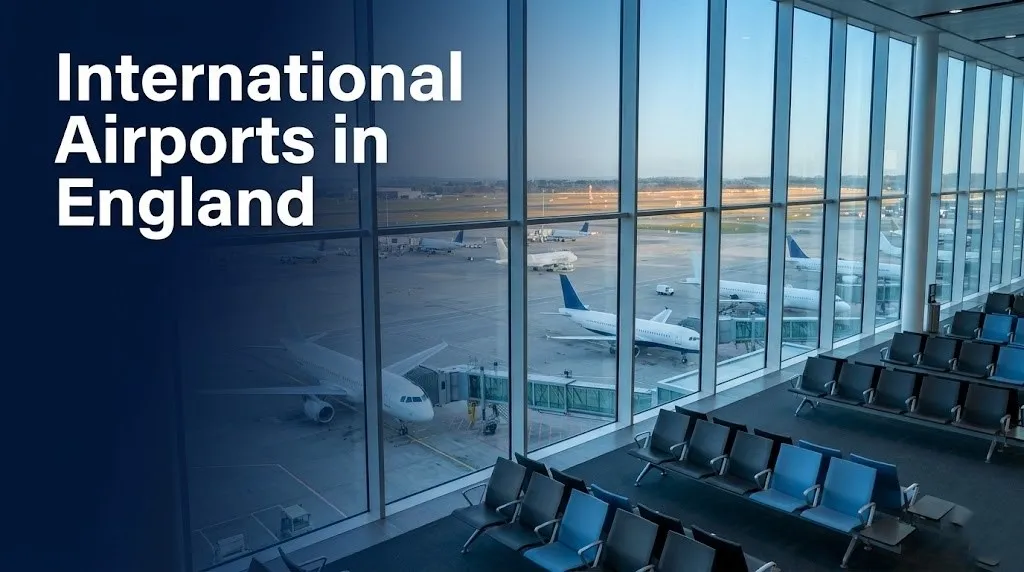
There are 81 airports total in the United Kingdom, though the number with regular scheduled international passenger service is considerably smaller. The airports covered in this guide all handle scheduled international flights to at least one non-UK destination.
Budget travelers should note that England’s busiest airports are not always its best-value airports. Stansted and Luton serve low-cost carriers well but require longer, more expensive ground transfers into central London.
How Many International Airports Are There in England?
England has approximately 15 airports with scheduled international service, ranging from global mega-hubs to single-terminal regional gateways. The number fluctuates slightly as routes open and close seasonally.
The six airports in the London airport system all hold international designations. Outside London, the major international hubs are Manchester Airport (MAN), Birmingham Airport (BHX), Bristol Airport (BRS), Newcastle International Airport (NCL), Leeds Bradford Airport (LBA), and East Midlands Airport (EMA).
Smaller airports with some international charter or scheduled service include Southampton Airport (SOU), Exeter Airport (EXT), and Liverpool John Lennon Airport (LPL). These serve primarily European leisure routes.
First-time international travelers should focus on the six London airports and the three major regional hubs (MAN, BHX, BRS). Smaller airports offer fewer airlines and fewer departure times, which limits flexibility if something goes wrong.
Key Takeaway: England has roughly 15 airports with international scheduled service. London’s six airports and three regional hubs (MAN, BHX, BRS) handle the vast majority of international traffic.
London Heathrow Airport (LHR)
London Heathrow Airport (LHR) is England’s largest and busiest airport, handling over 83 million passengers in 2025 and serving more than 200 destinations worldwide. It is the primary gateway for long-haul international flights into England.
Heathrow currently operates four passenger terminals: Terminal 2, Terminal 3, Terminal 4, and Terminal 5. Terminal 1 is permanently closed and is being cleared to allow an eventual expansion of Terminal 2.
Terminal 2, branded The Queen’s Terminal, handles many Star Alliance airlines. Terminal 3 is home to a mix of long-haul carriers including major transatlantic operators and some British Airways services. Terminal 4 is used by a range of SkyTeam and other international airlines. Terminal 5 is the primary hub for British Airways and Iberia, with three satellite concourses serving both short-haul and long-haul flights.
The Heathrow Express train runs non-stop from Terminals 2 and 3 to London Paddington in approximately 15 minutes. The Heathrow Express takes 15 minutes to get into central London. The Elizabeth line offers a slower but cheaper alternative, connecting all terminals to central London and Canary Wharf.
Heathrow provides free transfer options between terminals, but moving between them can still take 20 to 30 minutes door to door once you include walking and waiting times. Travelers on connecting flights should confirm the minimum connection time for their specific terminal pair.
Business and frequent flyers will find LHR’s lounge offering unmatched in England. British Airways operates the Galleries Lounge and the Concorde Room in Terminal 5. The Virgin Atlantic Clubhouse in Terminal 3 is widely considered one of the strongest airport lounges in the UK.
Families with children should plan for significant terminal distances at LHR. Arrivals with strollers and multiple bags need more transfer time between connections than solo travelers.
| Feature | Detail |
|---|---|
| IATA Code | LHR |
| Terminals | 4 active (T2, T3, T4, T5) |
| Top Airlines | British Airways, Virgin Atlantic, American Airlines, Emirates, United Airlines, Air India, Cathay Pacific |
| Transfer to Central London | 15 min (Heathrow Express), 45-60 min (Elizabeth line), 45-75 min (taxi) |
| Best For | Long-haul international, premium cabin travelers, connecting flight passengers |
| Honest Limitation | Scale creates complexity: wrong terminal or missed connection adds hours |
Verify your terminal assignment directly with your airline before leaving for LHR. Terminal errors at Heathrow are more consequential than at any other English airport.
London Gatwick Airport (LGW)
London Gatwick Airport (LGW) is England’s second-busiest airport, handling 42.8 million passengers in 2025 and connecting travelers to over 227 destinations worldwide. It is located approximately 30 miles south of central London.
London Gatwick Airport has two terminals, the North Terminal and the South Terminal, and was the first in the world to open its own dedicated airport rail station.
easyJet is the largest carrier at Gatwick, with its main base in the North Terminal, while British Airways operates a significant short-haul and leisure long-haul schedule from the South Terminal. Norse Atlantic UK, TUI Airways, Vueling, and Wizz Air UK all use Gatwick as an operating base.
The Gatwick Express runs non-stop to London Victoria in 30 minutes and departs twice per hour. Thameslink services also connect Gatwick to St Pancras International, London Bridge, and London Blackfriars. A taxi to central London typically runs in the £55 to £75 range, though this varies by traffic; verify current fares before traveling.
London Gatwick is set to welcome seven new airlines in 2026, with carriers launching routes across Europe, the Middle East, and Asia as the airport benefits from continued capacity constraints at Heathrow.
Budget travelers benefit most from LGW. easyJet offers extensive European routes at competitive fares. Norse Atlantic UK serves transatlantic routes at lower price points than the legacy carriers at Heathrow.
Business travelers connecting to long-haul routes should note that Gatwick’s long-haul offering is narrower than Heathrow’s. The lounge options are also fewer. The British Airways Lounge in the South Terminal and the No1 Lounge network cover most premium needs, but the selection does not match Terminal 5.
Insider Tip:
- Gatwick’s North and South Terminals are linked by a free automated people mover on the landside before security.
- Confirm your terminal before you leave for the airport; easyJet check-in is in the North Terminal while British Airways uses the South.
- Solo travelers flying low-cost to European cities will find Gatwick’s check-in process faster than Heathrow’s at comparable times of day.
London Stansted Airport (STN)
London Stansted Airport (STN) is England’s third-busiest airport after LHR and LGW, handling approximately 29.8 million passengers in 2025, with its traffic dominated by low-cost European routes. It operates from a single terminal.
London Stansted Airport is located 63 kilometers northeast of central London, making it the most distant of the six London airports from the city center. Ryanair operates its largest UK base at STN, and easyJet also maintains a significant operation here.
The Stansted Express train connects the airport to London Liverpool Street in approximately 47 minutes. Services run frequently but are priced higher than comparable journeys on the Elizabeth line or Gatwick train services. Verify current fares before booking ground transport.
Budget travelers choosing STN for cheap Ryanair or easyJet fares should factor the Stansted Express cost into the total trip price. The combined ticket cost plus ground transport often narrows the fare gap compared to flying from a more central London airport.
First-time international travelers using STN for onward European connections should be aware that STN’s single-terminal layout is straightforward to navigate. The airport is simpler to use than multi-terminal Heathrow, which is an advantage for travelers unfamiliar with large hub airports.
Key Takeaway: Stansted suits budget travelers flying Ryanair or easyJet on European routes. Factor the Stansted Express fare and journey time into your total trip cost before booking.
London Luton Airport (LTN)
London Luton Airport (LTN) serves approximately 16.9 million passengers annually and operates as a hub for low-cost and leisure carriers including Wizz Air, easyJet, and Ryanair. It is located 55 kilometers north of central London.
LTN serves primarily European leisure and VFR (visiting friends and relatives) routes. Long-haul options from Luton are limited compared to Heathrow and Gatwick. The airport operates from a single terminal.
Ground transport from LTN requires a shuttle bus from the terminal to Luton Airport Parkway train station, followed by a Thameslink train to St Pancras International in approximately 30 to 40 minutes. This two-step process catches some first-time travelers off guard. Verify current shuttle timings and train frequency before your trip.
Budget travelers choosing LTN for Wizz Air fares on Eastern European routes will find Luton’s position in the market reasonable. Wizz Air’s base at LTN covers destinations including Budapest, Warsaw, and Bucharest.
Families with children should plan for the shuttle bus step between the terminal and the train station. With multiple bags and young children, this transfer adds complexity. A taxi to central London typically takes 40 to 60 minutes depending on traffic and costs more than the train option.
London City Airport (LCY)
London City Airport (LCY) is England’s most centrally located major airport, sitting just 14 kilometers east of central London in the Docklands area. It handled 3.57 million passengers in 2024 and serves primarily business routes within Europe.
London City Airport (LCY) is located 14 km from central London and is served by the Elizabeth line, with a journey time to Liverpool Street of approximately 15 minutes. This is the fastest and most reliable airport-to-city connection in the London airport system.
British Airways, Loganair, KLM Royal Dutch Airlines, and several regional operators serve LCY. The airport’s short runway limits operations to smaller aircraft, predominantly the Airbus A318, Embraer 190, and similar regional jets. Wide-body long-haul aircraft cannot operate from LCY.
Business and frequent flyers represent LCY’s core audience. The airport’s compact size means short walks, fast security, and minimal queuing. The No1 Lounge at LCY offers a quiet pre-flight option for eligible passengers.
Budget travelers will find fewer low-cost options at LCY than at STN or LTN. Fares tend to run higher given the airport’s location and business-focused passenger mix. LCY does not suit travelers looking for leisure charter flights or long-haul departures.
Key Takeaway: London City Airport is the right choice for business travelers based in east London or Canary Wharf. It is not the right choice for long-haul departures or budget leisure travel.
Manchester Airport (MAN)
Manchester Airport (MAN) is England’s busiest airport outside London and the third-busiest in the entire UK, serving 32 million passengers in 2025 across destinations in Europe, North America, the Middle East, and Asia.
Manchester Airport is located 7 miles (11 km) south-west of Manchester city centre. It operates two passenger terminals. Terminal 1 and Terminal 2 handle a broad mix of airlines including British Airways, easyJet, Jet2.com, TUI Airways, Emirates, Qatar Airways, and Delta Air Lines.
A dedicated rail station connects MAN to Manchester Piccadilly in approximately 20 minutes. From Piccadilly, onward rail connections reach Liverpool, Leeds, Sheffield, and Edinburgh. National Express coaches serve destinations across northern England from the airport’s coach station.
Travelers visiting Yorkshire, Lancashire, Cheshire, or the Lake District will find MAN the most practical arrival airport. The rail network from Manchester Piccadilly is extensive.
Business travelers will find the Escape Lounge and No1 Lounge at MAN offer adequate pre-flight facilities. The full-service long-haul offering from Emirates and Qatar Airways makes MAN a genuine alternative to routing through London for passengers traveling from North America to the Middle East or Asia.
| Airline | Destination Type | Notes |
|---|---|---|
| British Airways | European + domestic | Operates from T3 |
| easyJet | European low-cost | Large base at MAN |
| Jet2.com | European leisure | Major northern base |
| Emirates | Dubai long-haul | Daily A380 service |
| Qatar Airways | Doha long-haul | Daily Airbus A350 service |
| Delta Air Lines | Transatlantic | New York and Atlanta routes |
Verify current airline terminal assignments directly with your carrier before traveling to MAN, as terminal reallocations occur periodically.
Birmingham Airport (BHX)
Birmingham Airport (BHX) is the largest English airport outside London and Manchester, handling a record 13 million passengers in 2024/25 and flying to over 135 destinations across Europe, the Middle East, the Indian subcontinent, Africa, and the Caribbean.
Located in Bickenhill, Solihull, 8 miles (13 km) east of Birmingham city centre, BHX operates from a single integrated terminal. Ryanair, easyJet, Jet2, and TUI Airways are the largest carriers, with long-haul services from Emirates, Qatar Airways, Turkish Airlines, Air India, and Saudia.
The fastest way to reach the city centre is by train from Birmingham International station, connected via the free Air-Rail Link monorail, taking just 10 minutes to Birmingham New Street. Train fares from Birmingham International to New Street run from approximately £3. Verify current pricing before travel.
Travelers visiting the Midlands, Stratford-upon-Avon, Coventry, or the Cotswolds will find BHX considerably more convenient than routing through London. The direct train to London Euston takes approximately 70 minutes from Birmingham International.
Business travelers on Middle East or Indian subcontinent routes will find Emirates and Qatar Airways at BHX a practical alternative to Heathrow. The Aspire Lounge at BHX covers premium pre-flight needs, though the selection is narrower than Heathrow’s T5.
The Air-Rail Link monorail runs every 2 minutes between the Airport Terminal and Birmingham International Train Station. The journey takes just 90 seconds. This is one of the most efficient airport-to-rail connections in England.
Key Takeaway: Birmingham Airport is the Midlands traveler’s best starting point. The free Air-Rail Link to Birmingham International station and the 10-minute train to New Street make it one of the most rail-connected airports in England.
Bristol Airport (BRS)
Bristol Airport (BRS) is the primary international gateway for southwest England and serves as a practical alternative for travelers visiting Wales, Somerset, or the Cotswolds. It operates from a single terminal approximately 7 miles from Bristol city center.
Bristol Airport is about seven miles from the centre of Bristol. You can fly to many places in Europe from here. There are even direct flights to Orlando and Cancun. Ryanair and easyJet operate the largest route networks from BRS, with Jet2.com serving popular European leisure destinations.
The Bristol Airport Flyer Express bus connects the terminal to Bristol city center and Temple Meads railway station in approximately 30 minutes. Coach services also connect BRS to Bath, making it a practical entry point for travelers heading to Bath without needing to transit through London. Verify current bus timetables and fares before travel.
Budget travelers flying to Spanish, Portuguese, or Greek destinations from the southwest of England will find BRS competitive with flying from London. The shorter ground transfer from southwest England addresses the cost and time penalty of routing through Heathrow.
Families visiting Cornwall or the Somerset coast should consider BRS over routing through London. The drive time from Bristol Airport to popular southwest destinations is significantly shorter than from any London airport.
Insider Tip:
- The Aspire Lounge at BRS covers Priority Pass members and eligible cardholders. Pre-book access in peak summer months.
- BRS operates more seasonal routes than year-round routes; confirm your intended destination operates in your travel month before booking.
- Travelers heading to Wales can reach Cardiff by road from BRS in under an hour, making BRS a practical alternative to Cardiff Airport for some routes.
Newcastle International Airport (NCL)
Newcastle International Airport (NCL) is the primary international airport for northeast England, located approximately 7 miles north of Newcastle city center and serving destinations across Europe and beyond.
Newcastle International Airport is approximately six miles north of the city of Newcastle and serves as a hub to the far north of England. Loganair and Jet2.com use NCL as an operating base. Ryanair and TUI Airways also serve the airport.
The Metro light rail system connects NCL to Newcastle city center in approximately 25 minutes. This is one of the most convenient airport-to-city rail connections among England’s regional airports. Train fares on the Metro are low relative to London airport ground transport. Verify current Metro fares before travel.
Travelers heading to Durham, Northumberland, or the Scottish Borders will find NCL considerably more convenient than routing through Manchester or London. The drive from NCL to Durham takes under 30 minutes.
Budget travelers should note that NCL’s route network, while useful for European destinations, is narrower than MAN or BHX. Long-haul options from NCL are limited. Travelers flying long-haul to North America or Asia will generally need to route through London or Manchester.
Newcastle International Airport is also an operating base for a few airlines. You can relax in lounges like the Aspire Lounge or the British Airways Lounge. The Aspire Lounge at NCL is the main pre-flight lounge option for eligible Priority Pass members.
Leeds Bradford Airport (LBA)
Leeds Bradford Airport (LBA) serves the Yorkshire region and offers a range of European leisure routes alongside a small number of long-haul charter services, primarily to holiday destinations. It is located approximately 9 miles from Leeds and 8 miles from Bradford.
Leeds Bradford Airport is approximately nine miles away from the city of Leeds and is accessible via a shuttle bus service that connects to major train stations in Leeds, Bradford, and Harrogate. No direct rail link exists between LBA and Leeds city center. A shuttle bus connects the airport to Horsforth and Guiseley train stations, from where trains run to Leeds and Bradford. Verify current shuttle schedules before travel.
Jet2.com operates its largest base from LBA, with routes to Spain, Portugal, Greece, Turkey, and the Canary Islands. easyJet and Ryanair also serve the airport. Long-haul options from LBA are very limited; travelers needing transatlantic or long-haul connections should use MAN.
Budget travelers visiting the Yorkshire Dales, the Broads, or York will find LBA practical for European origins. Jet2.com fares from LBA to Mediterranean leisure destinations are competitive.
Business travelers and anyone needing a long-haul connection should route through Manchester Airport instead. MAN’s broader airline network and direct rail access to Leeds Piccadilly via Manchester Piccadilly make it a more practical option for complex itineraries.
Key Takeaway: Leeds Bradford Airport suits Yorkshire leisure travelers on European routes. For any long-haul itinerary or business travel, Manchester Airport is a stronger choice with better connections.
East Midlands Airport (EMA)
East Midlands Airport (EMA) is located near Castle Donington in Leicestershire, roughly equidistant between Nottingham, Derby, and Leicester, and serves primarily European leisure routes with a smaller set of year-round scheduled services.
EMA operates from a single terminal and is served by Ryanair, Jet2.com, and a smaller set of carriers. TUI Airways operates extensive charter and leisure routes from EMA to sun-holiday destinations in Spain, Greece, and Turkey. Long-haul options from EMA are minimal.
Ground transport from EMA to city centers in the region requires a coach or taxi, as no direct rail link connects the airport to the national rail network. Skylink coach services connect EMA to Nottingham, Derby, and Leicester, with journey times ranging from 40 to 70 minutes depending on destination. Verify current Skylink timetables before travel.
Budget travelers visiting Nottingham, Leicester, or Derby may find EMA convenient if their airline serves the airport on their required route. However, EMA’s lack of rail access means ground transport costs and journey times are higher than comparable regional airports.
Families driving to the airport from the Midlands will find EMA’s car parking infrastructure practical. EMA is well positioned on the M1 motorway corridor. For those without a car, BHX or MAN are generally more accessible options for the wider Midlands region.
Which English Airport Should I Fly Into?
The right English airport depends entirely on your destination within England and which airlines serve your origin city. There is no universally best answer.
For travelers arriving in London, Heathrow (LHR) offers the most connections and the most reliable onward rail access. Gatwick (LGW) is the better choice for travelers arriving on easyJet or budget long-haul carriers. Stansted (STN) and Luton (LTN) suit budget travelers flying Ryanair or Wizz Air who are willing to accept longer ground transfer times.
For travelers heading to the Midlands, Birmingham Airport (BHX) is the clear choice. The 10-minute rail link to Birmingham New Street and the city’s central position make BHX significantly more practical than routing through Heathrow.
For travelers heading to the north of England, Manchester Airport (MAN) is the primary hub. Newcastle Airport (NCL) suits travelers heading specifically to the northeast. Leeds Bradford (LBA) suits Yorkshire-bound travelers on European leisure routes.
| Airport | IATA | Best For | Distance to City Center | Transfer Time |
|---|---|---|---|---|
| London Heathrow | LHR | Long-haul, premium cabin | 26 km | 15 min (Heathrow Express) |
| London Gatwick | LGW | European budget, growing long-haul | 45 km | 30 min (Gatwick Express) |
| London Stansted | STN | Ryanair, European budget | 63 km | 47 min (Stansted Express) |
| London Luton | LTN | Wizz Air, Eastern Europe | 55 km | 30-40 min (train, after shuttle) |
| London City | LCY | Business, Docklands | 14 km | 15 min (Elizabeth line) |
| Manchester | MAN | North England, long-haul | 11 km | 20 min (rail) |
| Birmingham | BHX | Midlands, Middle East routes | 13 km | 10 min (train) |
| Bristol | BRS | Southwest, Wales | 11 km | 30 min (bus) |
| Newcastle | NCL | Northeast England | 11 km | 25 min (Metro) |
| Leeds Bradford | LBA | Yorkshire leisure | 14 km | 30-40 min (shuttle+train) |
First-time international travelers should choose LHR for arrivals if their airline serves it. The Heathrow Express and the Elizabeth line are both straightforward to use and signposted clearly.
Key Takeaway: Choose your English airport based on your destination city first, not on price alone. A cheaper fare into Stansted can cost more in total trip time than flying into Heathrow.
Ground Transport from English Airports to City Centers
Getting from an English airport to your destination involves train, coach, bus, taxi, or a combination of these. The options, costs, and journey times vary significantly between airports.
London Heathrow (LHR): The Heathrow Express runs non-stop to Paddington in 15 minutes. The Elizabeth line is slower but cheaper and connects to more central London stations including Bond Street, Tottenham Court Road, and Liverpool Street. Taxi fares to central London vary by destination and traffic. Verify current Heathrow Express and Elizabeth line fares before booking.
London Gatwick (LGW): The Gatwick Express runs non-stop to London Victoria twice every hour, with a journey time of just 30 minutes. Thameslink trains provide a cheaper alternative connecting Gatwick to St Pancras International.
London Stansted (STN): The Stansted Express runs to London Liverpool Street in approximately 47 minutes. National Express coaches connect STN to central London and other English cities. Coach fares are generally lower than the train.
London Luton (LTN): A shuttle bus connects the terminal to Luton Airport Parkway station. Thameslink trains then run to St Pancras International in approximately 30 to 40 minutes. Verify current shuttle timings as these run on a fixed schedule with gaps.
London City (LCY): The Elizabeth line connects LCY to Liverpool Street and central London in approximately 15 minutes. This is the most straightforward airport-to-city transfer in the London airport system.
Manchester Airport (MAN): A direct rail connection from the airport station reaches Manchester Piccadilly in approximately 20 minutes. From Piccadilly, onward trains connect across northern England. Verify current National Rail timetables before travel.
Birmingham Airport (BHX): The Air-Rail Link monorail runs every 2 minutes to Birmingham International station, with the journey taking just 90 seconds. Trains from International reach Birmingham New Street in approximately 10 minutes.
Solo travelers using public transport should pre-purchase Heathrow Express or Stansted Express tickets online, as walk-up fares are higher. The Oyster card and contactless payment work on the Elizabeth line, London Underground, and Thameslink services.
Airport Lounges at English International Airports
English international airports offer a range of pre-flight lounges accessible through airline status, business class tickets, credit card membership, or Priority Pass and Lounge Key memberships.
London Heathrow (LHR) has the strongest lounge offering in England. British Airways operates the Galleries Club, Galleries First, and the Concorde Room in Terminal 5. The Virgin Atlantic Clubhouse in Terminal 3 is widely recognized among premium travelers for its dining, bar, and spa facilities. Star Alliance member airlines access the United Club and Air Canada Maple Leaf Lounge in Terminal 2.
London Gatwick (LGW) offers the No1 Lounge in both the North and South Terminals, accessible via Priority Pass. British Airways has a lounge in the South Terminal for eligible business class passengers and Gold Executive Club members. The selection at LGW is narrower than at LHR but covers most common access methods.
Manchester Airport (MAN) offers the Escape Lounge and the No1 Lounge, accessible to Priority Pass members and qualifying cardholders. Emirates and Qatar Airways passengers flying long-haul from MAN may have access to their respective airline lounges on qualifying tickets.
Birmingham Airport (BHX) operates the Aspire Lounge, accessible through Priority Pass, Lounge Key, and certain airline ticket classes. The lounge covers standard food, drink, and comfortable seating, though it does not match the scale of Heathrow’s Terminal 5 options.
Regional airports including BRS, NCL, and LBA predominantly offer the Aspire Lounge network through Priority Pass. Travelers holding Priority Pass through a credit card or travel membership can access these lounges. Confirm your specific lounge eligibility before arriving, as access rules and capacity limits apply.
Business and frequent flyers should verify lounge access eligibility directly with the lounge operator before assuming priority access applies at smaller English regional airports. Priority Pass access at some regional lounges may require pre-booking during peak periods.
Insider Tip:
- British Airways Galleries access at LHR Terminal 5 requires either a business class ticket, Executive Club Gold or Silver status, or a qualifying companion card.
- The Virgin Atlantic Clubhouse at LHR Terminal 3 is one of the strongest pre-flight lounges in England. Access requires a Virgin Atlantic Upper Class ticket or specific Amex Platinum card access.
- Priority Pass members should verify specific lounge participation before assuming access at smaller airports. Participation can change without advance notice.
Frequently Asked Questions About International Airports in England
How many international airports are there in England?
England has approximately 15 airports with scheduled international service in 2026, ranging from London Heathrow with over 83 million annual passengers to smaller regional gateways like Exeter Airport.
The six airports in the London airport system all hold international designations: Heathrow (LHR), Gatwick (LGW), Stansted (STN), Luton (LTN), City (LCY), and Southend (SEN).
Outside London, the main international airports are Manchester (MAN), Birmingham (BHX), Bristol (BRS), Newcastle (NCL), Leeds Bradford (LBA), and East Midlands (EMA).
What is the best airport to fly into for London?
London Heathrow Airport (LHR) is the best airport to fly into for most travelers visiting London, offering the most airline connections and the fastest rail link to central London via the Heathrow Express in 15 minutes.
London Gatwick (LGW) is the better choice for budget travelers flying easyJet or Norse Atlantic UK, with the Gatwick Express reaching Victoria in 30 minutes.
Stansted (STN) and Luton (LTN) are furthest from central London and suit travelers whose specific airline only flies into those airports and who have flexible ground transfer plans.
Is Heathrow or Gatwick better for first-time visitors?
London Heathrow Airport (LHR) is generally better for first-time visitors because it offers more airlines, more flight frequencies, and a faster rail connection to central London.
Gatwick is a strong second choice, particularly for travelers flying with easyJet or arriving on transatlantic Norse Atlantic UK services, with straightforward terminal navigation and a reliable train connection.
The main honest caution about Heathrow for first-time visitors is terminal complexity: LHR has four active terminals and inter-terminal transfers take 20 to 30 minutes, which can stress a new traveler on a tight connecting flight.
Which airport should I use for the north of England?
Manchester Airport (MAN) is the primary international gateway for the north of England, offering direct long-haul routes to North America, the Middle East, and Asia alongside extensive European services.
Newcastle International Airport (NCL) is the right choice for travelers heading specifically to the northeast, including County Durham, Northumberland, and the Scottish Borders, with Metro rail access to Newcastle city center in 25 minutes.
Leeds Bradford Airport (LBA) suits Yorkshire-bound travelers on European leisure routes, though MAN is a stronger option for any long-haul connection or complex itinerary.
How do I get from Heathrow Airport to central London?
The Heathrow Express train is the fastest option, running non-stop from Heathrow Terminal 2 and 3 to London Paddington in 15 minutes, with trains departing every 15 minutes. A terminal 4 and 5 service also runs.
The Elizabeth line provides a cheaper and slightly slower alternative, connecting all Heathrow terminals to central London stations including Bond Street, Tottenham Court Road, and Liverpool Street.
Verify current Heathrow Express fares and Elizabeth line pricing before your trip, as these change periodically. The Heathrow Express requires a separate ticket, while the Elizabeth line accepts Oyster cards and contactless payment.
Is it cheaper to fly into Stansted or Luton than Heathrow?
The ticket price into Stansted (STN) or Luton (LTN) is often lower because both airports serve primarily low-cost carriers like Ryanair and Wizz Air, but the total trip cost depends on ground transport.
Stansted and Luton host many low-cost European services, while the Stansted Express and the Luton shuttle-plus-Thameslink combination cost more in both money and time than flying into a more central London airport.
Calculate the total door-to-door trip cost including ground transport from both options before booking. For some travelers on tight itineraries, the slightly higher Heathrow or Gatwick fare is the cheaper total-trip option.
England’s international airports cover every travel need, from ultra-long-haul connections at Heathrow to low-cost European leisure at Stansted, budget-friendly Midlands access at Birmingham, and practical northern England entry at Manchester. The right airport for you is the one closest to your actual destination, served by your airline, with ground transport you can afford and manage.
Book your ground transport before you arrive, not after you land. Heathrow Express and Stansted Express tickets are cheaper purchased in advance online. Verify your terminal assignment directly with your airline before leaving for the airport, as terminal reallocations happen without widely publicized advance notice.
Airline schedules, lounge access policies, terminal assignments, and ground transport fares all change without notice. Verify every detail directly with your airline and the official airport authority before you travel.