Turkish Airlines configures its Airbus A350-900 with 32 business class suites in a 1-2-1 layout and 297 economy seats in a 3-3-3 arrangement. Every business class seat offers direct aisle access and converts to a fully lie-flat bed.
The A350 is Turkish Airlines’ most modern wide-body aircraft and the best passenger experience in the fleet. Its cabin is quieter, the air is more humid, and the windows are larger than the older Boeing 777.
This guide names the exact rows to book and avoid in every cabin class. It compares Turkish Airlines’ A350 layout against Singapore Airlines’ A350 and gives specific seat recommendations for solo travelers, couples, and families.
Airbus A350-900 Turkish Airlines Seat Map: Cabin Overview
Turkish Airlines A350-900 seats 329 passengers across two cabin classes with business class in the forward cabin and economy filling the remainder. The aircraft features the Airbus Airspace cabin with wider aisles and larger overhead bins.
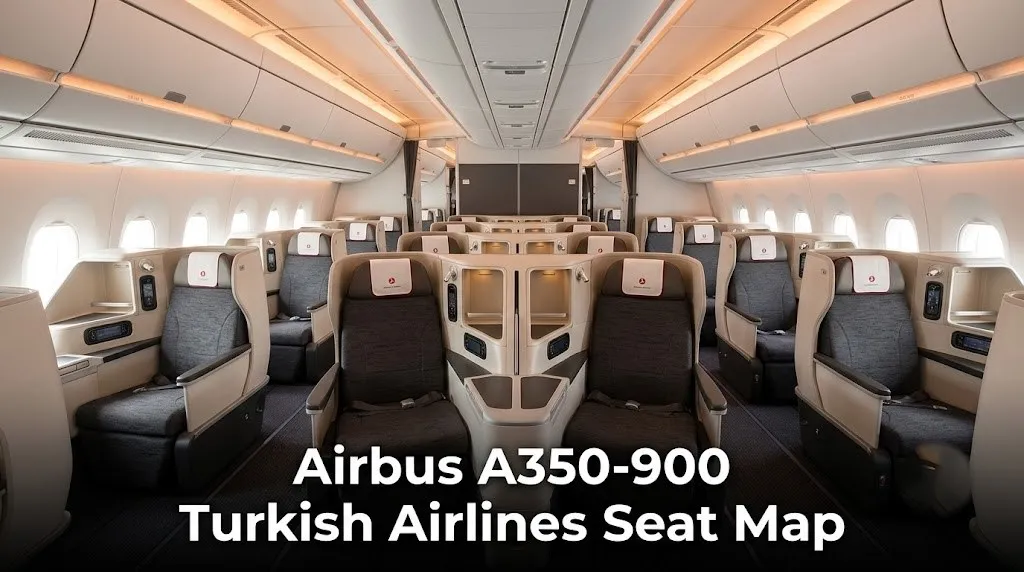
Business class occupies the space between the forward entry door and door two with 32 lie-flat suites in eight rows. The 1-2-1 reverse herringbone configuration gives every suite direct aisle access.
Economy class begins behind door two and extends to the rear of the aircraft with 297 seats across 33 rows. The 3-3-3 layout is standard for the A350 with an 18-inch seat width in most economy rows.
Galley and lavatory placement affects specific seats with forward and mid-cabin galleys creating noise and light disturbances for nearby rows. The rear galley and lavatories affect the last several rows of the economy cabin.
Key Takeaway: Turkish Airlines A350-900 has 32 business suites in 1-2-1 and 297 economy seats in 3-3-3. This is the airline’s best wide-body cabin.
Turkish Airlines Airbus A350-900 Seat Map: Complete Layout
The Turkish Airlines A350-900 seat map shows business class in rows 1 through 8 with a galley and lavatory complex forward of row 1. A mid-cabin galley and lavatory area separates business class from economy class behind row 8.
Economy class spans rows 10 through 43 with two over-wing exit rows at rows 24 and 25. Row 10 is a bulkhead row behind the mid-cabin galley with bassinet positions on the center section.
The seat map layout on Turkish Airlines A350 aircraft is largely consistent across the fleet with minor galley placement variations between sub-fleets. The configuration has remained stable since the A350 entered service with the airline.
Overhead bins on the A350 are the Airbus Airspace design with more capacity than older aircraft types. Bin space is rarely an issue in business class and manageable in economy except on completely full flights.
The aircraft features large windows with electronic dimming rather than physical shades on most A350s. Window seat passengers control the dimming level with a button below the window.
Turkish Airlines A350 Seat Map: Row-by-Row Guide
Row 1 in business class sits directly behind the forward galley and lavatory with potential noise from galley activity and lavatory door operation. The bulkhead position provides a larger footwell cutout for sleeping.
Rows 2 through 7 in business class are standard lie-flat suites with no bulkhead restrictions. Row 8 is the last business class row before the mid-cabin galley with some noise from the galley area during meal service.
Row 10 in economy is a bulkhead row behind the mid-cabin galley with bassinet positions on the center section. Legroom is better than standard economy but the tray table deploys from the armrest reducing seat width slightly.
Rows 11 through 23 are standard economy rows with consistent seat pitch and no unusual restrictions. These rows are the best balance of position and quiet in the economy cabin.
Row 24 is an over-wing exit row with substantial legroom due to the exit door cutout. Row 25 behind it is also an exit row with good legroom and full recline unlike some exit row configurations.
Row 43 is the last economy row before the rear galley and lavatories with limited or no recline and constant passenger traffic nearby. Avoid row 43 unless no other seats are available.
Key Takeaway: Book business class rows 2 through 7 for standard suites. Choose economy rows 11 through 23 for quiet. Avoid row 43 entirely.
Turkish Airlines A350-900 Seat Map: What You See at Booking
The Turkish Airlines A350-900 seat map appears during the booking flow on turkishairlines.com and in the manage booking portal after ticketing. The map displays available seats with color coding for occupied, available, and blocked seats.
Seat selection fees apply based on fare class and seat type with business class seats free for business class passengers. Economy seat selection fees vary with standard seats free on flexible fares and costing a fee on promotional fares.
The seat map legend identifies bassinet positions, exit rows, seats with limited recline, and seats near galleys and lavatories. Review the legend carefully before selecting seats on an unfamiliar aircraft type.
Extra legroom seats including exit rows and select bulkhead positions are marked on the seat map with a higher fee tier. These seats are the first to be selected by paying passengers and elite members.
Miles and Smiles Elite members receive complimentary seat selection including extra legroom seats on most fare classes. Star Alliance Gold members also benefit from free seat selection on Turkish Airlines.
Airbus A350-900 Seat Map Turkish Airlines: Business Class
Turkish Airlines A350-900 business class features Stelia Aerospace Symphony seats in a 1-2-1 reverse herringbone configuration. Each suite offers direct aisle access with no need to step over a seatmate.
The seat converts to a fully lie-flat bed measuring approximately 76 inches in length with a width of 21 inches at the shoulder. The lie-flat mechanism operates with intuitive touch controls located on the side console.
The 18-inch high-definition inflight entertainment screen is positioned on the suite wall or a swing-out arm depending on seat location. The IFE system includes a USB port, AC power outlet, and headphone jack at each seat.
Storage includes a side console with a small personal items area, a literature pocket, and a shoe storage space below the ottoman. The storage is adequate for a long-haul flight but not as generous as the Qatar Airways Qsuite.
Solo travelers should select true window seats on the A and K sides for maximum privacy with the suite angled toward the window. The center E and F seats angle toward each other with a privacy divider that can be partially lowered.
Couples traveling together should choose center seats in the same row where the privacy divider allows conversation and shared dining. The center seats offer less privacy for solo travelers but work perfectly for pairs.
Airbus A350 Seat Map Turkish Airlines: Economy Cabin
Turkish Airlines A350-900 economy class features 297 seats in a 3-3-3 configuration with a standard seat pitch of approximately 31 to 32 inches. Seat width measures 18 inches on most seats with slightly reduced width at armrest positions.
The economy seat includes an adjustable headrest, a personal IFE screen measuring 11 to 12 inches, and a USB port for device charging. AC power outlets are shared between seats with two outlets per three-seat group.
The seatback IFE system offers a solid selection of movies, television shows, music, and games with a responsive touchscreen interface. The content library is competitive with other major international carriers though not as deep as Emirates ICE.
Window and aisle seats are the best choice in economy with middle seats remaining the least desirable position. The 3-3-3 layout means each row has two aisle seats, two window seats, and four middle seats.
Underseat storage varies by seat location with aisle seats often having slightly less width due to the seat support structure. Window seats generally have the most underseat space in the economy cabin.
Budget travelers on Turkish Airlines A350 economy flights should select window or aisle seats at booking to avoid the middle seat assignment that auto-assigned Basic Economy tickets often receive.
Turkish Airlines Airbus A350 Seat Map: Cabin Zones
Turkish Airlines divides the A350-900 cabin into zones for boarding and service purposes with business class as Zone 1 and economy split into multiple zones. The front economy cabin behind business class boards before the rear economy cabin.
The forward economy cabin spans rows 10 through approximately row 24 with a quieter environment and faster meal service. This zone is preferable for passengers who want to deplane quickly upon arrival.
The rear economy cabin extends from approximately row 25 through row 43 with the final rows affected by galley and lavatory proximity. The rear zone boards last and receives meal service after the forward economy cabin.
Galley noise affects specific rows near the mid-cabin and rear galley areas including rows 10, 24, 25, and 42 through 43. Lavatory congregation areas form near rows 10, 24, 25, and 43.
Passengers sensitive to noise should avoid rows adjacent to galley and lavatory complexes. The quietest economy rows on the Turkish Airlines A350 are typically rows 15 through 20 in the forward economy cabin.
Airbus A350 Wide Body Turkish Airlines Seat Map: Twin-Aisle Layout
The Turkish Airlines A350-900 features a standard twin-aisle wide-body layout with two aisles running the length of the cabin separating the seat columns. The 1-2-1 business class and 3-3-3 economy configurations use both aisles for passenger movement.
The twin-aisle layout means no passenger is more than one seat from an aisle in economy class. Window seat passengers in 3-3-3 cross one seatmate to reach the aisle while center section passengers have direct or one-seat aisle access.
Aisle width on the A350 is slightly wider than older wide-body aircraft due to the Airspace cabin design. Cart service in the aisle is less disruptive to aisle seat passengers than on the Boeing 777.
The two aisles create two independent streams for boarding and deplaning with passengers in the left and center-left columns using the left aisle and right and center-right columns using the right aisle. Boarding is faster than on single-aisle aircraft.
Overhead bins above the center section are larger than the outboard bins on the A350. Passengers in center seats may find bin space above their seats more available than window seat passengers.
Turkish Airlines A350-900 Business Class Seat Map: Suite Details
Turkish Airlines A350-900 business class suites are arranged in a 1-2-1 layout with alternating rows angled toward the window or aisle depending on seat position. The reverse herringbone design angles seats away from the aisle for privacy.
Row 1 suites have a larger footwell cutout in the bulkhead wall providing more foot space in bed mode. The trade-off is proximity to the forward galley and lavatory with associated noise throughout the flight.
Row 8 suites sit directly in front of the mid-cabin galley and economy cabin divider. Meal preparation noise and passenger congregation near the galley affect these suites during service periods.
The center suites in rows 2 through 7 offer the best couple experience with the privacy divider that can be lowered for shared conversation and dining. These suites do not combine into a double bed but allow face-to-face interaction.
Solo business travelers should avoid center suites in rows 2 through 7 when traveling alone. The center seats angle toward each other and offer less privacy for single occupants than the window seats.
True window suites on the A and K sides throughout rows 2 through 7 are the best overall business class seats on the Turkish Airlines A350. These suites offer maximum privacy with the seat angled toward the window and away from the aisle.
Key Takeaway: Business class window seats in rows 2 through 7 are best for solo travelers. Center seats work for couples.
Turkish Airlines A350 Business Class Seats: Best and Worst
The best business class seats on the Turkish Airlines A350-900 are window suites in rows 2 through 7 on the A and K sides. These seats offer maximum privacy, minimal galley noise, and the standard lie-flat bed experience.
The worst business class seats are row 1 suites due to forward galley and lavatory noise plus the brightest cabin lighting near the forward entry door. Row 8 suites suffer from mid-cabin galley noise and economy cabin light spill.
Center suites in rows 2 through 7 are the best choice for couples traveling together who want to interact during the flight. The privacy divider partially lowers for conversation while maintaining suite enclosure.
Seats immediately adjacent to the lavatory on the left side of the forward cabin experience door operation noise and occasional passenger queuing. These seats are still private suites but with slightly more disturbance.
Business travelers on overnight flights should prioritize the window seats in rows 3 through 6 for the quietest sleep environment. These rows are centrally located between both galley areas with minimal noise from either end.
Turkish Airlines A350 Economy Seat Map: Standard Rows
Turkish Airlines A350-900 standard economy rows span rows 11 through 23 and rows 26 through 42 with consistent seat pitch of 31 to 32 inches. These rows offer the baseline economy experience with no special features or restrictions.
Row 11 is a standard row behind the bulkhead row 10 with full recline and no underseat storage restrictions. Row 11 benefits from slightly faster meal service than rows further aft.
Rows 12 through 23 are the best economy position on the aircraft with proximity to the forward economy galley for faster service and forward lavatories for shorter walks. These rows also deplane earlier than the rear cabin.
Rows 26 through 42 offer the same seat dimensions as the forward economy cabin but board later and receive meal service after the forward zone. Seat quality is identical but the location is less desirable.
Row 42 is the second-to-last row with limited recline due to the rear galley wall proximity. Row 43 is the last row with no recline and constant lavatory and galley traffic making it the worst economy seat on the aircraft.
Solo travelers in economy should select a window seat in rows 12 through 20 for the best combination of quiet, view, and position. Aisle seats in these rows work well for passengers who prioritize easy lavatory access.
Turkish Airlines A350 Economy Extra Legroom: Exit and Bulkhead
Turkish Airlines A350-900 extra legroom economy seats are located at row 10 bulkhead, row 24 exit row, and row 25 exit row. These seats offer substantially more legroom than standard economy rows.
Row 10 is a bulkhead row behind the mid-cabin galley with legroom extending into the open space in front of the seats. The tray table deploys from the armrest reducing seat width by approximately half an inch.
Row 10 center section seats are bassinet positions with fold-down infant bassinet attachments. Passengers without infants may be reassigned from these seats if a traveling infant requires the bassinet.
Row 24 is the primary over-wing exit row with maximum legroom among all economy seats. The exit door creates a large open space in front of these seats with no underseat storage limitation.
Row 25 is the secondary exit row behind row 24 with similar legroom and full recline. The exit row position behind row 24 means row 25 seats are less likely to be bumped for exit row qualification.
Tall passengers should target rows 24 or 25 window or aisle seats for the best legroom on the aircraft. These exit row seats are the single best value in the Turkish Airlines A350 economy cabin.
Key Takeaway: Rows 24 and 25 exit row seats offer the best economy legroom. Row 10 bulkhead suits families with infants.
Turkish Airlines A350 Best Seats: Top Picks by Profile
For solo business travelers, the best seat is any true window suite on the A or K side in rows 2 through 7. These suites offer maximum privacy with the seat angled away from the aisle and toward the window.
For couples in business class, the best seats are center E and F suites in rows 2 through 7. The privacy divider partially lowers allowing conversation and shared dining with full suite enclosure.
For families with infants, the best seats are row 10 center section bassinet positions in economy or bulkhead suites in business class row 1. Request bassinet seating at booking through Turkish Airlines customer service.
For tall economy passengers, the best seats are row 24 or 25 exit row window or aisle positions. These exit rows offer maximum legroom and are the best value upgrade in the economy cabin.
For economy passengers wanting quiet, the best seats are window seats in rows 15 through 20 in the forward economy cabin. These seats are far from all galleys and lavatories with minimal passenger traffic nearby.
The worst seats on the aircraft are row 43 in economy with no recline and lavatory proximity, and row 1 and row 8 in business class with galley noise throughout the flight.
Turkish Airlines A350 Bassinet Seats: Family Guide
Turkish Airlines A350-900 bassinet positions are located in business class row 1 center suites and economy class row 10 center section seats. These positions have fold-down infant bassinet attachments for babies under a specified weight and length.
Bassinet seats must be requested through Turkish Airlines customer service at the time of booking or as early as possible before departure. Bassinet availability is limited and not guaranteed until confirmed by the airline.
The bassinet attaches to the bulkhead wall in front of the seat and is deployed after takeoff and stowed before landing. The infant must be secured in an adult’s lap or an approved child restraint during taxi, takeoff, and landing.
Families traveling with infants should book bassinet seats directly rather than relying on standard seat selection. The bassinet request is separate from the seat assignment and both must be confirmed.
Passengers seated in bassinet positions who are not traveling with an infant may be reassigned if the bassinet is needed for a traveling infant. Select an alternative extra legroom seat if bassinet displacement is a concern.
Business class row 1 center suites offer the bassinet position for premium cabin families. The forward bulkhead location provides a stable bassinet attachment with minimal disturbance to other business class passengers.
Airbus A350-900 Seat Map Singapore Airlines: Comparison
Singapore Airlines A350-900 configures its business class differently from Turkish Airlines with a 1-2-1 layout using a different seat manufacturer and design. The Singapore Airlines seat is a custom Stelia Aerospace product distinct from Turkish Airlines’ Symphony seat.
Singapore Airlines A350 business class seats offer a similar lie-flat bed experience with direct aisle access in a forward-facing staggered configuration rather than Turkish Airlines’ reverse herringbone. The Singapore seat bed is slightly longer at approximately 78 inches.
Singapore Airlines A350 economy class uses a 3-3-3 layout with similar pitch to Turkish Airlines at 32 inches but with a newer generation seat design featuring an 11.6-inch IFE screen. Turkish Airlines economy IFE screens are comparable in size and quality.
Singapore Airlines does not operate a premium economy cabin on the A350-900 in most configurations. Turkish Airlines similarly does not offer Comfort Class on the A350 reserving that product for the Boeing 787 fleet.
The Singapore Airlines A350 business class is rated higher by Skytrax and Conde Nast Traveler for overall passenger experience. However, the Turkish Airlines A350 business class hard product is genuinely competitive with the Singapore product in seat dimensions and privacy.
A350-900 Seat Map Singapore Airlines: Key Differences
The primary seat map difference between Singapore Airlines and Turkish Airlines A350-900 aircraft is the business class seat design and the presence of premium economy on some Singapore Airlines A350 configurations. The economy layouts are broadly similar.
Singapore Airlines A350 business class uses a forward-facing staggered seat while Turkish Airlines uses a reverse herringbone angled seat. Both offer direct aisle access and lie-flat beds but the privacy feel differs.
Singapore Airlines A350 aircraft on some routes feature a premium economy cabin with 24 seats in a 2-4-2 configuration between business and economy. Turkish Airlines A350s do not have a premium economy section.
Singapore Airlines A350 economy seat pitch is 32 inches across most configurations compared to Turkish Airlines at 31 to 32 inches. The difference is marginal and most passengers will not notice the variation.
The IFE systems on both airlines are excellent with Singapore Airlines KrisWorld offering a slightly larger content library. Turkish Airlines’ Planet IFE is competitive with a good selection of international content.
Solo travelers on either airline should select true window seats in business class. The experience difference between the two carriers is in the soft product, service, and catering, not the hard product seat map layout.
Key Takeaway: Singapore Airlines A350 business class uses staggered forward-facing seats. Turkish Airlines uses reverse herringbone. Both are 1-2-1 lie-flat.
Important Accuracy Notes for Turkish Airlines A350 Seat Map
Turkish Airlines A350-900 seat configurations and specific row assignments can vary between sub-fleets. The layout described reflects the most common configuration with minor variations possible on specific tail numbers.
Verify the following directly before traveling:
Your specific flight’s aircraft type and seat map on turkishairlines.com at the time of booking using the interactive seat map tool.
Seat selection fees for your specific fare class and seat type displayed during the booking or manage booking process.
Bassinet availability for your flight by contacting Turkish Airlines customer service directly after booking.
Aircraft type confirmation 24 hours before departure as equipment substitutions can change the seat map entirely.
Miles and Smiles elite seat selection benefits for your specific fare class and route.
The most important action is verifying your flight is actually operated by an A350-900 and reviewing the seat map specific to that flight. Turkish Airlines may substitute aircraft types and the A350 seat map differs significantly from the 777 and 787 layouts.
Frequently Asked Questions About Turkish Airlines A350-900 Seat Map
What is the seat configuration on Turkish Airlines A350-900?
Turkish Airlines A350-900 features 32 business class seats in a 1-2-1 reverse herringbone configuration.
The economy cabin has 297 seats arranged in a 3-3-3 layout across 33 rows.
Total passenger capacity is 329 seats across the two cabin classes.
Does Turkish Airlines A350-900 business class have lie-flat seats?
Turkish Airlines A350-900 business class offers fully lie-flat seats that convert to a bed measuring approximately 76 inches in length.
Every business class suite has direct aisle access with the seat angled toward the window for privacy.
The lie-flat mechanism operates with touch controls and includes a mattress pad on overnight flights.
Which are the best seats on Turkish Airlines A350-900?
The best business class seats are window suites on the A and K sides in rows 2 through 7 for solo travelers.
The best economy seats are exit row window or aisle positions in rows 24 and 25 for extra legroom.
Couples should select center E and F suites in business class rows 2 through 7.
How many seats does Turkish Airlines A350-900 have?
Turkish Airlines A350-900 has a total of 329 seats in a two-class configuration.
Business class has 32 lie-flat suites and economy class has 297 seats.
The aircraft does not feature a premium economy or Comfort Class cabin.
Does Turkish Airlines A350-900 have extra legroom seats?
Turkish Airlines A350-900 offers extra legroom seats at row 10 bulkhead and rows 24 and 25 exit rows.
Row 24 and 25 exit row seats provide the maximum legroom in the economy cabin.
Row 10 bulkhead seats offer good legroom but slightly reduced seat width due to tray table design.
Where are the bassinet seats on Turkish Airlines A350-900?
Bassinet seats on the Turkish Airlines A350-900 are located in business class row 1 center suites.
Economy class bassinet positions are at row 10 center section seats on the bulkhead.
Bassinet seats must be requested through Turkish Airlines customer service and are subject to availability.
Your Turkish Airlines A350 Seat Selection
Turkish Airlines A350-900 offers the best passenger experience in the airline’s fleet with 32 lie-flat business class suites in 1-2-1 and 297 economy seats in 3-3-3. The aircraft is quieter, more comfortable, and more modern than the Boeing 777 and 787 alternatives.
Solo business travelers should target true window suites on the A and K sides in rows 2 through 7. Couples should book center E and F suites. Economy passengers wanting space should secure exit row 24 or 25. Families with infants need bassinet row 10 confirmed through customer service.
Verify your aircraft type on turkishairlines.com at booking and confirm the seat map 24 hours before departure. The Turkish Airlines A350 is the aircraft to target for any long-haul flight from Istanbul.