Frontier Airlines and Spirit Airlines are not the same airline.
They are separate, competing ultra-low-cost carriers with very different operational cultures.
Both airlines sell a bare-bones ticket and charge heavily for everything else.
The real product is the ancillary fee, not the base airfare itself.
This guide compares seats, personal item sizers, and the true all-in cost.
It tells you which airline actually delivers a less miserable experience for your specific trip.
Frontier Airlines vs Spirit: The Core Difference
The core difference is the seat and the service philosophy.
Spirit Airlines offers a slightly softer, more traditionally designed slimline seat on its Airbus fleet.
Frontier Airlines uses a lighter, non-reclining, pre-reclined seat across its entire main cabin.
This makes Frontier’s seat feel significantly firmer and more rigid on longer flights.
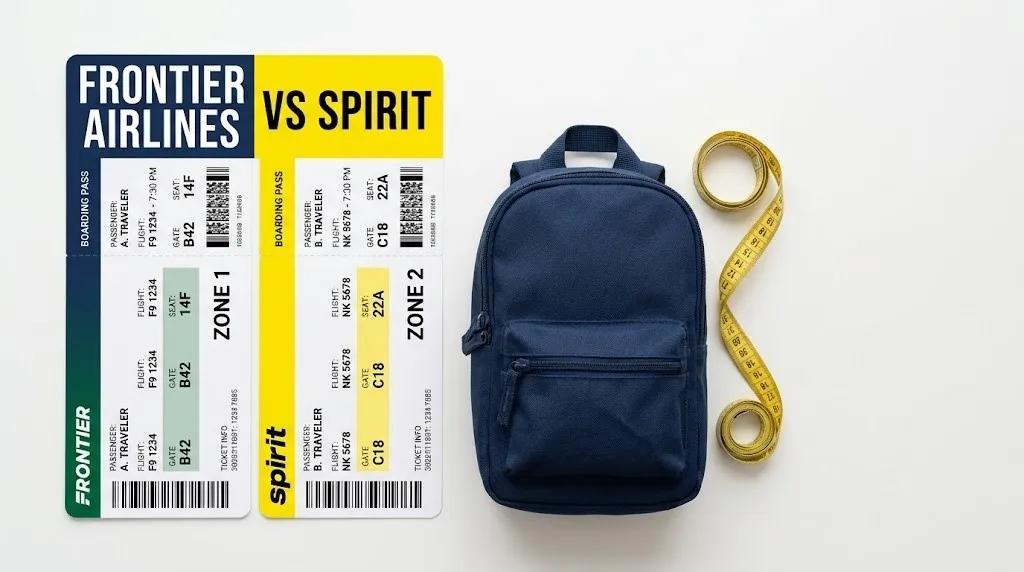
Both airlines charge for everything beyond a single small personal item.
Spirit bundles more optional perks into its mid-tier fare bundles for a small premium.
Key Takeaway: Spirit prioritizes a bundle-friendly upsell model, while Frontier aggressively minimizes aircraft weight and sells everything à la carte.
Spirit Airlines vs Frontier Route Network: Where They Fly
Spirit operates a dense, hub-centric network connecting major cities and leisure destinations.
Its largest bases include Fort Lauderdale (FLL), Detroit, and Las Vegas.
Frontier’s network is more sprawling, with a massive presence in Denver (DEN) and Orlando.
It often serves smaller secondary airports that Spirit ignores entirely.
Both airlines heavily serve Florida, the Caribbean, and Las Vegas from cold-weather cities.
Spirit offers more total daily frequencies on trunk routes like FLL to New York.
Frontier’s route map is wider geographically but often thinner on per-route frequencies.
A Frontier cancellation can mean a much longer wait for a rebooked flight.
Key Takeaway: Check the frequency on your specific city pair. Spirit typically offers more backup rebooking options on major routes if things go wrong.
The Bare Fare Trap: True Cost of Frontier vs Spirit
The advertised base fare is a trap if you need anything more than a backpack.
A bare fare covers transportation and one small item that fits strictly under the seat.
Spirit’s “Bare Fare” and Frontier’s base ticket price out identically for the seat itself.
The financial damage appears the moment you add a carry-on bag or select a standard seat.
A carry-on bag often costs more than the seat on both airlines when added at booking.
Paying that same fee at the airport gate is the single most punitive charge in domestic aviation.
Families buying four tickets with carry-ons might pay double the displayed fare.
Compare the all-in price against a mainline carrier’s basic economy before you book.
Key Takeaway: Always build your full cart on both airline websites. The cheaper base fare often becomes the more expensive total trip.
Cabin Comfort: Frontier Seat vs Spirit Seat on the A320
Spirit’s standard slimline seat pitch is typically around 28 inches on its A320 family fleet.
The seat cushion itself has a contour that feels minimally padded but ergonomically shaped.
Frontier’s seat pitch is identical at 28 inches on its dense Airbus A320neo configurations.
The critical difference is that Frontier’s main cabin seat does not recline at all.
Spirit’s standard seat also does not recline in many configurations.
The back shell is fixed in a pre-reclined position to save weight and maintenance costs.
For travelers under six feet tall on a two-hour hop, neither seat is torturous.
A passenger over six feet will find the fixed knee-crushing position genuinely painful on both airlines.
Key Takeaway: Spirit’s seat bottom foam is marginally less punishing. Frontier’s rigid shell feels more like molded plastic over a metal frame.
The Personal Item War: Frontier vs Spirit Sizer Boxes
This is the single most important section for budget travelers.
Both airlines enforce personal item sizing with near-religious zeal at the gate.
Spirit’s personal item size limit is 18 x 14 x 8 inches, checked in a rigid metal sizer box.
Frontier’s personal item size is marginally smaller at 18 x 14 x 8 inches, identically dimensioned but strictly enforced.
The gate agent earns a commission on some baggage fee captures at Spirit.
This creates a powerful financial incentive to force every bag into the sizer.
A bulging backpack that squishes into the Spirit sizer might get waved through.
The same bag will be scrutinized more harshly at Frontier, where policy is zero-tolerance.
Soft-sided backpacks without rigid frames are the safest bet on both airlines.
A fully stuffed standard school backpack will fail the test on either carrier.
Key Takeaway: Physically measure your packed bag at home. The airport sizer is not the place to discover your bag is one inch too thick.
Important Accuracy Notes for Personal Item Policies
Spirit and Frontier gate agent behavior and fee commission structures change without public notice.
Verify the following directly before your trip:
- The exact personal item dimensions listed on the official Spirit Airlines website baggage page.
- The current wording of Frontier’s carry-on and personal item policy on the FlyFrontier.com baggage page.
- Recent traveler reports on forums like r/spiritair or r/frontierairlines for current gate enforcement culture.
The most important single action: print the current policy page or screenshot the dimensions. Gate agents rarely override their own printed policy.
Carry-On and Checked Baggage Fee Comparison
Paying for a carry-on at the gate is a catastrophic financial decision on both airlines.
Booking the carry-on online during the initial purchase saves a significant amount.
Spirit charges a dynamic fee for carry-ons that fluctuates based on route demand and booking channel.
Frontier uses a similar dynamic model, with the lowest price offered exclusively at the time of initial booking.
Adding a carry-on at the check-in kiosk is more expensive than booking it from your couch.
Adding it at the gate is the most expensive option by a wide margin.
A checked bag often costs less than a carry-on bag on Frontier’s pricing engine.
This defies all traditional airline logic and rewards passengers who pack a larger, checked suitcase.
Budget travelers should prepay for exactly one bag type during the checkout flow.
Paying for a checked bag online is the most cost-effective way to transport more than a backpack.
Key Takeaway: Never wait until you reach the airport to pay for luggage. Prepay online or pack everything into a strictly measured personal item.
| Fee Category | Spirit Airlines | Frontier Airlines | Best Strategy |
|---|---|---|---|
| Personal Item | Free (18x14x8 in) | Free (18x14x8 in) | Measure before flying |
| Carry-On (Online) | Lowest dynamic fee | Lowest dynamic fee | Pay during booking only |
| Carry-On (At Gate) | Highest dynamic fee | Highest dynamic fee | Avoid at all costs |
| Checked Bag (Online) | Moderate dynamic fee | Often cheaper than carry-on | Prepay for best value |
| Overweight Bag | Steep flat fee | Steep flat fee | Weigh your bag at home |
Fare Bundles: Frontier Go Big vs Spirit Bundle Deals
Both airlines hide their best value inside front-end fare bundles.
Frontier’s “Go Big” bundle includes a Big Front Seat, a carry-on, and a checked bag.
This bundle also waives some change fees and includes priority boarding.
For a solo traveler on a three-hour route, the Go Big bundle is a genuine domestic first-class lite product.
Spirit’s bundle deals aggregate a carry-on, a checked bag, a standard seat assignment, and priority boarding.
The price premium for Spirit’s bundles is typically lower than the sum of the parts purchased separately.
Spirit’s bundle is a pure logistics play that strips out the nickel-and-dime pain.
Frontier’s bundle is an upsell into its only comfortable seat on the aircraft.
Families should run the math on a single Go Big seat for one parent carrying shared snacks and devices.
A solo traveler can buy a Spirit bundle and still have a relatively cramped standard seat.
Key Takeaway: Bundles are not the enemy. À la carte buying at the airport is the enemy.
Loyalty Programs and Credit Cards: Free Spirit vs FRONTIER Miles
Spirit’s Free Spirit program ties point value directly to the cash price of the fare.
Points never expire as long as you earn or redeem any points once every 12 months.
The Free Spirit Travel More World Elite Mastercard offers a straightforward points-earning structure.
Cardholders get Zone 2 priority boarding and a one-time points bonus after hitting minimum spend.
Frontier’s FRONTIER Miles program also links points value to fare cost.
Miles expire after 12 months of inactivity, which is stricter than Spirit’s policy.
The FRONTIER Airlines World Mastercard provides automatic Discount Den membership and priority boarding.
Discount Den offers lower fares for members and up to one companion on Frontier’s website.
Infrequent flyers should prioritize the program where miles do not expire quickly.
Frequent budget flyers should get the credit card matching their home airport’s dominant carrier.
Key Takeaway: Spirit’s co-branded card and loyalty program are slightly more forgiving for travelers who only fly once a year.
Operational Reliability: On-Time Stats and Customer Service
The U.S. Department of Transportation publishes monthly Air Travel Consumer Reports.
These reports rank airlines by on-time arrivals, cancellations, and mishandled baggage rates.
Spirit historically outperforms Frontier in on-time arrival percentage by a notable margin.
Frontier’s sprawling point-to-point network is more vulnerable to cascading delays from weather events.
A single thunderstorm in Denver can cripple Frontier’s entire system for a full day.
Spirit’s hub-and-spoke model allows for slightly faster aircraft and crew recovery during irregular operations.
Both airlines rank near the bottom of the DOT complaint rankings for customer satisfaction.
Frontier’s customer service was recently overhauled with a promise of better digital chat tools.
Do not expect proactive rebooking during mass cancellation events on either airline.
You must be your own advocate, refreshing the app and calling the customer service line immediately.
Key Takeaway: Spirit is statistically more likely to get you there on time. Neither airline will coddle you when a meltdown occurs.
Safety Record: Is Frontier Safe and Is Spirit Safe?
Both Frontier Airlines and Spirit Airlines operate under identical FAA safety regulations.
Both carriers maintain an impeccable safety record with no passenger fatalities in their histories.
The Federal Aviation Administration mandates the same pilot training standards for all U.S. airlines.
Spirit and Frontier mechanics follow the exact same FAA-mandated maintenance protocols as Delta or United.
Spirit operates one of the youngest and most fuel-efficient fleets in the United States.
Frontier also flies a very young all-Airbus fleet with modern A320neo and A321neo aircraft.
Turbulence feels more intense in a 28-inch pitch seat on a light aircraft.
This sensation creates a false perception that the aircraft is less structurally sound.
Physically, the Airbus A320neo family is among the safest commercial airframes ever built.
No rational safety argument exists for choosing one of these airlines over the other.
Key Takeaway: The question is not about mechanical safety. The question is about the statistical odds of sleeping on an airport floor after a cancellation.
Which Airline Is Best for Families?
Families with young children should choose Spirit Airlines over Frontier.
Spirit’s gate agents are less aggressive about sizing a diaper bag that doubles as a personal item.
Spirit allows family boarding after pre-boarding, giving parents time to corral car seats.
Frontier’s boarding process is more rigid and less accommodating to families needing extra minutes.
Frontier’s non-reclining seat is a genuine problem for a sleeping toddler on a parent’s lap.
Spirit’s minimally contoured seat is slightly easier to manage a small child in.
Neither airline offers a discounted child fare.
A lap infant still pays taxes and fees on international segments, even if the base fare is free.
Both airlines make it difficult and expensive to guarantee adjacent seats without paying fees.
Purchasing the fare bundle that includes seat assignment is non-negotiable for families with children.
Key Takeaway: Pay the premium for assigned seats together. Do not rely on the gate agent’s goodwill to seat your family together.
When to Avoid Both Budget Airlines
Avoid both carriers when the all-in cost approaches a mainline airline’s basic economy fare.
Delta, United, and American basic economy often includes a full-size carry-on for a similar price.
Business travelers should never fly Frontier or Spirit for time-sensitive meetings.
A single cancellation on a thin route can mean missing an entire workday.
First-time international travelers should avoid these carriers for cross-border flights.
Navigating customs with a strictly limited personal item adds unnecessary stress to a novice traveler’s trip.
Anyone with a tight connection at a large hub should book a mainline carrier.
Spirit and Frontier do not have interline agreements to rebook you on another airline during a meltdown.
A long weekend trip requiring more than a backpack pushes the cost math toward a mainline carrier.
Booking a traditional airline with a credit card that offers free checked bags is often the better deal.
Key Takeaway: Price out the Spirit or Frontier total cost first. Then immediately price out Southwest or a legacy basic economy fare.
Key Accuracy Caveat for 2026 Policies
Every fee, dimension, and policy mentioned here is subject to unannounced change.
Baggage sizer dimensions and dynamic fee pricing algorithms shift without warning.
Gate agent commission structures can change by quarter or season.
A policy that was lenient last summer might be strictly enforced this winter.
Do not make a booking decision based on a blog published six months ago.
Open the official Spirit Airlines and Frontier Airlines baggage pages in two separate tabs right now.
Read the terms on your specific booking path before entering your credit card number.
The “Full Fare Rules” link on the checkout page contains the legally binding policy.
Screenshot the policy page on the day you travel.
Gate supervisors rarely argue with a passenger who holds a printed, current policy document.
Key Takeaway: Verify everything. A $10 difference in a blog is not worth a $99 surprise fee at the gate.
Frequently Asked Questions About Frontier Airlines vs Spirit
Is Spirit Airlines better than Frontier?
Spirit is marginally better for seat comfort, bundle value, and operational reliability.
Frontier is better for West Coast travelers and those seeking a true domestic premium seat upgrade via the Go Big bundle.
Does Frontier or Spirit have bigger seats?
Neither airline has a wider standard economy seat on the Airbus A320.
Frontier’s Big Front Seat is significantly larger and more comfortable than any seat Spirit offers on the same route.
What is the strictest airline for personal item size?
Frontier Airlines is widely considered the strictest U.S. airline for personal item enforcement.
Gate agents actively patrol the boarding area and require every bag to fit the sizer without bulging.
Which is safer, Frontier Airlines or Spirit Airlines?
Both airlines are equally safe and meet all FAA safety mandates.
They operate modern all-Airbus fleets with flawless passenger fatality safety records.
Does Frontier Airlines recline their seats?
No, Frontier’s standard economy seats do not recline at all.
The seat back is fixed in a single pre-reclined position to reduce maintenance and weight.
Which budget airline has the most flight delays?
Frontier Airlines historically reports a lower on-time arrival rate than Spirit Airlines.
The DOT Air Travel Consumer Report consistently ranks Spirit higher for on-time performance and fewer chronic delays.
The real winner between Frontier and Spirit depends on your torso length and your packing discipline.
If you live in Denver or need the Big Front Seat, book Frontier.
If you live in Florida or want a slightly better delay recovery rate, book Spirit.
If the all-in bundled price is within $30 of a Delta ticket, book Delta immediately.
Open both apps right now, build your full cart for your travel dates, and buy the cheapest complete package.
Verify the baggage rules on the official airline site on the day you fly, and never pay for a bag at the gate.