Istanbul is served by two wildly different airports on two different continents. Your booking choice dictates whether you land in Europe or Asia.
The airport you arrive at is not a minor detail. It is a decision that adds either a 30-minute or a 90-minute transfer to your hotel.
This guide names both airports, their codes, and their specific airlines. You will know exactly which bus or metro to board the moment you land.
how many airports in istanbul
There are two active international airports in Istanbul. The city is served by Istanbul Airport and Sabiha Gökçen Airport.
A third airport, the old Atatürk Airport, is permanently closed to commercial passenger flights. Do not confuse it with the current airports.
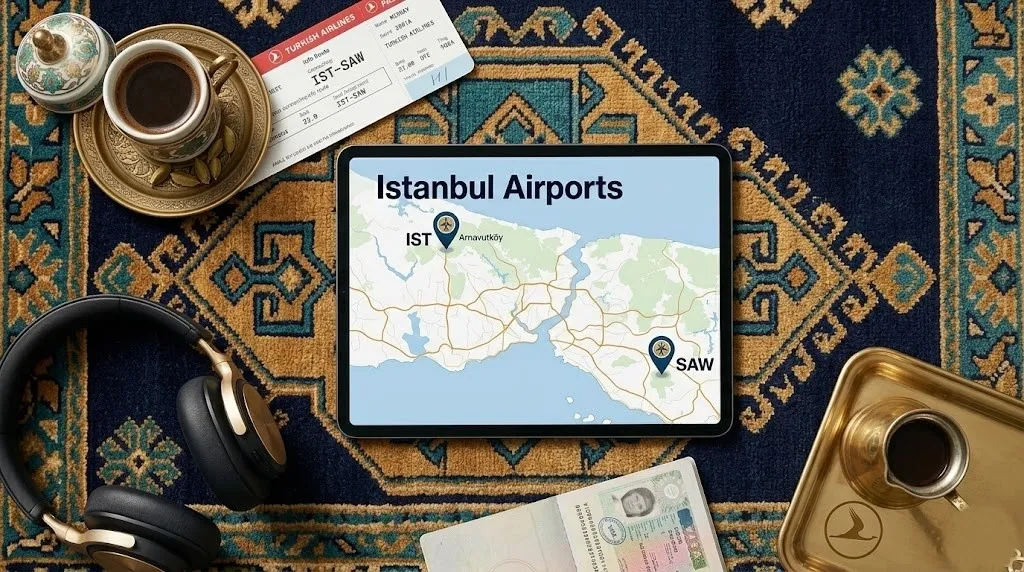
This dual-airport setup is a result of Istanbul’s massive geographic footprint. One sits on the European side, and the other is firmly in Asia.
For a first-time traveler, this is the most critical fact to understand. Your ride-share driver is not going to the wrong airport if you name the wrong one.
The two-airport system is not a choice you make independently. The airport is a direct consequence of the airline you book.
- Total Active Airports: 2.
- European Side: Istanbul Airport (IST).
- Asian Side: Sabiha Gökçen Airport (SAW).
istanbul airports
The two Istanbul airports are distinct in character, scale, and purpose. Istanbul Airport is a global mega-hub. Sabiha Gökçen is a busy regional and low-cost base.
Istanbul Airport (IST) is a palatial, purpose-built titan on the European side. It serves as the home for Turkish Airlines and its Star Alliance partners.
Sabiha Gökçen International Airport (SAW) is a bustling, dense terminal on the Asian side. It is the main base for Pegasus Airlines and other low-cost carriers.
A business traveler flying to Europe will almost certainly use IST. A budget traveler on a short-haul flight from within Turkey or the Middle East will likely land at SAW.
The airports are a 90-minute drive from each other on a good traffic day. There is no fast rail link connecting them.
- Istanbul Airport (IST): The main, full-service international hub.
- Sabiha Gökçen Airport (SAW): The secondary, low-cost and domestic hub.
Key Takeaway: Your airline ticket has already chosen your airport for you. Check the IATA code on your booking right now.
istanbul international airport code
The main Istanbul international airport code is IST. This is the code for the new Istanbul Airport on the European side.
The secondary airport code is SAW. This stands for Sabiha Gökçen International Airport on the Asian side.
You must look for these three-letter codes on your flight booking. A search for “Istanbul” on a booking site will often show results for both.
A traveler heading to the historic Sultanahmet district must know this distinction. A booking for SAW puts you an hour further from the Blue Mosque than IST.
The old Atatürk Airport code was ISL. If you see this code on any old documentation, it is completely obsolete.
- IST: The current main European-side airport code.
- SAW: The current Asian-side airport code.
- ISL: The permanently closed, defunct airport code.
what is the main airport in istanbul
Istanbul Airport (IST) is the main airport in Istanbul. It is the home base for the national flag carrier.
It is one of the largest and newest airport terminals in the world. This is the grand gateway for nearly all long-haul international travelers.
The facility is a single, massive, cathedral-like terminal under one roof. The scale of the building is genuinely overwhelming on a first visit.
A first-time traveler landing at IST will be struck by its architectural ambition. The walking distances from check-in to a far gate can easily exceed 20 minutes.
It is located on the European side, near the Black Sea coast. Its remote location means a long drive into the central city.
- Official Name: Istanbul Airport.
- Code: IST.
- Location: European side, Arnavutköy district.
- Status: The undisputed primary international gateway.
ist airport istanbul
IST airport is a modern marvel that functions as Turkish Airlines’ global fortress hub. The passenger experience is defined by its sheer, unapologetic size.
The terminal features a central, airy bazaar area under a massive skylight. The Turkish Airlines Business Class and Miles&Smiles lounges here are legendary.
These lounges offer a level of luxury that rivals the best in the world. They include multiple cooking stations, a putting green, and private sleeping suites.
For a business traveler with a Star Alliance Gold card, the lounge is an unrivaled perk. It transforms a long layover from a chore into a genuinely pleasant experience.
The honest limitation is the walking distance and the gate setup. A short connection time between a far domestic gate and an international departure is a stressful, breathless sprint.
- Ambiance: Vast, modern, cathedral-like.
- Lounge Highlight: The Turkish Airlines Business Lounge is a destination in itself.
- Pain Point: Extremely long walks to some gates make tight connections risky.
turkish airlines airport istanbul
Turkish Airlines uses Istanbul Airport (IST) as its sole hub in the city. All mainline Turkish Airlines flights operate from here.
This is a critical planning point for passengers on connecting itineraries. You will not be transferred from IST to SAW for a Turkish Airlines connection.
The airline has built a dedicated business check-in pavilion at the terminal’s entrance. Its premium ground service is a fully integrated part of the IST experience.
The Star Alliance is deeply embedded at IST. If you are connecting from a United Airlines flight onto Turkish Airlines, you will do so here.
A solo traveler on a long-haul Turkish Airlines itinerary benefits the most from this. The seamless connection within a single, world-class terminal is a strategic advantage over using two separate airports.
- Turkish Airlines Hub: Exclusively at IST.
- Star Alliance Hub: Yes, partners are consolidated here.
- No SAW Presence: Turkish Airlines does not operate scheduled mainline flights from Sabiha Gökçen.
Key Takeaway: If your ticket says Turkish Airlines, you are flying to IST. There is no alternative, so plan your ground transfer accordingly.
sabiha gokcen airport saw
Sabiha Gökçen Airport (SAW) is Istanbul’s bustling secondary hub on the Asian side. It is the kingdom of the low-cost carrier.
Pegasus Airlines, Turkey’s leading LCC, has its main base here. AnadoluJet, the low-cost arm of Turkish Airlines, also operates heavily from SAW.
The terminal is a single, dense, and highly functional building. The passenger experience is less about architectural wonder and more about high-volume throughput.
A budget traveler will find SAW’s airline lineup a perfect fit for a cheap domestic or regional flight. The terminal is designed for quick turnarounds, not luxury.
A traveler with a final destination on the Asian side, like the Kadıköy district, will find SAW much closer. The drive across the Bosphorus bridge from IST to Kadıköy is a notorious traffic nightmare.
- Official Name: Sabiha Gökçen International Airport.
- Code: SAW.
- Location: Asian side, Pendik district.
- Main Airlines: Pegasus Airlines, AnadoluJet, and various international LCCs.
istanbul ataturk airport closed
Atatürk Airport (ISL) is permanently closed to all commercial passenger flights. It is a historical footnote for a traveler booking a trip today.
All passenger operations moved to the new Istanbul Airport (IST) in a massive overnight transfer in 2019. The old airport is now a public park and exhibition space.
If you see a reference to Atatürk Airport on a travel forum, it is dangerously outdated. Any guide still mentioning it as a current travel option should not be trusted.
A first-time traveler reading old blog posts might be confused by this. Know that the airport does not exist as a passenger terminal anymore.
The single act of knowing that ISL is closed prevents a catastrophic and costly taxi mistake. You will never need to know the code except to disregard it.
- Atatürk Airport: Closed and decommissioned.
- Replacement: All flights now use Istanbul Airport (IST).
- Beware: Outdated online guides may still reference it.
Key Takeaway: Atatürk Airport is a ghost. Never enter its old code, ISL, into a GPS or ride-share app.
ist or saw which airport to choose
You do not choose between IST or SAW in most cases. The airline you book chooses the airport for you.
If you are flying Turkish Airlines or a Star Alliance partner, you are going to IST. If you book a Pegasus Airlines or other low-cost carrier ticket, you will land at SAW.
The only real choice is when you are comparing fares on an identical route. A cheap fare from a full-service carrier into IST may compete with a cheap fare on a LCC into SAW.
A business traveler must select the flight that lands at IST. The premium infrastructure and downtown connections are non-negotiable for a productive trip.
A budget traveler bound for the Asian side might choose SAW even if a similar fare exists to IST. The time and taxi fare saved by avoiding the Bosphorus crossing can be significant.
- Fly into IST if: You are on Turkish Airlines, Star Alliance, or heading to the European side.
- Fly into SAW if: You are on Pegasus, AnadoluJet, or your hotel is in Kadıköy.
istanbul airport to city center
The journey from Istanbul Airport to the city center is a long one. The airport is about 40 kilometers from the main tourist areas.
The most popular transfer option is the Havaist airport bus. These comfortable coaches run from IST to major hubs like Taksim Square and Sultanahmet.
A new metro line, the M11, now connects IST to the city’s wider rail network. It is the fastest option, immune to the terrible Istanbul traffic.
For a family with luggage, the Havaist bus is the best option. The metro involves a transfer and potentially a long walk at a connecting station.
A solo traveler on a budget should master the metro from day one. It is the cheapest and most reliable method, taking about an hour to central transfer points.
- Havaist Bus: Direct, comfortable, fixed price, serves Taksim and Sultanahmet.
- Metro M11: The fastest option, but requires a transfer to reach the historical peninsula.
- Taxi: Expensive, highly variable due to traffic. Verify the fare on the BiTaksi app before accepting a ride.
saw airport to sultanahmet
The journey from SAW Airport to Sultanahmet is the most punishing transfer in Istanbul. It is a long, multi-stage trip across two continents.
Sabiha Gökçen is on the Asian side, and Sultanahmet is the heart of the old European city. The journey involves crossing the congested Bosphorus.
The Havabus coaches run from SAW to Taksim Square. From Taksim, you must change to a taxi or a packed funicular and tram to reach Sultanahmet.
This journey takes over 90 minutes on a standard day. In rush hour traffic, it can easily stretch to two hours or more.
A first-time traveler arriving at SAW for a Sultanahmet hotel should not take a random taxi. Use the Havabus to Taksim, then a short, monitored taxi for the final leg.
- Havabus Route: SAW to Taksim, then a secondary transfer.
- Total Time: 90 to 120 minutes in typical traffic.
- Honest Verdict: This transfer is a trip-defining slog, so budget your time and energy accordingly.
istanbul airport transfer options
Your Istanbul airport transfer options are buses, metro, taxis, and private shuttles. Each has a starkly different cost-to-convenience profile.
The Havaist and Havabus networks are the official, reliable bus services. They are the backbone of airport transfers for savvy tourists.
The metro is the new, traffic-proof champion for IST and is expanding. The ancient Marmaray suburban rail line connects to a commuter station near SAW.
An unregulated taxi is the wildcard. A solo female traveler arriving late at night should not hail a random cab from the airport curb.
A pre-booked private transfer or using the app-based BiTaksi service is a far safer choice. You get a fixed fare, a tracked driver, and a clear record of the trip.
- Havaist/Havabus: Best balance of cost and comfort.
- Metro: The fastest and cheapest, if you pack light.
- Pre-booked Shuttle: Best for safety, families, and late-night arrivals.
- Taxi/App (BiTaksi): Only safe via an app with a tracked fare. Avoid random street hails.
istanbul airports map
A mental map of Istanbul airports is a simple east-west line. Picture the Bosphorus Strait cutting the city in half.
On the European side, far to the northwest, sits Istanbul Airport (IST). This is your gateway to the city’s historic core.
On the Asian side, deep in the eastern suburbs, is Sabiha Gökçen Airport (SAW). This is your gateway to the modern Kadıköy district and beyond.
The Taksim and Sultanahmet tourist zones lie in the center of the European side. These are the targets for nearly all first-time visitors.
A traveler booking a hotel must place their accommodation on this mental map. The wrong airport for your hotel’s location adds hours of unnecessary transit time.
- IST (NW): European side, remote. Use Havaist bus or M11 metro.
- SAW (E): Asian side, remote from the old city. Use Havabus plus a taxi.
- City Center: Sultanahmet and Taksim are on the European side, much closer to IST.
Frequently Asked Questions About Istanbul Airports
What are the two airports in Istanbul?
The two airports in Istanbul are Istanbul Airport (IST) on the European side.
The other is Sabiha Gökçen International Airport (SAW) on the Asian side.
They are very far apart and serve different airlines.
How far is Istanbul Airport from the city center?
Istanbul Airport (IST) is about 40 kilometers from the main city center.
The drive to Taksim Square takes about 45 to 60 minutes without traffic.
The journey to Sultanahmet takes a similar amount of time on the Havaist bus.
Is Sabiha Gökçen Airport on the Asian side?
Yes, Sabiha Gökçen International Airport (SAW) is located on the Asian side of Istanbul.
It is deep in the Pendik district.
This location makes the transfer to the European side a long trip over the Bosphorus.
Which Istanbul airport does Turkish Airlines use?
Turkish Airlines uses Istanbul Airport (IST) as its main global hub.
All mainline Turkish Airlines flights depart and arrive exclusively from IST.
The airline does not operate from Sabiha Gökçen Airport (SAW).
Is the old Ataturk Airport in Istanbul still open?
No, the old Atatürk Airport is permanently closed to all passenger flights.
It was replaced by the new Istanbul Airport (IST).
If you see a reference to Atatürk Airport in a guide, it is dangerously outdated.
How do I get from Istanbul airport to Sultanahmet?
The easiest way from IST to Sultanahmet is the Havaist airport bus.
The bus takes about 60 minutes and drops you near the tram line.
You can also take the M11 metro and connect to the city network.
Your Istanbul airport is not a choice, it is a consequence of your airline booking. Check your ticket for the IATA code IST or SAW right now.
Once you know the code, plan your ground transfer based on the time of day. Nighttime arrivals and rush hour traffic demand a pre-booked service, not a curb hail.
Airport metro lines in Istanbul are opening in phases and bus schedules change. Always check the official Havaist website for the current schedule before you land.