The worst airlines in the US share a consistent pattern: low base fares, high add-on fees, poor on-time records, and economy seats that punish anyone over 5’8″. Knowing which carriers to avoid and when to pay more is the single most useful decision a traveler can make before booking.
The U.S. Department of Transportation Air Travel Consumer Report tracks complaint rates, cancellation percentages, and baggage mishandling across all U.S. carriers. Spirit Airlines, Frontier Airlines, and Allegiant Air consistently appear at the top of complaint rankings.
This guide ranks U.S. airlines honestly by seat quality, complaint rate, baggage policy, delay record, and traveler profile fit. Every airline named here gets a fair assessment of both its specific failure and the narrow situation where it still makes sense to book.
Worst Airlines in the US: How We Ranked Them
The worst airlines in the US are ranked here using four criteria: DOT complaint rate, on-time performance, economy seat pitch, and total cost with fees.
The DOT Air Travel Consumer Report publishes monthly and annual rankings of U.S. airline complaint rates per 100,000 passengers. This is the most consistent public dataset for airline quality comparison.
Seat pitch data comes from airline seat maps and SeatGuru documentation. Seat pitch directly affects physical comfort, especially on routes over 90 minutes.
Total cost calculations include the base fare plus a standard carry-on bag and one checked bag. For Spirit Airlines and Frontier Airlines, this fee addition often changes the cost comparison entirely.
For budget travelers, the ranking methodology matters most at the total-cost stage. A Spirit fare that looks $60 cheaper than JetBlue frequently reverses after adding a carry-on fee and a seat selection fee.
Insider Tip:
- Always calculate total cost with one carry-on before comparing Spirit or Frontier to mainline fares.
- Check the DOT Air Travel Consumer Report directly for the most recent complaint rate data by airline.
- Business travelers should weight on-time performance at 50% of their decision, not fare.
US Airlines Ranked Best to Worst: The Full Picture
From best to worst, U.S. airlines rank as follows: Alaska Airlines, Delta Air Lines, JetBlue Airways, Southwest Airlines, United Airlines, American Airlines, Allegiant Air, Frontier Airlines, and Spirit Airlines.
This ranking reflects DOT complaint data, J.D. Power North America Airline Satisfaction Study results, on-time performance records, and economy seat quality across standard domestic configurations.
| Airline | Complaint Risk | Economy Seat Pitch | Baggage Fee Level | Best For | Avoid If |
|---|---|---|---|---|---|
| Alaska Airlines | Low | 31-32 in. typical | Moderate | West Coast, families | Midwest routes (limited) |
| Delta Air Lines | Low | 31-32 in. typical | Moderate-High | Business, reliability | Budget domestic |
| JetBlue Airways | Low-Medium | 32-33 in. typical (core cabin) | Moderate | Northeast, comfort | Transcon premium (Mint pricing) |
| Southwest Airlines | Medium | 31-32 in. typical | Low (2 bags free) | Families, flexibility | Business (no assigned seats) |
| United Airlines | Medium-High | 30-31 in. typical | High | Hub connections | Domestic economy value |
| American Airlines | Medium-High | 30-31 in. typical | High | Oneworld routes | Domestic economy comfort |
| Allegiant Air | High | 30 in. typical | High add-ons | Leisure nonstop routes | Anyone checking a bag |
| Frontier Airlines | High | 28-29 in. typical | Very High | Carry-on-only, short hops | Families, reliability-sensitive |
| Spirit Airlines | Very High | 28 in. typical | Very High | Carry-on-only, ultra-short | Anyone with checked bags |
Seat pitch figures are typical configurations. Confirm your specific aircraft layout on the airline’s seat map tool before booking, as configurations vary by aircraft age and subtype.
For first-time travelers, starting with Alaska Airlines or Delta Air Lines on domestic routes provides the most predictable, complaint-free experience before building tolerance for the budget carrier trade-offs.
Why Spirit Airlines Ranks Among the Worst US Airlines
Spirit Airlines ranks as the worst U.S. airline by DOT complaint rate and passenger satisfaction, driven by ultra-tight seat pitch, aggressive fee structures, and high cancellation rates.
Spirit Airlines operates a fleet of Airbus A320 family aircraft including the Airbus A320, Airbus A320neo, and Airbus A321. Economy seat pitch on Spirit is typically around 28 inches, which is among the tightest in U.S. aviation.
For context, 28 inches of seat pitch means your knees will touch the seat in front on any Airbus A320 family aircraft if you are over 5’10”. This is not a comfort issue. It is a physical constraint.
Spirit’s Big Front Seat product offers more space but is not a true business class. It is a wider seat without a dedicated cabin, meal service, or lounge access.
The DOT Air Travel Consumer Report has consistently placed Spirit Airlines among the highest complaint rate carriers per 100,000 passengers over multiple reporting periods.
For budget travelers doing a carry-on-only trip under 90 minutes, Spirit’s economics can work. The seat discomfort is tolerable on a 60-minute Orlando to Fort Lauderdale hop.
For families with children, Spirit is a poor choice. Seat selection fees mean you may not sit with your children without paying extra. Verify Spirit’s current seat assignment policy directly with Spirit before booking.
The honest limitation of Spirit Airlines: It is not a resilient operation. When weather or mechanical issues hit, Spirit’s thin network and minimal buffer capacity produce cascading cancellations that strand passengers for days, not hours.
Key Takeaway: Spirit Airlines can work for solo carry-on-only travelers on sub-90-minute routes. It is a poor choice for families, anyone checking a bag, or time-sensitive travelers.
Frontier Airlines: Honest Review
Frontier Airlines ranks as the second-worst U.S. airline by passenger complaint rates and total cost transparency, with seat pitch typically around 28 to 29 inches on its Airbus A320neo fleet.
Frontier Airlines operates a fleet of Airbus A320neo and Airbus A321neo aircraft. The neo-series aircraft offer somewhat better fuel efficiency but no meaningful passenger comfort improvement over Spirit’s configuration.
Frontier’s fare structure is similar to Spirit’s. The base fare is low. Every add-on carries a fee: carry-on bags, checked bags, seat selection, and even printing a boarding pass at the airport.
Frontier’s FRONTIER Miles program has historically offered limited redemption value compared to programs like Delta SkyMiles or Southwest Rapid Rewards. Verify current program terms directly with Frontier.
The J.D. Power North America Airline Satisfaction Study has consistently ranked Frontier near the bottom of U.S. carrier satisfaction scores in the low-cost carrier segment.
For solo travelers doing a carry-on-only weekend trip between leisure destinations like Denver and Las Vegas, Frontier can produce genuine savings. Calculate the total cost with all fees before assuming savings.
For business travelers, Frontier offers no lounge access, no elite status with meaningful benefits, and no reliable on-time performance record suitable for time-sensitive travel. Avoid Frontier for business trips.
Insider Tip:
- Frontier’s “The Works” bundle combines a carry-on, checked bag, seat selection, and change/cancellation flexibility in one fee.
- Buying “The Works” upfront often makes the total fare comparable to Southwest, where two bags are already included.
- For families, Southwest Airlines remains a better value than Frontier once bag fees are added to the Frontier total.
Allegiant Air: Is It Worth Flying?
Allegiant Air is worth flying only for nonstop leisure routes where no major carrier offers direct service, and only if you have no checked bags.
Allegiant Air operates primarily Boeing 757-200 and Airbus A319 aircraft on point-to-point leisure routes connecting smaller U.S. cities to sun destinations. This route model is its genuine standout feature.
Allegiant connects cities like Provo, Utah and Punta Gorda, Florida with nonstop flights that no other carrier offers. For travelers in smaller markets, this is genuinely useful.
The honest limitation of Allegiant Air: Its on-time performance record is among the worst in U.S. aviation. Allegiant operates an older fleet with less redundancy than major carriers, producing higher mechanical delay rates.
Allegiant’s baggage fees for carry-on bags and checked bags are applied aggressively. Factor these into your total cost calculation before assuming Allegiant’s base fare is cheap.
According to the DOT Air Travel Consumer Report, Allegiant Air generates complaint rates significantly above the industry average, particularly for flight cancellations and delays.
For budget travelers in smaller markets with no other nonstop options, Allegiant’s route uniqueness can justify the trade-offs. Flying Allegiant from Provo to Orlando beats a connection through Salt Lake City on Delta if your time is constrained.
For families with children, Allegiant’s delay risk creates specific problems. A mechanical delay at a smaller airport with no alternative carriers means a much longer wait than at a hub. Plan accordingly.
Key Takeaway: Allegiant Air serves nonstop routes no major carrier covers, but its delay risk and baggage fee structure make it a poor choice for anyone with schedule sensitivity or checked luggage.
American Airlines: Where It Falls Short
American Airlines underperforms its price tier on domestic economy routes, with seat pitch typically around 30 to 31 inches on the Boeing 737-800 and Boeing 737 MAX 8, limited complimentary amenities in basic economy, and complaint rates higher than Delta and Alaska.
American Airlines operates a large fleet including Boeing 737-800, Boeing 737 MAX 8, Boeing 737 MAX 9, Boeing 787-9 Dreamliner, and Airbus A321 aircraft across domestic and international routes.
In domestic economy, American’s basic economy fare class restricts seat selection, carry-on bag placement, and same-day change options. The seat product itself is not meaningfully worse than other legacy carriers but delivers less value at equivalent price points.
American’s AAdvantage loyalty program is part of the Oneworld alliance, which is a genuine advantage for international frequent flyers connecting with British Airways, Cathay Pacific, and Japan Airlines.
The Admirals Club lounge network is reasonably distributed across major hubs but requires membership or eligible premium fare booking. Verify current access policies directly with American Airlines.
For business and frequent flyers, American’s Flagship Business product on the Boeing 777-300ER and Boeing 787-9 long-haul routes offers a competitive lie-flat seat. The domestic product does not justify a premium fare over Delta on most routes.
For budget travelers, American’s basic economy restrictions make it a genuinely worse choice than Southwest on most domestic routes. Southwest includes two free checked bags. American basic economy does not.
The honest limitation of American Airlines: Its domestic customer service has generated consistent complaint volume. The Points Guy identifies American’s customer service responsiveness as a recurring weakness relative to Delta and Alaska in comparable price tiers.
United Airlines: Performance and Complaints
United Airlines generates higher complaint rates than Delta Air Lines and Alaska Airlines at comparable price points, with domestic economy seat pitch typically around 30 to 31 inches on the Boeing 737 MAX 8 and Boeing 737 MAX 9.
United Airlines operates Boeing 737 MAX 8, Boeing 737 MAX 9, Boeing 757-200, Boeing 767-300ER, and Boeing 787-9 aircraft across its network. The MileagePlus loyalty program is part of Star Alliance, offering broad international partner access.
United’s Polaris business class on long-haul widebody routes is a genuine competitive product. The Boeing 787-9 Dreamliner Polaris configuration offers lie-flat seats with direct aisle access in a 1-2-1 layout on select routes. Confirm your specific aircraft layout on United’s seat map before booking.
The domestic economy story is less positive. United’s economy cabin on the Boeing 737 MAX 8 offers seat pitch typically around 30 inches. This is competitive with American but trails Delta Comfort+ and JetBlue core seating on equivalent fare tiers.
United’s hub operations at Chicago O’Hare International Airport (ORD) and Newark Liberty International Airport (EWR) generate notable delay exposure, particularly during summer thunderstorm season.
For business and frequent flyers who value Star Alliance access, United’s MileagePlus program offers strong international redemption value, particularly on partner airlines like Singapore Airlines and Lufthansa. The domestic United product does not match this international reputation.
For first-time travelers, United’s basic economy fare is highly restrictive. Seat selection, carry-on placement, and changes are all limited. Verify current basic economy restrictions directly with United before booking.
The honest limitation of United Airlines: Its hubs at ORD and EWR consistently rank among the most delay-prone in U.S. aviation due to weather exposure and traffic volume. Plan connections with extra buffer time at these airports.
Key Takeaway: United Polaris on widebody international routes is competitive. United domestic economy at mainline pricing is poor value compared to Delta or Alaska on equivalent routes.
Southwest Airlines: The Meltdown Legacy
Southwest Airlines carries a specific operational risk legacy from its December 2022 system meltdown that stranded over one million passengers and exposed deep scheduling infrastructure weaknesses.
Southwest Airlines operates an all-Boeing 737 fleet including Boeing 737-700, Boeing 737-800, and Boeing 737 MAX 8 aircraft. Its open-seating model and two free checked bags are genuine standout features.
The December 2022 operational collapse was the most significant U.S. airline operational failure in recent history. Southwest’s SOARS crew scheduling system failed during a winter storm, causing cascading cancellations that lasted 10 days.
Southwest has since invested in scheduling system infrastructure. The DOT fined Southwest Airlines for the December 2022 meltdown. Verify Southwest’s current operational reliability record at the DOT Air Travel Consumer Report before booking around major holidays.
Southwest’s Rapid Rewards program is straightforward and redemption-friendly compared to American’s AAdvantage or United’s MileagePlus. Points do not expire as long as you have account activity. Verify current program terms directly with Southwest.
For families with children, Southwest’s two free checked bags and open boarding policy (where families with children board in Group B before general boarding) make it one of the better legacy-adjacent options for family travel. The open seating format requires boarding strategy to keep families together.
For business travelers, Southwest’s lack of assigned seats, no lounge network, and no alliance membership make it unsuitable for frequent business travel requiring reliability and status benefits.
The honest limitation of Southwest Airlines: Peak holiday season carries elevated meltdown risk. The December 2022 event was extreme, but Southwest’s thin buffer capacity at high-demand periods remains a documented vulnerability.
Worst Airlines for On-Time Performance and Cancellations
The worst U.S. airlines for on-time performance are consistently Spirit Airlines, Frontier Airlines, and Allegiant Air, with American Airlines and United Airlines generating above-average cancellation rates among legacy carriers.
The DOT Air Travel Consumer Report publishes monthly on-time performance data for all U.S. carriers. Alaska Airlines and Delta Air Lines consistently lead on-time performance rankings. Spirit, Frontier, and Allegiant consistently trail.
On-time performance matters differently by traveler type. A 30-minute delay means little for a leisure traveler with no connection. For a business traveler connecting to an international flight, a 30-minute delay can mean a missed flight and a rebooking fee.
To check current on-time performance before booking:
- Go to the DOT Air Travel Consumer Report page at the Bureau of Transportation Statistics.
- Select the airline and route month you are researching.
- Compare on-time arrival percentages across carriers on your specific route.
- Check cancellation rates separately, as some airlines delay more but cancel less.
- For connecting itineraries, add 30 minutes to the minimum legal connection time as a personal buffer.
For business and frequent flyers, on-time performance on the departure hub is the single most important booking variable for connecting international itineraries. Choose Delta or Alaska over American or United at ORD and EWR for this reason.
The honest limitation: On-time performance data is route-specific and seasonal. An airline that performs well on average may have specific route-level failures. Always check route-level data, not just airline-wide averages.
Key Takeaway: Check route-specific on-time data at the DOT Bureau of Transportation Statistics before booking any time-sensitive itinerary. Airline-wide averages mask route-level failures.
Worst Airlines for Baggage Fees and Policies
Spirit Airlines and Frontier Airlines charge the most aggressive baggage fees in U.S. aviation, with carry-on bag fees that convert an apparent low fare into a mid-range total cost.
Baggage fee structures at Spirit and Frontier are dynamic. Fees vary by route, booking timing, and whether you pay online versus at the gate. Gate-paid bag fees at Spirit are typically the highest tier. Verify current fee schedules directly with Spirit Airlines and Frontier Airlines before traveling.
| Airline | Carry-On Fee (typical) | Checked Bag Fee (typical) | Gate Add-On Risk | Free Bag Policy |
|---|---|---|---|---|
| Spirit Airlines | Fee applies | Fee applies | Very High | Personal item only |
| Frontier Airlines | Fee applies | Fee applies | High | Personal item only |
| Allegiant Air | Fee applies | Fee applies | High | Personal item only |
| American Airlines | Included in most fares | Fee for basic economy | Medium | First class: 2 free |
| United Airlines | Included in most fares | Fee for basic economy | Medium | Premier status: fee waived |
| Southwest Airlines | Included | 2 bags free | Low | All fares: 2 bags free |
| Delta Air Lines | Included in most fares | Fee applies | Low-Medium | Medallion status: waived |
| Alaska Airlines | Included in most fares | Fee applies | Low-Medium | MVP status: waived |
All fee amounts listed are typical ranges. Verify current baggage fee schedules directly with each airline before traveling, as fees change without public notice.
For budget travelers, Southwest Airlines offers the best all-in value for travelers who check bags. Two free checked bags included in every fare frequently makes Southwest cheaper in total than Spirit or Frontier once bag fees are added.
For families with children, the baggage fee gap between Southwest and Spirit or Frontier is often $120 to $200 per round trip for a family of four with bags. Verify current totals with each airline before assuming the budget carrier is cheaper.
Worst Airlines for Families with Children
The worst airlines for families with children are Spirit Airlines, Frontier Airlines, and Allegiant Air, primarily because seat assignment fees may separate families unless they pay extra.
All three ultra-low-cost carriers apply seat selection fees that mean a family of four booking basic fares may be assigned middle seats in different rows. This is not theoretical. It is a documented passenger complaint pattern across all three carriers.
For families with children, the practical calculus is straightforward. On Spirit Airlines, adding seat selection fees for a family of four, plus carry-on bag fees, plus checked bag fees, often produces a total fare that exceeds Southwest Airlines, which already assigns seats to families boarding early and includes two free bags.
Southwest Airlines’ family boarding policy allows families with children age 6 and under to board before general boarding in Group B. This is a practical benefit that Spirit, Frontier, and Allegiant do not offer.
American Airlines and United Airlines allow families to select seats together in advance on standard economy fares (not basic economy). Verify current seat assignment policies directly with each airline before booking.
Condé Nast Traveler identifies Alaska Airlines as one of the most family-friendly U.S. carriers based on seat assignment flexibility, baggage policies, and customer service response to family travel issues.
The honest limitation for families: Even on better airlines like Southwest, the open boarding process requires arriving at the gate early to secure adjacent seats. Families who arrive late to the gate may not sit together even with family boarding priority.
Key Takeaway: For families with children, total cost including bag and seat fees often makes Southwest Airlines cheaper than Spirit or Frontier. Calculate the full fare before booking any ultra-low-cost carrier.
Worst Airlines for Business Travelers
The worst airlines for business travelers are Spirit Airlines, Frontier Airlines, Allegiant Air, and Southwest Airlines, for four distinct reasons: no elite status with real benefits, no lounge access, poor on-time records, and no assigned seating flexibility.
Business and frequent flyers require three things a budget airline cannot provide: reliable on-time departure, a lounge to work in during delays, and seat assignment control on every booking.
Spirit’s elite status program, Free Spirit Gold, offers minimal operational benefits compared to Delta’s Medallion status or Alaska’s MVP Gold 75K status. Neither Spirit nor Frontier operates airport lounges at any U.S. hub.
For business travel, the minimum viable U.S. airline is United Airlines with MileagePlus Premier status, American Airlines with AAdvantage Platinum Pro, Delta with SkyMiles Medallion, or Alaska with Mileage Plan MVP Gold. All four offer meaningful lounge access and on-time priority handling.
The Admirals Club (American Airlines), Sky Club (Delta), United Club, and Alaska Lounge networks represent the minimum acceptable lounge infrastructure for a frequent business traveler.
For business travelers on transcontinental routes specifically, JetBlue Mint business class on the Airbus A321 offers a lie-flat pod at a price point typically below Delta One or American Flagship Business on the same routes. Confirm current Mint availability and route coverage directly with JetBlue.
The honest limitation for business travelers on legacy carriers: American Airlines and United Airlines in domestic economy do not justify their price premium over JetBlue or Alaska. Status accrual on AAdvantage and MileagePlus is the only rational reason to pay the premium on domestic routes.
Regional Carrier Complaints: Mesa Airlines and SkyWest Airlines
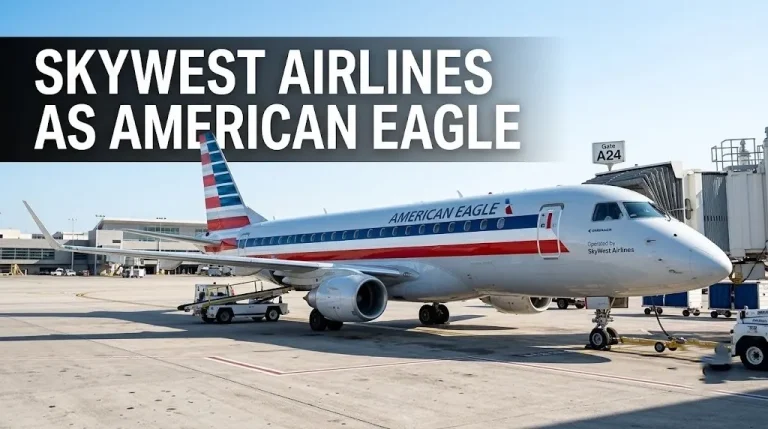
Mesa Airlines and SkyWest Airlines generate significant passenger complaints through their operations as regional partners for American Eagle and United Express, despite operating under major airline branding.
Mesa Airlines operates Bombardier CRJ-700 and CRJ-900 aircraft as American Eagle and formerly as United Express. When your “American Airlines” regional flight delays or cancels, Mesa Airlines is frequently the actual operating carrier.
SkyWest Airlines operates Embraer 175 and Bombardier CRJ-700 aircraft as United Express, Delta Connection, and Alaska Airlines affiliate service. SkyWest is one of the largest regional carriers in U.S. aviation by passenger count.
The key problem for passengers: When a Mesa or SkyWest flight delays or cancels, the customer service and rebooking process runs through the major carrier (American or United), not the regional operator. This creates accountability gaps.
For first-time travelers booking what appears to be an American Airlines or United Airlines flight, check the “operated by” line in your booking confirmation. If it says “operated by American Eagle” or “operated by United Express,” your physical aircraft is a regional jet.
The DOT Air Travel Consumer Report tracks complaint data by marketing carrier, not operating carrier. This means Mesa and SkyWest complaints often appear under American or United in public rankings.
Insider Tip:
- Regional jets like the Bombardier CRJ-900 have very limited overhead bin space. Gate-check your roller bag even before the gate agent asks.
- Embraer 175 aircraft operated by SkyWest for Delta and United have full-size overhead bins in most configurations. Check your specific aircraft type on SeatGuru before traveling.
- For business travelers connecting through small regional markets, build at least 90 minutes of connection time at the hub airport when your first segment is on a regional jet.
Key Takeaway: Always check the “operated by” field on your booking. Regional carriers like Mesa Airlines and SkyWest Airlines operate under major airline branding but with different service standards and equipment.
Good Airlines Worth Paying More For
The U.S. airlines consistently worth paying more for are Alaska Airlines, Delta Air Lines, and JetBlue Airways, based on complaint rates, on-time performance, seat comfort, and total cost value.
Alaska Airlines consistently ranks at or near the top of domestic U.S. airline satisfaction surveys. Its Mileage Plan loyalty program offers some of the best international partner redemption rates in U.S. aviation, including access to Emirates, Cathay Pacific, and British Airways.
Delta Air Lines leads on operational reliability and customer service responsiveness among legacy carriers. Its Sky Club lounge network is the most extensive of the three legacy carriers. Delta Comfort+ economy at a slight premium over main cabin offers meaningfully more legroom on most aircraft.
JetBlue Airways consistently leads on seat comfort in economy on domestic routes, with core cabin seat pitch typically around 32 to 33 inches. Verify your specific aircraft configuration on JetBlue’s seat map before booking.
- Alaska Airlines: Best for West Coast routes, international partner redemptions, and family travel value.
- Delta Air Lines: Best for business travelers who value reliability, Sky Club access, and a consistent economy product.
- JetBlue Airways: Best for Northeast transcon routes, Mint business class on transcontinental routes, and economy seat comfort.
For budget travelers who find Alaska, Delta, or JetBlue fares within $40 to $60 of Spirit or Frontier after adding bag fees, the premium airline is almost always the better total-value choice. The gap in reliability and seat comfort exceeds the price difference at that range.
Top Rated Airlines for Long Haul Flights
For long haul international flights from U.S. airports, the top-rated airlines are Delta Air Lines, United Airlines (Polaris), and JetBlue Airways (Mint), with foreign carriers like Singapore Airlines and Japan Airlines consistently outranking all U.S. carriers in independent quality assessments.
Delta’s Delta One business class on the Boeing 767-400ER and Airbus A350-900 offers a fully lie-flat product with direct aisle access. Seat pitch and width vary by aircraft. Confirm your specific layout on Delta’s seat map before booking.
United’s Polaris business class on the Boeing 787-9 and Boeing 777-300ER is a competitive lie-flat product on transatlantic and transpacific routes. The Polaris lounges at Chicago O’Hare (ORD), Newark (EWR), San Francisco (SFO), and Los Angeles (LAX) are a genuine differentiator for long-haul business travelers.
For business and frequent flyers evaluating long haul options, Condé Nast Traveler consistently ranks non-U.S. carriers, including Singapore Airlines, Japan Airlines, and Qatar Airways, above all U.S. carriers for business class product quality. If routing flexibility allows, a non-U.S. carrier connection through a foreign hub frequently delivers a better long-haul experience.
For budget travelers on long haul routes, the cheapest U.S. option in economy is typically American Airlines or United Airlines basic economy. The seat product is competitive. The restrictions on changes and carry-on bags make it a poor choice for international trips where plans may change.
The honest limitation of U.S. long haul airlines: Even Delta One and United Polaris trail Singapore Airlines Suites, Qatar Airways Qsuite, and Japan Airlines First Class on equivalent route lengths, according to Condé Nast Traveler and Skytrax assessments.
How to Avoid the Worst Airline Experience
The most effective way to avoid the worst airline experience is to calculate the total fare including all fees, check the route-specific on-time performance before booking, and match your airline choice to your specific trip type and traveler profile.
To evaluate and book the right airline for your next trip:
- Start with Google Flights or Kayak to compare base fares across all carriers on your route.
- Add the carry-on and checked bag fee for each airline you are considering at their official website.
- Check route-specific on-time performance at the DOT Bureau of Transportation Statistics before finalizing.
- Review seat pitch for your specific aircraft on SeatGuru to verify comfort on your route length.
- Check the DOT Air Travel Consumer Report for the most recent complaint rate data for your shortlisted carriers.
- Book the airline whose total cost, on-time record, and seat comfort align with your specific trip type and traveler profile.
Important Accuracy Notes for Airline Fees and Policies:
Baggage fees, seat selection policies, and fare class restrictions are among the most frequently changed elements in U.S. aviation.
Verify the following directly before traveling:
- Current carry-on and checked bag fees at the official website of every airline you are comparing. Do not rely on third-party fee summaries.
- Current seat assignment policy for families, particularly on Spirit Airlines, Frontier Airlines, and Allegiant Air, where fees change without public notice.
- Current on-time performance data at the DOT Bureau of Transportation Statistics for your specific route and month of travel.
The single most important action before booking: Calculate the all-in total fare including every fee you will realistically incur. The airline with the lowest base fare is rarely the airline with the lowest total cost.
Frequently Asked Questions About the Worst Airlines in the US
What is the single worst airline in the US right now?
Spirit Airlines consistently ranks as the worst U.S. airline by DOT complaint rate, on-time performance, and passenger satisfaction scores.
Its combination of ultra-tight seat pitch (typically around 28 inches on the Airbus A320 family), aggressive add-on fees, and a thin operational network that produces cascading cancellations places it last in most quality assessments.
The DOT Air Travel Consumer Report publishes current complaint rate data monthly, which you can check directly before booking.
Is Spirit Airlines actually that bad, or is it fine for short trips?
Spirit Airlines is acceptable for solo travelers doing a carry-on-only trip under 90 minutes who have no schedule sensitivity.
On a 60-minute route like Fort Lauderdale to Orlando, the seat discomfort is tolerable and the savings can be real if you carry only a personal item that fits under the seat.
Spirit becomes genuinely problematic for trips over 2 hours, for anyone checking a bag, for families, or for travelers with tight connections or time-sensitive plans.
Is Frontier Airlines worse than Spirit Airlines?
Frontier Airlines and Spirit Airlines are roughly equivalent in complaint rate and product quality, though Frontier’s Airbus A320neo fleet is marginally newer.
Both airlines offer seat pitch typically around 28 to 29 inches, apply aggressive carry-on and checked bag fees, and generate above-average DOT complaint rates relative to the U.S. industry.
The practical difference for most travelers is route availability. Frontier is stronger in Denver and leisure sun destinations. Spirit covers more East Coast and Florida routes.
Which US airlines have the best on-time performance?
Alaska Airlines and Delta Air Lines consistently lead U.S. domestic on-time performance rankings, followed by Southwest Airlines.
The DOT Bureau of Transportation Statistics publishes monthly on-time arrival percentages for every U.S. carrier. Check route-specific data rather than airline-wide averages for the most accurate picture.
Spirit Airlines, Frontier Airlines, and Allegiant Air consistently trail the field on on-time performance, particularly during peak summer and holiday travel periods.
What airlines should families avoid when flying with kids?
Families with children should avoid Spirit Airlines, Frontier Airlines, and Allegiant Air due to seat assignment fee structures that may separate family members unless additional fees are paid.
Southwest Airlines is the most family-friendly option among value carriers, offering early family boarding for children age 6 and under, two free checked bags, and no seat selection fees.
Alaska Airlines and Delta Air Lines offer better seat assignment flexibility for families on standard economy fares compared to American and United basic economy restrictions.
Is Allegiant Air safe to fly?
Allegiant Air is FAA-certified and meets all U.S. federal aviation safety standards. Safety and operational reliability are different measurements.
Allegiant’s safety record is not a concern. Its operational reliability record, including on-time performance and mechanical delay rates, is among the worst in U.S. aviation per DOT data.
For travelers in smaller markets where Allegiant is the only nonstop option, it is a reasonable choice for leisure trips with flexible travel dates.
Closing
The clearest conclusion from this analysis: Spirit Airlines and Frontier Airlines are genuinely poor choices for anyone checking a bag, traveling with children, or flying on a tight schedule. The low base fare disappears quickly under the weight of carry-on fees, seat fees, and cancellation risk.
For most travelers, Alaska Airlines, Delta Air Lines, and JetBlue Airways deliver meaningfully better reliability and comfort at total costs that frequently match the budget carriers once all fees are included. Calculate every fee before booking. The airline that looks cheapest at step one is often not cheapest at step six.
Airline fee structures, seat configurations, and on-time performance data change throughout the year. Verify all fee information directly with each airline and check the current DOT Air Travel Consumer Report before finalizing any booking. One hour of research before you book can save an entire day of frustration at the airport.