TACA International Airlines no longer operates as an independent carrier. The airline merged with Avianca in 2013 to form Avianca El Salvador and other Central American subsidiaries.
The Points Guy traces modern LifeMiles accounts through the Avianca merger directly to TACA’s original loyalty program. Many Central America-based Avianca frequent flyers hold accounts with roots in the old TACA system.
This guide covers the complete TACA story from founding through merger to modern legacy. You will find aircraft fleet details, hub history, and clear explanations of how the airline’s operations shaped Avianca’s Central American presence in 2026.
TACA International Airlines Overview
TACA International Airlines was a major Central American carrier headquartered in San Salvador, El Salvador. The airline operated from 1931 until merging with Avianca in 2013.
TACA grew from a small regional cargo carrier to Central America’s largest airline group. The carrier’s distinctive green and white livery became recognizable throughout the Americas.
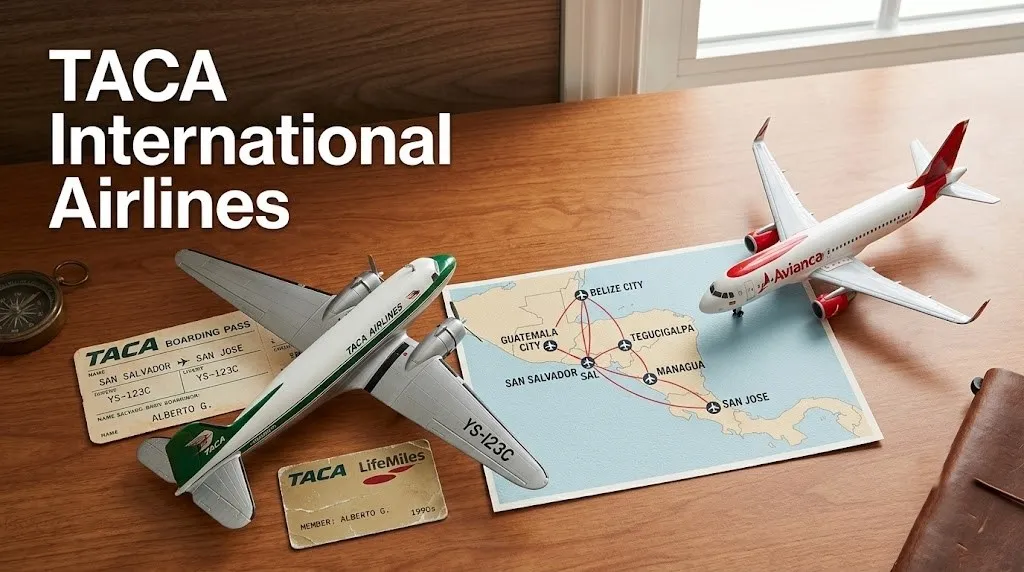
Business travelers who flew TACA in the 1990s and 2000s remember the airline as Central America’s primary international carrier. The San Salvador hub connected the region to North and South America.
Budget travelers benefited from TACA’s competitive pricing on Central American routes. The airline’s regional focus provided essential connectivity between Central American capital cities.
Solo travelers used TACA’s hub network to explore multiple Central American countries efficiently. The airline’s schedule enabled multi-destination itineraries throughout the region.
TACA’s legacy lives on in Avianca’s Central American operations and in LifeMiles accounts descended from the original TACA loyalty program.
Key Takeaway: TACA International Airlines operated from 1931 to 2013 as Central America’s largest carrier headquartered in San Salvador, El Salvador.
What Happened to TACA Airlines
What happened to TACA Airlines is the most common question from travelers who encounter the name on old documents or airport references. The airline merged with Avianca in 2013.
The merger combined TACA’s Central American network with Avianca’s South American operations. The combined airline adopted the Avianca name while incorporating TACA’s routes and hubs.
Avianca El Salvador, Avianca Costa Rica, and other Central American subsidiaries continue TACA’s legacy. These carriers operate under the unified Avianca brand across the region.
First-time researchers of this airline history should understand the merger created one of Latin America’s largest airline groups. TACA’s Central American expertise combined with Avianca’s South American strength.
Business travelers with old TACA stock certificates or employee records should contact Avianca corporate offices. The merger means Avianca holds TACA’s corporate history and records.
Solo travelers who find TACA references in family travel documents can trace their journey through Avianca. The airline’s physical operations transformed while its regional legacy endures.
Key Takeaway: TACA Airlines merged with Avianca in 2013 with the combined airline adopting the Avianca name while incorporating TACA’s Central American routes.
TACA Airlines History and Founding
TACA Airlines history began in 1931 when the airline was founded in Honduras. The original name stood for Transportes Aereos Centroamericanos.
The airline moved headquarters to San Salvador, El Salvador and expanded throughout Central America. TACA became the primary carrier connecting the region’s capital cities.
The U.S. Department of Transportation records show TACA grew significantly in the 1990s. The airline modernized its fleet with Airbus A320 family aircraft and expanded international routes.
Business travelers in the 1990s watched TACA evolve from a regional carrier. The airline added routes to major U.S. cities including Los Angeles, Miami, and New York.
Solo travelers benefited from TACA’s expansion throughout the Americas. The airline connected Central America to destinations from Canada to Argentina.
TACA operated as a multi-carrier group with subsidiaries in several countries. The group structure positioned the airline for the eventual Avianca merger.
Key Takeaway: TACA Airlines launched in 1931 in Honduras as Transportes Aereos Centroamericanos before moving to El Salvador and becoming Central America’s largest carrier.
Is TACA Airlines Still Operating
Is TACA Airlines still operating has a clear and direct answer. The airline ceased independent operations in 2013 and no longer flies under its own name.
TACA’s operating certificate was merged into Avianca’s system. Avianca El Salvador and Avianca Costa Rica now operate the former TACA routes.
Travelers searching for TACA flights in 2026 will not find the airline on any booking platform. The carrier exists only in historical records and aviation archives.
First-time researchers who find old TACA tickets or boarding passes should understand these are historical artifacts. The airline cannot honor old tickets or reservations.
Former TACA employees seeking benefits information should contact Avianca human resources. The merger consolidated employee records through the Avianca system.
Aviation enthusiasts who spot TACA references on airport signage or older aircraft registrations should know these are remnant artifacts. No active aircraft carry TACA livery in 2026.
Key Takeaway: TACA Airlines does not operate in 2026 having merged into Avianca in 2013 with its routes operated by Avianca Central American subsidiaries.
TACA Airlines Merger with Avianca
TACA Airlines merger with Avianca represented one of the most significant Latin American airline consolidations. The 2013 transaction created one of the region’s largest airline groups.
The merger combined TACA’s Central American expertise with Avianca’s South American network. The resulting airline group served destinations throughout the Americas and Europe.
Avianca adopted unified branding across the combined airline. TACA’s distinctive green livery gave way to Avianca’s red and white color scheme.
Business travelers who followed Latin American aviation watched this merger reshape regional connectivity. The combined airline offered more routes than either carrier independently.
Star Alliance membership transferred through the merger. Avianca joined Star Alliance bringing TACA’s former routes into the global alliance network.
Aviation historians note the TACA-Avianca merger as creating a genuine Latin American mega-carrier. The combination joined Central and South American aviation markets.
Key Takeaway: The 2013 TACA-Avianca merger created one of Latin America’s largest airline groups combining Central and South American networks under the Avianca brand.
TACA Avianca Integration Details
TACA Avianca integration combined two airlines with different histories and route networks. The operational merger took several years to complete fully.
The combined airline operated under a single air operator certificate following integration. TACA’s certificates transitioned to Avianca branding across the entire Central American fleet.
TACA’s San Salvador headquarters became a major Avianca operational center. The facility serves as Avianca’s Central American regional headquarters.
Solo travelers who flew both TACA and Avianca before the merger experienced gradual service standardization. Cabin products, boarding procedures, and loyalty programs unified over time.
Business travelers benefited from the combined airline’s expanded route network. TACA’s Central American strength combined with Avianca’s South American presence created continental coverage.
The integration process preserved TACA’s regional expertise within the larger Avianca group. Central American routes continue operating with deep regional knowledge.
Key Takeaway: The TACA-Avianca integration combined two airlines’ fleets and routes over several years with TACA’s San Salvador base becoming Avianca’s Central American hub.
TACA Avianca Merger Timeline
TACA Avianca merger timeline spans from the initial announcement through full integration. The merger process took several years to complete.
The merger was announced in 2009 with regulatory approvals following. The airlines formally combined operations in 2013 under the unified Avianca brand.
Avianca joined Star Alliance in 2012 bringing TACA’s routes into the global alliance. The membership provided seamless connections for TACA’s former passengers.
Business travelers experienced gradual changes as the airlines integrated. Unified ticketing, check-in, and loyalty programs rolled out over several years.
Solo travelers noticed the most visible change in aircraft livery. TACA’s green and white planes gradually received Avianca’s red and white paint scheme.
The merger timeline completed with full operational integration by 2015. Avianca El Salvador, Avianca Costa Rica, and other subsidiaries now operate the former TACA network.
Key Takeaway: The TACA-Avianca merger announced in 2009 completed full integration by 2015 with Avianca joining Star Alliance during the transition period.
TACA Airlines Hub at San Salvador
TACA Airlines hub at San Salvador International Airport formed the carrier’s operational backbone. The airport served as TACA’s headquarters and primary connecting hub.
San Salvador remains a critical Avianca hub in 2026. The airport’s Avianca operation descends directly from TACA’s original hub development.
The San Salvador hub connected Central American capital cities to each other and to destinations throughout the Americas. TACA’s scheduling enabled efficient regional connections.
Business travelers in Central America relied on TACA’s San Salvador hub for regional connectivity. The hub provided service to cities that larger carriers might not serve directly.
First-time Central America visitors should understand San Salvador’s current Avianca operation traces to TACA. The airline’s hub development shaped the region’s aviation infrastructure.
The San Salvador hub remains strategically important to Avianca. TACA’s original hub strategy determines which routes operate and how the airline schedules connections.
Key Takeaway: TACA’s San Salvador hub formed the carrier’s operational core and now anchors Avianca’s Central American operations.
TACA Airlines Fleet and Aircraft
TACA Airlines fleet evolved from early propeller aircraft to a modern all-Airbus narrow-body fleet. The airline operated one of Central America’s most modern aircraft collections.
The airline’s later fleet consisted primarily of Airbus A320 family aircraft. TACA also operated Embraer 190 aircraft for thinner regional routes.
Aviation enthusiasts studying TACA’s fleet note the airline’s early adoption of Airbus narrow-body aircraft. The A320 fleet provided efficiency and commonality across the network.
Business travelers who flew TACA in its later years remember the modern A320 cabin. The aircraft provided competitive comfort on Central American and international routes.
Solo travelers appreciated the A320’s wider cabin compared to older regional aircraft. The fleet modernization improved the passenger experience throughout the network.
The TACA fleet transitioned to Avianca colors following the merger. Aircraft eventually received full Avianca livery and cabin configurations.
Key Takeaway: TACA operated an all-Airbus A320 family fleet with Embraer 190 aircraft for regional routes before transitioning to Avianca livery.
TACA Airlines Routes and Network
TACA Airlines routes connected Central America to North and South America with San Salvador as the primary hub. The network grew from regional routes to continental coverage.
The route network served major U.S. cities including Los Angeles International Airport, Miami International Airport, and John F. Kennedy International Airport. South American destinations included Lima, Bogota, and Buenos Aires.
Business travelers watched TACA’s route map expand throughout the Americas. The airline connected Central American business centers to major economic hubs.
Solo travelers seeking multi-country Central America itineraries relied on TACA’s network. The airline’s regional routes enabled efficient exploration of the isthmus.
The TACA route map lives on through Avianca’s Central American operations. Many routes TACA pioneered remain in Avianca’s schedule from San Salvador and San Jose.
Avianca El Salvador continues operating the former TACA network under the unified Avianca brand. Central American connectivity remains a core part of Avianca’s business.
Key Takeaway: TACA’s route network connected Central America to destinations throughout the Americas with San Salvador as the primary connecting hub.
TACA Airlines El Salvador Legacy
TACA Airlines El Salvador legacy endures in the country’s aviation infrastructure and Avianca’s continued presence. The airline shaped El Salvador’s connectivity to the world.
Avianca El Salvador operates as the largest carrier at San Salvador International Airport. The subsidiary directly descends from TACA’s original operations.
Business travelers in El Salvador continue benefiting from TACA’s legacy. The San Salvador hub provides connectivity that traces directly to TACA’s route development.
Solo travelers visiting El Salvador will encounter TACA’s legacy throughout San Salvador Airport. The terminal layout and route network reflect TACA’s historical operations.
TACA’s headquarters building in San Salvador remains an Avianca facility. The office complex serves as Avianca’s Central American regional headquarters.
The airline’s cultural impact on El Salvador extends beyond aviation. TACA represented Salvadoran national pride and global connectivity for decades.
Key Takeaway: TACA’s El Salvador legacy endures through Avianca El Salvador’s operations and San Salvador’s role as a Central American aviation hub.
TACA Airlines LifeMiles Program
TACA Airlines LifeMiles served as the airline’s frequent flyer program. LifeMiles members earned miles on TACA flights redeemable for award travel.
LifeMiles operated as a traditional frequent flyer program with elite status tiers. Members earned miles based on distance flown with bonus earning for premium cabin tickets.
Solo travelers who were LifeMiles members saw their accounts transition to Avianca LifeMiles. Miles transferred at a one-to-one ratio preserving member value.
Business travelers who maintained LifeMiles elite status received comparable status in the Avianca program. The merger preserved benefits including upgrades and priority services.
First-time researchers of old loyalty accounts should know LifeMiles still exists as Avianca LifeMiles. The program traces directly to TACA’s original loyalty system.
Avianca LifeMiles ranks among the most valuable frequent flyer programs for award redemptions. The Points Guy consistently rates LifeMiles highly for partner award value.
Key Takeaway: TACA LifeMiles transitioned to Avianca LifeMiles with miles transferring at a one-to-one ratio and the program continuing as a leading loyalty currency.
TACA LifeMiles to Avianca Migration
TACA LifeMiles to Avianca migration completed the loyalty program consolidation. LifeMiles accounts transferred to Avianca LifeMiles following the merger.
The LifeMiles migration preserved all miles and elite status at equivalent levels. TACA elite members received matching Avianca status tiers.
Business travelers who held TACA elite status continued receiving benefits through Avianca. Priority check-in, boarding, and lounge access transferred to the combined program.
Solo travelers with legacy TACA LifeMiles accounts can still access their miles. Avianca LifeMiles customer service can trace account history to the original TACA program.
Avianca LifeMiles offers award redemptions on Star Alliance partners worldwide. The program’s value extends far beyond the original TACA route network.
LifeMiles points can be purchased during frequent promotions. The program offers transfer bonuses from major credit card reward programs.
Key Takeaway: TACA LifeMiles migrated to Avianca LifeMiles with full value preservation and the program now offering Star Alliance partner redemptions worldwide.
Avianca LifeMiles Program Today
Avianca LifeMiles program today ranks among the most valuable frequent flyer programs. The Points Guy consistently includes LifeMiles in top loyalty program rankings.
LifeMiles offers award redemptions on Star Alliance airlines including United Airlines, Lufthansa, and Singapore Airlines. Partner award availability provides global reach.
Business travelers value LifeMiles for competitive award pricing on international routes. The program’s mileage requirements often undercut U.S. carrier programs for similar awards.
Solo travelers can earn LifeMiles through Avianca flights, credit card transfers, and mileage purchase promotions. The program offers multiple earning pathways.
LifeMiles points do not expire with qualifying account activity. The flexible expiration policy benefits infrequent travelers.
Chase Ultimate Rewards, American Express Membership Rewards, and Citi ThankYou all transfer to LifeMiles. These transfer options make LifeMiles accessible to U.S. travelers.
Key Takeaway: Avianca LifeMiles ranks among the top frequent flyer programs with competitive Star Alliance award pricing and multiple U.S. credit card transfer partners.
Avianca Central America Routes
Avianca Central America routes descend directly from TACA’s original network. The airline continues serving the region from San Salvador and San Jose hubs.
Avianca El Salvador operates routes to major U.S. cities including Los Angeles, Miami, New York, and Washington D.C. These routes trace directly to TACA’s international expansion.
Central American capital cities remain connected through Avianca’s regional network. San Salvador, San Jose, Guatemala City, and Managua enjoy frequent service.
Business travelers in Central America rely on Avianca’s regional connectivity. The route network provides essential links between Central American business centers.
Solo travelers exploring Central America can use Avianca’s network for multi-destination itineraries. The airline’s schedule enables efficient country-to-country travel.
Star Alliance connections through San Salvador provide global reach. Partner airlines feed passengers into Avianca’s Central American network.
Key Takeaway: Avianca’s Central American routes continue TACA’s legacy connecting the region to North and South America through San Salvador and San Jose hubs.
TACA Airlines Website Today
TACA airlines website today redirects to Avianca’s official site. The original TACA web domain no longer functions as an independent booking platform.
Travelers searching for the TACA airlines website will arrive at Avianca’s booking portal. All former TACA routes book through Avianca’s website.
The Avianca website handles bookings for Avianca El Salvador and other Central American subsidiaries. Former TACA routes appear alongside Avianca’s broader network.
Business travelers seeking Central America flights should book through Avianca’s website. The unified platform provides access to the complete Central American network.
Solo travelers can manage Avianca LifeMiles accounts through the Avianca website. Legacy TACA LifeMiles account access is available through the same portal.
The Avianca website accepts major credit cards and offers English and Spanish language options. U.S.-based travelers can book Central America flights easily through the platform.
Key Takeaway: The TACA airlines website redirects to Avianca where all former TACA routes book through the unified Avianca platform with LifeMiles account access.
Frequently Asked Questions About TACA Airlines
What happened to TACA Airlines?
TACA Airlines merged with Avianca in 2013 to form one of Latin America’s largest airline groups.
The combined airline adopted the Avianca name while incorporating TACA’s Central American routes and hubs.
Avianca El Salvador and other Central American subsidiaries now operate the former TACA network.
Is TACA Airlines still flying?
TACA Airlines does not operate in 2026 having merged into Avianca in 2013.
No aircraft carry TACA livery and the airline’s operating certificate is no longer active.
Former TACA routes are operated by Avianca El Salvador and other Avianca Central American subsidiaries.
What happened to TACA LifeMiles?
TACA LifeMiles migrated to Avianca LifeMiles following the merger with miles transferring at a one-to-one ratio.
Avianca LifeMiles continues as a leading frequent flyer program with Star Alliance partner redemptions.
Contact Avianca LifeMiles customer service for legacy account history questions.
Who bought TACA Airlines?
TACA Airlines merged with Avianca in a 2013 transaction combining the two airlines.
The combined airline adopted the Avianca brand with TACA’s operations becoming Avianca El Salvador.
The merger created one of Latin America’s largest airline groups.
Where was TACA Airlines based?
TACA Airlines was headquartered in San Salvador, El Salvador.
The San Salvador headquarters now serves as Avianca’s Central American regional office.
San Salvador International Airport continues as a major Avianca hub.
What aircraft did TACA Airlines fly?
TACA Airlines operated Airbus A320 family aircraft including the A319 and A320.
The airline also flew Embraer 190 aircraft for regional routes within Central America.
Earlier fleet types included Boeing 737 and various turboprop aircraft.
TACA Airlines ceased independent operations in 2013 but shaped modern Central American aviation through its San Salvador hub strategy, regional route network, and the LifeMiles loyalty program. The airline’s influence persists in every Avianca flight departing San Salvador International Airport.
Former LifeMiles members should verify their Avianca LifeMiles account reflects the complete loyalty history from the TACA era. Contact Avianca customer service for assistance tracing legacy accounts.
Current Avianca operations, LifeMiles program terms, and Central America route networks change periodically. Verify current information directly with Avianca before traveling through the former TACA network.