China Airlines and EVA Air are Taiwan’s two major international carriers competing directly on trans-Pacific and Asia routes. Both airlines operate modern wide-body fleets from their hub at Taiwan Taoyuan International Airport.
China Airlines is the state-linked flag carrier with a mixed fleet of Airbus A350-900 and Boeing 777-300ER aircraft. EVA Air is the privately-owned competitor that also operates the Boeing 787-9 and 787-10 Dreamliner.
The single most important difference for U.S. travelers is the airline alliance membership. China Airlines belongs to SkyTeam alongside Delta Air Lines, while EVA Air belongs to Star Alliance alongside United Airlines.
This alliance split determines frequent flyer mileage earning, elite status benefits, and lounge access for travelers with existing loyalty to one alliance. Business and frequent flyers should choose the airline in their alliance unless the product difference is overwhelming.
First-time travelers to Taipei will find both airlines deliver a distinctly Taiwanese service culture. The cabin crew on both carriers are professional, attentive, and offer service in Mandarin, English, and Taiwanese.
Budget travelers will find China Airlines typically prices slightly lower than EVA Air on identical routes. The fare difference is not dramatic, but consistent enough to influence a cost-conscious booking decision.
China Airlines vs EVA Air Business Class
China Airlines Dynasty Business Class and EVA Air Royal Laurel Class both offer lie-flat seats with direct aisle access on their modern wide-body aircraft. EVA Air’s Royal Laurel seat on the Boeing 777-300ER is the superior business class product.
China Airlines business class on the A350-900 uses a 1-2-1 reverse herringbone configuration with a fully flat bed. The seat measures approximately 78 inches in bed length with direct aisle access from every seat.
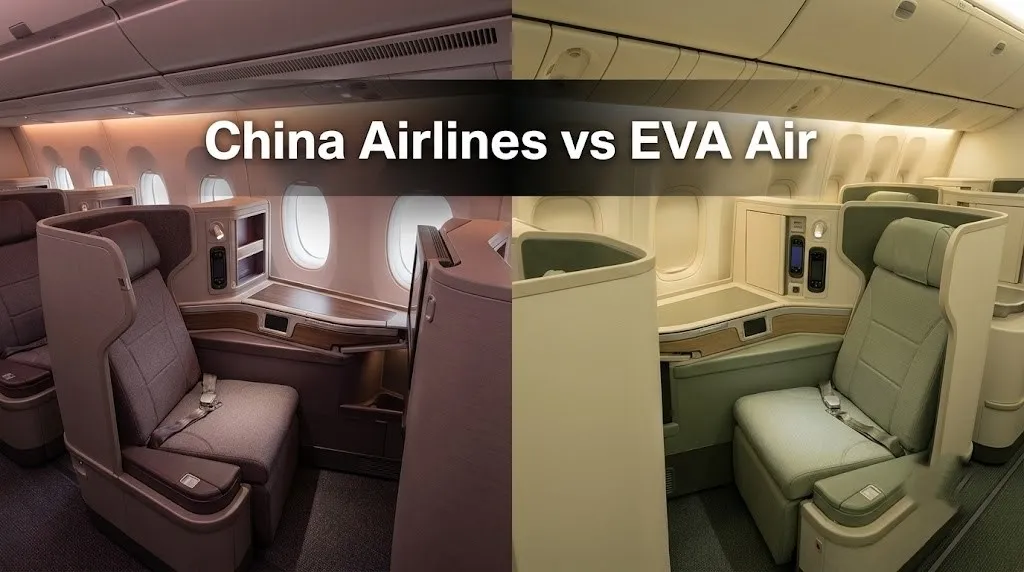
EVA Air Royal Laurel Class on the 777-300ER also uses a 1-2-1 reverse herringbone layout with a slightly more spacious seat. The Royal Laurel seat feels wider and the bedding quality from the Taiwanese designer brand is noticeably better.
Business and frequent flyers on U.S. to Taipei routes will find the EVA Air Royal Laurel seat more comfortable for sleeping. The mattress pad and duvet are thicker, and the pajama set is a nice touch absent on China Airlines.
Solo travelers should choose a window seat on either airline for maximum privacy in the reverse herringbone layout. The aisle-side seats on both carriers feel slightly more exposed to passing traffic.
The amenity kit on EVA Air is a genuine step up from China Airlines, featuring premium skincare products. China Airlines provides a functional but less luxurious amenity kit.
| Feature | China Airlines Dynasty Business | EVA Air Royal Laurel Class |
|---|---|---|
| Seat Configuration | 1-2-1 reverse herringbone | 1-2-1 reverse herringbone |
| Bed Length | 78 inches | 78 to 80 inches |
| Direct Aisle Access | Yes, every seat | Yes, every seat |
| Best Aircraft | A350-900 | 777-300ER |
| Amenity Kit | Functional | Premium brand |
| Pajamas | No | Yes, on long-haul |
Key Takeaway: EVA Air Royal Laurel Class wins on bedding and amenities, but both airlines offer true lie-flat beds with direct aisle access.
China Airlines vs EVA Air Economy Class
China Airlines and EVA Air economy class are closely matched on modern wide-body aircraft with similar seat pitch and width. EVA Air economy edges slightly ahead on cabin design and IFE screen quality.
China Airlines economy class on the A350-900 offers 31 to 32 inches of seat pitch and 17 to 18 inches of width. The cabin is quiet, the humidity levels are comfortable, and the seat cushioning is adequate for long-haul flights.
EVA Air economy class on the 777-300ER and 787-10 offers 31 to 33 inches of seat pitch with a similar width. The seat design feels slightly more ergonomic and the headrest adjusts more precisely for neck support.
Budget travelers will find both airlines deliver a solid economy product with good meals and professional service. The fare difference typically favors China Airlines by a modest margin.
Tall passengers over six feet should choose the airline with the specific aircraft offering the best seat pitch on the route. Check the seat map for exit row availability on both airlines during booking.
First-time travelers will appreciate the clear English signage and helpful cabin crew on both carriers. Neither airline makes a first-time long-haul flyer feel lost or unwelcome.
Solo travelers in economy should select a window seat on either airline to create a cocoon against the aisle. The 3-3-3 layout on the A350 and 777 is standard and comfortable for a solo traveler.
China Airlines vs EVA Air Premium Economy
EVA Air premium economy is the clear winner in this cabin class with a genuinely distinct product. China Airlines premium economy is a modest step up from economy and less differentiated.
EVA Air premium economy on the 777-300ER offers a dedicated cabin with wider seats, a larger IFE screen, and a footrest. The seat pitch measures approximately 38 inches with a width of 19 to 20 inches.
China Airlines premium economy on the A350-900 and 777-300ER offers 38 to 39 inches of pitch with a similar width. The seat is comfortable but lacks the design refinement and dedicated cabin feel of EVA Air.
Budget travelers considering a premium economy upgrade should choose EVA Air for the better value. The EVA Air premium economy product feels closer to domestic first class than a slightly upgraded economy seat.
Business and frequent flyers who cannot justify the business class fare should book EVA Air premium economy. The footrest, meal service, and amenity kit create a genuinely upgraded experience.
Families with children will find the EVA Air premium economy cabin more spacious and child-friendly. The dedicated cabin section feels quieter and more private than the China Airlines premium economy area.
Solo travelers on overnight long-haul flights should book EVA Air premium economy for the better recline and footrest. The sleep quality difference on a 13-hour flight is meaningful.
| Feature | China Airlines Premium Economy | EVA Air Premium Economy |
|---|---|---|
| Seat Pitch | 38 to 39 inches | 38 inches |
| Seat Width | 19 inches | 19 to 20 inches |
| Footrest | Yes | Yes, better design |
| Dedicated Cabin | No, curtain divider | Yes, separate section |
| Meal Service | Upgraded economy meal | Premium meal service |
| Verdict | Modest upgrade | Genuinely distinct product |
China Airlines vs EVA Air Fleet and Aircraft
China Airlines operates the Airbus A350-900, Boeing 777-300ER, and Boeing 737-800 on regional routes. EVA Air operates the Boeing 777-300ER, Boeing 787-9 Dreamliner, and Boeing 787-10 Dreamliner.
The A350-900 is China Airlines’ best aircraft with a quieter cabin, higher humidity, and better passenger comfort on ultra-long-haul flights. EVA Air counters with the 787-10 Dreamliner offering similar cabin improvements.
Business and frequent flyers should check the specific aircraft operating the route during booking. A China Airlines A350 is a better experience than a China Airlines 777, and an EVA Air 787-10 is better than an EVA Air 777.
First-time travelers will find both airlines operate modern, well-maintained aircraft with an average fleet age under seven years. Neither carrier uses aging wide-body aircraft on U.S. routes.
The EVA Air 777-300ER on U.S. routes features the Royal Laurel business class seat and premium economy cabin. China Airlines deploys both the A350 and 777 on U.S. routes depending on the specific city.
The 787-10 Dreamliner in the EVA Air fleet is the newest aircraft type and offers the best cabin environment. Verify the aircraft type on the booking screen before selecting your flight.
Key Takeaway: Both airlines fly modern wide-body aircraft, but specific routes require checking the exact aircraft type for the best experience.
China Airlines vs EVA Air Inflight Meals
EVA Air inflight dining is consistently rated higher than China Airlines across all cabin classes. The EVA Air meal presentation, ingredient quality, and beverage program are genuinely better.
China Airlines business class offers a dine-on-demand service with Taiwanese and Western menu options. The food is good and satisfying, but the presentation and flavor complexity lag behind EVA Air.
EVA Air Royal Laurel Class features a more refined dining experience with plated courses and a broader beverage selection. The champagne and wine list on EVA Air is a noticeable step up from China Airlines.
Budget travelers in economy will find the meal quality comparable on both airlines with a slight edge to EVA Air. The snack selection and mid-flight refreshments are better stocked on EVA Air economy.
First-time travelers should try the Taiwanese meal option on either airline for a cultural experience. The braised pork rice and beef noodle soup are genuinely good representations of Taiwanese cuisine.
Solo travelers in business class on EVA Air can pre-order meals through the airline’s online portal. China Airlines also offers pre-order meal selection, but the EVA Air online system is more user-friendly.
The mid-flight snack bar on EVA Air is stocked with instant noodles, pastries, and fresh fruit. China Airlines offers a more limited snack selection that does not match the EVA Air variety.
China Airlines vs EVA Air Inflight Entertainment
EVA Air inflight entertainment offers a larger screen, a more responsive interface, and a deeper content library than China Airlines. Both airlines provide seat-back IFE on all wide-body aircraft.
China Airlines IFE screens measure approximately 10 to 13 inches in economy and 16 to 18 inches in business class. The content library includes Hollywood releases, Chinese cinema, and a modest selection of Western TV series.
EVA Air IFE screens measure approximately 11 to 13 inches in economy and 18 inches in business class. The content selection is broader with more current Hollywood releases and a better-organized interface.
Business and frequent flyers will find the EVA Air IFE system more intuitive to browse with a faster response time. The China Airlines IFE works well but feels one generation behind in interface design.
Families with children will find EVA Air’s IFE includes a better kids’ content section with more animation options. The EVA Air Hello Kitty jet content adds a unique entertainment layer for children on specific routes.
First-time travelers should bring personal headphones with a 3.5mm jack for either airline. The provided headphones are adequate in economy but not high quality on either carrier.
Solo travelers on long flights can find plenty of content to fill the journey on both airlines. EVA Air’s larger library reduces the chance of running out of things to watch on a 14-hour flight.
China Airlines vs EVA Air Lounge Access
EVA Air operates the superior lounge at Taiwan Taoyuan International Airport with the Infinity Lounge compared to China Airlines’ Dynasty Lounge. The EVA Air Infinity Lounge offers better food, more space, and a more modern design.
China Airlines Dynasty Lounge at TPE offers a functional space with hot food, showers, and seating areas. The lounge is comfortable but feels dated compared to the EVA Air Infinity Lounge.
EVA Air Infinity Lounge features a noodle bar with made-to-order Taiwanese beef noodle soup, a broader buffet, and premium spirits. The shower suites are more modern and the overall ambiance is more premium.
Business and frequent flyers with a long TPE layover will have a better experience in the EVA Air Infinity Lounge. The food quality alone makes the EVA Air lounge worth arriving early for.
China Airlines business class passengers at U.S. airports use partner lounges like the Air France KLM Lounge at SFO. EVA Air business class passengers use Star Alliance partner lounges like the United Club or Singapore Airlines SilverKris Lounge.
Solo travelers with a long TPE connection should choose EVA Air for the lounge experience. The Infinity Lounge noodle bar and quiet seating areas are genuinely good for a multi-hour wait.
The lounge access policy for both airlines includes business class passengers, premium economy on select routes, and elite status members of their respective alliances.
| Feature | China Airlines Dynasty Lounge TPE | EVA Air Infinity Lounge TPE |
|---|---|---|
| Food Quality | Good buffet | Excellent, noodle bar |
| Shower Suites | Available, functional | Modern, well-stocked |
| Design | Dated | Modern, premium feel |
| Made-to-Order Food | No | Yes, beef noodle soup |
| Best For | Quick stopover | Long layover |
China Airlines vs EVA Air Baggage Policy
China Airlines and EVA Air offer comparable baggage allowances on U.S. to Taipei routes with two free checked bags in economy class. The checked bag weight limit is 23 kilograms per piece for economy and 32 kilograms for business class on both airlines.
Business class passengers on both airlines receive two checked bags at 32 kilograms each plus an expanded carry-on allowance. The carry-on allowance is one bag up to 7 kilograms plus a personal item.
Budget travelers should verify the specific fare class baggage rules on both airlines before booking. Some discount economy fares on both carriers may have different baggage inclusions.
Families with children receive the standard baggage allowance per ticketed passenger on both airlines. Strollers and car seats are accepted free of charge in addition to the checked bag allowance.
Solo travelers packing light can travel with a carry-on and personal item on either airline without checking luggage. The overhead bins on the A350 and 777 accommodate standard carry-on luggage.
First-time travelers should check the baggage allowance on any connecting flights operated by a different carrier. A domestic U.S. connection on Delta or United may apply different baggage rules.
Important Accuracy Notes for Baggage Policies
Baggage allowances vary by route, fare class, and frequent flyer status on both airlines.
Verify the following directly before packing:
Your specific fare class baggage allowance on the China Airlines or EVA Air manage booking portal
Carry-on weight and dimension limits for your exact route
The baggage policy for any codeshare or alliance partner connection on your itinerary
China Airlines Dynasty Flyer vs EVA Air Infinity MileageLands
China Airlines operates the Dynasty Flyer Program within the SkyTeam alliance. EVA Air operates Infinity MileageLands within the Star Alliance network.
U.S. travelers can earn and redeem China Airlines Dynasty Flyer miles through Delta SkyMiles and other SkyTeam partner programs. EVA Air Infinity MileageLands miles can be earned and redeemed through United MileagePlus and other Star Alliance programs.
Business and frequent flyers with elite status on Delta should fly China Airlines to retain lounge access and priority boarding benefits. United elite members should fly EVA Air for the same reason.
First-time travelers without existing alliance loyalty should choose the airline with the better schedule and fare. The alliance difference matters most for travelers who already hold status with a U.S. carrier.
Solo travelers building miles toward a future award ticket should consolidate flights on one alliance. Flying both China Airlines and EVA Air splits miles across two unconnected programs.
China Airlines Dynasty Flyer miles expire after three years of inactivity. EVA Air Infinity MileageLands miles also expire after a set period without earning or redemption activity.
Key Takeaway: The alliance membership is the single most important difference for frequent flyers choosing between these two airlines.
China Airlines vs EVA Air Safety and Reputation
Both China Airlines and EVA Air maintain strong modern safety records with young fleets and international safety certifications. EVA Air consistently ranks higher in global safety and product quality ratings.
China Airlines has invested heavily in fleet modernization and safety culture improvement over the past two decades. The airline holds an IATA Operational Safety Audit certification and passes all international safety oversight requirements.
EVA Air is regularly ranked among the world’s safest airlines by independent aviation safety assessment organizations. The airline’s safety culture and maintenance standards are frequently cited as industry-leading.
Business and frequent flyers can board either airline with full confidence in the safety standards. The safety difference between the two carriers is negligible for a modern traveler.
First-time travelers nervous about long-haul flights should know both airlines operate at or above global safety benchmarks. No safety concern should push a traveler toward one Taiwanese carrier over the other.
Solo female travelers report feeling safe and respected on both airlines throughout the journey. The cabin crew on both carriers are professional and attentive to passenger needs.
Conde Nast Traveler and Skytrax consistently rank EVA Air among the top 10 global airlines for safety and service quality. China Airlines ranks lower in these surveys but still within the global top tier.
China Airlines vs EVA Air Routes and Network
China Airlines and EVA Air both operate direct flights from multiple U.S. cities to Taiwan Taoyuan International Airport. China Airlines flies from Los Angeles, San Francisco, New York JFK, and Honolulu.
EVA Air flies from Los Angeles, San Francisco, New York JFK, Seattle, Chicago O’Hare, and Houston. EVA Air offers more U.S. gateway cities, giving travelers more departure options.
Business and frequent flyers on the West Coast have both airlines as options from Los Angeles and San Francisco. East Coast travelers have both airlines from New York JFK.
Budget travelers should compare fares on both airlines for the same U.S. departure city. The price difference is usually modest, but promotional fares can create larger gaps.
First-time travelers heading to Taipei will find nonstop service on both airlines from major U.S. hubs. The nonstop flight eliminates the complexity of a connection in a third country.
Beyond Taipei, both airlines connect to an extensive Southeast Asian network including Bangkok, Singapore, Manila, and Ho Chi Minh City. China Airlines has a larger mainland China network, while EVA Air offers more Japan frequencies.
Solo travelers with a complex multi-city Asia itinerary should compare the onward connection schedules from TPE. The airline with the better onward connection timing saves hours of transit time.
China Airlines vs EVA Air for US Travelers
U.S. travelers with existing Delta Air Lines elite status should fly China Airlines for SkyTeam benefits including lounge access and priority boarding. United Airlines elite members should fly EVA Air for Star Alliance benefits.
U.S. travelers without existing alliance loyalty should choose EVA Air for the superior hard product and lounge experience. The EVA Air Royal Laurel Class and Infinity Lounge are genuinely better than the China Airlines equivalents.
Budget travelers should compare fares on both airlines and book the cheaper option if the product difference is not critical. The experience on either airline is good enough that a significant fare saving justifies the choice.
First-time travelers to Taiwan should consider EVA Air for the slightly more polished experience. The EVA Air cabin crew, meal service, and IFE create a smoother introduction to long-haul Asia travel.
Families with children should check if the EVA Air Hello Kitty jet operates on the specific route being considered. The Hello Kitty themed aircraft from check-in to landing is a memorable experience for children.
Solo travelers should book the airline with the better schedule and seat availability on the travel date. The 1-2-1 business class layout on both airlines is excellent for solo travelers.
| Traveler Profile | Choose China Airlines | Choose EVA Air |
|---|---|---|
| Delta SkyMiles Elite | Yes, SkyTeam benefits | No |
| United MileagePlus Elite | No | Yes, Star Alliance benefits |
| No Alliance Loyalty | If significantly cheaper | Better product overall |
| Business Class Traveler | Solid A350 product | Superior Royal Laurel Class |
| Family with Children | Good service | Hello Kitty jet option |
| Budget Economy Traveler | Usually cheaper | Worth small premium |
China Airlines vs EVA Air Final Verdict
EVA Air wins the overall comparison on hard product quality, lounge experience, and inflight dining. The Royal Laurel business class seat, Infinity Lounge at TPE, and superior meal service give EVA Air a clear edge.
China Airlines counters with a competitive A350 product, a slightly lower average fare, and a solid SkyTeam network for Delta loyalists. The difference between the two airlines is noticeable but not dramatic in economy class.
The single most important deciding factor is the airline alliance membership. Delta SkyMiles elite members should fly China Airlines, and United MileagePlus elite members should fly EVA Air.
Business and frequent flyers booking a premium cabin should choose EVA Air for the Royal Laurel Class experience. The better bedding, pajama service, and lounge create a genuinely superior business class journey.
Budget travelers should compare fares and book the cheaper option unless the price difference is under roughly 10 percent. The EVA Air economy experience is slightly better, but not enough to justify a large fare premium.
Solo travelers have an excellent experience on either airline in business class with the 1-2-1 reverse herringbone layout. The decision should come down to schedule, price, and alliance loyalty.
Key Takeaway: EVA Air wins the product comparison, but China Airlines is a strong value pick, and alliance membership is the deciding factor.
Frequently Asked Questions About China Airlines vs EVA Air
Is EVA Air better than China Airlines?
EVA Air is generally rated higher than China Airlines for business class seat quality, inflight dining, and lounge experience.
The EVA Air Royal Laurel Class and Infinity Lounge at Taipei Taoyuan Airport are superior to the China Airlines equivalents.
China Airlines offers a competitive product on the A350 and is often priced slightly lower than EVA Air on the same routes.
Which airline has better business class, China Airlines or EVA Air?
EVA Air Royal Laurel Class on the Boeing 777-300ER offers a better business class experience with superior bedding, pajamas, and amenity kit.
China Airlines Dynasty Business Class on the A350-900 is a strong product with a lie-flat seat and direct aisle access.
Both airlines use a 1-2-1 reverse herringbone configuration, so the seat layout is similar while the soft product favors EVA Air.
Does China Airlines or EVA Air have premium economy?
Both China Airlines and EVA Air offer premium economy on most long-haul wide-body aircraft.
EVA Air premium economy is the superior product with a more distinct cabin section, better footrest design, and upgraded meal service.
China Airlines premium economy is a comfortable upgrade from economy but less differentiated than the EVA Air equivalent.
What alliance is China Airlines in vs EVA Air?
China Airlines is a member of the SkyTeam alliance alongside Delta Air Lines, Korean Air, and Air France.
EVA Air is a member of the Star Alliance alongside United Airlines, Singapore Airlines, and ANA.
This alliance difference determines frequent flyer mileage earning and elite status benefits for U.S.-based travelers.
Which airline has better food, China Airlines or EVA Air?
EVA Air consistently receives higher ratings for inflight meal quality, presentation, and beverage selection across all cabin classes.
China Airlines offers good Taiwanese and Western dining options with a solid dine-on-demand service in business class.
The mid-flight snack selection and champagne list on EVA Air are noticeably better than the China Airlines equivalents.
Do China Airlines and EVA Air fly to the same US cities?
China Airlines and EVA Air both fly nonstop from Los Angeles, San Francisco, and New York JFK to Taipei.
EVA Air operates additional U.S. gateways from Seattle, Chicago O’Hare, and Houston that China Airlines does not serve.
China Airlines serves Honolulu, which EVA Air does not currently serve as a U.S. gateway.
Your China Airlines vs EVA Air Booking Decision
EVA Air wins the head-to-head comparison on product quality, but the right airline for you depends on your alliance loyalty and specific route. A Delta SkyMiles elite member should fly China Airlines regardless of the product gap. A United MileagePlus elite member gains more value from EVA Air for the Star Alliance benefits.
Your single best move is to check the aircraft type on your specific flight date and verify the seat map before booking. A China Airlines A350 is better than an EVA Air 777 on cabin quietness, even though the EVA Air soft product is superior. The aircraft type, not the airline logo, determines your actual seat comfort for 13 hours.
Aircraft assignments, lounge access policies, baggage allowances, and loyalty program earning rates change without public notice. Verify your specific flight details, cabin configuration, and alliance benefits on the airline’s official website before booking. A confirmed aircraft type and a clear understanding of your alliance benefits make the difference between a smart booking and an expensive lesson in airline loyalty politics.