A connecting flight means you use two separate aircraft to reach your final destination. You buy one ticket but fly on two distinct segments with a stop in between.
The airline is legally responsible for getting you to your destination on a single ticket. This “protected connection” is your insurance policy against a first-flight delay.
This guide explains the exact airport process for a connection. It covers your bags, your boarding pass, and the legal risks of a missed flight.
How Do Connecting Flights Work
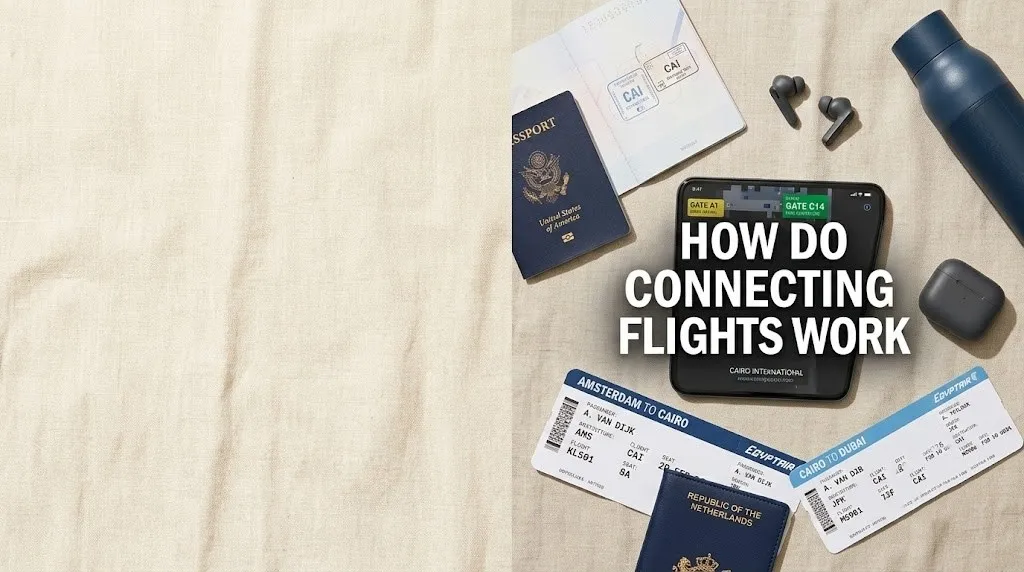
You book a single itinerary from point A to point C with a stop in city B. The airline sells you a “married segment” fare that legally links both flights together.
Your boarding passes for both flights are often issued at the very first check-in counter. You hold both stubs, or they load onto your phone app immediately.
First-time international travelers should book an itinerary with a single airline or an alliance partner. Delta Air Lines and Air France work together, making the transfer process seamless.
Budget travelers must read the fine print on online travel agencies for this specific reason. A cheap fare may consist of two separate, unlinked tickets with no legal protection.
The Points Guy identifies protected interline connections as the single safest way to book. These tickets follow strict global IATA standards for baggage and passenger transfer.
How Does a Connecting Flight Work
You step off your first flight and follow “Transfer” or “Flight Connections” airport signs. You do not walk toward baggage claim or the airport exit doors.
You must pass through the connecting airport’s sterile transit zone, not public land. This airside path keeps you inside the security-cleared bubble without exiting to the street.
Business travelers should use an airline lounge app to locate the fastest walk route. The Delta Sky Club at Atlanta (ATL) sits directly above the Plane Train for quick access.
A short layover requires you to walk directly to the departure gate immediately. Do not stop for coffee, food, or a bathroom break until you locate the gate.
The airline scans your second boarding pass directly at the gate door for your onward flight. Your boarding pass has already been checked, and your seat remains confirmed.
Key Takeaway: Always follow “Flight Connections” signs, never “Baggage Claim.”
What Is a Layover vs Connecting Flight
A layover is the waiting time spent inside the airport between your two flights. A connecting flight is the second plane you physically board after that waiting period.
A layover is typically a short connection window under four hours for domestic flights. International layovers can stretch to 12 hours or even extend overnight legally.
Solo travelers with a long six-hour layover should look for a pay-per-use airport lounge. A quiet shower and a hot meal change the entire physical experience of a trip.
A “stopover” differs from a layover because it involves leaving the airport overnight. You clear immigration, collect your bags, and sleep in a city hotel room.
IATA reports that a standard domestic layover requires a minimum of 35 minutes for a legal connection. Airlines enforce this minimum connection time strictly when issuing a protected ticket.
Do You Have to Recheck Baggage on Connecting Flights
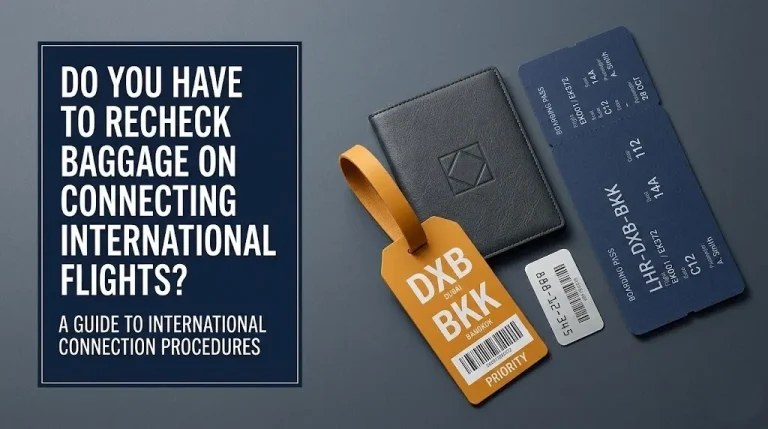
You do not need to recheck baggage on a protected domestic connection in the United States. The airline tags your bag to the final destination printed on the luggage sticker.
The gate-checked rolling carry-on bag at the first flight is returned at the jet bridge. You carry it straight to the next gate without a trip to a baggage claim carousel.
Families with children should visually verify the final airport code on the bag tag at check-in. The three-letter IATA code must match your final destination, not just the connection hub.
A gate-checked stroller is returned to you at the aircraft door during the connection. You do not need to chase it down at a baggage carousel mid-trip.
Verify your bag’s final destination tag directly with the airline agent at the check-in counter. An incorrect tag is a fast track to a lost luggage nightmare.
What Happens to Checked Baggage During a Connecting Flight
Ground crews at the connection hub unload your suitcase from the first aircraft’s belly. They scan it into an automated sorting system that reads your final destination barcode tag.
The bag moves through a tunnel network on a conveyor belt to the next terminal. It reaches your second aircraft’s baggage cart before you even leave the gate area.
A tight 40-minute connection severely stresses the baggage transfer system on a single ticket. Your body might sprint to the gate, but a heavy suitcase may not make the transfer.
Budget travelers on a self-transfer flight must physically collect and re-check the bag. This non-protected process requires exiting security and visiting the public check-in counter again.
The U.S. Department of Transportation mandates that airlines track and reunite delayed bags on protected itineraries. Your lost bag is traced via a unique WorldTracer number you report at the desk.
Do You Have to Pick Up Luggage on a Connecting Flight International
You do not collect your checked bag during a protected international-to-international connection in a sterile transit zone. The bag is automatically transferred to your next aircraft at the hub.
You must physically collect your checked bag when connecting from international to a domestic US flight. You clear U.S. Customs, grab the bag, and then immediately re-deposit it on the belt.
This process applies at every major U.S. gateway, including Dallas/Fort Worth (DFW) and Atlanta (ATL) . You walk the bag through Customs and Border Protection yourself before rechecking it.
A traveler connecting through Toronto Pearson (YYZ) experiences the opposite sequence due to US pre-clearance. You clear U.S. customs in Canada before boarding the US-bound leg of your trip.
Check the specific customs procedure for your exact connection airport on the official CBP website. The rules differ significantly between a European hub and a U.S. entry point.
Key Takeaway: You always handle your own bag at the first US entry point.
How to Navigate a Connecting Flight Airport
Ignore the exit doors and baggage claim signs immediately after deplaning the first flight. Look only for the colored “Flight Connections” or “Transit” overhead directional signage.
Follow the screen monitors to find your second flight’s gate number and departure time. The gate printed on your old boarding pass could be wrong due to a last-minute change.
To navigate this process:
- Locate the nearest flight information display screen just outside your arrival gate.
- Find your flight number and confirm the new departure gate assignment visually.
- Look for the specific color-coded signage for your terminal, such as “Gates E1 to E36.”
- Walk briskly to the transit train if your gate is in a completely separate concourse.
- Report directly to the gate agent’s desk to scan your boarding pass and confirm arrival.
Solo travelers navigating a massive hub like Frankfurt Airport (FRA) should download the airport map offline. In-terminal WiFi fails precisely when you need it the most.
How to Catch a Connecting Flight on Time
Alert a flight attendant on your first flight if a delay eats into your tight connection window. They can radio the gate to hold the departure or arrange a gate-side cart for you.
Never stop for a restroom break or a coffee before reaching your departure gate first. Locate the gate number, scan the monitor for delays, then step away.
Business travelers with top-tier elite status should call the airline’s dedicated hotline while still taxiing. The agent can rebook a missed flight before the plane door even opens on the delayed arrival.
A family traveling with young children should request a seat near the front of the first cabin. This single strategy saves precious minutes during the crucial disembarkation scramble.
Airlines will not hold a flight for a late passenger who stopped for a slow meal. The gate door closes exactly on schedule if you are not present at the podium.
What Happens if You Miss a Connecting Flight
You are automatically rebooked on the next available flight at no cost on a protected itinerary. The airline’s computer algorithms scan for the fastest alternative route to your destination immediately.
Walk directly to your airline’s customer service desk in the transit area of the terminal. Do not exit the secure airside area to reach the chaotic public check-in hall.
American Airlines contract of carriage states you are entitled to meal vouchers during a long mechanical delay. A weather-related missed connection often provides far less legal compensation.
Budget travelers on a self-transfer ticket forfeit the entire second flight if they miss the connection. A no-show on the first leg cancels the return flight automatically with no refund issued.
Insist on a hotel voucher if the rebooked flight does not depart until the next morning. The airline is obligated to provide accommodation for an overnight delay on a protected ticket.
Key Takeaway: Stay airside and go straight to the airline service desk.
How Long Should a Layover Be for a Connecting Flight
A domestic US layover should be a minimum of 60 minutes for a comfortable connection. This allows a quick walk to the gate with a brief five-minute restroom stop.
An international connection through a European mega-hub requires a 90-minute minimum buffer. The walking distances at Amsterdam Schiphol (AMS) or London Heathrow (LHR) are genuinely extreme.
Business travelers with lounge access should book a two-hour minimum layover for a hot shower. A rushed sprint destroys any productivity gain from the premium seat on the long-haul segment.
A first-time international traveler should book at least a two-and-a-half-hour window through a foreign hub. Getting lost, a language barrier, and a slow security re-screen all consume precious minutes.
Verify the specific minimum connection time (MCT) for your airline pairing on the IATA website. A legal 45-minute MCT connection is technically possible but physically and mentally exhausting.
Is a One Hour Layover Enough for a Connecting Flight
A one-hour domestic layover at a single-terminal airport is often perfectly sufficient for an adult. You can walk from gate A-1 to gate A-20 in under five minutes.
A one-hour international connection at a massive hub like Frankfurt (FRA) is a high-risk gamble. You will likely be sprinting through a passport control line during peak morning rush.
Families with young children should never accept a one-hour connection window regardless of legality. A diaper change, a bathroom break, and a slow walking pace will kill the 60-minute window.
A winter connection through Chicago O’Hare (ORD) with a one-hour layover is a dangerous plan. A small de-icing delay on the inbound leg will cause a certain misconnect every single time.
Book a one-hour layover only if the airline sells it as a protected single-ticket itinerary. This legally obligates the airline to fix the problem if the tight connection fails.
Are Connecting Flights Cheaper Than Direct Flights
Connecting flights are almost always significantly cheaper than a nonstop direct flight to the same city. Airlines price direct routes at a premium for the business traveler market.
A route from New York (JFK) to Paris with a stop in London will cost less than the nonstop. You trade your time and physical energy for a reduced fare on the ticket.
Budget travelers should specifically search for “hidden city” connection savings only with extreme caution. This practice violates an airline’s contract of carriage and can result in a mileage account ban.
The fare difference between a direct and connecting flight can fund a full hotel night. This trade-off is the single most important financial calculation for a budget-conscious traveler.
Search for connecting flights on Google Flights and compare the total fare against the direct option. The savings often justify the extra four hours of transit time on a transatlantic route.
Key Takeaway: Connections are cheaper but cost you time. Direct flights are expensive but fast.
Do I Need a Visa for a Connecting Flight
You do not need a transit visa if you stay in the airside sterile zone of most international hubs. This is known as a “sterile transit” and requires no immigration clearance.
You need a transit visa if your connection forces you to switch airports or exit security. A self-transfer through London Gatwick (LGW) requires legal entry into the United Kingdom to re-check a bag.
US citizens transiting through China or Russia must secure a specific transit visa in advance. The “24-hour visa-free transit” rule changes based on diplomatic relations and current global events.
A traveler connecting through Canada to the US always needs an Electronic Travel Authorization. This rule applies even for a 60-minute dash between two gates at Toronto Pearson (YYZ) .
Check the specific transit visa requirements for your passport on the official IATA Travel Centre website. An airline will deny boarding if your documents do not match the transit country’s rules.
Connecting Flight International to Domestic Customs
You clear customs and immigration at the first port of entry into the United States, not your final city. A Delta flight from Paris through Atlanta to Tampa clears border control in Atlanta.
You physically collect your suitcase after passing the CBP immigration checkpoint at the first US airport. You then walk the bag through a customs inspection lane and re-deposit it on a connecting belt.
This process requires a longer layover of at least two hours for a smooth experience. The baggage re-check belt closes strictly one hour before the domestic departure time.
Business travelers with Global Entry can pass through the customs hall in under five minutes. This biometric shortcut is the single best investment for a frequent international connector.
Verify your specific port of entry on your airline’s itinerary map before booking. You clear customs in the city where the plane lands on US soil, not where you end your journey.
What Is a Self Transfer Flight
A self-transfer flight is two completely separate tickets you stitch together to reach a destination. These are not protected by any airline alliance interline agreement or legal obligation.
| Feature | Protected Connection | Self-Transfer Flight |
|---|---|---|
| Ticket | Single PNR number | Two separate booking codes |
| Baggage | Automatically transferred | Must be collected and re-checked |
| Missed Flight | Free rebooking by airline | You lose the value of the second ticket |
| Visa | Usually not needed airside | Often required to exit and re-enter |
| Price | Higher base fare | Can be significantly cheaper |
Budget travelers are often seduced by the very low price of a self-transfer flight. This comes with a massive hidden financial risk of a missed connection with zero legal recourse.
Skyscanner and Kiwi.com heavily promote these self-transfer itineraries to budget-conscious users. Always read the fine print to identify if a “Protected by the Carrier” label is present on the booking.
Connecting Flights for First Time International Travelers
Book a single protected itinerary with a legacy carrier like Delta, United, or American Airlines. Avoid any online travel agency that splits your ticket into two separate reservation codes.
Print a physical paper copy of your second boarding pass before leaving your first airport. A dead phone battery at a foreign connection hub disables your mobile boarding pass instantly.
A first-time traveler should book a layover of at least two and a half hours for an international connection. This generous window absorbs a 30-minute delay and a slow walk through an unfamiliar terminal.
Pack an essential change of clothes and basic toiletries in your personal item carry-on bag. This small act insulates you against a lost checked bag at the intermediate connection hub.
Navigating an airport in a foreign language for the first time is a completely manageable task. Just follow the universal symbols for train connections and departure gate signs confidently.
Frequently Asked Questions About Connecting Flights
How do connecting flights work with luggage?
On a protected single-ticket itinerary, your checked bag is tagged to your final destination automatically.
You physically collect it only when you reach the very last airport on your itinerary.
For a self-transfer flight, you must always collect and re-check your own bag at the connection point.
Do I have to go through security again for a connecting flight?
You do not go through security again for a domestic-to-domestic connection within the same terminal.
You must clear security again if you exit the sterile zone to switch terminals or collect a bag.
International connections often force a security re-screen before entering the new departure gate area.
Is 45 minutes enough time for a connecting flight?
A 45-minute domestic layover at a small single-terminal airport is legally sufficient and possible.
It is a high-risk disaster at a large hub like Atlanta (ATL) or Dallas (DFW) requiring a train ride.
If an airline sells you this tight connection, it is “legal” but leaves zero margin for a minor delay.
What happens if I miss my connecting flight due to a delay?
The airline rebooks you on the next available flight at no cost for a protected single-ticket itinerary.
You are entitled to meal and hotel vouchers if the delay is the airline’s own operational fault.
On a self-transfer ticket, you lose the full value of the missed flight with zero recourse.
Do I need a visa just to change planes in a foreign country?
You do not need a transit visa if you stay inside the airport’s sterile international transit zone.
You need a visa if you must exit security to collect a bag or switch to a different airport building.
Always verify specific transit rules for your passport on the IATA Travel Centre website before booking.
What is the difference between a layover and a connecting flight?
The layover is the waiting time spent inside the airport between your two flights.
The connecting flight is the actual second aircraft you physically board to reach your destination.
A stopover is a layover that lasts longer than 24 hours and lets you leave the airport for a short visit.
A protected connection on a single ticket is the safest way to fly almost anywhere. The airline takes full legal responsibility for your transfer if the inbound flight runs late.
Right now, confirm that your next online booking shows a single PNR and a protected connection flag. If not, add a buffer of three hours to protect your own wallet from a missed flight.
Airline minimum connection times, transit visa rules, and alliance interline agreements shift in 2026. Always verify the specific MCT for your route on the official airport or IATA website before you book.