American Airlines accepts trained service dogs in the cabin for free under federal law.
The airline strictly follows the U.S. Department of Transportation (DOT) 2026 enforcement guidelines.
Emotional support animals no longer count as service animals on any U.S. airline.
If you bring an ESA to the gate, American Airlines will treat it as a standard cabin pet.
This guide walks you through the exact forms, the booking script, and the behavior test.
You will learn how to board that plane without a single document dispute at the gate.
American Airlines Service Dog Policy: The Core 2026 Rule
American Airlines only accepts a dog that is individually trained to perform a task.
The task must directly assist a person with a physical, sensory, psychiatric, or intellectual disability.
The Air Carrier Access Act (ACAA) grants this right, not the airline’s goodwill.
American Airlines gate agents are federal compliance officers enforcing the DOT mandate in real time.
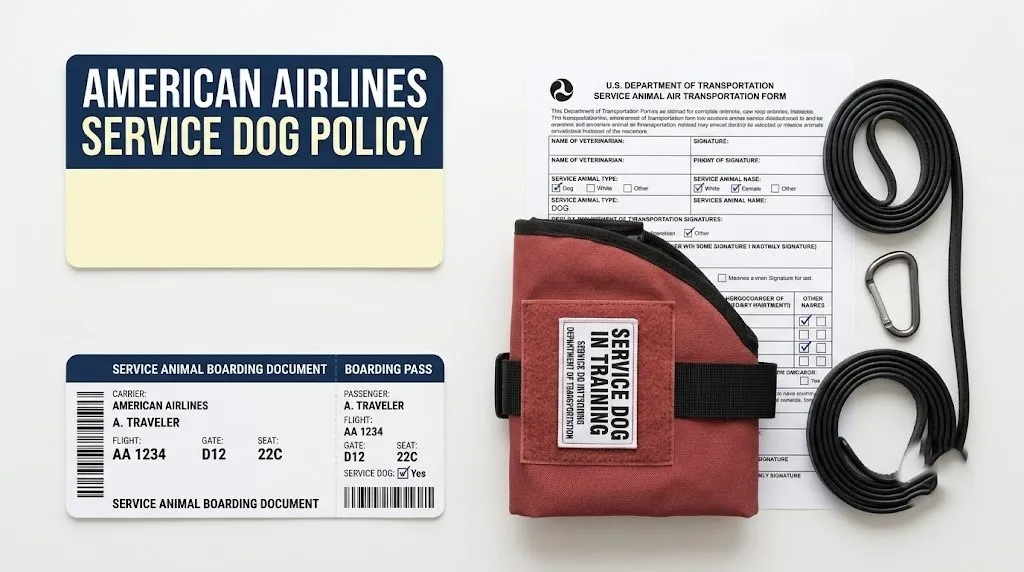
You must submit the DOT Service Animal Air Transportation Form before your flight.
This form attests to the dog’s training, health, and behavior under federal penalty of perjury.
The airline no longer accepts emotional support animals in the cabin for free.
An ESA must travel in a carrier under the seat, and you must pay the standard pet fee.
This rigid enforcement protects the access rights of disabled handlers with legitimate task-trained dogs.
It directly penalizes passengers who previously abused the ESA loophole with untrained pets.
Key Takeaway: Only a task-trained dog with a completed DOT form flies free as a service animal.
What Counts as a Service Animal on American Airlines
A service animal is a dog trained to do work or perform a task for a disabled person.
The task must be something the person cannot do for themselves because of their disability.
American Airlines recognizes physical tasks like guiding a blind person or pulling a wheelchair.
It also recognizes medical alert tasks like detecting a drop in blood sugar or an oncoming seizure.
Psychiatric service dogs are fully recognized if they perform a trained action during a crisis.
Deep pressure therapy, room search, and medication reminders are valid trained tasks.
Comfort alone does not count as a trained task under federal law.
A dog that simply licks your face when you feel anxious is legally a pet.
The gate agent may ask two specific questions permitted by DOT guidelines.
“Is the dog a service animal required because of a disability?” and “What work or task has the dog been trained to perform?”
Key Takeaway: Be prepared to state your dog’s specific trained task clearly and concisely at the gate.
| Animal Type | Allowed in Cabin? | Fee | Documentation Required |
|---|---|---|---|
| Task-Trained Service Dog | Yes, footwell or lap | Free | DOT Service Animal Form |
| Emotional Support Animal | Yes, in carrier | Standard cabin pet fee | None (treated as pet) |
| Standard Cabin Pet | Yes, in carrier under seat | Cabin pet fee | None |
American Airlines Service Animal Form: The DOT Documentation
The U.S. DOT Service Animal Air Transportation Form is the only document you need.
Do not bring a doctor’s note, a registry certificate, or a vest card from the internet.
The form requires your contact information and your dog’s basic details.
It asks you to certify the dog has been trained to behave in a public setting.
You must list the specific task your dog performs for your disability.
Vague answers like “helps with anxiety” will trigger a secondary review and potential denial.
The form also contains a health attestation and a rabies vaccination date.
You must confirm the dog is free of diseases and has not bitten anyone recently.
Submit the DOT form to the American Airlines Special Assistance Desk at least 48 hours before departure.
You can upload it digitally through the airline’s online portal or email it directly.
Key Takeaway: Complete the DOT form online, sign it digitally, and submit it two days before takeoff.
American Airlines Emotional Support Animal Policy in 2026
Emotional support animals are not recognized as service animals by the DOT in 2026.
American Airlines reclassified all ESAs as regular pets for cabin travel purposes.
You must book your ESA a pet reservation and pay the standard cabin pet fee.
The animal must fit inside an approved carrier stowed under the seat for the entire flight.
There is no free pass for an ESA regardless of what a mental health professional writes.
A letter from your therapist or psychiatrist holds zero legal weight at the American Airlines gate.
This rule change is permanent and strictly enforced by every U.S. carrier.
Gate agents are trained to reject any documentation that is not the official federal DOT form.
The only exception is a psychiatric service dog trained to perform a specific task.
If your dog is task-trained for psychiatric mitigation, it qualifies as a service animal under the new rules.
Key Takeaway: A letter from a doctor does not waive the pet fee. Only task training qualifies for free cabin access.
Adding a Service Dog to Your American Airlines Booking
You must contact the Special Assistance Desk to add a service dog to an existing booking.
You cannot simply tick a box during the online checkout process on the American Airlines website.
The desk can be reached by phone or through a dedicated accessibility chat portal.
Have your booking reference number and the completed DOT form ready before you make contact.
You can request a bulkhead seat at the time of adding the dog.
Bulkhead seating provides the most floor space for a larger service dog to tuck safely.
The agent will note your record with a service animal code tied to your itinerary.
This prevents gate agents from questioning you excessively during the boarding process.
Adding the dog early protects you in case of an aircraft swap to a tighter configuration.
An early notification allows the airline to block a seat with more adequate footwell space.
Key Takeaway: Call immediately after booking to lock in a bulkhead seat and secure your file code.
American Airlines Service Dog Breed Restrictions
American Airlines does not ban any specific dog breed from flying as a service animal.
The airline complies with DOT regulations that prohibit categorical breed discrimination.
The sole legal filter is the dog’s individual behavior, not its breed or physical appearance.
A well-behaved pit bull, mastiff, or husky service dog cannot be denied boarding based on looks.
An aggressive or growling chihuahua will be denied boarding for behavioral non-compliance.
The standard is a behavioral assessment at the gate and during the flight.
International destinations often override the DOT’s non-discrimination policy.
Countries like Jamaica, New Zealand, and parts of the Caribbean impose strict breed bans on entry.
Confirm the import laws of your destination country for your specific dog breed.
American Airlines will not fly a dog to a country where the breed is banned by local law.
Key Takeaway: Domestic flights have no breed bans, but individual dog behavior is the gate check test.
Important Accuracy Notes for International Travel with Service Dogs
Foreign entry rules for animals override DOT regulations the moment you land.
Verify the following directly before booking an international ticket:
- The official USDA APHIS pet travel website for the destination country’s vaccination and microchip requirements.
- The embassy website of your destination country for specific breed bans, as American Airlines enforces these strictly for international segments.
- The CDC dog importation rules if returning to the U.S. from a high-risk rabies country.
The most important action: apply for an import permit months in advance if your destination country requires one.
Service Dog Behavior and Training Standards for Flying
American Airlines requires your service dog to be harnessed, leashed, or tethered at all times.
The dog must remain under your direct control during check-in, boarding, and the entire flight.
The dog cannot bark, growl, lunge, or bite any passenger or crew member.
A single aggressive display is grounds for immediate denial of boarding or removal from the flight.
The dog must not urinate or defecate in the gate area or onboard the aircraft.
A trained service dog must be able to hold its bladder for the duration of the flight.
The footwell is the only legally compliant place for the dog to rest during the flight.
The dog cannot sit in an empty passenger seat, even if one is available next to you.
A service dog cannot block the aisle or protrude into the emergency exit path.
If the dog is too large for a standard coach seat footwell, a cabin seat may be provided if space exists.
Key Takeaway: Perfect public access behavior is the price of entry. No aggressive dogs, no exceptions.
American Airlines Service Animal Seating Rules Onboard
Service dogs must sit in the floor space directly in front of your assigned seat.
They cannot occupy a passenger seat, an aisle, or the galley jump seat area.
A small service dog may sit on your lap if it is the size of a human infant.
The dog must remain within your lap footprint without spilling into the neighboring seat.
You may not be seated in an emergency exit row with a service dog.
The dog is considered an obstruction to the exit row pathway under FAA safety regulations.
Bulkhead seats provide the largest underseat footprint for large breed service dogs.
Request a bulkhead seat assignment when you add the dog to your booking file.
If your dog cannot fit safely, the airline may move you to a row with more space.
This re-seating is an airline policy accommodation, not a legally mandated right.
Key Takeaway: The dog must fit entirely in your footwell or lap footprint, not the seat next to you.
TSA Screening with a Service Dog at the Airport
You and your service dog must pass through standard TSA security screening together.
The dog’s harness, collar, and leash must stay on while walking through the metal detector.
You can carry the dog or walk it through the metal detector on a loose leash.
The metal detector will not harm the dog’s microchip or training collar electronics.
TSA officers are not allowed to separate you from your service dog.
They cannot ask you to remove the dog’s gear and send it alone through the X-ray belt.
If the dog alarms the metal detector, a pat-down of the dog will be performed.
The officer will swab your hands for explosive residue after touching the dog’s collar.
A treat pouch attached to the leash will be visually inspected if it alarms.
Keep high-value training treats in an easily accessible, clear plastic bag for this moment.
Key Takeaway: Walk through the metal detector together calmly; keep the leash loose and your voice steady.
American Airlines Psychiatric Service Dog Policy
American Airlines fully complies with the DOT rule recognizing psychiatric service dogs.
A dog trained to interrupt self-harm or apply deep pressure therapy is a valid service animal.
The dog must perform a specific, trained action during a psychiatric episode.
Passive comfort during a panic attack is not a federally recognized task.
Psychiatric service dog handlers face more gate-side scrutiny than physical disability handlers.
Be prepared to clearly articulate the trained task your dog performs and the cue command.
The same DOT form is used for psychiatric service dogs with no extra medical documentation.
You do not need to disclose your diagnosis, medication, or therapist’s name to the airline.
A psychiatric service dog must meet all the same behavioral standards as a guide dog.
Zero barking, zero anxiety-driven panting that disturbs other passengers, zero accidents.
Key Takeaway: Articulate your dog’s trained task with clarity and confidence at the gate podium.
Animal Relief Areas at Major American Airlines Hubs
Every major American Airlines hub has post-security pet relief stations.
Dallas/Fort Worth (DFW) features multiple indoor and outdoor relief areas in each terminal.
Miami International (MIA) relief stations are located near gates D14 and E5.
Charlotte Douglas (CLT) provides a grassy outdoor relief zone past security on the atrium level.
Chicago O’Hare (ORD) relief areas are in Terminal 3 near gates H6 and K1.
Plan your connection to allow at least 20 minutes for an unhurried relief visit.
Bring a collapsible water bowl and a small sealed bag of kibble in your personal item.
Airport relief stations often lack clean water sources for dogs.
Key Takeaway: Map the relief station location on the American Airlines app before your first flight segment departs.
Frequently Asked Questions About American Airlines Service Dog Policy
Does American Airlines allow service dogs in 2026?
Yes, American Airlines allows trained service dogs in the cabin for free.
The dog must meet DOT behavioral standards and assist a person with a disability.
What form do I need for my service dog on American Airlines?
You must submit the DOT Service Animal Air Transportation Form.
This federal form attests to your dog’s training, health, and behavior under law.
Are emotional support animals allowed on American Airlines?
Yes, but only as pets with a paid fee and a carrier.
ESAs no longer fly free or outside a carrier under the DOT rule change.
What dog breeds are restricted by American Airlines?
American Airlines does not ban any dog breed for domestic service animals.
Behavior, not breed, is the legal standard enforced at the gate.
Can a service dog sit on my lap during an American Airlines flight?
A small service dog can sit in your lap if it fits within your footprint.
A larger dog must remain in the footwell space directly in front of your seat.
How early should I call American Airlines to add a service dog?
Call the Special Assistance Desk immediately after you finish booking your flight.
Submit the completed DOT form at least 48 hours before your departure time.
Fill out the DOT form tonight, and call the American Airlines Special Assistance Desk tomorrow.
State your dog’s trained task clearly, request a bulkhead seat, and reconfirm the file code 48 hours before departure.
Carry a printed copy of your DOT form and your dog’s rabies certificate in your personal item.
Never let a gate agent mistake a legitimate medical alert dog for an untrained pet.
The rules protect you if your paperwork is perfect and your dog’s behavior is flawless.
Visit the official American Airlines service animal page right now to download the current DOT form.