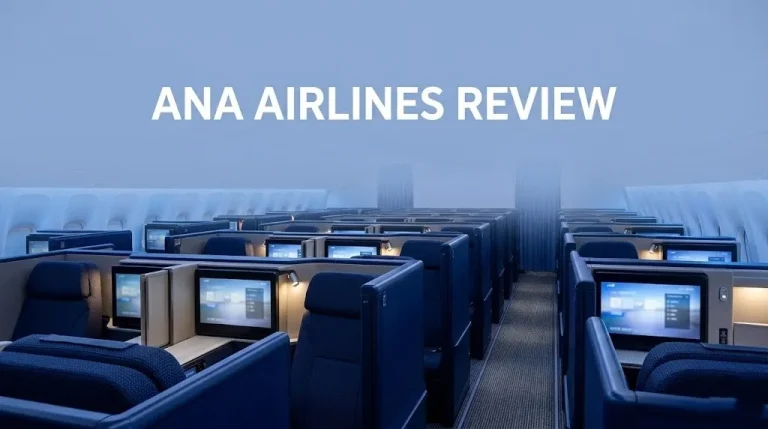
ANA vs Japan Airlines is a contest between two of the world’s best airlines. ANA wins the battle of business class hard product with “The Room” on select Boeing 777-300ER aircraft. JAL wins on premium economy and consistent excellence across its entire fleet.
Choosing the wrong aircraft on either airline will completely change your experience. An older ANA 787 with a dated staggered seat is a worse flight than JAL’s new Airbus A350-1000. Your specific aircraft type matters more than the logo painted on the tail.
This guide compares every cabin class, the lounge experience, the food, and the loyalty programs. You will know exactly which airline to book for your specific route and budget.
ANA vs Japan Airlines
ANA vs Japan Airlines is a comparison between two five-star Skytrax airlines with distinct strengths. All Nippon Airways focuses on technological innovation and a wide variety of seat configurations. Japan Airlines emphasizes consistent, warm hospitality and a more uniform fleet-wide product.
ANA is a Star Alliance member, which makes it the natural choice for travelers loyal to United Airlines MileagePlus or Air Canada Aeroplan. JAL is a Oneworld member, aligning it with American Airlines AAdvantage and Alaska Airlines Mileage Plan. Your existing loyalty to an alliance will be a major factor in your decision.
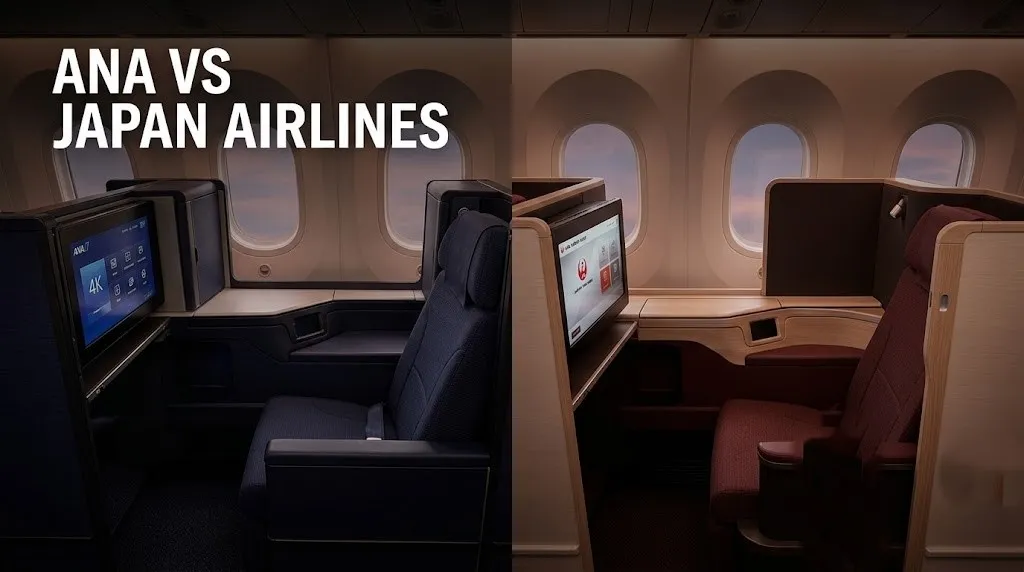
ANA operates a diverse fleet with multiple business class seat types on the same aircraft model. The Boeing 777-300ER fleet includes both the new “The Room” suites and older staggered seats. JAL operates a more consistent fleet with the Apex Suite on most 787s and the new A350-1000 suite on select flagship routes.
Business travelers with flexible schedules should prioritize the specific aircraft type over the airline. Solo travelers will find JAL’s hard product more consistently private across the fleet. Families flying to Japan for a vacation should book the best flight time and price first, then consider the airline.
The Points Guy ranks both airlines in the top 10 global carriers annually, with ANA often edging out JAL on seat innovation and JAL winning on service consistency.
Key Takeaway: ANA leads on innovative hard products, JAL leads on consistent service and premium economy across the fleet.
Japan Airlines or ANA
Japan Airlines or ANA is a decision that begins with your departure airport and your destination in Japan. ANA offers more direct flights from the US West Coast to Tokyo Haneda Airport (HND). JAL offers a stronger network from the US East Coast and a convenient connection to Osaka on a single ticket.
Both airlines operate from Haneda Airport, which is significantly closer to central Tokyo than Narita. Landing at HND on either airline saves you 45 to 60 minutes of ground transportation compared to Narita. This is a genuine tiebreaker if the price and schedule are equal.
ANA operates its flagship “The Room” business class on the New York to Tokyo Haneda route on the Boeing 777-300ER. JAL deploys its new Airbus A350-1000 on the same route with a distinct suite product. The competition between these two specific aircraft on the JFK-to-Tokyo route is the most intense in transpacific aviation.
Business travelers departing from San Francisco or Los Angeles will find more ANA flight options. Couples traveling to Japan for the first time will enjoy the service on either airline equally. Solo travelers who prioritize absolute privacy should target “The Room” on ANA or the A350-1000 suite on JAL.
Confirm your aircraft type on the airline’s official seat map tool during the booking process because the product varies dramatically by the specific plane assigned to the route.
ANA Airlines vs Japan Airlines
ANA Airlines vs Japan Airlines in overall terms is a split decision based on cabin class. ANA wins first class and the best business class suite. JAL wins premium economy, economy class, and the most consistently good business class experience across all aircraft.
The two airlines compete directly on the same transpacific routes with very similar ticket prices. The fare difference between an ANA and a JAL business class ticket on the Los Angeles to Tokyo route is often negligible. This makes the hard product comparison the deciding factor for most knowledgeable travelers.
ANA’s first class product, “The Suite,” is a fully enclosed cabin with a 43-inch seat, a closing door, and a massive 32-inch 4K entertainment screen. JAL’s first class is an elegant, wide-open seat with excellent privacy but no fully closing door. ANA wins the first class comparison on pure hardware, but JAL’s first class soft product remains legendary.
Solo travelers in pursuit of the absolute best business class seat should book ANA’s “The Room” on a confirmed Boeing 777-300ER. Budget travelers upgrading from economy to premium economy should choose JAL for the superior hard product. Families in economy class will find JAL’s seat slightly more comfortable for a long-haul flight.
SeatGuru and the airline official sites are the best resources to confirm the exact seat configuration for your flight number.
ANA The Room vs JAL Sky Suite
ANA The Room vs JAL Sky Suite is the centerpiece battle of the business class comparison. “The Room” is ANA’s latest business class seat on select Boeing 777-300ER aircraft. It features a fully enclosed suite with a closing door, a massive 24-inch 4K screen, and a seat that converts to a 198-centimeter lie-flat bed.
The JAL Sky Suite on the Boeing 787-9 Dreamliner is an Apex Suite configuration with direct aisle access and a privacy shell, but no closing door. The Sky Suite on the new Airbus A350-1000 adds a closing door and a larger screen, bringing it closer to “The Room” in privacy. The older JAL Sky Suite on the 787 is a very good product, but it is not a suite in the enclosed sense.
The difference between these two seats for a solo traveler is stark. “The Room” wraps you in three solid walls with a sliding door that isolates you completely from the aisle. The JAL Sky Suite on the 787 provides a high privacy shell that blocks the view of your neighbor but leaves you open to the aisle.
Solo travelers who value absolute privacy should book “The Room” on a confirmed ANA 777-300ER. Business travelers who work on their laptop for most of the flight will find both seats perfectly adequate. Couples traveling together should select center seats on either airline, where the divider can be lowered.
Confirm your specific aircraft has “The Room” or the JAL A350-1000 Suite because older configurations on both airlines lack a closing door.
Key Takeaway: “The Room” is the single best transpacific business class seat, but only on specific ANA 777-300ERs.
ANA 787 Business Class vs JAL 787
ANA 787 business class vs JAL 787 business class is a comparison of two very different products on the same aircraft type. ANA operates the Boeing 787-9 Dreamliner with a staggered 1-2-1 configuration that offers direct aisle access but less privacy than “The Room.” JAL operates the same aircraft with the Apex Suite, also in a 1-2-1 layout.
The ANA 787 staggered seat is comfortable, with a fully lie-flat bed and a 17-inch screen. The design alternates window seats between being closer to the window or closer to the aisle. A seat closer to the aisle feels exposed to passing foot traffic and carts during the overnight portion of the flight.
The JAL Sky Suite on the 787 is an Apex Suite that positions every passenger between the window and a solid side console. This design creates a consistent, private feel for every window seat without the alternating exposure problem of the ANA staggered seat. The JAL seat feels more like a private pod, while the ANA staggered seat feels like a very good business class seat.
Solo travelers on the 787 should choose JAL for a guaranteed private window experience. Business travelers who frequently fly ANA for the Star Alliance benefits will still find the 787 seat comfortable. Families with children should select the JAL 787 for the easier-to-manage window seat configuration.
The Points Guy identifies the JAL Sky Suite as the best business class seat on the 787 platform across all airlines, beating ANA on consistency.
ANA Premium Economy vs JAL
ANA premium economy vs JAL premium economy is a clear win for Japan Airlines. JAL’s premium economy seat on the Boeing 787-9 and Airbus A350-1000 is widely considered the best premium economy product in the sky. It features a 19-inch seat width, 42 inches of pitch, and a fixed-back shell design that allows recline without intruding on the passenger behind you.
ANA’s premium economy seat is a comfortable upgrade over economy with 38 inches of pitch and a footrest, but it lacks the fixed-back shell. The ANA seat reclines into the space of the passenger behind you, which limits the effective recline on a crowded flight. The JAL seat is a genuinely distinct product that feels closer to a domestic first class seat than a standard premium economy seat.
The catering in premium economy on both airlines is an upgraded version of the economy meal with a choice of Japanese or Western options. The service is attentive in both cabins, with dedicated flight attendants for the premium economy section. The JAL hard product advantage is so significant that it overwhelms any minor differences in the soft product.
Business travelers on a corporate premium economy budget should book JAL without hesitation. Solo leisure travelers upgrading from economy will find the JAL premium economy seat worth the extra cost. Families traveling together in premium economy should choose JAL for the fixed-back shell that prevents a child from disturbing the passenger in front.
JAL’s premium economy is a genuine differentiator and the single best reason to choose JAL over ANA.
ANA Economy Class Review
This ANA economy class review focuses on the standard 3-3-3 configuration on the Boeing 787-9 Dreamliner. The seat offers 34 inches of pitch, which is one of the most generous in the international economy market. The seat width is a standard 17.5 inches, and the cushion is firm but supportive for a 10-hour flight.
The inflight entertainment system on ANA is a 12-inch HD touchscreen loaded with a wide selection of Japanese and Hollywood movies. The meal service includes a choice of Japanese or Western cuisine, with the Japanese option typically featuring a beautifully presented bento box. The cabin crew is attentive and passes through the economy cabin regularly with water and snacks.
ANA’s economy class is a very good product that beats US legacy carriers by a wide margin. The 34-inch pitch is the standout feature, giving taller travelers space to stretch their legs without paying for an extra-legroom seat. The cabin is clean, the crew is professional, and the experience is consistent across the fleet.
Solo travelers in economy should select a window seat for a wall to lean against during sleep. Couples should choose a pair of seats on the left or right side of the cabin. Families should book the bulkhead row for extra legroom and a bassinet position if traveling with an infant.
Budget travelers flying round-trip from the US to Tokyo will find ANA economy a very comfortable option for the base fare.
Key Takeaway: ANA economy stands out for its generous 34-inch pitch, which beats most other international carriers.
JAL Economy vs ANA
JAL economy vs ANA economy is a closer contest than the premium economy comparison. JAL’s economy seat on the Boeing 787-9 offers 33 inches of pitch, one inch less than ANA’s 34 inches. The JAL seat width is the same at roughly 17.5 inches.
The JAL economy meal service is slightly better, with the Japanese meal option featuring a well-executed rice dish and a proper miso soup. The ANA meal is also excellent, but JAL’s catering is frequently cited by travelers as the best economy class food on any airline. The difference is marginal, and both airlines serve a true Japanese meal that you will actually look forward to eating.
The JAL cabin crew provides a level of warmth and personal attention that is legendary even within the Japanese airline industry. The ANA crew is professional and efficient, but JAL crew members are often described as going above and beyond in small, memorable ways. The soft product edge goes to JAL in economy class, but the hard product edge belongs to ANA for the extra inch of pitch.
Solo travelers who value a slightly larger personal space should choose ANA for the seat pitch. Couples who care about the meal experience should choose JAL for the superior catering. Families with tall teenagers should prioritize the ANA 34-inch pitch over the JAL meal quality.
The economy class decision between these two airlines is a luxury of choice. Both are excellent, and the specific flight time and price should be the deciding factors.
ANA First Class vs JAL First Class
ANA first class vs JAL first class is a battle of ultra-premium cabins that represent the absolute best of each airline. ANA’s first class is called “The Suite” on the Boeing 777-300ER, featuring a fully enclosed suite with a closing door, a 43-inch seat width, and a 32-inch 4K monitor. JAL’s first class on the Airbus A350-1000 features a wide, open seat with a privacy partition but no fully closing door.
ANA’s “The Suite” is a harder product that encloses you in a private room in the sky. The sliding door, the massive screen, and the deep seat cushion create a genuinely private, quiet space. JAL’s first class seat is wider and feels more like a luxurious, spacious lounge chair than a private suite.
The food in both first class cabins is exceptional, with multi-course kaiseki meals, premium Champagne, and an on-demand dining service. JAL offers Salon by Cristal, a highly sought-after Champagne, while ANA serves Krug Grande Cuvée. The catering difference is a matter of personal preference, and both airlines deliver a world-class culinary experience.
Solo travelers seeking the ultimate private experience should book ANA “The Suite” on a confirmed Boeing 777-300ER. Couples traveling together in first class should choose JAL for the wider, more open seat that feels shared and intimate. Business travelers who want to close a door and sleep undisturbed should prioritize ANA.
Conde Nast Traveler ranks ANA “The Suite” as the best first class product in the world, citing the suite door and the 4K entertainment system.
ANA Inflight Meal Review
An ANA inflight meal review must begin with the airline’s Japanese meal option, which is consistently ranked among the best in the sky. The meal is a multi-course kaiseki-style presentation with a focus on seasonal ingredients and exquisite visual presentation. The appetizer tray alone features five or six small, perfectly composed bites.
The Western meal option is also well-executed, with a protein like beef tenderloin or pan-seared fish accompanied by a seasonal vegetable and a potato gratin. The bread is served warm, the butter is soft, and the dessert is a refined pastry or a fruit plate. The meal service in business class is a dine-on-demand or a set meal service depending on the route and the flight length.
The beverage list includes Krug Grande Cuvée in first class and a rotating premium Champagne selection in business class. The sake list is curated by a sake sommelier and features small-batch producers from across Japan. The tea service after the meal is a formal affair with a choice of Japanese green tea, hojicha, or genmaicha.
Solo travelers who prioritize food as a core part of the travel experience will be deeply satisfied with ANA’s catering. Business travelers on a tight schedule should request the dine-on-demand option to eat quickly and then sleep. Families with children should pre-order a child meal at least 24 hours before departure.
The ANA inflight meal is a genuine strength and a reason to choose the airline over a US legacy carrier.
JAL Food vs ANA
JAL food vs ANA is a debate that often tips slightly toward Japan Airlines among frequent Japan travelers. JAL’s Japanese meal is prepared by a Michelin-starred chef and features a more traditional, homestyle presentation than ANA’s kaiseki approach. The JAL meal feels like a carefully prepared dinner in a Kyoto restaurant, while ANA’s meal feels like a modern, artistic interpretation.
The JAL Western meal is a collaboration with a famous restaurant and changes regularly with the seasons. The appetizer, the main course, and the dessert are all prepared to a standard that surpasses most first class products on US airlines. The bread basket on JAL is filled with warm, crusty rolls and a small pat of excellent Japanese butter.
The beverage list on JAL includes Salon by Cristal, a Champagne that is exclusively available in very few places in the world. The sake selection is curated by a sake master and includes rare bottles that are difficult to find outside of Japan. The after-meal tea service is a quiet, ceremonial moment that caps the meal beautifully.
Solo travelers who are serious foodies should try both airlines on separate trips and compare the meals directly. Couples traveling on a special occasion should choose JAL for the Salon Champagne and the traditional meal service. Business travelers who just want a high-quality meal and then sleep will be satisfied on either airline.
JAL’s catering is often cited by The Points Guy as the single best business class meal service of any airline in the world.
Key Takeaway: JAL wins the food battle with Salon Champagne and Michelin-starred Japanese meals, but ANA is very close behind.
ANA Lounge HND
The ANA Lounge HND at Tokyo Haneda Airport Terminal 3 is a two-level facility with a dedicated Suite Lounge for first class passengers and a separate main lounge for business class and Star Alliance Gold members. The Suite Lounge is a serene, exclusive space with a full made-to-order dining room, a sushi counter, and private shower suites.
The main ANA Lounge at HND is a large, modern space with floor-to-ceiling windows overlooking the runway. The buffet features a noodle bar where a chef prepares fresh udon and soba noodles to order, a curry rice station, and a full bar. The lounge has ample seating, power outlets at every chair, and a quiet zone with recliners for napping.
The ANA lounge complex at Haneda is a genuine strength of the airline. The Suite Lounge for first class passengers is one of the best first class lounges in the world, rivaling the Lufthansa First Class Terminal in Frankfurt. The business class lounge is a solid, comfortable space that beats JAL’s Sakura Lounge in the same terminal.
Solo travelers in first class should arrive at the airport early specifically to enjoy the ANA Suite Lounge dining room. Business travelers on a long layover should use the shower suites and the noodle bar. Families with a Star Alliance Gold member can access the business class lounge and enjoy a relaxed meal before the flight.
The ANA lounges at Haneda are a significant competitive advantage and a compelling reason to choose ANA for a Tokyo connection.
JAL Sakura Lounge
The JAL Sakura Lounge at Tokyo Haneda Airport Terminal 3 is a single-level lounge that serves both first and business class passengers, with a small cordoned section for first class guests. The lounge is a comfortable, quiet space with a view of the ramp, but it lacks the grandeur and the exclusive Suite Lounge concept of ANA.
The JAL Sakura Lounge buffet features a curry rice station, a noodle bar, and a self-serve bar with beer, wine, and spirits. The food quality is good, but the selection is more limited than the ANA lounge. The shower suites are clean and well-maintained, with a queue system during peak hours.
The JAL First Class Lounge at Haneda is a separate facility for JAL first class passengers only, located in a different area of the terminal. This lounge is a quiet, carpeted room with made-to-order dining and a dedicated service staff. The JAL First Class Lounge is a better experience than the main Sakura Lounge, but it does not match the ANA Suite Lounge in scale or amenity.
Business travelers on a JAL ticket should expect a solid, pleasant lounge experience but not a destination-worthy lounge. Solo travelers with a long layover at Haneda should choose ANA for the superior lounge complex. Families with JAL first class tickets should use the dedicated First Class Lounge for a calm, exclusive pre-flight experience.
JAL’s lounge strategy at Haneda is a rare weak point for an otherwise excellent airline, and the ANA lounge complex is unequivocally superior.
ANA Mileage Club vs JAL Mileage Bank
ANA Mileage Club vs JAL Mileage Bank is a comparison of two loyalty programs with distinct redemption sweet spots. ANA Mileage Club is a Star Alliance program that offers excellent award availability on partner airlines, including United Airlines, Lufthansa, and Singapore Airlines. JAL Mileage Bank is a Oneworld program that partners with American Airlines, British Airways, and Cathay Pacific.
ANA Mileage Club charges fuel surcharges on partner award tickets, which can add hundreds of dollars to a transpacific business class redemption. JAL Mileage Bank is more transparent about surcharges on its own flights but charges them on partner redemptions as well. Both programs require careful attention to the total cost of an award ticket, not just the mileage price.
ANA miles are transferable from American Express Membership Rewards points, making them accessible to US travelers. JAL miles are not directly transferable from a major US bank program, making them harder to earn for a US-based traveler. This is a massive practical advantage for ANA if you plan to earn and burn miles from US credit card spending.
Business travelers with American Express points should target ANA Mileage Club for Star Alliance redemptions. Couples saving miles for a Japan trip should compare the total cost of an ANA award versus booking a JAL flight through American Airlines AAdvantage. Solo travelers on a budget should use Alaska Airlines Mileage Plan to book JAL business class awards at a very competitive mileage rate.
The easiest path to a business class seat to Japan is often using American AAdvantage or Alaska Mileage Plan miles to book JAL, not JAL Mileage Bank.
ANA Service vs JAL Service
ANA service vs JAL service is a comparison between two airlines that define Japanese hospitality. ANA’s service is professional, precise, and efficient, with cabin crew who perform their duties to an exacting standard. JAL’s service is warmer, more personal, and more likely to include a spontaneous gesture of kindness.
The difference between the two service styles is subtle and often comes down to individual crew interactions. An ANA flight attendant will deliver your meal, refill your glass, and clear your tray with perfect timing and a polite bow. A JAL flight attendant will do the same but may also notice that you are enjoying a particular dish and offer you an extra portion with a genuine smile.
The ANA crew uniform is a crisp navy blue with precise lines and a modern aesthetic. The JAL crew uniform is more traditional, with a softer silhouette and a classic scarf pattern. The visual difference mirrors the service style difference between the two airlines.
Solo travelers who prefer a polished, unobtrusive service experience will love ANA. Couples celebrating a special occasion will appreciate the warm, personal service on JAL. Business travelers who just want to work and sleep without interruption will be satisfied with either airline.
The honest verdict is that JAL’s service feels more human and memorable, while ANA’s service feels more technically perfect and consistent.
Key Takeaway: JAL service is warm and personal, ANA service is polished and precise, and both are a pleasure to experience.
Best Miles for Japan Flights
The best miles for Japan flights in business or first class are American Express Membership Rewards transferred to ANA Mileage Club, and Alaska Airlines Mileage Plan miles used to book JAL flights. These two redemption paths offer the lowest mileage prices and the most reasonable fuel surcharges.
ANA Mileage Club charges roughly 75,000 to 90,000 miles round-trip for a business class flight from the US to Japan, which is a competitive rate. The fuel surcharges on ANA’s own flights are moderate, but the surcharges on partner flights can be very high. American Express Membership Rewards frequently offers transfer bonuses to ANA, reducing the effective mileage cost.
Alaska Airlines Mileage Plan charges 60,000 miles one-way for a JAL business class flight from the US to Japan, with low fuel surcharges. Alaska miles are harder to earn than Amex points but are available through the Alaska Airlines Visa Signature credit card. This redemption is widely considered the single best use of Alaska miles in the entire award chart.
American Airlines AAdvantage also offers access to JAL business class awards at a competitive price with low surcharges. Business travelers with a stockpile of Amex points should target ANA Mileage Club for direct ANA redemptions. Solo travelers with Alaska miles should book JAL business class for the lowest mileage price and the excellent JAL hard product.
Check award availability 11 months in advance for the most options, especially if you are booking multiple seats for a family.
Important Accuracy Notes for ANA vs JAL
Both airlines operate multiple business class configurations on the same aircraft type. An ANA Boeing 777-300ER flight may feature “The Room” or an older staggered seat. A JAL Boeing 787-9 may feature the Sky Suite III or an older configuration.
Verify the following directly before traveling:
- Your specific aircraft configuration on the airline’s official seat map during booking
- The current lounge access policy for your class of service and elite status on the airline’s website
- The latest ANA Mileage Club or JAL Mileage Bank award chart and fuel surcharge policy
- The specific aircraft type assigned to your flight 48 hours before departure
Book your flight based on the confirmed aircraft and seat type, not just the airline logo.
Frequently Asked Questions About ANA vs JAL
Which is better for business class, ANA or Japan Airlines?
ANA wins for the best individual seat, “The Room” on select Boeing 777-300ER aircraft.
Japan Airlines wins for the most consistent business class across the entire fleet.
The best choice depends entirely on your specific aircraft type and your home airport route.
Does ANA or JAL have better premium economy?
Japan Airlines has the best premium economy seat of any airline, with a fixed-back shell and 42 inches of pitch.
ANA’s premium economy is good, but the standard recliner seat does not match the JAL hard product.
Choose JAL for premium economy without hesitation.
What are the best ANA business class seats?
The best ANA business class seat is “The Room” on the Boeing 777-300ER, a fully enclosed suite with a closing door.
The staggered business class on the ANA Boeing 787-9 is a comfortable but less private option.
Confirm your specific aircraft has “The Room” before booking, as many 777s still feature the older product.
Is Japan Airlines A350 business class better than the 777?
JAL’s new Airbus A350-1000 business class suite is a significant upgrade over the Boeing 777-300ER Sky Suite.
The A350-1000 features a closing door, a larger screen, and a wider seat.
The 777-300ER Sky Suite is still excellent, but the A350-1000 is JAL’s new flagship.
Which airline has better lounges in Tokyo, ANA or JAL?
ANA has the superior lounge complex at Tokyo Haneda Airport, with a dedicated Suite Lounge for first class passengers.
JAL’s Sakura Lounge is a solid, comfortable space but lacks the exclusive Suite Lounge concept of ANA.
The ANA lounges at Haneda are a genuine competitive advantage and a reason to choose ANA for a Tokyo connection.
How can I book ANA or JAL business class with miles?
Transfer American Express Membership Rewards points to ANA Mileage Club for ANA business class awards.
Use Alaska Airlines Mileage Plan miles to book JAL business class at a very competitive mileage rate.
American Airlines AAdvantage miles also provide excellent access to JAL business class awards with low surcharges.
Choose Your Aircraft, Then Your Airline
ANA and JAL are the two best airlines flying across the Pacific Ocean, and you cannot make a bad choice between them. ANA wins on the highest highs with “The Room” and “The Suite,” a superior lounge complex at Haneda, and the more accessible loyalty program. JAL wins on consistency, the best premium economy seat in the sky, and a warmer, more personal service style.
Your specific aircraft type is more important than your airline choice. Book “The Room” on ANA’s 777-300ER or the A350-1000 Suite on JAL, and you will have a world-class experience. Book an older ANA staggered seat or an aging JAL 777, and you will still have a very good flight but not a transcendent one.
Check your flight’s seat map and aircraft type on the airline’s official website before you pay for your ticket. Verify the aircraft assignment again 48 hours before departure. The right seat on the right plane is the entire game.