United uses a complex inventory system behind its simple fare names. A basic economy ticket is not just one fare, it is multiple hidden booking codes.
This guide decodes every letter from Y to S for 2026. You will learn exactly how to read your fare class for maximum loyalty value.
United Airlines Class Codes
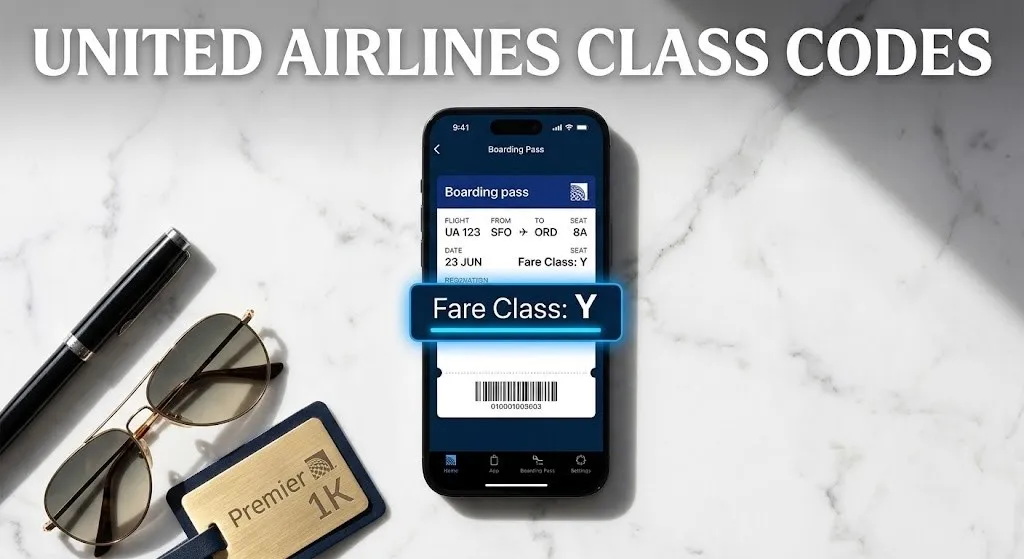
United Airlines class codes are single letters that represent your ticket’s exact fare category. The code appears on your booking confirmation and determines your MileagePlus earnings.
A capital “Y” on your ticket means a full-fare, unrestricted economy seat. This code earns you 100 percent Premier qualifying points and the highest upgrade priority.
A “K” or “L” code signifies a deeply discounted economy ticket. These cheaper fares earn fewer redeemable miles and place you low on the upgrade list.
Business travelers must check this letter before purchasing a restricted ticket. An “S” or “T” code in economy can mean zero flight changes are allowed.
The honest truth is that the airline sells the same seat for vastly different prices. The single letter defines your real passenger rights on the plane.
United Airlines Fare Class Chart
The United Airlines fare class chart organizes cabin inventory from most to least expensive. The highest letters like J, C, and D represent the priciest business class seats.
Economy starts with Y for full fare and descends through B, M, E, U, H, Q, V, W. The deepest discount economy codes sit at S, T, L, K, and G.
Budget travelers should understand this hierarchy before booking. The lowest fare, typically a G or N code in basic economy, offers the least flexibility.
The fare class chart is visible on United’s “Expert Mode” during the booking process. Activating this hidden feature on the website reveals the actual code before you buy.
The limitation is that the chart changes with every flight. A V code might be the cheapest available on a busy Monday morning route.
United Airlines Fare Codes
United Airlines fare codes are the building blocks of the airline’s revenue management system. Each letter corresponds to a specific price bucket on a specific flight.
A “PN” code is the holy grail for Global Services members using PlusPoints to upgrade. The “PZ” code signals a deeply discounted business class instant-upgrade fare.
Revenue management opens and closes these buckets based on demand. A “W” code fare might be available on a Tuesday and completely gone by Wednesday.
Frequent flyers searching for upgrade space should look for “PZ” or “RN” codes. These specific letters indicate that a business class or premium economy seat is available for an instant upgrade.
The honest limitation is that these codes are invisible on most consumer booking sites. You need the Expert Mode view on United.com to see the real inventory.
| Fare Code | Cabin | Flexibility | Upgrade Priority | MileagePlus Earning |
|---|---|---|---|---|
| J, C, D | Business/First | Fully Flexible | Highest | High |
| Y, B | Economy (Full Fare) | Flexible | High | High |
| M, E, U | Economy (Mid) | Moderate Fee | Medium | Medium |
| Q, V, W | Economy (Discounted) | High Fee | Low | Reduced |
| S, T, L, K | Economy (Deep Discount) | Restrictive | Very Low | Low |
| G, N | Basic Economy | Very Restrictive | None | Very Low |
United Airlines Fare Class Codes
United Airlines fare class codes are often confused with the simple cabin name. “Economy” is the seat, but the letter code defines your specific contract.
A “J” class ticket and a “C” class ticket are both business class seats. The “J” ticket costs more but might earn a bonus mileage multiplier.
An “O” class ticket is a premium economy seat booked with miles on a saver award. This is different from an “A” code, which is a premium economy cash fare.
First-time international travelers should look at the letter, not just the name. A “Deep Discount” economy ticket may not include a checked bag on a transatlantic flight.
The code is the ultimate source of truth for your allowance. Verify this letter in your confirmation email under “Fare Class” before arguing with a gate agent.
Key Takeaway: The fare letter defines your contract. A business class seat sold as “C” or “J” has different mileage earnings.
How United Airlines Fare Classes Affect MileagePlus Miles
Your United Airlines fare class directly determines the number of MileagePlus miles you earn. A full-fare Y ticket earns a different percentage than a discounted K ticket.
Premier qualifying points (PQP) are also tied to this specific letter. A cheap G code basic economy ticket earns minimal PQP toward elite status.
A business class J or C fare earns a significant multiplier of redeemable miles. This can mean the difference between 5,000 and 15,000 miles earned on the same route.
Frequent flyers chasing elite status for the next year must prioritize higher fare codes. A few extra dollars spent on a V or W code can secure the needed PQP qualification.
The honest reality is that a cheap ticket has a hidden opportunity cost. You might save money upfront but lose out on a free award flight later.
Upgrading with United Fare Classes
United upgrades use specific fare class codes to determine your waitlist position. The computer sorts passengers first by status, then by the fare code letter.
An instant upgrade with PlusPoints requires “PZ” or “RN” inventory to be available. A waitlisted upgrade request will not clear until United releases these specific seats.
The most expensive economy fares, Y and B, sit at the top of the upgrade list. The cheapest M, E, and U codes are below them, even for the same elite status level.
Business travelers on a corporate booking must avoid the lowest codes. A K or L class ticket often makes you completely ineligible for any complimentary upgrade.
The secret is that the airline wants to reward the highest revenue. Your fare code is the direct proxy for your value on that specific flight.
Key Takeaway: A Y or B fare code gives you the highest upgrade priority. A deep-discount code often makes you ineligible.
Deep Discount Codes and Basic Economy
The “N” and “G” codes are United’s Basic Economy fare class identifiers. These codes signal the most restrictive ticket the airline sells.
A basic economy code means you board last and cannot bring a full carry-on bag. You also earn very few miles and cannot select a seat in advance.
The “S” and “T” codes are deep discount standard economy fares. They are slightly better than Basic Economy because they include a carry-on bag.
Budget travelers should always check the code to confirm what they bought. A third-party booking site may display “Economy” when you are actually buying a restrictive “N” code.
The honest verdict is that these codes are a poor choice for a family traveler. Being separated from your children on a Basic Economy ticket is not worth the small savings.
How to Find Your United Fare Class Before Booking
You can find your United Airlines fare class before booking by enabling Expert Mode. This hidden setting on the United.com website displays the raw fare codes.
Log into your MileagePlus account and search for a flight as usual. The detailed view will now show the specific letter codes next to each flight price.
A “Y9” notation means nine full-fare economy seats are still for sale. An “J4” means four expensive business class seats are currently available.
Solo travelers can use this tool to maximize upgrade chances. Choosing a flight with “PZ1” availability means an instant upgrade is possible before you even pay.
The honest limitation is that Expert Mode is not available on the United mobile app. You must use a desktop browser to see the true inventory picture.
United Fare Codes for Business and First Class
United business class fare codes start with “J” for the most expensive unrestricted ticket. “C” and “D” are progressively cheaper business class inventory buckets.
The “P” code is a deeply discounted business class fare for international flights. “Z” is an even more aggressively priced business class fare with restrictions.
United First, the domestic product, uses similar codes like “J” for full fare. The “PN” code is the highly sought-after instant upgrade space for Global Services elites.
Business travelers should specifically request a “J” or “C” code from their corporate travel desk. These fare classes guarantee you a seat in the front cabin, not just a waitlisted upgrade.
The critical distinction is that a cheap “Z” business fare may not allow a refund. A more expensive “J” fare is fully flexible for unpredictable business schedules.
Premium Economy and Economy Plus Fare Codes
Premium Economy uses the “O,” “A,” and “R” fare class codes on international flights. The “O” fare is the most common for saver award tickets in this cabin.
A standard seat in Economy Plus is not a separate fare code. It is simply an “E” or “M” economy ticket with a paid or complimentary seat assignment in a better row.
Purchasing an Economy Plus subscription only changes your seat, not your fare code. Your ticket still books into whatever economy letter was available at the time.
First-time international travelers on a premium economy ticket should verify the “O,” “A,” or “R” on the confirmation. This guarantees you are not just in an extra-legroom economy seat.
The honest confusion is that United markets these products together. The single-letter code is the only indisputable proof of which cabin you are actually in.
Key Takeaway: Premium Economy is a separate cabin with “O, A, R” codes. Economy Plus is just an economy seat with more legroom.
How Award Tickets Use United Fare Codes
United award tickets have their own specific fare class codes. An economy saver award books into the “X” code, while a business class saver is “I.”
If you see an “X” on your confirmation, you are on an award ticket. This code does not earn miles because you did not pay a cash fare for the seat.
The “I” code is the most important letter for a mileage collector. Finding “I” availability means you have secured the cheapest possible business class seat with miles.
Frequent flyers should search for “IN” space, which is expanded saver award availability for elite members. This code opens up more seats on the same flights.
The honest challenge is that award codes are the most scarce. An “X” seat on a popular route can disappear months in advance of the travel date.
United Fare Class Code Comparison to Other Airlines
United Airlines class codes are similar to Delta Air Lines and American Airlines codes. The industry broadly uses “Y” for full-fare economy and “J” for full-fare business.
The critical difference is how each airline treats these codes for upgrades. United’s “V” code might be upgradeable, while a similar fare on Delta might not be.
Star Alliance partners like Lufthansa and ANA can also read your United fare code. A lowly “K” code on United might earn zero miles when credited to a Lufthansa Miles & More account.
Business travelers on a multi-airline itinerary must check this carefully. A cheap United connecting to a partner flight could be a “G” code that blocks a lounge entry.
The honest verdict is to never assume a letter means the same thing. Always verify the earning chart on your specific frequent flyer program’s website.
| Fare Type | United Codes | Delta Codes | American Codes |
|---|---|---|---|
| Full-Fare Economy | Y, B | Y, B | Y |
| Discount Economy | Q, V, W | L, U, T | N, Q, O |
| Deep Discount | S, T, L, K | X, E | S, G |
| Basic Economy | N, G | E | B |
| Business Full-Fare | J, C | J, C | J, C |
Changing and Canceling Tickets by Fare Class
The United Airlines fare class code dictates your change and cancellation rules. A “Y” or “J” code ticket is fully refundable with no questions asked.
A “Q” or “V” code ticket typically allows changes with a fee. A “K” or “G” code often means the entire ticket value is lost if you cancel.
A basic economy “N” code is completely non-changeable. You lose the money entirely unless United issues a specific, rare travel waiver.
Budget travelers must read the fare rules attached to the letter before booking. A cheap “S” fare might cost more in change fees than buying a more expensive “M” fare upfront.
The insider knowledge is that United sometimes offers a one-time free change on specific deep discount codes. This is not a policy but a targeted customer service gesture.
Key Takeaway: The fare code defines your refund rights. A non-refundable “G” or “N” code means you lose your money if you cancel.
How Travel Hackers Use United Fare Codes
Advanced travelers use United Airlines class codes to predict fare sales and rebook tickets. A sudden drop in price is always a move from one fare code to a lower one.
You can use Expert Mode to see if a “W” or “V” code has been released. If it has, you can potentially change your ticket and bank a travel credit for the difference.
The “Fare Lock” feature holds a specific fare code for a fee. This locks the inventory letter and protects you from a price jump while you finalize plans.
Solo travelers with flexible dates can hunt for the “T” or “L” code sweet spot. These are the cheapest standard economy fares that still allow a carry-on and seat selection.
The honest reality is that this is the true language of the airline. Mastering these letters is the difference between a traveler who is played by the system and one who plays it.
Verifying United Airlines Fare Class Codes for 2026
United Airlines can and does change the rules attached to its fare codes. A “W” code that allowed free changes in 2025 might be more restrictive in 2026.
You must verify the specific fare rules on the “Review and Pay” page during booking. The fare class letter and its restrictions are displayed there in plain text.
The official United Airlines website is the only source for the current fare chart. Third-party blogs and old forum posts may reference outdated code definitions.
Use the “Fare Rules” link on your e-ticket receipt for the final legal definition. This document is the contract of carriage tied directly to your single-letter code.
Frequently Asked Questions About United Airlines Class Codes
What is a class code on United Airlines?
A class code is a single letter indicating your ticket’s exact fare category.
It is not the same as your cabin, such as Economy or Business.
This hidden letter controls your mileage earnings, upgrade rights, and flexibility.
How do I find my fare class on United Airlines?
You find your fare class on your e-ticket confirmation email.
Look for a line that says “Fare Class” followed by a single capital letter.
You can also see it on United.com in the “My Trips” section under the flight details.
What is the Y class code on United Airlines?
The “Y” code is the most expensive, fully flexible economy fare on United.
It earns the highest number of MileagePlus miles and top upgrade priority.
A Y ticket is usually fully refundable and allows free same-day flight changes.
What is basic economy’s fare code on United?
United basic economy tickets use the “N” and “G” fare class codes.
These are the most restrictive fares with no changes and no full-size carry-on bag.
You will see this code on your receipt, even if the website said “Economy.”
Which fare codes are upgradeable on United Airlines?
The most upgradeable fare codes in economy are the full-fare “Y” and “B” codes.
Discounted codes like “M,” “E,” and “U” have a lower waitlist priority.
Deep discount codes like “S” and “T” may be completely ineligible for upgrades.
What does PZ fare class mean on United?
“PZ” is a specific fare class for instant business class upgrades using PlusPoints.
If you see PZ availability, an elite member can confirm a business seat immediately.
This code is displayed in the Expert Mode view and is highly sought-after.
The single most important lesson about United Airlines class codes is that the letter is your contract. Understanding the difference between an “S” and a “Y” fare gives you power over your booking.
Your next step is to enable the Expert Mode on your United.com account. Then, check your next booking for the hidden letter that defines your true travel rights.
Airline fare codes and their attached rules can change by the season. Always verify your specific fare rules on the official United website before booking.
Stop buying just a cabin. Start buying the right letter for your trip.